
Bahram Çobin Reyin ətrafından olan Mihran nəslindən Sasani sərkərdəsi idi.[1] O, Xorasana basqın etmiş göytürk ordusunu məhv etdi. Sonra kralı IV Hormizdə qarşı çıxdı.[2] 590-cı ildə özünü kralların kralı elan etdi. 591-ci ildə Hormizdin oğlu II Xosrov Roma ordusu ilə qayıdıb onu məğlub etdi.[3] Bahram ömrünü göytürklərin arasında başa vurdu.[4]
Mənşə və karyera
Təbəri onu Reydən olan adam, Bahram-Gushnaspın oğlu Bahram adlandırır.[5] İmperator Mavrikiyin yunan tarixçisi Teofilakt Simokatta bir fars məmurundan eşitdi ki, Bahram Rey dairəsi olan Rhazakenedəndir. Məmur həmçinin dedi ki, o, Mirrames nəslindəndir.[1] Yunan və erməni xəbərlərində o, Mihrandır, yəni Farsın böyük zadəgan nəsillərindən birindən.[6] aṯ-Ṯaʿālibī onu sərhəd əyalətinin valisi, marzban edir. Göytürk müharibəsi zamanı o, Azərbaycanda idi.[7] Chobin ləqəbi, «ağacdan olan», mənşəyi məlum deyil.[8]
Teofilakt onun yüksəlişini izləyir. Bahram kralın mühafizəçiləri arasında xidmət etdi. I Xosrovun dövründə farslar Roma qalası Daranı alanda o, bir dəstəyə komandanlıq etdi. O, Ermənistana qədər vuruşdu və general oldu. Sonra darigbedum, yəni kral təsərrüfatının idarəçisi təyin edildi.[9] Sonrakı bir ərəb kitab kataloqu ona oxatma haqqında bir əsər aid edirdi.[10]
Göytürklərə qarşı müharibə
IV Hormizd, ənənəyə görə, İstəminin qızının oğlu idi. 588-ci ildə o, Bahramı Oksusu keçmiş göytürk ordusuna qarşı göndərdi.[11] Bahram həmin ordunu məhv etdi və çaya qədər təqib etdi. Fars dastanına görə, o, onun başçısını oxla öldürdü.[11]
Təbəri onu özünün seçdiyi on iki min adamla türklərin ali kralı Šābaya qarşı yürüşə çıxarır. Heratdan və Badğisdən o yanda Šābanı oxla öldürdü.[12] Sonra Šābanın oğlu Parmūdhanı qalada təslim olana qədər mühasirədə saxladı. Parmūdhanı xəzinə ilə Hormizdin yanına göndərdi.[13] Yeddinci əsrə aid erməni tarixi olan Sebeos Bahramın Tʿetalların ordusunu məğlub etdiyini deyir. O, Balxı və kuşanların ölkəsini Oksusun o biri tərəfinə qədər alır. Çayın o tayında «Mazkʿutʿkʿların böyük kralını» öldürür.[14] Teofilakt qələbəni Hormizdə verir. O, Bahramı yalnız yürüşdə fərqlənmiş general kimi adlandırır.[15]
Məğlubiyyət 589-cu ildə Heratda olduğu kimi yerləşdirilib. Bu, göytürk başçısı Šābanı fars-islam ənənəsinin «türklərin ən böyük kralı», Tarduşun oğlu edir.[16] Başqa bir hesab onu Bağa edir və döyüşü 588-ci ilin aprelində Hirkaniya qayasına yerləşdirir.[17] 589-cu ildə Bahram şərqə yürüdü və Heratı geri aldı. Orada o, göytürk xanının qızıl taxtını götürmüş kimi görünür. Sonra Buxara ölkəsinə çatdı.[18] Teofilakt farsların götürdüyü qənimət arasında qızıl taxtları sadalayır.[19] aṯ-Ṯaʿālibīdə Bahram Oksusu keçdi. Buxara yaxınlığındakı Paykənddə o, aṯ-Ṯaʿālibīnin Barmūdha adlandırdığı Šābanın oğlunun təslim olmasını qəbul etdi.[20]
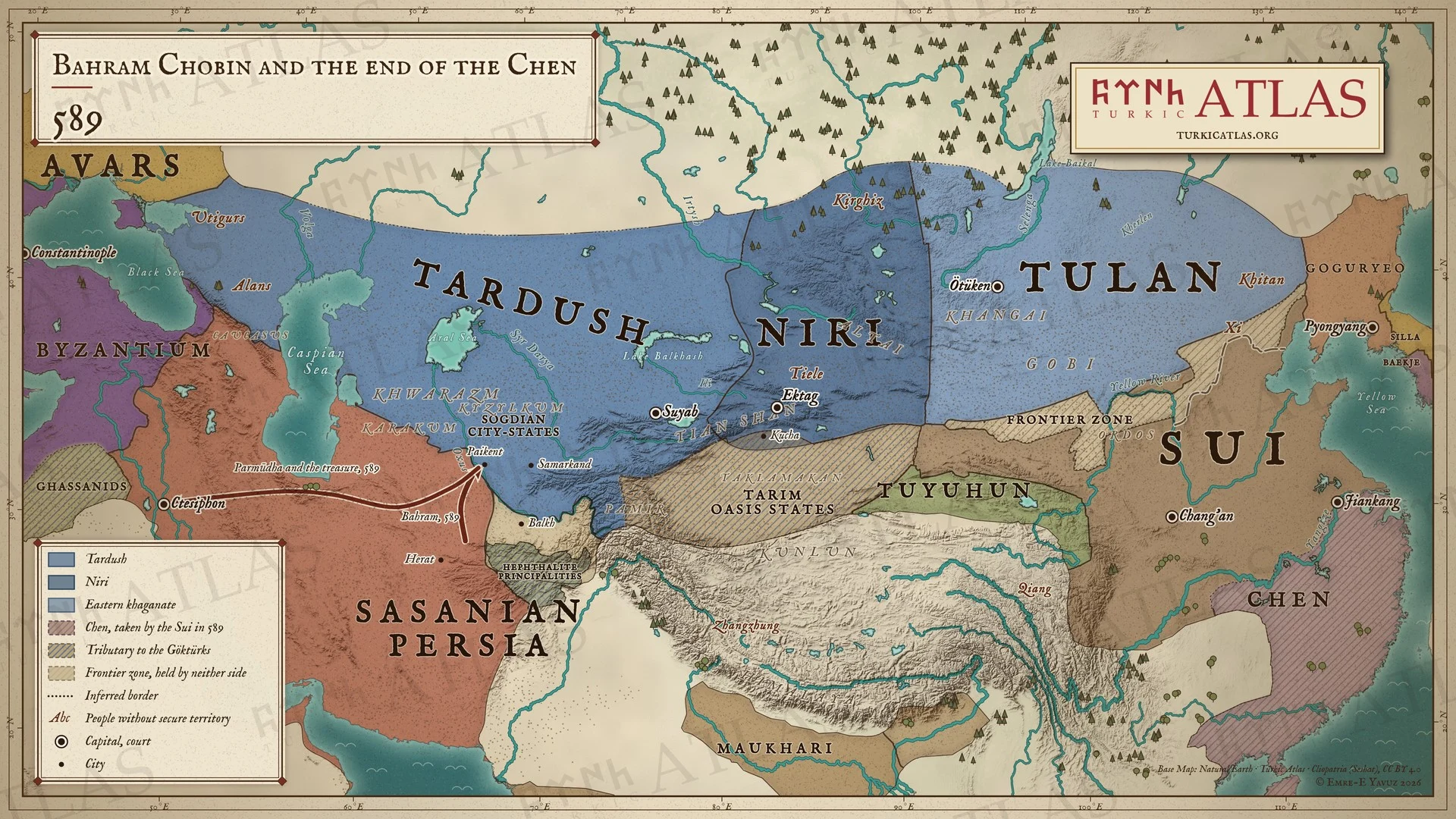
Üsyan və krallıq
Qələbə Bahramı kralı ilə ziddiyyətə saldı. Sebeos deyir ki, Bahram Hormizdə qənimətin yalnız kiçik bir hissəsini göndərdi, qalanını qoşunlarına verdi. Hormizd bütün xəzinəni tələb etdi. Ordu onun adamlarını öldürdü və Bahramı özünün kralı etdi.[21] aṯ-Ṯaʿālibīdə Hormizd Bahramın xəzinəni gizlətdiyindən şübhələndi. O, ona pambıq, əyirmə iyi və qadın paltarı göndərdi.[22] Teofilakt başqa bir hekayə danışır. Romanusun başçılıq etdiyi Roma ordusu Bahramı Albaniyada məğlub etdi və Hormizd onu vəzifəsindən çıxarıb ona qadın paltarı göndərdi. Bahram Hormizdə Xosrovun oğlu yox, qızı kimi müraciət edərək cavab verdi.[23] Başqa bir fəsildə Teofilakt üsyanı Bahramın göytürklər üzərindəki qələbələri ilə qürurlanmasına bağlayır.[24]
Sonra Bahram qoşunlarını topladı və özünü kralların kralı elan etdi. Ardınca gələn vətəndaş müharibəsini gənc II Xosrova və onun Bizans himayəçilərinə uduzdu. O, keçmiş düşmənləri olan göytürklərin yanına qaçdı və onlar onu yaxşı qarşıladı.[18] Teofilakt xəbər verir ki, Bahram farsların böyük bayramında kral tacını taxdı və özünü kral elan etdi.[25] Xosrov Bahramın hakimiyyətinə son qoyan döyüşdə onun ordusundan əsirlər aldı. Onların arasında «türk irqindən» olan adamlar var idi və o, onları imperator Mavrikiyə göndərdi.[26]
Göytürklərin yanına qaçış və ölüm
Suyabda Bahram hörmətli sərkərdə mərtəbəsinə yüksəldi. O, Aşina daxilində bir sui-qəsdi üzə çıxardı. Çox keçmədən Xosrovun fars agenti onu zəhərlədi.[18] Onun xidmət etdiyi saray Tarduşun sarayı idi.
Mənbələr sonu bir neçə cür danışır. Təbəri Bahramı Xorasana, sonra göytürklərin yanına qaçırır. O, onların kralının yanında böyük hörmətlə yaşadı.[4] Xosrov Hormizd adlı bir adamı qiymətli cəvahiratla göndərdi. Hormizd kralın arvadı xatunu ələ aldı və xatun Bahramın üstünə qatillər qoydu.[27] aṯ-Ṯaʿālibīdə Bahram Nişapur vasitəsilə Mavərənnəhrə, Barmūdhanın oğlu olan xaqanın yanına qaçdı. Xaqan onu bərabər kimi qəbul etdi və təhvil verməkdən imtina etdi.[28] Xosrovun elçisi Hormizd Jarābzīn əvəzinə xatunu ələ aldı. O, saraydan bir türk tutdu və o, Bahramı zəhərə batırılmış xəncərlə bıçaqladı.[29] Sebeos Bahramı Balxa qaçırır. Oranın əhalisi onu Xosrovun əmri ilə orada edam etdi.[30]
Əksər hesablarda göytürk ordusunu məhv etmiş sərkərdə ömrünü göytürk sarayında başa vurdu.
-
588 Persia attacked from four sides
In the eleventh year of Hormizd IV, Tabari reports, Šāba, “the over-king of the Turks”, advanced with three hundred thousand men as far as Badghis and Herat. In Thaʿālibī the khagan Šāba-Šāh marches on Balkh with a hundred thousand horsemen. At the same time the Roman emperor moved into the Syrian desert with eighty thousand men, the king of the Khazars came to Derbent, and two Arab chiefs camped on the Euphrates and raided the Sawād. Persia was called a sieve with many holes. The Roman march is exaggerated, and the two Arab chiefs are probably invented. One reading has the Göktürk army cross the Oxus, take Balkh, Herat, Talakan and Badghis, and march on west into Hyrcania. The sources name the goals; the way to them is drawn, and the leg into Hyrcania follows that reading.
-
588–589 Bahram Chobin against Šāba
Hormizd sent against Šāba a man of Rayy, Bahram son of Bahram-Gushnasp, called Chobin, with twelve thousand men he had chosen himself. In Tabari he marched fast until he was past Herat and Badghis, and Šāba noticed nothing until the Persians had built a fortified camp close to his own. After negotiations and fighting Bahram killed Šāba with an arrow. In Thaʿālibī, Šāba-Šāh sends his brother Faghfūra to offer Bahram a safe return or high office; Bahram answers that he has come for Šāba-Šāh's head, and Faghfūra is found among the dead. One reading sets the decisive battle in April 588 at the Hyrcanian rock, where Bahram beat the Göktürks under Bagha, pursued them to the Oxus and, reportedly, killed Bagha there with an arrow; a second places the defeat at Herat in 589. Tabari's march is drawn to the place he gives; the pursuit of the first reading is dotted, and where it reached the river is not recorded.
-
589 Beyond the Oxus: Parmūdha and the treasure
Šāba's son Parmūdha, “who was his father's equal”, came up next. Bahram beat him, shut him up in one of his fortresses and pressed him until he surrendered. In Thaʿālibī, Bahram crosses the Oxus, routs Barmūdha in a night attack and besieges him in Paikent, near Bukhara, until he gives himself up on Hormizd's guarantee of his life. Bahram sent the prisoner to the king with the treasure of the fortress, by Tabari's account two hundred and fifty thousand camel loads; Thaʿālibī counts among it the crown, belt and earrings of Siyāwush. One reading has Bahram retake Herat in 589 and reach the country around Bukhara. Sebeos tells the campaign as the conquest of Balkh and of the land of the Kushans to the far side of the Oxus, where Bahram killed the great king of the Mazkʿutʿkʿ. The stations are those Thaʿālibī and Sebeos name; the way between them is drawn, and so is the road to the capital at Ctesiphon.
-
589 The break with Hormizd
Theophylact sends Bahram from the war against the Göktürks to the Caucasus. In the eighth year of Maurice he ravaged Suania, sent its booty to Babylonia and moved camp to the Araxes. The Roman general Romanus came from Lazica into Albania; Bahram drew back towards Ganzak, crossed the river again and was beaten in the plain of Albania. Hormizd dismissed him and sent him women's clothes as the prize of his disgrace. One reading holds that the Mazkʿutʿkʿ whom Sebeos puts beyond the Oxus belong to this campaign. The Persian and Arabic accounts know nothing of a Roman defeat. In them the quarrel is over the booty: in Sebeos the army killed the guards whom Hormizd sent for the whole treasure and made Bahram its king, and in Thaʿālibī the king sends him cotton, a spindle and women's clothes. Theophylact names Suania, the Araxes and Albania; the way between them is drawn.
-
590 Bahram takes Ctesiphon; Khosrow II flees
In Thaʿālibī, Bahram made peace with the khagan, Barmūdha's son, gave him back his country and raised the revolt in Khorasan. The rebels declared Hormizd deposed and marched on Ctesiphon, in the Persian and Arabic accounts from Khorasan. In Theophylact they wait at the crossing of the Zab, and the army sent against them goes over to Bahram. In the capital the nobles deposed Hormizd and blinded him, and his son Khosrow II took the throne; Hormizd was killed soon after. Bahram came on fast. After a meeting on the Nahrawan and a night attack, Khosrow fled across the Tigris. Theophylact takes him through the desert and along the Euphrates past Anatha to Circesium, and on to the Roman general at Hierapolis; Sebeos has him stop at a city he calls Khaab, read as Aleppo, and Tabari has him write to the emperor Maurice from Antioch. Bahram took the palace and at the great festival put on the royal diadem. The stations are those Theophylact names; the way between them is drawn.
-
591 The battle of 591
Maurice sent Khosrow back with a Roman army. It set out from Dara, crossed the Tigris and the Zab, and joined a second Roman army that came from Armenia. Bahram marched from Ctesiphon into Atropatene. Theophylact puts the battle near Ganzak, on the river Blarathos, with more than sixty thousand men on Khosrow's side and forty thousand on Bahram's; Tabari and Sebeos also place the fighting in Atropatene. Bahram's army broke, and he escaped. Among the prisoners were men “of the Turkish race” with a cross tattooed on their foreheads, and Khosrow sent them to Maurice. The stations are those Theophylact names; the way between them is drawn, and so is the meeting of the two Roman armies south of Lake Urmia.
-
from 591 Bahram's flight and death
Tabari has Bahram escape to Khorasan and go on to the Göktürks, whose king received him with high honour. In Thaʿālibī he halts at Nishapur and crosses into Transoxiana to the khagan, Barmūdha's son, who meets him as an equal and refuses to give him up. Khosrow sent an envoy with a precious jewel who won over the khatun, the khagan's wife, and she had Bahram killed; in Thaʿālibī a man of the court stabbed him with a dagger dipped in poison. Sebeos has Bahram flee to Balkh and be put to death there by its people on Khosrow's order. One reading makes him a respected general at Suyab who uncovered a conspiracy within the Ashina before a Persian agent poisoned him. The flight is drawn through the stations Thaʿālibī names; the way on to Suyab follows that reading and is dotted.
-
606 or 614 The host of the great khagan
Khosrow II sent the Armenian Smbat Bagratuni east against the Kushans. Smbat called up his old troops from Hyrcania, beat the Kushan raiders and camped at Apr Shahr near Nishapur, in the province of Tus, with three hundred men in the walled village of Khrokht. The kings of the Kushans called on the great khagan, king of the regions of the north. A host of three hundred thousand, thirty thousand in an older translation, crossed the Oxus. It surrounded Khrokht, from which Smbat broke out, and routed the Persian relief force under Datoyean; its raids reached the borders of Rayy and of the province of Isfahan. Then an order of the great khagan reached its commander, the Chembukh, and the host recrossed the river and went home. Sebeos gives no year. One reading dates the war to 606 and 607 and has the western yabgu Shegui withdraw the army; a second places it in 614 and 615, counting back from Smbat's death in the twenty-eighth year of Khosrow II; a third dates it to 597 and 598. Khrokht is not located; the routes between the named places are drawn.
-
607 or 615 Smbat's counter-campaign
Khosrow's inquiry blamed Datoyean, who was put to death, and cleared Smbat. With fresh troops Smbat marched against the Kushans and the Hephthalite king. The Kushan king challenged him to single combat between the lines, and Smbat's lance split his armour and killed him. Smbat's horsemen pursued the fleeing army as far as Balkh, the capital of the Kushans, and plundered Herat, Badghis, Tokharistan and Talaqan. He came back with great booty and camped in the province of Merv. In the reading that dates the war to 606 and 607, the Hephthalites he beat near Balkh were still vassals of the Göktürks; in the second the campaign falls in 615. Sebeos names Balkh and Merv; the way between them is drawn.
- Place named in a source (position as commonly identified)
- Position disputed or approximate
- Extent of a realm, inferred; border uncertain (soft edge)
- Tokharistan between Persia and the Göktürks, its overlord contested (hatched)
- Movement named in a source (route drawn)
- Route between the stations a source names (way inferred)
- Route after a modern reconstruction
Qeydlər
- ^ a b Teofilakt Simokatta; Whitby 1986, p. 101
- ^ Təbəri; Nöldeke 1879, p. 270-273
- ^ Whitby 1986, xix
- ^ a b Təbəri; Nöldeke 1879, p. 287-289
- ^ Təbəri; Nöldeke 1879, p. 270
- ^ Nöldeke 1879, p. 270
- ^ Əs-Səalibi; Zotenberg 1900, p. 643
- ^ Nöldeke 1879, p. 271
- ^ Teofilakt Simokatta; Whitby 1986, p. 101-102
- ^ Nöldeke 1879, p. 272
- ^ a b Şahnamə
- ^ Təbəri; Nöldeke 1879, p. 270-271
- ^ Təbəri; Nöldeke 1879, p. 272
- ^ Sebeos, ch. 10; Howard-Johnston 1999, p. 15
- ^ Teofilakt Simokatta; Whitby 1986, p. 80-81
- ^ Golden 1992, p. 132
- ^ Yavuz 2025, p. 324
- ^ a b c Yavuz 2025, p. 325
- ^ Teofilakt Simokatta; Whitby 1986, p. 81
- ^ Əs-Səalibi; Zotenberg 1900, p. 650-654
- ^ Sebeos, ch. 10; Howard-Johnston 1999, p. 15-16
- ^ Əs-Səalibi; Zotenberg 1900, p. 656-657
- ^ Teofilakt Simokatta; Whitby 1986, p. 82-83
- ^ Teofilakt Simokatta; Whitby 1986, p. 102
- ^ Teofilakt Simokatta; Whitby 1986, p. 119
- ^ Teofilakt Simokatta; Whitby 1986, p. 146
- ^ Təbəri; Nöldeke 1879, p. 289
- ^ Əs-Səalibi; Zotenberg 1900, p. 674-676
- ^ Əs-Səalibi; Zotenberg 1900, p. 678-682
- ^ Sebeos; Howard-Johnston 1999, p. 23
Mənbələr
Ədəbiyyat
- Emre-E. Yavuz, The Gokturk Empire: 2nd Edition (2025)
- Peter B. Golden, An Introduction to the History of the Turkic Peoples (1992)
- Theodor Nöldeke, Geschichte der Perser und Araber zur Zeit der Sasaniden. Aus der arabischen Chronik des Tabari übersetzt und mit ausführlichen Erläuterungen und Ergänzungen versehn (1879)
- Michael Whitby, Mary Whitby (trans.), The History of Theophylact Simocatta (1986)
- Michael Whitby, The Emperor Maurice and His Historian (1988)
- R. W. Thomson (trans.), James Howard-Johnston (commentary), The Armenian History attributed to Sebeos (1999)
- Hermann Zotenberg (ed., trans.), Histoire des rois des Perses par Abou Mansour ʿAbd al-Malik ibn Mohammad ibn Ismaʿil al-Thaʿalibi (1900)
Bura keçid verənlər25
- States
- Sasani Farsı
- Battles & Events
- Alnında xaç daşıyan göytürk əsirləri (591) · Bahram Çobinin öldürülməsi
- Sources
- Əs-Səalibi · Sebeos · Təbəri · Teofan İtirafçı · Teofilakt Simokatta
Məqaləyə istinad
Yavuz, Emre-E. “Bahram Çobin.” Turkic Atlas, revised 18 November 2026. https://turkicatlas.org/persons/bahram-chobin/
Last revised: 18 November 2026

