31 articles
Inscriptions
What the steppe wrote about itself: the runiform monuments and the one runiform book.
On stone
- Bugut inscription 584 A stone of about 582 to 584 on a stone tortoise in central Mongolia, in Sogdian. The earliest monument of the Göktürk state, set up for Taspar Khan according to some scholars and for Mahan Tegin according to others.
- Begre inscription (E 11) 650–950 Runiform epitaph on a stele in north-eastern Tuva for Tör Apa, who rode against the Tabgach khan at fifteen and died at seventy-seven. Placements run from the seventh century to the ninth and later.
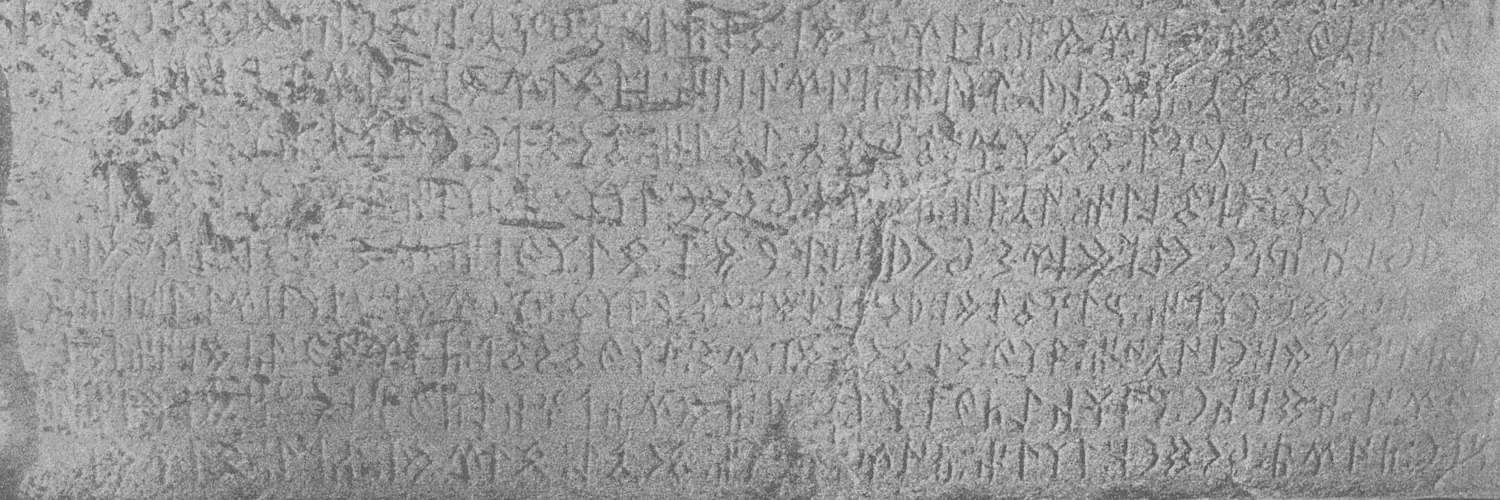
- Yenisei inscriptions 650–1000 More than 150 runiform epitaphs and short texts on stone along the upper Yenisei. They are the writing of the Kirghiz, in a regional form of the script of the Orkhon stones.
- South Yenisei inscriptions 700–1000 Some seventeen short texts in a second runiform alphabet, on rock, stelae and grave goods in Khakassia and Tuva. Graves date them to the eighth to tenth century. None has been read with confidence.
- Ulaangom inscription 700–750 Gravestone with eight lines in Uyghur letters, found in 1955 near Ulaangom in Mongolia. Its language is Old Turkic of the Orkhon kind, the name in line 1 is read in four ways, and its date is argued.
- Ongi inscription 716–740 Runiform stele on the Ongi river in southern Mongolia, put up by a son for his father in the reign of Bilge Khan. Its date is argued, from 716 to 740.
- Küli Čor inscription 719–725 Runiform stele at Ikhe Khushotu in central Mongolia for Küli Čor, a lord of the Tardush. It tells his campaigns to the Iron Gate and his death in battle. Dated between 719 and 725.
- Tonyukuk inscription 720 Runiform monument of two stones at Bain Tsokto on the upper Tola. In sixty-two lines the counsellor tells, in the first person, how the state was restored.
- Kül Tegin inscription 732 Runiform monument of 732 on the Orkhon, with the full text of its three Turkic faces. It tells the history of the Göktürk state, the service record of one man, and a speech to the living.
- Bilge Khan inscription 735 Runiform monument for Bilge Khan on the Orkhon, with the text of its faces. Its historical section runs parallel to the Kül Tegin inscription; its own passages give the khan's campaigns by age.
- Suji inscription 745–900 Runiform inscription in Mongolia, spoken by a Kirghiz officer. Its date is argued: before 780 on one view, after 840 by another. One translation has a teacher called mar in it, another has none.
- Tariat inscription 750–756 Runiform stele found in Mongolia in 1957. It speaks in the name of the second Uyghur khan and gives his campaigns year by year, from 741 to 748.
- Tes inscription 750–762 Runiform stele of the Uyghur Khaganate from the valley of the Tes river in north-western Mongolia, found in 1915. It survives only in pieces, and its date is placed anywhere from 750 to after 761.
- Hoyto Tamir inscriptions 753–756 Thirty-four painted runiform texts on the Tayhar rock by the Tamir river in Mongolia. Three have animal-year dates that have been placed in 753 and 756, and three name a journey to Beshbalik.
- Šine-Usu inscription 759–761 Runiform memorial stele found in northern Mongolia in 1909. It speaks in the first person in the name of the second khan of the Uyghurs and tells his campaigns.
- Karabalghasun inscription 800–830 Trilingual stele from the Uyghur capital on the Orkhon, found in 1889. The only early source for the Uyghur conversion to Manichaeism.
- Altai runiform inscriptions More than a hundred short runiform texts cut into rock in the Altai Republic, first reported in 1819. They are undated, many are damaged, and most readings are provisional.
- Altın Köl Inscriptions Two runiform stelae found in 1878 in Khakassia, Yenisei texts E 28 and E 29. Stone I names a leopard, Erklig and perhaps Umay; stone II is a hero's epitaph. Some scholars tie them to Bars Beg.
- Jabogan inscription Five runiform lines on a split rock from Jabogan in the Altai Republic, found in 1927 and again in 2004. One line names three saddled horses. The stone is undated.
- Talas and Tian Shan runiform inscriptions More than thirty runiform inscriptions in Kyrgyzstan, from the Talas valley, Issyk Kul and the Kochkor valley. Mostly epitaphs and visitors' texts, undated, with many unreliable readings.
- Epitaph of Qarï Čor Tegin (Xi'an) Gravestone found at the end of 2012 in Xi'an, the former Tang capital Chang'an. It has a long Chinese text and seventeen short lines in runiform Turkic, for an Uyghur prince.
Runiform, but not on stone
A stone stands in one place and says one thing to whoever comes to it. Irk Bitig is a book: the same runiform script on paper, copied and carried, and so the one steppe text of this period that could be multiplied.
- Issyk inscription -500–-200 Inscription on a silver cup from the Issyk kurgan near Almaty, fifth to third century BC. Some scholars call its signs early runes, others the script of Iranian nomads. Outside the secured corpus.
- Runiform finds in Mongolia, 1990 to 1999 600–900 Thirteen short runiform inscriptions found in Mongolia in the 1990s: seven one-line texts in Bayan-Ölgii, four on Del Uul, one at Ikh Bichigt and a vessel from Tsetsuuhey.
- Afrasiab paintings 650–665 Wall paintings of about 660 in the Hall of the Ambassadors at Samarkand. Long-haired Göktürks usher the embassies to the Sogdian king Varkhuman, and two figures in feathered caps are identified as Koreans.
- Runiform inscriptions of the Khazar lands 650–950 Short texts and marks in runiform signs from the Don, the North Caucasus and the Crimea, seventh to tenth century. They have been ascribed to the Khazars, the Bulgars and others.
- Treasure of Nagyszentmiklós 700–850 Hoard of gold vessels known since 1799, with runiform and Greek inscriptions, from the Avar age in the Carpathian basin. The date of the runiform inscriptions against the vessels is disputed.
- Szarvas needle case inscription 700–800 Short runiform text on a bone needle case from a late Avar cemetery at Szarvas in Hungary, found in 1983. About the eighth century.
- Nalaikh Inscription 730 Four-line runiform text from Nalaikh, dated by estimate to about 730 and read as naming Tengri and Umay. A catalogue of 1983 lists it as a tile and a later fake made for tourists.
- Protobulgarian sign corpus 800–900 More than a thousand runiform-looking marks from Pliska, Madara, Preslav and other sites of the first Bulgar state, mostly of the ninth century. Whether they are letters or marks is disputed.
- Murfatlar inscriptions 850–950 About sixty runiform inscriptions on the rock walls of the churches of a cave monastery near Constanța, in the Bulgar lands on the lower Danube. Ninth to tenth century.
- Rock inscriptions found in Mongolia, 2018 to 2021 Fifteen short runiform texts on rock, found in four provinces. They contain names such as Ädiz, Tuŋrač, Čur and Yegän Irkin, and a Yaglakar tamga. None is dated.
Everything on this page was written in the steppe, by the people it is about. Everything else the Turkic Atlas rests on — the Chinese annals, the Greek historians, the Arabic and Persian traditions — is under Sources. Sources →
Image credits
- Bugut inscription: A broad face of the Bugut stone with its Sogdian lines, in the courtyard of the museum at Tsetserleg. Richard Mortel, 2018, CC BY 2.0 ↗
- Yenisei inscriptions: The inscription of Ujuk-Archan on the upper Yenisei in runic type, with transcription, in W. Radloff, Die alttürkischen Inschriften der Mongolei, St Petersburg 1895, p. 305. W. Radloff, 1895, Public domain
- Tonyukuk inscription: Upper part of the south face of the first Tonyukuk stone, photographed in June 1909 (cropped). G. J. Ramstedt and Sakari Pälsi, Finnish Heritage Agency, VKK532:464, CC BY 4.0 ↗
- Kül Tegin inscription: Crown and upper runes of the Kül Tegin stone, photographed by the Finnish expedition of 1890 (Inscriptions de l’Orkhon, Helsingfors 1892, Tab. 2). Finnish expedition of 1890, Public domain
- Bilge Khan inscription: The site of the Bilge Khan stone in 1890, general view (Inscriptions de l’Orkhon, Helsingfors 1892, “II Monum. Vue générale”). Finnish expedition of 1890, Public domain
- Tariat inscription: The upper piece of the Tariat stele, reassembled, in the National Museum of Mongolia (cropped). Gary Lee Todd, 2017, CC0 ↗
- Šine-Usu inscription: Upper halves of the four faces of the Shine Usu stone, the tamga on the north face; photograph of the Finnish expedition of 1909, published by G. J. Ramstedt in the Journal de la Société Finno-Ougrienne 30 (1913). Public domain
- Karabalghasun inscription: Fragment of the dragon crown of the Karabalghasun stone, 1890 (Inscriptions de l’Orkhon, Helsingfors 1892, Tab. 46). Finnish expedition of 1890, Public domain
- Afrasiab paintings: The west wall of the Hall of the Ambassadors, as mounted in the museum beside the Afrasiab mound. Richard Mortel, 2023, CC BY 2.0 ↗

