
بەھرام چوبىن ساسانىيلار دۆلىتىنىڭ، رەي ناھىيىسىدىن چىققان، مىھران جەمەتىدىكى گېنېرالى ئىدى.[1] ئۇ خۇراسانغا بېسىپ كىرگەن كۆكتۈرك قوشۇنىنى تارمار قىلدى. ئاندىن ئۇ ئۆز پادىشاھى تۆتىنچى ھورمىزدغا قارشى چىقتى.[2] ئۇ 590-يىلى ئۆزىنى پادىشاھلار پادىشاھى قىلىپ جاكارلىدى. 591-يىلى ھورمىزدنىڭ ئوغلى ئىككىنچى خوسراۋ رىم قوشۇنى بىلەن قايتىپ كېلىپ ئۇنى مەغلۇب قىلدى.[3] بەھرام ھاياتىنى كۆكتۈركلەر ئارىسىدا ئاخىرلاشتۇردى.[4]
كېلىپ چىقىشى ۋە ھاياتى
تەبەرى ئۇنى رەيلىك بىر ئادەم، باھرام-گۇشناسپنىڭ ئوغلى بەھرام دەپ ئاتايدۇ.[5] ئىمپېراتور ماۋرىكىيوسنىڭ گرېك تارىخچىسى تېئوفىلاكت سىموكاتتا بىر پارس ئەمەلدارىدىن بەھرامنىڭ رەي ناھىيىسى بولغان رازاكېنېدىن كەلگەنلىكىنى ئاڭلىغان. ئەمەلدار ئۇنىڭ مىررامېس جەمەتىگە مەنسۇپ ئىكەنلىكىنىمۇ ئېيتقان.[1] گرېك ۋە ئەرمەن خەۋەرلىرىدە ئۇ مىھران، يەنى پارسىيەنىڭ ئۇلۇغ ئاقسۆڭەك جەمەتلىرىنىڭ بىرىدىن.[6] ئەسسەئالىبى ئۇنى مارزبان، يەنى چېگرا ۋىلايىتىنىڭ ھاكىمى قىلىدۇ. كۆكتۈرك ئۇرۇشى ۋاقتىدا ئۇ ئازەربەيجاندا ئىدى.[7] «چوبىن»، يەنى «ياغاچتىن ياسالغان» دېگەن تەخەللۇسنىڭ كېلىپ چىقىشى مەلۇم ئەمەس.[8]
تېئوفىلاكت ئۇنىڭ كۆتۈرۈلۈشىنى بايان قىلىدۇ. بەھرام پادىشاھنىڭ قوغدىغۇچىلىرى ئارىسىدا خىزمەت قىلغان. بىرىنچى خوسراۋ دەۋرىدە پارسلار رىملىقلارنىڭ دارا قەلئەسىنى ئالغاندا ئۇ بىر بۆلۈمگە قوماندانلىق قىلغان. ئۇ ئەرمېنىيەگىچە جەڭ قىلىپ، گېنېرال بولغان. ئاندىن ئۇ دارىگبېدۇم، يەنى شاھ ئوردىسىنىڭ ئىدارىچىسى دەپ ئاتالغان.[9] كېيىنكى بىر ئەرەب كىتاب كاتالوگى ئۇنىڭغا ئوقيا ئېتىش ھەققىدە بىر ئەسەرنى مەنسۇپ قىلغان.[10]
كۆكتۈركلەرگە قارشى ئۇرۇش
ئەنئەنىگە كۆرە، تۆتىنچى ھورمىزد ئىستەمىنىڭ قىزىنىڭ ئوغلى ئىدى. 588-يىلى ئۇ بەھرامنى ئوكسۇستىن ئۆتكەن كۆكتۈرك قوشۇنىغا قارشى ئەۋەتتى.[11] بەھرام ئۇ قوشۇننى تارمار قىلىپ، دەريا بويىغىچە قوغلىدى. پارس داستانىغا كۆرە، ئۇ ئۇنىڭ يېتەكچىسىنى ئوق بىلەن ئۆلتۈردى.[11]
تەبەرى ئۇنى ئۆزى تاللىغان ئون ئىككى مىڭ ئادەم بىلەن تۈركلەرنىڭ ئۇلۇغ پادىشاھى شاباغا قارشى ماڭدۇرىدۇ. ھېرات ۋە بادغىستىن ئۆتكەندىن كېيىن ئۇ شابانى ئوق بىلەن ئۆلتۈردى.[12] ئاندىن ئۇ شابانىڭ ئوغلى پارمۇدھانى بىر قەلئەدە ئۇ تەسلىم بولغۇچە قورشاپ تۇردى. ئۇ پارمۇدھانى خەزىنە بىلەن ھورمىزدقا ئەۋەتتى.[13] يەتتىنچى ئەسىردىكى ئەرمەن تارىخى سېبېئوستا بەھرام تېتاللار قوشۇنىنى يېڭىدۇ. ئۇ بەلخنى ۋە كۇشانلار زېمىنىنى ئوكسۇسنىڭ ئۇ تەرىپىگىچە ئالىدۇ. دەريانىڭ ئۇ تەرىپىدە ئۇ «ماسكۇتلارنىڭ ئۇلۇغ پادىشاھى»نى ئۆلتۈرىدۇ.[14] تېئوفىلاكت غەلىبىنى ھورمىزدقا بېرىدۇ. ئۇ بەھرامنى پەقەت يۈرۈشتە ئالاھىدە كۆرۈنگەن گېنېرال دەپلا ئاتايدۇ.[15]
مەغلۇبىيەت 589-يىلى ھېراتتا بولغان دەپ قارىلىدۇ. بۇ پارس-ئىسلام ئەنئەنىسىدىكى «تۈركلەرنىڭ ئەڭ ئۇلۇغ پادىشاھى»، يەنى تاردۇشنىڭ ئوغلى كۆكتۈرك يېتەكچىسى شابانى كۆرسىتىدۇ.[16] باشقا بىر بايان ئۇنى باغا دەپ قارايدۇ ۋە جەڭنى 588-يىلى ئاپرېلدىكى ھىركانىيە قىيالىقىغا قويىدۇ.[17] 589-يىلى بەھرام شەرققە يۈرۈش قىلىپ ھېراتنى قايتۇرۇپ ئالدى. ئۇ يەردە ئۇ كۆكتۈرك خانىنىڭ ئالتۇن تەختىنى ئالغاندەك قىلىدۇ. ئاندىن ئۇ بۇخارا زېمىنىغا يەتتى.[18] تېئوفىلاكت پارسلار ئالغان ئولجا ئىچىدە ئالتۇن تەختلەرنى ساناپ ئۆتىدۇ.[19] ئەسسەئالىبىدە بەھرام ئوكسۇستىن ئۆتتى. بۇخارا يېنىدىكى پايكەنتتە ئۇ شابانىڭ ئوغلىنىڭ، ئەسسەئالىبى ئۇنى بارمۇدھا دەپ ئاتايدۇ، تەسلىم بولۇشىنى قوبۇل قىلدى.[20]
ئىسيان ۋە پادىشاھلىق
غەلىبە بەھرامنى ئۆز پادىشاھى بىلەن توقۇنۇشتۇردى. سېبېئوس ئېيتىشىچە، بەھرام ھورمىزدقا ئولجىنىڭ پەقەت ئازراق قىسمىنىلا ئەۋەتىپ، قالغىنىنى ئەسكەرلىرىگە بەرگەن. ھورمىزد پۈتۈن خەزىنىنى تەلەپ قىلدى. قوشۇن ئۇنىڭ ئادەملىرىنى ئۆلتۈرۈپ، بەھرامنى ئۆزىنىڭ پادىشاھى قىلدى.[21] ئەسسەئالىبىدە ھورمىزد بەھرامدىن خەزىنىنى يوشۇرۇۋالدى دەپ گۇمان قىلدى. ئۇ ئۇنىڭغا پاختا، ئەگىرىش ۋە ئاياللار كىيىمى ئەۋەتتى.[22] تېئوفىلاكت باشقا بىر ھېكايىنى سۆزلەيدۇ. رومانۇس باشلىغان رىم قوشۇنى بەھرامنى ئالبانىيەدە مەغلۇب قىلدى، ھورمىزد ئۇنى ئىشتىن بوشىتىپ ئۇنىڭغا ئاياللار كىيىمى ئەۋەتتى. بەھرام ھورمىزدنى خوسراۋنىڭ ئوغلى ئەمەس، قىزى دەپ ئاتاپ جاۋاب قايتۇردى.[23] باشقا بىر بابتا تېئوفىلاكت ئىسياننى بەھرامنىڭ كۆكتۈركلەرگە قارشى غەلىبىلىرىدىن بولغان مەغرۇرلۇقىغا باغلايدۇ.[24]
ئاندىن بەھرام ئەسكەرلىرىنى يىغىپ، ئۆزىنى پادىشاھلار پادىشاھى دەپ جاكارلىدى. ئۇ كېيىنكى ئىچكى ئۇرۇشتا ياش ئىككىنچى خوسراۋ ۋە ئۇنىڭغا ياردەم بەرگەن ۋىزانتىيەلىكلەرگە يېڭىلدى. ئۇ ئۆزىنىڭ ئەسلىدىكى دۈشمىنى بولغان، ئۇنى ياخشى كۈتۈۋالغان كۆكتۈركلەرگە قېچىپ باردى.[18] تېئوفىلاكت بەھرامنىڭ پارسلارنىڭ چوڭ بايرىمىدا شاھ باش تاجىنى كىيىپ، ئۆزىنى پادىشاھ دەپ جاكارلىغانلىقىنى خەۋەر قىلىدۇ.[25] ئۇنىڭ ھۆكۈمرانلىقىغا خاتىمە بەرگەن جەڭدە خوسراۋ بەھرامنىڭ قوشۇنىدىن ئەسىرلەرنى ئالدى. ئۇلارنىڭ ئارىسىدا «تۈرك مىللىتىدىن» بولغان كىشىلەرمۇ بار ئىدى، خوسراۋ ئۇلارنى ئىمپېراتور ماۋرىكىيوسقا ئەۋەتتى.[26]
كۆكتۈركلەرگە قېچىش ۋە ئۆلۈمى
سۇيابتا بەھرام ھۆرمەتكە سازاۋەر گېنېرالغا ئايلاندى. ئۇ ئاشىنا ئىچىدىكى بىر سۇيىقەستنى ئاشكارىلىدى. ئۇزۇن ئۆتمەي خوسراۋنىڭ بىر پارس ئاگېنتى ئۇنى زەھەرلىدى.[18] ئۇ خىزمەت قىلغان ئوردا تاردۇشنىڭ ئوردىسى ئىدى.
مەنبەلەر ئاخىرىنى بىر نەچچە خىل ئۇسۇلدا بايان قىلىدۇ. تەبەرىدە بەھرام خۇراسانغا، ئاندىن كۆكتۈركلەرگە قاچىدۇ. ئۇ ئۇلارنىڭ پادىشاھىنىڭ يېنىدا ئۇلۇغ ھۆرمەت بىلەن ياشىدى.[4] خوسراۋ ھورمىزد ئىسىملىك بىر ئادەمنى قىممەتلىك بىر گۆھەر بىلەن ئەۋەتتى. ھورمىزد خاتۇننى، يەنى پادىشاھنىڭ ئايالىنى قايىل قىلدى ۋە ئۇ بەھرامنىڭ ئۈستىگە قاتىللارنى سالدى.[27] ئەسسەئالىبىدە بەھرام نىشاپۇر ئارقىلىق ماۋەرائۇننەھرگە، بارمۇدھانىڭ ئوغلى بولغان قاغاننىڭ يېنىغا قاچتى. قاغان ئۇنى تەڭ دەرىجىلىك ئادەمدەك قوبۇل قىلدى ۋە ئۇنى تاپشۇرۇشنى رەت قىلدى.[28] خوسراۋنىڭ ئەلچىسى ھورمىزد جارابزىن ئۇنىڭ ئورنىغا خاتۇننى قايىل قىلدى. خاتۇن ئوردىدىكى بىر تۈركنى ياللىدى، ئۇ بەھرامنى زەھەرگە چىلانغان خەنجەر بىلەن پىچاقلىدى.[29] سېبېئوستا بەھرام بەلخقا قاچىدۇ. ئۇ يەرنىڭ خەلقى ئۇنى خوسراۋنىڭ بۇيرۇقى بىلەن شۇ يەردە ئۆلتۈرىدۇ.[30]
كۆپ بايانلاردا بىر كۆكتۈرك قوشۇنىنى تارمار قىلغان گېنېرال ھاياتىنى بىر كۆكتۈرك ئوردىسىدا ئاخىرلاشتۇردى.
-
588 Persia attacked from four sides
In the eleventh year of Hormizd IV, Tabari reports, Šāba, “the over-king of the Turks”, advanced with three hundred thousand men as far as Badghis and Herat. In Thaʿālibī the khagan Šāba-Šāh marches on Balkh with a hundred thousand horsemen. At the same time the Roman emperor moved into the Syrian desert with eighty thousand men, the king of the Khazars came to Derbent, and two Arab chiefs camped on the Euphrates and raided the Sawād. Persia was called a sieve with many holes. The Roman march is exaggerated, and the two Arab chiefs are probably invented. One reading has the Göktürk army cross the Oxus, take Balkh, Herat, Talakan and Badghis, and march on west into Hyrcania. The sources name the goals; the way to them is drawn, and the leg into Hyrcania follows that reading.
-
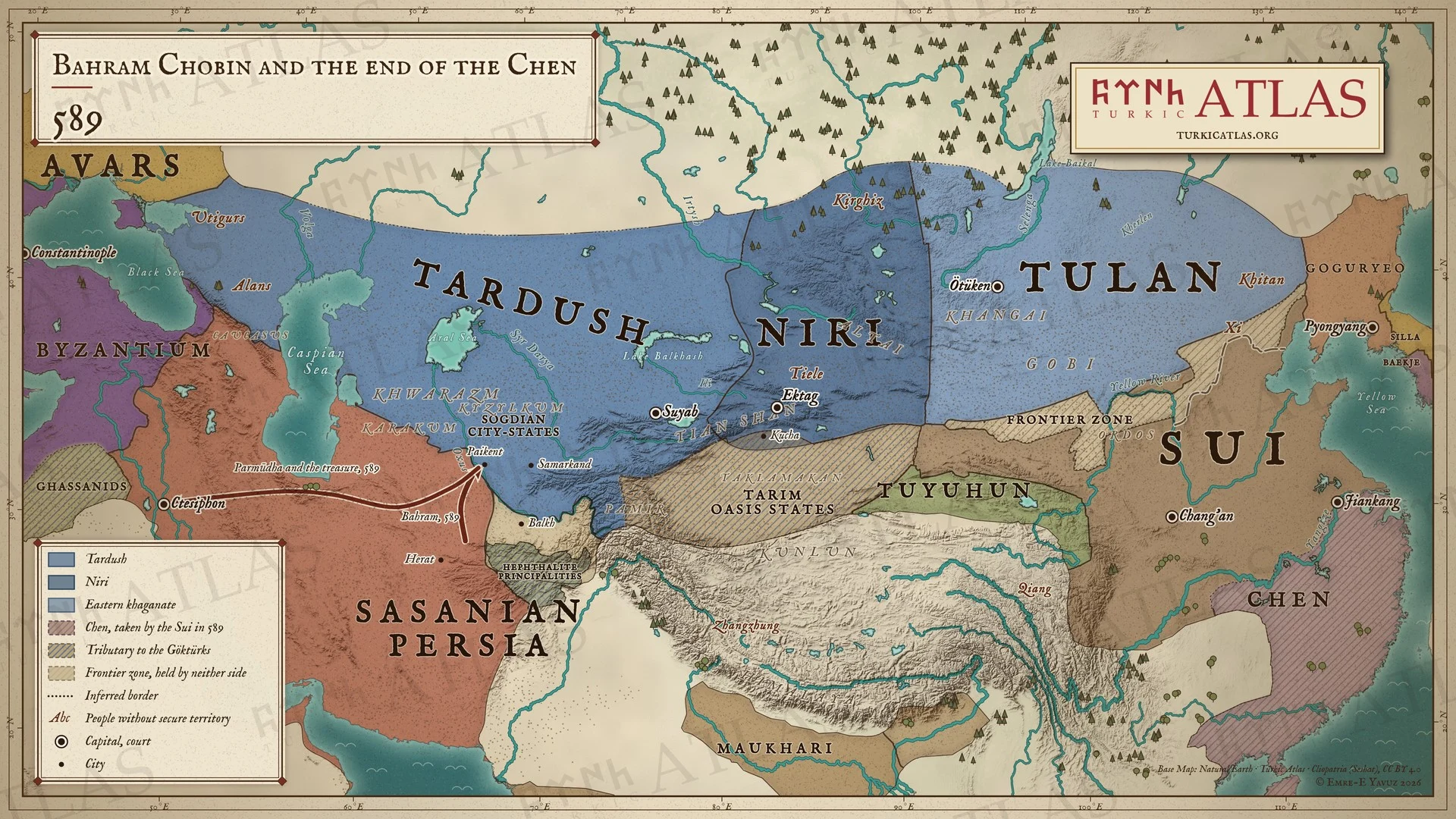
588–589 Bahram Chobin against Šāba
Hormizd sent against Šāba a man of Rayy, Bahram son of Bahram-Gushnasp, called Chobin, with twelve thousand men he had chosen himself. In Tabari he marched fast until he was past Herat and Badghis, and Šāba noticed nothing until the Persians had built a fortified camp close to his own. After negotiations and fighting Bahram killed Šāba with an arrow. In Thaʿālibī, Šāba-Šāh sends his brother Faghfūra to offer Bahram a safe return or high office; Bahram answers that he has come for Šāba-Šāh's head, and Faghfūra is found among the dead. One reading sets the decisive battle in April 588 at the Hyrcanian rock, where Bahram beat the Göktürks under Bagha, pursued them to the Oxus and, reportedly, killed Bagha there with an arrow; a second places the defeat at Herat in 589. Tabari's march is drawn to the place he gives; the pursuit of the first reading is dotted, and where it reached the river is not recorded.
-
589 Beyond the Oxus: Parmūdha and the treasure
Šāba's son Parmūdha, “who was his father's equal”, came up next. Bahram beat him, shut him up in one of his fortresses and pressed him until he surrendered. In Thaʿālibī, Bahram crosses the Oxus, routs Barmūdha in a night attack and besieges him in Paikent, near Bukhara, until he gives himself up on Hormizd's guarantee of his life. Bahram sent the prisoner to the king with the treasure of the fortress, by Tabari's account two hundred and fifty thousand camel loads; Thaʿālibī counts among it the crown, belt and earrings of Siyāwush. One reading has Bahram retake Herat in 589 and reach the country around Bukhara. Sebeos tells the campaign as the conquest of Balkh and of the land of the Kushans to the far side of the Oxus, where Bahram killed the great king of the Mazkʿutʿkʿ. The stations are those Thaʿālibī and Sebeos name; the way between them is drawn, and so is the road to the capital at Ctesiphon.
-
589 The break with Hormizd
Theophylact sends Bahram from the war against the Göktürks to the Caucasus. In the eighth year of Maurice he ravaged Suania, sent its booty to Babylonia and moved camp to the Araxes. The Roman general Romanus came from Lazica into Albania; Bahram drew back towards Ganzak, crossed the river again and was beaten in the plain of Albania. Hormizd dismissed him and sent him women's clothes as the prize of his disgrace. One reading holds that the Mazkʿutʿkʿ whom Sebeos puts beyond the Oxus belong to this campaign. The Persian and Arabic accounts know nothing of a Roman defeat. In them the quarrel is over the booty: in Sebeos the army killed the guards whom Hormizd sent for the whole treasure and made Bahram its king, and in Thaʿālibī the king sends him cotton, a spindle and women's clothes. Theophylact names Suania, the Araxes and Albania; the way between them is drawn.
-
590 Bahram takes Ctesiphon; Khosrow II flees
In Thaʿālibī, Bahram made peace with the khagan, Barmūdha's son, gave him back his country and raised the revolt in Khorasan. The rebels declared Hormizd deposed and marched on Ctesiphon, in the Persian and Arabic accounts from Khorasan. In Theophylact they wait at the crossing of the Zab, and the army sent against them goes over to Bahram. In the capital the nobles deposed Hormizd and blinded him, and his son Khosrow II took the throne; Hormizd was killed soon after. Bahram came on fast. After a meeting on the Nahrawan and a night attack, Khosrow fled across the Tigris. Theophylact takes him through the desert and along the Euphrates past Anatha to Circesium, and on to the Roman general at Hierapolis; Sebeos has him stop at a city he calls Khaab, read as Aleppo, and Tabari has him write to the emperor Maurice from Antioch. Bahram took the palace and at the great festival put on the royal diadem. The stations are those Theophylact names; the way between them is drawn.
-
591 The battle of 591
Maurice sent Khosrow back with a Roman army. It set out from Dara, crossed the Tigris and the Zab, and joined a second Roman army that came from Armenia. Bahram marched from Ctesiphon into Atropatene. Theophylact puts the battle near Ganzak, on the river Blarathos, with more than sixty thousand men on Khosrow's side and forty thousand on Bahram's; Tabari and Sebeos also place the fighting in Atropatene. Bahram's army broke, and he escaped. Among the prisoners were men “of the Turkish race” with a cross tattooed on their foreheads, and Khosrow sent them to Maurice. The stations are those Theophylact names; the way between them is drawn, and so is the meeting of the two Roman armies south of Lake Urmia.
-
from 591 Bahram's flight and death
Tabari has Bahram escape to Khorasan and go on to the Göktürks, whose king received him with high honour. In Thaʿālibī he halts at Nishapur and crosses into Transoxiana to the khagan, Barmūdha's son, who meets him as an equal and refuses to give him up. Khosrow sent an envoy with a precious jewel who won over the khatun, the khagan's wife, and she had Bahram killed; in Thaʿālibī a man of the court stabbed him with a dagger dipped in poison. Sebeos has Bahram flee to Balkh and be put to death there by its people on Khosrow's order. One reading makes him a respected general at Suyab who uncovered a conspiracy within the Ashina before a Persian agent poisoned him. The flight is drawn through the stations Thaʿālibī names; the way on to Suyab follows that reading and is dotted.
-
606 or 614 The host of the great khagan
Khosrow II sent the Armenian Smbat Bagratuni east against the Kushans. Smbat called up his old troops from Hyrcania, beat the Kushan raiders and camped at Apr Shahr near Nishapur, in the province of Tus, with three hundred men in the walled village of Khrokht. The kings of the Kushans called on the great khagan, king of the regions of the north. A host of three hundred thousand, thirty thousand in an older translation, crossed the Oxus. It surrounded Khrokht, from which Smbat broke out, and routed the Persian relief force under Datoyean; its raids reached the borders of Rayy and of the province of Isfahan. Then an order of the great khagan reached its commander, the Chembukh, and the host recrossed the river and went home. Sebeos gives no year. One reading dates the war to 606 and 607 and has the western yabgu Shegui withdraw the army; a second places it in 614 and 615, counting back from Smbat's death in the twenty-eighth year of Khosrow II; a third dates it to 597 and 598. Khrokht is not located; the routes between the named places are drawn.
-
607 or 615 Smbat's counter-campaign
Khosrow's inquiry blamed Datoyean, who was put to death, and cleared Smbat. With fresh troops Smbat marched against the Kushans and the Hephthalite king. The Kushan king challenged him to single combat between the lines, and Smbat's lance split his armour and killed him. Smbat's horsemen pursued the fleeing army as far as Balkh, the capital of the Kushans, and plundered Herat, Badghis, Tokharistan and Talaqan. He came back with great booty and camped in the province of Merv. In the reading that dates the war to 606 and 607, the Hephthalites he beat near Balkh were still vassals of the Göktürks; in the second the campaign falls in 615. Sebeos names Balkh and Merv; the way between them is drawn.
- Place named in a source (position as commonly identified)
- Position disputed or approximate
- Extent of a realm, inferred; border uncertain (soft edge)
- Tokharistan between Persia and the Göktürks, its overlord contested (hatched)
- Movement named in a source (route drawn)
- Route between the stations a source names (way inferred)
- Route after a modern reconstruction
ئىزاھلار
- ^ a b تېئوفىلاكت سىموكاتتا (Theophylact Simocatta); Whitby 1986, p. 101
- ^ تەبەرى (Tabari); Nöldeke 1879, p. 270-273
- ^ Whitby 1986, xix
- ^ a b تەبەرى (Tabari); Nöldeke 1879, p. 287-289
- ^ تەبەرى (Tabari); Nöldeke 1879, p. 270
- ^ Nöldeke 1879, p. 270
- ^ ئەس-سەئالىبى (aṯ-Ṯaʿālibī); Zotenberg 1900, p. 643
- ^ Nöldeke 1879, p. 271
- ^ تېئوفىلاكت سىموكاتتا (Theophylact Simocatta); Whitby 1986, p. 101-102
- ^ Nöldeke 1879, p. 272
- ^ a b شاھنامە (Shahnameh)
- ^ تەبەرى (Tabari); Nöldeke 1879, p. 270-271
- ^ تەبەرى (Tabari); Nöldeke 1879, p. 272
- ^ Sebeos, ch. 10; Howard-Johnston 1999, p. 15
- ^ تېئوفىلاكت سىموكاتتا (Theophylact Simocatta); Whitby 1986, p. 80-81
- ^ Golden 1992, p. 132
- ^ Yavuz 2025, p. 324
- ^ a b c Yavuz 2025, p. 325
- ^ تېئوفىلاكت سىموكاتتا (Theophylact Simocatta); Whitby 1986, p. 81
- ^ ئەس-سەئالىبى (aṯ-Ṯaʿālibī); Zotenberg 1900, p. 650-654
- ^ Sebeos, ch. 10; Howard-Johnston 1999, p. 15-16
- ^ ئەس-سەئالىبى (aṯ-Ṯaʿālibī); Zotenberg 1900, p. 656-657
- ^ تېئوفىلاكت سىموكاتتا (Theophylact Simocatta); Whitby 1986, p. 82-83
- ^ تېئوفىلاكت سىموكاتتا (Theophylact Simocatta); Whitby 1986, p. 102
- ^ تېئوفىلاكت سىموكاتتا (Theophylact Simocatta); Whitby 1986, p. 119
- ^ تېئوفىلاكت سىموكاتتا (Theophylact Simocatta); Whitby 1986, p. 146
- ^ تەبەرى (Tabari); Nöldeke 1879, p. 289
- ^ ئەس-سەئالىبى (aṯ-Ṯaʿālibī); Zotenberg 1900, p. 674-676
- ^ ئەس-سەئالىبى (aṯ-Ṯaʿālibī); Zotenberg 1900, p. 678-682
- ^ سېبېئوس (Sebeos); Howard-Johnston 1999, p. 23
مەنبەلەر
- تەبەرى (Tabari)
- ئەس-سەئالىبى (aṯ-Ṯaʿālibī)
- شاھنامە (Shahnameh)
- تېئوفىلاكت سىموكاتتا (Theophylact Simocatta)
- سېبېئوس (Sebeos), ch. 10
ئەدەبىيات
- Emre-E. Yavuz, The Gokturk Empire: 2nd Edition (2025)
- Peter B. Golden, An Introduction to the History of the Turkic Peoples (1992)
- Theodor Nöldeke, Geschichte der Perser und Araber zur Zeit der Sasaniden. Aus der arabischen Chronik des Tabari übersetzt und mit ausführlichen Erläuterungen und Ergänzungen versehn (1879)
- Michael Whitby, Mary Whitby (trans.), The History of Theophylact Simocatta (1986)
- Michael Whitby, The Emperor Maurice and His Historian (1988)
- R. W. Thomson (trans.), James Howard-Johnston (commentary), The Armenian History attributed to Sebeos (1999)
- Hermann Zotenberg (ed., trans.), Histoire des rois des Perses par Abou Mansour ʿAbd al-Malik ibn Mohammad ibn Ismaʿil al-Thaʿalibi (1900)
بۇ بەتكە ئۇلانغانلار25
- شەخسلەر
- باغا خان · فاغفۇرا · تۆتىنچى ھورمىزد · بىرىنچى خوسراۋ · ناترا · پارمۇدھا · شابا · تاردۇش
- States
- ساسانىي پارسىيە
- Battles & Events
- پېشانىسىدە كرېست بار كۆكتۈرك ئەسىرلىرى (591) · بەھرام چوبىننىڭ ئۆلتۈرۈلۈشى
ماقالىنى نەقىل كەلتۈرۈش
Yavuz, Emre-E. “بەھرام چوبىن.” Turkic Atlas, revised 18 November 2026. https://turkicatlas.org/persons/bahram-chobin/
Last revised: 18 November 2026

