
The sources name musical instruments for the peoples of the steppe and for their neighbours, but not in equal measure. The fullest lists are Chinese lists of the music of the oasis kingdoms, which the Sui and Tang courts kept as divisions of their orchestras.[1] For the steppe peoples themselves the names are few. They are three instruments of the Han court that a Xiongnu chanyu asked to have replaced, a bell and a drum in a rite of 569, the instruments of the Kirghiz and the Turkic words that Mahmud al-Kashgari wrote down in the eleventh century.[2] Wall paintings from Qizil, Qocho and Sängim show instruments of the oases in the hands of gods, demons and the musicians of a Manichaean book.[3] Instruments in war are the subject of Drums and Horns in War. The songs are told in Turkic Songs at the Tang Court.
Instruments of the Han court among the Xiongnu
In AD 50 the Han court sent the Southern chanyu a large set of gifts. It included musical instruments and a drum carriage.[4] Two years later the Northern chanyu asked for music.[4] The Han reply, which Ban Biao drafted, repeats what the chanyu had said. The yu, the se and the konghou that an earlier emperor had given to Huhanye were all broken, and he wished for new ones.[4]
The yu is a mouth organ and the se a zither. The konghou is a harp, and the Jiu Tang Shu describes its two forms below. The reply declined the request. The chanyu’s state was still unsettled and he was set on war, it says, and good bows and sharp swords served him better than a yu and a se.[4]
The passage shows that instruments of the Han court had stood at a chanyu’s court since the time of Huhanye. It does not say who played them or what was played.[4] The exchange is told in Han Reply to the Northern Xiongnu (AD 52), and the gifts in Han Bestowals on the Chanyu.
Instruments of the Göktürks and the Huns
For the Göktürk khaganates the sources name drums, horns and bells. None of the passages is about song or entertainment. Drums and horns belong to war and to the gifts of the Chinese courts. Drums and Horns in War and Drums and Banners for the Khans treat them.
Bells and drums appear in a rite. In 569 Göktürk exorcisers met the Roman envoy Zemarchus.[5] They took his baggage and set fire to branches of frankincense. They chanted in their own language and made noise with bells and drums, and they waved the burning boughs over the baggage.[5] Purification by Fire tells the rite.
Music at the khans’ courts is recorded without instruments. When the pilgrim Xuanzang came to Tong Yabgu, the khan had wine served to the envoys to the sound of music. Sounds of all kinds of music then rang out together, and the text calls it the usual music of the foreign peoples.[6] It names no instrument.[7] The Göktürk Feast tells the feast. The Sui Shu lists a Göktürk troupe among the performers of the Sui court and does not say what it played.[8]
The Huns north of the Caucasus beat drums and whistled over their dead in the winter of 681 to 682.[9] Funeral Games of the Caucasian Huns gives the account.
The Xin Tang Shu lists the music of the Kirghiz of the upper Yenisei. It used flutes, drums, the mouth organ sheng, the reed pipe bili and plate bells.[10] Kirghiz Entertainments gives the passage.
Turkic words for instruments
Mahmud al-Kashgari wrote his dictionary between 1073 and 1077.[11] It gives four Turkic words for instruments, and each stands with an Arabic equivalent. Qopuz is the lute, in Arabic ʿūd.[12] Sibizγu is the flute, in Arabic mizmār.[13] Tümrüg is the tambourine, duff, in the Oghuz dialect.[14] Tavul is the drum, ṭabl.[15] Turkic Songs at the Tang Court gives the entries in full.
The Arabic words tell a reader in Baghdad which instrument to picture. These entries give no shape, no number of strings and no way of playing.[16]
A Turkish handbook reports that Old Uyghur texts use kövrüg for a large drum.[17] It names a Buddhist sutra in which golden kövrüg sound, and an Old Uyghur text translated from the pilgrim Xuanzang’s account, in which a “drum of victory” renders a Chinese word that means only “drum”.[17]
The Kutadgu Bilig, written in 1069 to 1070, has a comparable image.[18] In couplet 86 the cloud thunders and beats the kettledrum, and the lightning flashes and brandishes the khan’s sword.[19] The one drum word of the runic inscriptions, in a damaged line of the Bilge Khan monument, is discussed in Drums and Horns in War.
The divisions of the court orchestra
The Sui court set up seven divisions of court music at the beginning of the Kaihuang era and nine under the emperor Yang. The Tang took over the nine and later made them ten.[1] A division was a company of players, dancers and instruments that the court kept for the music of one country. Kucha, Kang, Shule and Anguo stood among the nine of the emperor Yang.[8] Gaochang joined them after the Tang emperor Taizong took the kingdom and collected its music.[20] The Sui Shu counts fifteen kinds of instrument and twenty players for Kucha, ten kinds and twelve players for Shule and for Anguo, and four kinds and seven players for Kang.[8]
The Jiu Tang Shu lists the instruments of the five divisions. The table gives its counts. “Listed” means that the text names the instrument and gives no number.[20]
| Instrument | Gaochang | Kucha | Shule | Kang | Anguo |
|---|---|---|---|---|---|
| Vertical konghou (harp) | 1 | listed | listed | ||
| Konghou, form not given | 1 | listed | |||
| Pipa (lute) | 2 | 1 | listed | listed | |
| Five-string pipa | 2 | 1 | listed | listed | |
| Sheng (mouth organ) | 1 | ||||
| Transverse flute | 2 | 1 | listed | listed | |
| Flute, form not given | 2 | ||||
| Xiao | 2 | 1 | listed | listed | |
| Bili (reed pipe) | 2 | 1 | listed | listed | |
| Copper horn | 1 | ||||
| Dala, waist, jilou and jie drums | 1 each | 1 each | listed | ||
| Maoyuan and dudan drums | 1 each | ||||
| Main drum and harmonizing drum | 1 each | listed | |||
| Copper cymbals | 1 | 1 | listed | ||
| Shell | 1 |
The Jiu Tang Shu marks three of these instruments as lost in its own day. They are the konghou of Gaochang, the maoyuan drum of Kucha and the five-string pipa of Anguo.[20]
The Tongdian lists the instruments of Kang in its own words. They are large and small drums, the pipa, a five-string konghou and the flute.[21] The Tongdian has the five-string konghou where the court lists have the five-string pipa. The texts do not say whether the two names mean one instrument.[22] The same entry quotes a report on the western lands that the people of Kang love music.[21] The music of Kang reached the Zhou court in the train of the Göktürk empress, as Music of Empress Ashina tells.[1]
All these lists are Chinese lists of what the Chinese court kept. They say which instruments an orchestra at Chang’an used for the music of a country. They do not say what was played in Kucha or Kang itself.
Origins given for the instruments
At the end of its chapter the Jiu Tang Shu describes the instruments one by one and says where each came from. Its answers are claims of the tenth century, and they are given here as such.[20] The word Hu in them is the Chinese word for the foreigners of the north and west. In the Tang period it mostly meant Sogdians and other Iranian speakers, and it does not name one people. See Hu.
| Instrument | What the Jiu Tang Shu says | Origin it gives |
|---|---|---|
| Vertical konghou | 22 strings, held upright in the lap, played with both hands | music of the Hu |
| Curved-neck pipa | also from among the Hu | |
| Five-string pipa | somewhat smaller than the others | from the northern country |
| Bili | its sound is sad | from among the Hu, who are said to blow it to startle the horses of China |
| Waist drum | wide at the heads, narrow at the waist | originally a Hu drum |
| Jie drum | shaped like a lacquered bucket, struck with two sticks | from among the Jie |
| Dala drum | shorter and wider than the jie drum, rubbed with the fingers | not given |
| Copper horn | two chi long, shaped like an ox horn | the Western Rong |
| Copper cymbals | round, several cun across | the Western Rong and the Southern Man |
The entries show which instruments the court thought foreign.[20] They do not say by whom or by which route an instrument came.[20]
Kucha
The Sui Shu traces the music of Kucha to the conquest of Kucha by the general Lü Guang, who took its sounds with the kingdom. After his house fell the music scattered, and the Northern Wei got it again when it took the central plain.[8] By the Sui there were three Kucha divisions, called Kucha of the Western Countries, Kucha of the Qi and native Kucha.[8]
In the Kaihuang era players of this music made names at the Sui court. The Sui Shu names five of them, Cao Miaoda, Wang Changtong, Li Shiheng, Guo Jinle and An Jingui, and calls all of them masters of strings and pipes.[8] They changed their new pieces from morning to evening and sold their skill among the princes and dukes. The first Sui emperor disliked it and told his ministers that what they played was no longer the correct sound.[8]
Under the Tang the music of Kucha served the court dances. From the Breaking the Ranks dance onward, the Jiu Tang Shu says, the pieces used thunder drums mixed with the music of Kucha, and the sound shook a hundred li and the valleys.[20] A lute player of Kucha came to Chang’an with the Göktürk empress, and the Sui court weighed his seven modes. Music of Empress Ashina tells that story. The Pipa and Music on Horseback gives the history of his instrument.
The Han Shu records gifts of banners, drums, singers and wind players to the wife of a king of Kucha, who visited the Han court in 65 BC.[23] Drums and Horns in War tells it.
Pictures of musicians at Qizil
The cave temples of Qizil near Kucha carry wall paintings of musicians. The Prussian Turfan expedition of 1906 to 1907 called one cave the cave with the choir of musicians.[24] Along both side walls runs a balcony, and in this cave the balcony is painted. In other caves such balconies were made of wood and stucco and carried clay figures.[24] The excavator took the painted balcony to show what the destroyed ones had looked like.[24]
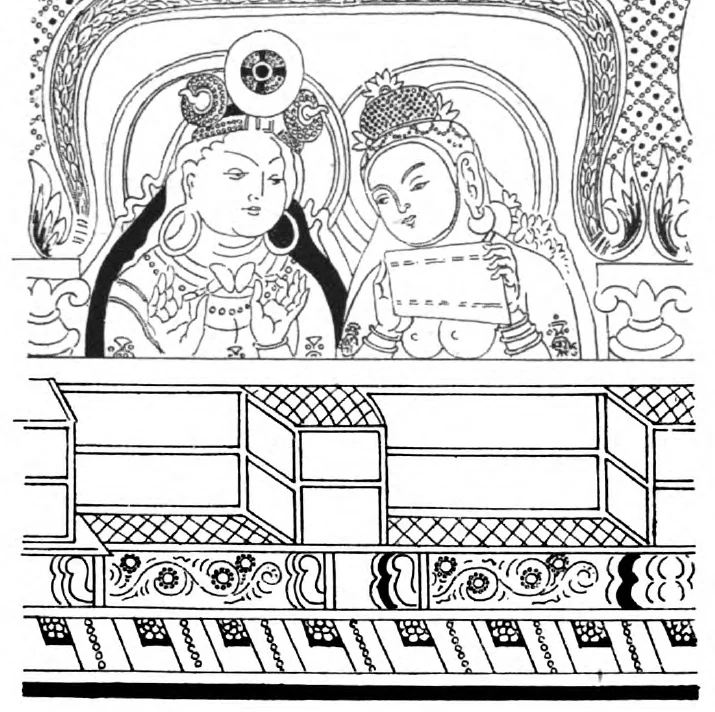
Each wall has seven arched bays, and in each bay stands a god and a goddess.[25] Eighteen of the twenty-eight figures play an instrument. There are five lutes, four transverse flutes, two panpipes, two pointed flutes, two arched harps, a pair of cymbals, a tambourine and a zither.[25] One goddess claps her hands. The others hold necklaces, flower baskets, a drinking bowl and a mirror.[25] The report sets the cave in the second of its style groups and gives no year.[26]
The musicians are gods, and the paintings show a Buddhist subject.[25] The instruments in them need not be those that a court played. The paintings and the court lists share the lute, the harp, the transverse flute and the cymbals. The lists have no zither and no tambourine, and the paintings show no reed pipe and no mouth organ.[25] No text says that the paintings picture the orchestra of Kucha.
Pictures of musicians near Turfan
Two pictures from the ruins near Turfan show instruments. Both are published in the report on the finds of the first Prussian expedition to Turfan, which appeared in 1913.[27]
A Manichaean book leaf from the ruin K at Qocho has Turkic text on both sides and painted musicians along the top of its reverse.[28] Three men are preserved. One sits alone, and his arms seem to have held an instrument, but only the underpainting remains. Two kneel on a green carpet. The first wears a red robe with large woven flowers. The second wears a robe of blue and white and plays a lute with four strings. The arm of a further figure shows at the torn edge.[28] The describer of the leaf compared the lute with the Indian vina and thought it may have been played with a plectrum.[28]
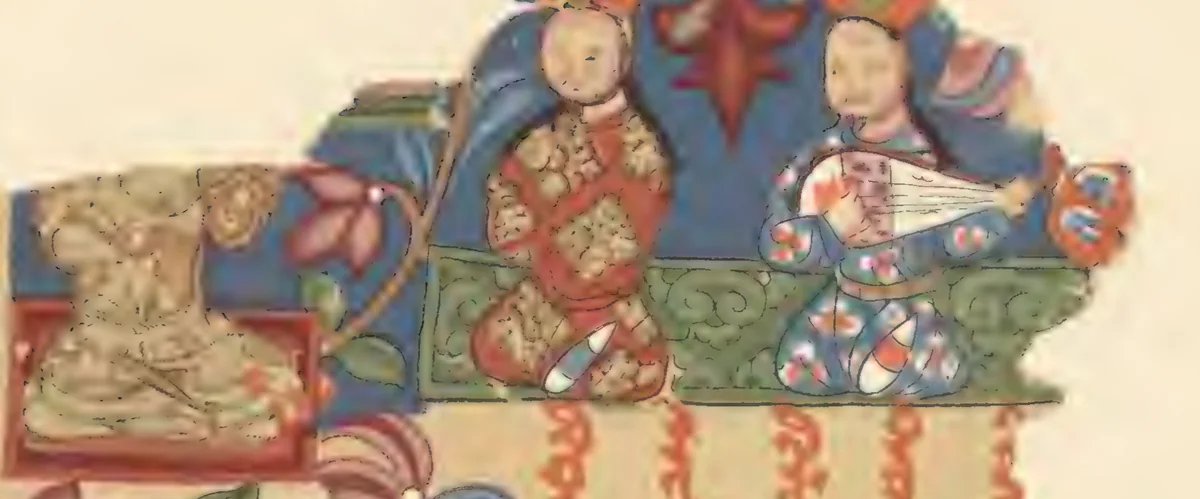
The leaf is not dated. A column of text on its reverse gives the opening of a khan’s title, and the khan’s name is lost. Four khans are known whose titles begin with the same words. They ruled in 789 to 790, about 808, until 832 and about 833.[28] The khan of the Uyghur Khaganate took up Manichaeism in 762 and 763.
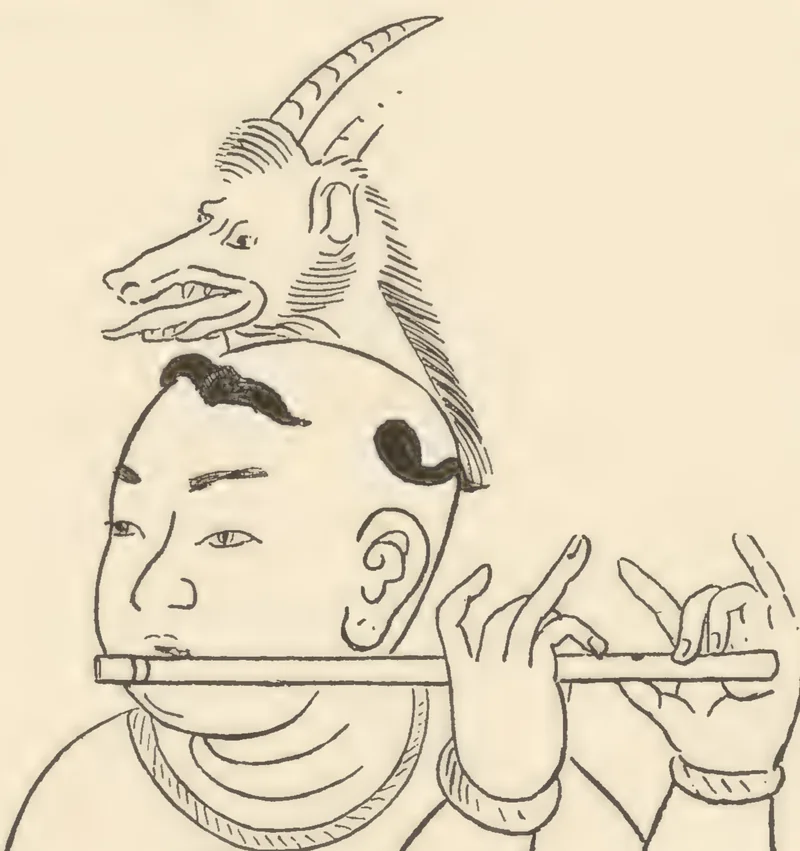
The second picture is a wall painting from temple 7 in the Sängim gorge. A demon prince stands in it with two young demons beside him.[29] One of them plays a lute with an egg-shaped body that runs without a break into a flat neck. The neck carries five broad frets, and two pegs suggest two strings. Two sound holes of crescent shape pierce the belly.[29] The plate does not say whether the player used a plectrum or his fingers, and it gives no date.[29] The other young demon plays a transverse flute. The painting is badly damaged, and the flute player survives in a tracing.[29]
Qocho in 981
In 981 the Song emperor sent Wang Yande as envoy to the Uyghur kingdom of Qocho, and he came home in 984.[30] His report says of the people of Gaochang that they use very many konghou in their music.[31] The translation of the report equates this konghou with the Turkic qopuz.[31] The Jiu Tang Shu describes the konghou as a harp, and Kashgari glosses qopuz as a lute.[32] The equation therefore does not come from the sources themselves. At the reception by the Uyghur king, one man held a stone chime and kept time for the ceremony. When the king heard its sound, he saluted.[33] After the reception came music, wine, a feast and a play by actors that lasted until midnight.[34] The report does not describe the konghou.[31]
Instruments the sources do not give
No source used here describes the shape of an instrument that the Xiongnu, the Huns or the Göktürks played. The runic inscriptions of the Orkhon name no instrument except the drum of a damaged line.[35] No painting shows the musicians of a Göktürk or Uyghur khan. The pictures show gods, demons and the musicians of a Manichaean book.
The horsehair fiddle appears in reports of the nineteenth century. Shamanism mentions the fiddle of a Kazakh baksa. No source of the period down to the eleventh century names a horsehair fiddle.
What remains is a few names, a few lists made at Chinese courts and a set of paintings made for Buddhists and Manichaeans. Together they show which instruments were known along the oases and which the Chinese courts thought foreign. They do not show what the khans and their people played.
References
- ^ a b c Sui Shu (Book of Sui), juan 15; Jiu Tangshu (Old Book of Tang), juan 29
- ^ Hou Han Shu, juan 89; Menander Protector; Xin Tangshu (New Book of Tang), juan 217; Dīvān Lughāt al-Turk
- ^ Grünwedel 1912; von Le Coq 1913
- ^ a b c d e Hou Han Shu, juan 89
- ^ a b Menander Protector; Blockley 1985, fr. 10.3, p. 119
- ^ Life of Xuanzang, juan 2; Beal 1911, p. 43
- ^ Life of Xuanzang, juan 2
- ^ a b c d e f g Sui Shu (Book of Sui), juan 15
- ^ Movsēs Dasxurancʿi, book II; Dowsett 1961, p. 156
- ^ Xin Tangshu (New Book of Tang), juan 217
- ^ Dīvān Lughāt al-Turk
- ^ Dīvān Lughāt al-Turk; al-Kāshgharī 1072–1074, p. 282
- ^ Dīvān Lughāt al-Turk; al-Kāshgharī 1072–1074, p. 363
- ^ Dīvān Lughāt al-Turk; al-Kāshgharī 1072–1074, p. 356
- ^ Dīvān Lughāt al-Turk; al-Kāshgharī 1072–1074, p. 47
- ^ Dīvān Lughāt al-Turk; al-Kāshgharī 1072–1074, p. 282, 356, 363
- ^ a b Ögel 2000, p. 196–197
- ^ Kutadgu Bilig
- ^ Kutadgu Bilig; Dankoff 1983, couplet 86
- ^ a b c d e f g Jiu Tangshu (Old Book of Tang), juan 29
- ^ a b Tongdian, juan 193
- ^ Tongdian, juan 193; Jiu Tangshu (Old Book of Tang), juan 29
- ^ Han Shu, juan 96
- ^ a b c Grünwedel 1912, p. 63
- ^ a b c d e Grünwedel 1912, p. 64
- ^ Grünwedel 1912, p. 42
- ^ von Le Coq 1913, pl. 5, pl. 13
- ^ a b c d von Le Coq 1913, pl. 5
- ^ a b c d von Le Coq 1913, pl. 13
- ^ İzgi 1989, p. 1
- ^ a b c İzgi 1989, p. 57
- ^ Jiu Tangshu (Old Book of Tang), juan 29; Dīvān Lughāt al-Turk
- ^ İzgi 1989, p. 65
- ^ İzgi 1989, p. 65–66
- ^ Bilge Khan inscription
Sources
- Hou Han Shu, juan 89
- Han Shu, juan 96 (after Shiji)
- Sui Shu (Book of Sui), juan 14, 15
- Jiu Tangshu (Old Book of Tang), juan 29
- Tongdian, juan 193 (after Sui Shu and Zhou Shu)
- Xin Tangshu (New Book of Tang), juan 215, 217 (after Jiu Tangshu)
- Life of Xuanzang, juan 2
- Menander Protector
- Movsēs Dasxurancʿi, book II
- Bilge Khan inscription
- Dīvān Lughāt al-Turk
- Kutadgu Bilig
Literature
- Albert Grünwedel, Altbuddhistische Kultstätten in Chinesisch-Turkistan. Bericht über archäologische Arbeiten von 1906 bis 1907 bei Kuča, Qarašahr und in der Oase Turfan (1912)
- Albert Grünwedel, Alt-Kutscha. Archäologische und religionsgeschichtliche Forschungen an Tempera-Gemälden aus buddhistischen Höhlen der ersten acht Jahrhunderte nach Christi Geburt (1920)
- Albert von Le Coq, Chotscho. Facsimile-Wiedergaben der wichtigeren Funde der ersten Königlich Preussischen Expedition nach Turfan in Ost-Turkistan (1913)
- Özkan İzgi, Çin Elçisi Wang Yen-te'nin Uygur Seyahatnamesi (1989)
- Maḥmūd al-Kāshgharī, Dīwān Lughat al-Turk (1072–1074)
- Robert Dankoff (trans.), Wisdom of Royal Glory (Kutadgu Bilig): A Turko-Islamic Mirror for Princes (1983)
- Bahaeddin Ögel, Türk Kültür Tarihine Giriş VIII: Türklerde devlet ve ordu mehteri (2000)
- Samuel Beal (trans.), The Life of Hiuen-Tsiang by the Shaman Hwui Li (1911)
- R. C. Blockley, The History of Menander the Guardsman: Introductory Essay, Text, Translation, and Historiographical Notes (1985)
- Charles J. F. Dowsett (trans.), The History of the Caucasian Albanians by Movsēs Dasxuranci (1961)
What links here1
- Customs & Pastimes
- The Pipa and Music on Horseback
Cite this article
Yavuz, Emre-E. “Musical Instruments in the Sources.” Turkic Atlas, revised 12 November 2026. https://turkicatlas.org/customs/musical-instruments-in-the-sources/
Last revised: 12 November 2026

