
Bahram Çobin Reý etrabyndan, Mihran öýünden bolan Sasanid serkerdesidi.[1] Ol Horasana çozan Göktürk goşunyny ýok etdi. Soňra öz şasy Hormizd IV-e garşy çykdy.[2] Ol 590-njy ýylda özüni şahlaryň şahy etdi. 591-nji ýylda Hormizdiň ogly Hosrow II rim goşuny bilen gaýdyp gelip, ony ýeňdi.[3] Bahram ömrüni Göktürkleriň arasynda tamamlady.[4]
Gelip çykyşy we wezipe ýoly
Tabari ony Reýli, Bahram-Guşnaspyň ogly Bahram diýip atlandyrýar.[5] Imperator Mawrikiýiň grek taryhçysy Teofilakt Simokatta bir pars ofisialyndan Bahramyň Razakeneden, ýagny Reý etrabyndan gelip çykandygyny eşitdi. Ofisial onuň Mirrames öýüne degişlidigini hem aýtdy.[1] Grek we ermeni habarlarynda ol Mihran, ýagny Eýranyň uly esil öýleriniň birinden.[6] Thaalibi ony serhet welaýatynyň häkimi, marzban edýär. Göktürk urşy wagtynda ol Azerbaýjanda bolupdyr.[7] Çobin, “agaçdan ýasalan”, lakamynyň gelip çykyşy näbelli.[8]
Teofilakt onuň ýokary galyşyny yzarlaýar. Bahram şanyň goragçylarynyň arasynda hyzmat etdi. Hosrow I-iň döwründe parslar rimlileriň Dara galasyny alanda, ol bir bölege serkerdelik etdi. Ol Ermenistana çenli söweşdi we general boldy. Soňra ol şanyň öýüniň müdiri darigbedum wezipesine bellendi.[9] Soňraky arap kitaplar katalogy oňa ok atmak baradaky bir eseri degişli edýär.[10]
Göktürklere garşy uruş
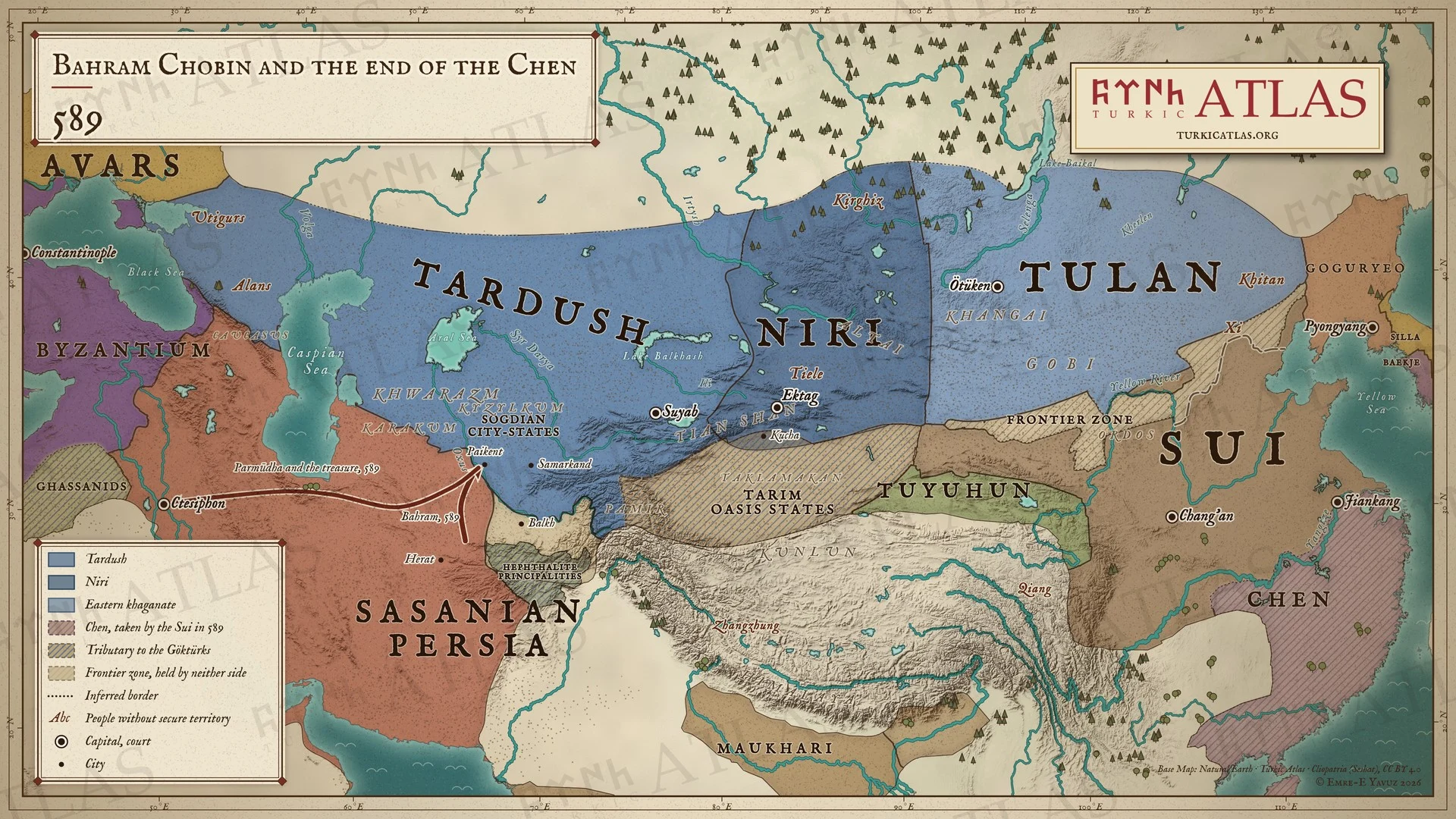
Hormizd IV rowaýata görä Istemiň gyzynyň ogludy. 588-nji ýylda ol Bahramy Oksusy geçen Göktürk goşunyna garşy iberdi.[11] Bahram şol goşuny ýok etdi we ony derýa çenli yzarlady. Pars eposyna görä, ol onuň ýolbaşçysyny ok bilen öldürdi.[11]
Tabari Bahramyň özi saýlan on iki müň adam bilen türkleriň baş patyşasy Şabanyň garşysyna ýörändigini aýdýar. Herat bilen Badgisiň aňyrsynda ol Şabany ok bilen öldürdi.[12] Soňra ol Şabanyň ogly Parmudhany bir galada, ol boýun egýänçä gabady. Ol Parmudhany hazyna bilen Hormizde iberdi.[13] Sebeos, ýedinji asyrdan galan ermeni taryhy, Bahramyň Tetallaryň goşunyny ýeňendigini aýdýar. Ol Balhy we Kuşanlaryň ýurduny Oksusyň aňry ýüzüne çenli alýar. Derýanyň aňyrsynda ol “Mazkutkyň beýik patyşasyny” öldürýär.[14] Teofilakt ýeňşi Hormizde berýär. Ol Bahramy diňe ýörişde tapawutlanan general hökmünde atlandyrýar.[15]
Ýeňilişiň 589-njy ýylda Heratda bolandygy aýdylýar. Bu aýdyma görä, Göktürk ýolbaşçysy Tarduşuň ogly Şaba pars-yslam rowaýatynyň “türkleriň iň beýik patyşasy” bolýar.[16] Başga bir beýan ony Bagha diýip hasaplaýar we söweşi 588-nji ýylyň aprelinde Hirkaniýa gaýasynda bolan diýip kesgitleýär.[17] 589-njy ýylda Bahram gündogara ýöräp, Herady yzyna aldy. Ol ýerde ol Göktürk hanynyň altyn tagtyny alan ýalydyr. Soňra ol Buhara ýurduna ýetdi.[18] Teofilakt parslaryň alan oljalarynyň arasynda altyn tagtlary sanaýar.[19] Thaalibide Bahram Oksusy geçdi. Buharanyň golaýyndaky Paýkentde ol Şabanyň ogly, Thaalibiniň Barmudha diýip atlandyrýan şahsynyň boýun egmesini kabul etdi.[20]
Gozgalaň we şalyk
Ýeňiş Bahramy şasy bilen çaknyşdyrdy. Sebeosa görä, Bahram Hormizde oljanyň diňe kiçi bölegini iberdi, galanyny goşunyna berdi. Hormizd ähli hazynany talap etdi. Goşun onuň adamlaryny öldürdi we Bahramy öz şasy etdi.[21] Thaalibide Hormizd Bahramyň hazynany gizländigine güman etdi. Ol oňa pagta, ýüp egirmek üçin şpindel we aýal eşiklerini iberdi.[22] Teofilakt başga bir hekaýany gürrüň berýär. Romanusyň ýolbaşçylygyndaky rim goşuny Bahramy Albaniýada ýeňdi, Hormizd bolsa ony wezipesinden aýyrdy we oňa aýal eşiklerini iberdi. Bahram Hormizde Hosrowyň ogly däl-de, gyzy diýip ýüz tutup jogap berdi.[23] Başga bir bapda Teofilakt gozgalaňy Bahramyň Göktürkler üstündäki ýeňişlerinden buýsanmagyna baglaýar.[24]
Soňra Bahram goşunlaryny ýygnap, özüni şahlaryň şahy diýip yglan etdi. Soňky raýat urşunda ýaş Hosrow II we onuň wizantiýaly goldawçylary ony ýeňdi. Ol öňki duşmanlary Göktürklere gaçdy, olar ony gowy garşyladylar.[18] Teofilakt Bahramyň parslaryň uly baýramynda şa täjini geýip, özüni patyşa yglan edendigini habar berýär.[25] Hosrow Bahramyň höküm sürmegine soňy goýan söweşde onuň goşunyndan ýesirler aldy. Olaryň arasynda “türk nesilinden” bolan adamlar hem bardy, olary ol imperator Mawrikiýe iberdi.[26]
Göktürklere gaçyşy we ölümi
Suýabda Bahram hormatly general derejesine ýetdi. Ol Aşinanyň içindäki bir dildüwşügi ýüze çykardy. Köp wagt geçmänkä Hosrowyň bir pars agenti ony zäherledi.[18] Onuň hyzmat eden köşgi Tarduşyňkydy.
Çeşmeler soňuny dürli görnüşde gürrüň berýär. Tabaride Bahram Horasana, soň Göktürklere gaçýar. Ol olaryň patyşasynyň ýanynda uly hormatda ýaşady.[4] Hosrow Hormizd atly bir adamy gymmatbahaly daş bilen iberdi. Hormizd patyşanyň aýaly hatyny özüne çekdi we ol Bahramyň üstüne öldürijileri goýberdi.[27] Thaalibide Bahram Nişapur arkaly Transoksiana tarap, Barmudhanyň ogly kagana gaçdy. Kagan ony deň hökmünde kabul etdi we ony tabşyrmakdan ýüz öwürdi.[28] Hosrowyň ilçisi Hormizd Jarabzin bolsa hatyny özüne çekdi. Ol sarayyň bir türkini hakyna tutdy, ol Bahramy zäherde batyrylan hanjar bilen pyçaklady.[29] Sebeosda Bahram Balha gaçýar. Onuň ilaty ony şol ýerde Hosrowyň buýrugy bilen öldürýär.[30]
Köp beýanda Göktürk goşunyny ýok eden general ömrüni Göktürk köşgünde tamamlady.
-
588 Persia attacked from four sides
In the eleventh year of Hormizd IV, Tabari reports, Šāba, “the over-king of the Turks”, advanced with three hundred thousand men as far as Badghis and Herat. In Thaʿālibī the khagan Šāba-Šāh marches on Balkh with a hundred thousand horsemen. At the same time the Roman emperor moved into the Syrian desert with eighty thousand men, the king of the Khazars came to Derbent, and two Arab chiefs camped on the Euphrates and raided the Sawād. Persia was called a sieve with many holes. The Roman march is exaggerated, and the two Arab chiefs are probably invented. One reading has the Göktürk army cross the Oxus, take Balkh, Herat, Talakan and Badghis, and march on west into Hyrcania. The sources name the goals; the way to them is drawn, and the leg into Hyrcania follows that reading.
-
588–589 Bahram Chobin against Šāba
Hormizd sent against Šāba a man of Rayy, Bahram son of Bahram-Gushnasp, called Chobin, with twelve thousand men he had chosen himself. In Tabari he marched fast until he was past Herat and Badghis, and Šāba noticed nothing until the Persians had built a fortified camp close to his own. After negotiations and fighting Bahram killed Šāba with an arrow. In Thaʿālibī, Šāba-Šāh sends his brother Faghfūra to offer Bahram a safe return or high office; Bahram answers that he has come for Šāba-Šāh's head, and Faghfūra is found among the dead. One reading sets the decisive battle in April 588 at the Hyrcanian rock, where Bahram beat the Göktürks under Bagha, pursued them to the Oxus and, reportedly, killed Bagha there with an arrow; a second places the defeat at Herat in 589. Tabari's march is drawn to the place he gives; the pursuit of the first reading is dotted, and where it reached the river is not recorded.
-
589 Beyond the Oxus: Parmūdha and the treasure
Šāba's son Parmūdha, “who was his father's equal”, came up next. Bahram beat him, shut him up in one of his fortresses and pressed him until he surrendered. In Thaʿālibī, Bahram crosses the Oxus, routs Barmūdha in a night attack and besieges him in Paikent, near Bukhara, until he gives himself up on Hormizd's guarantee of his life. Bahram sent the prisoner to the king with the treasure of the fortress, by Tabari's account two hundred and fifty thousand camel loads; Thaʿālibī counts among it the crown, belt and earrings of Siyāwush. One reading has Bahram retake Herat in 589 and reach the country around Bukhara. Sebeos tells the campaign as the conquest of Balkh and of the land of the Kushans to the far side of the Oxus, where Bahram killed the great king of the Mazkʿutʿkʿ. The stations are those Thaʿālibī and Sebeos name; the way between them is drawn, and so is the road to the capital at Ctesiphon.
-
589 The break with Hormizd
Theophylact sends Bahram from the war against the Göktürks to the Caucasus. In the eighth year of Maurice he ravaged Suania, sent its booty to Babylonia and moved camp to the Araxes. The Roman general Romanus came from Lazica into Albania; Bahram drew back towards Ganzak, crossed the river again and was beaten in the plain of Albania. Hormizd dismissed him and sent him women's clothes as the prize of his disgrace. One reading holds that the Mazkʿutʿkʿ whom Sebeos puts beyond the Oxus belong to this campaign. The Persian and Arabic accounts know nothing of a Roman defeat. In them the quarrel is over the booty: in Sebeos the army killed the guards whom Hormizd sent for the whole treasure and made Bahram its king, and in Thaʿālibī the king sends him cotton, a spindle and women's clothes. Theophylact names Suania, the Araxes and Albania; the way between them is drawn.
-
590 Bahram takes Ctesiphon; Khosrow II flees
In Thaʿālibī, Bahram made peace with the khagan, Barmūdha's son, gave him back his country and raised the revolt in Khorasan. The rebels declared Hormizd deposed and marched on Ctesiphon, in the Persian and Arabic accounts from Khorasan. In Theophylact they wait at the crossing of the Zab, and the army sent against them goes over to Bahram. In the capital the nobles deposed Hormizd and blinded him, and his son Khosrow II took the throne; Hormizd was killed soon after. Bahram came on fast. After a meeting on the Nahrawan and a night attack, Khosrow fled across the Tigris. Theophylact takes him through the desert and along the Euphrates past Anatha to Circesium, and on to the Roman general at Hierapolis; Sebeos has him stop at a city he calls Khaab, read as Aleppo, and Tabari has him write to the emperor Maurice from Antioch. Bahram took the palace and at the great festival put on the royal diadem. The stations are those Theophylact names; the way between them is drawn.
-
591 The battle of 591
Maurice sent Khosrow back with a Roman army. It set out from Dara, crossed the Tigris and the Zab, and joined a second Roman army that came from Armenia. Bahram marched from Ctesiphon into Atropatene. Theophylact puts the battle near Ganzak, on the river Blarathos, with more than sixty thousand men on Khosrow's side and forty thousand on Bahram's; Tabari and Sebeos also place the fighting in Atropatene. Bahram's army broke, and he escaped. Among the prisoners were men “of the Turkish race” with a cross tattooed on their foreheads, and Khosrow sent them to Maurice. The stations are those Theophylact names; the way between them is drawn, and so is the meeting of the two Roman armies south of Lake Urmia.
-
from 591 Bahram's flight and death
Tabari has Bahram escape to Khorasan and go on to the Göktürks, whose king received him with high honour. In Thaʿālibī he halts at Nishapur and crosses into Transoxiana to the khagan, Barmūdha's son, who meets him as an equal and refuses to give him up. Khosrow sent an envoy with a precious jewel who won over the khatun, the khagan's wife, and she had Bahram killed; in Thaʿālibī a man of the court stabbed him with a dagger dipped in poison. Sebeos has Bahram flee to Balkh and be put to death there by its people on Khosrow's order. One reading makes him a respected general at Suyab who uncovered a conspiracy within the Ashina before a Persian agent poisoned him. The flight is drawn through the stations Thaʿālibī names; the way on to Suyab follows that reading and is dotted.
-
606 or 614 The host of the great khagan
Khosrow II sent the Armenian Smbat Bagratuni east against the Kushans. Smbat called up his old troops from Hyrcania, beat the Kushan raiders and camped at Apr Shahr near Nishapur, in the province of Tus, with three hundred men in the walled village of Khrokht. The kings of the Kushans called on the great khagan, king of the regions of the north. A host of three hundred thousand, thirty thousand in an older translation, crossed the Oxus. It surrounded Khrokht, from which Smbat broke out, and routed the Persian relief force under Datoyean; its raids reached the borders of Rayy and of the province of Isfahan. Then an order of the great khagan reached its commander, the Chembukh, and the host recrossed the river and went home. Sebeos gives no year. One reading dates the war to 606 and 607 and has the western yabgu Shegui withdraw the army; a second places it in 614 and 615, counting back from Smbat's death in the twenty-eighth year of Khosrow II; a third dates it to 597 and 598. Khrokht is not located; the routes between the named places are drawn.
-
607 or 615 Smbat's counter-campaign
Khosrow's inquiry blamed Datoyean, who was put to death, and cleared Smbat. With fresh troops Smbat marched against the Kushans and the Hephthalite king. The Kushan king challenged him to single combat between the lines, and Smbat's lance split his armour and killed him. Smbat's horsemen pursued the fleeing army as far as Balkh, the capital of the Kushans, and plundered Herat, Badghis, Tokharistan and Talaqan. He came back with great booty and camped in the province of Merv. In the reading that dates the war to 606 and 607, the Hephthalites he beat near Balkh were still vassals of the Göktürks; in the second the campaign falls in 615. Sebeos names Balkh and Merv; the way between them is drawn.
- Place named in a source (position as commonly identified)
- Position disputed or approximate
- Extent of a realm, inferred; border uncertain (soft edge)
- Tokharistan between Persia and the Göktürks, its overlord contested (hatched)
- Movement named in a source (route drawn)
- Route between the stations a source names (way inferred)
- Route after a modern reconstruction
Bellikler
- ^ a b Theophylact Simocatta; Whitby 1986, p. 101
- ^ Tabari; Nöldeke 1879, p. 270-273
- ^ Whitby 1986, xix
- ^ a b Tabari; Nöldeke 1879, p. 287-289
- ^ Tabari; Nöldeke 1879, p. 270
- ^ Nöldeke 1879, p. 270
- ^ at-Thaalibi; Zotenberg 1900, p. 643
- ^ Nöldeke 1879, p. 271
- ^ Theophylact Simocatta; Whitby 1986, p. 101-102
- ^ Nöldeke 1879, p. 272
- ^ a b Shahnameh
- ^ Tabari; Nöldeke 1879, p. 270-271
- ^ Tabari; Nöldeke 1879, p. 272
- ^ Sebeos, ch. 10; Howard-Johnston 1999, p. 15
- ^ Theophylact Simocatta; Whitby 1986, p. 80-81
- ^ Golden 1992, p. 132
- ^ Yavuz 2025, p. 324
- ^ a b c Yavuz 2025, p. 325
- ^ Theophylact Simocatta; Whitby 1986, p. 81
- ^ at-Thaalibi; Zotenberg 1900, p. 650-654
- ^ Sebeos, ch. 10; Howard-Johnston 1999, p. 15-16
- ^ at-Thaalibi; Zotenberg 1900, p. 656-657
- ^ Theophylact Simocatta; Whitby 1986, p. 82-83
- ^ Theophylact Simocatta; Whitby 1986, p. 102
- ^ Theophylact Simocatta; Whitby 1986, p. 119
- ^ Theophylact Simocatta; Whitby 1986, p. 146
- ^ Tabari; Nöldeke 1879, p. 289
- ^ at-Thaalibi; Zotenberg 1900, p. 674-676
- ^ at-Thaalibi; Zotenberg 1900, p. 678-682
- ^ Sebeos; Howard-Johnston 1999, p. 23
Çeşmeler
Edebiýat
- Emre-E. Yavuz, The Gokturk Empire: 2nd Edition (2025)
- Peter B. Golden, An Introduction to the History of the Turkic Peoples (1992)
- Theodor Nöldeke, Geschichte der Perser und Araber zur Zeit der Sasaniden. Aus der arabischen Chronik des Tabari übersetzt und mit ausführlichen Erläuterungen und Ergänzungen versehn (1879)
- Michael Whitby, Mary Whitby (trans.), The History of Theophylact Simocatta (1986)
- Michael Whitby, The Emperor Maurice and His Historian (1988)
- R. W. Thomson (trans.), James Howard-Johnston (commentary), The Armenian History attributed to Sebeos (1999)
- Hermann Zotenberg (ed., trans.), Histoire des rois des Perses par Abou Mansour ʿAbd al-Malik ibn Mohammad ibn Ismaʿil al-Thaʿalibi (1900)
Şu sahypa salgylananlar25
- States
- Sasanid Persiýasy
- Battles & Events
- Alnynda haç bolan Göktürk ýesirleri (591) · Bahram Çobiniň öldürilmegi
- Sources
- at-Thaalibi · Sebeos · Tabari · Theophanes Ykrarçy · Theophylact Simocatta
Makalany sitata almak
Yavuz, Emre-E. “Bahram Çobin.” Turkic Atlas, revised 18 November 2026. https://turkicatlas.org/persons/bahram-chobin/
Last revised: 18 November 2026

