
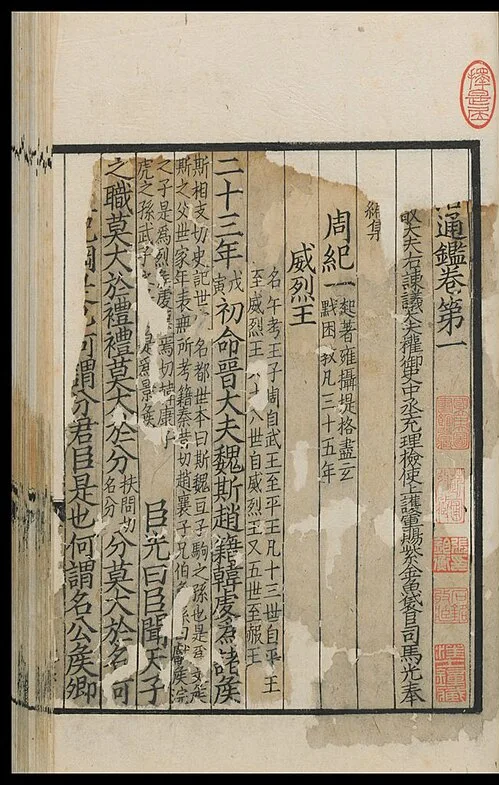
Zizhi tongjian on birinci əsrdə tərtib edilmiş ümumi salnamədir. Altıncı əsr üçün o, Zhou Shudan, Sui Shudan və Bei Shidən toplayır.
Onun buradakı dəyəri xronoloji xarakter daşıyır. Sima Guang materialını il-il, bəzən ay-ay düzür. Bu, salnaməni hadisələrin ardıcıllığını axtarmaq üçün təbii yer edir. 552-ci ildəki iki döyüşün sırası məhz burada yoxlanılardı. Bu döyüşlərə aid edilən aylar müasir nəqllərdə fərqlənir.
Salnamənin şahidlik kimi dəyəri yoxdur. O, hadisələrdən beş əsrdən çox sonra dayanır. Onun indi itmiş mənbədən istifadə etdiyi göstərilə bilməyincə, daha əvvəlki əsərlərdə olmayan heç nə ehtiva etmir.
Bibliografik təfərrüatlar
İstinadlar sülalə tarixləri üçün adət olduğu kimi səhifə ilə deyil, fəsil ilə verilir.
The passage
突闕土門襲擊柔然,大破之。
柔然頭兵可汗自殺,
其太子庵羅辰及阿那瑰從弟登注俟利、登注子庫提並帥眾奔齊,
餘眾復立登注次子鐵伐為主。
土門自號伊利可汗,
號其妻為可賀敦,
子弟謂之特勒,別將兵者皆謂之設。
Tumen of the Göktürks attacked the Rouran and defeated them utterly.
The Rouran khan Toubing killed himself.
His crown prince Anluochen, Anagui's cousin Dengzhu Qili and Dengzhu's son Kuti all led their people to flee to the Qi,
and the rest of the people raised Dengzhu's second son Tiefa to be their lord.
Tumen styled himself Yili Khan,
called his wife khatun,
called his sons and younger brothers tegin, and called all who led troops separately shad.
[1] Zizhi tongjian (Comprehensive Mirror in Aid of Governance), juan 164
鐵勒將伐柔然,突厥酋長土門邀擊,破之,盡降其眾五萬餘落。
土門恃其強盛,求婚於柔然,
柔然頭兵可汗大怒,使人詈辱之曰:「爾,我之鍛奴也,何敢發是言!」
土門亦怒,殺其使者,遂與之絕,而求婚於魏;
魏丞相泰以長樂公主妻之。
The Tiele were about to attack the Rouran, and the Göktürk chieftain Tumen intercepted them and defeated them, and received the submission of all their people, more than fifty thousand camps.
Relying on his strength, Tumen asked the Rouran for a marriage,
and the Rouran khan Toubing was greatly angered and sent a man to abuse him with the words: “You are my forging slave. How dare you say this!”
Tumen too was angry. He killed the envoy and broke with them, and asked the Wei for a marriage.
The Wei chancellor Tai gave him the princess Changle as his wife.
[1] Zizhi tongjian (Comprehensive Mirror in Aid of Governance), juan 164
癸未,頡利可汗進至渭水便橋之北,遣其腹心執失思力入見,以觀虛實。
思力盛稱「頡利、突利二可汗將兵百萬,今至矣。」
上讓之曰:「吾與汝可汗面結和親,贈遺金帛,前後無算。
汝可汗自負盟約,引兵深入,於我無愧?
汝雖戎狄,亦有人心,何得全忘大恩,自誇強盛?
我今先斬汝矣!」
思力懼而請命。
蕭瑀、封德彝請禮遣之。上曰:「我今遣還,虜謂我畏之,愈肆憑陵。」乃囚思力於門下省。
上自出玄武門,與高士廉、房玄齡等立騎逕詣渭水上,與頡利隔水而語,責以負約。
突厥大驚,皆下馬羅拜。
俄而諸軍繼至,旌甲蔽野,頡利見執失思力不返,而上挺身輕出,軍容甚盛,有懼色。
是日,頡利來請和,詔許之。上即日還宮。
乙酉,又幸城西,斬白馬,與頡利盟於便橋之上。突厥引兵退。
On the day guiwei Ilig Khan advanced to the north of the Bian Bridge on the Wei river and sent his confidant Zhishi Sili to be admitted to an audience, in order to see how things stood.
Sili loudly declared: “The two khans, Ilig and Tuli, are leading a million troops, and they have now arrived.”
The emperor reproached him: “I concluded an alliance of peace and kinship with your khan face to face, and the gifts of gold and silk I sent him, before and after, were beyond counting.
Your khan himself has turned his back on the covenant and led troops deep into my land. Does he feel no shame before me?
Though you are Rong and Di, you too have a human heart. How can you forget my great kindness altogether and boast of your strength?
I shall cut you down first, here and now!”
Sili was afraid and begged for his life.
Xiao Yu and Feng Deyi asked that he be sent back with courtesy. The emperor said: “If I send him back now, the enemy will say I fear them and will encroach all the more.” So he put Sili in prison in the Chancellery.
The emperor himself went out through the Xuanwu Gate and, with Gao Shilian, Fang Xuanling and others, all mounted, rode straight to the bank of the Wei. He spoke with Ilig across the water and reproached him for breaking the covenant.
The Göktürks were greatly startled and all dismounted and bowed in ranks.
Soon the armies arrived one after another, with banners and armour covering the plain. Ilig saw that Zhishi Sili did not return and that the emperor had come out lightly, in person, with a most splendid array of troops, and he looked afraid.
On that day Ilig came and asked for peace, and the emperor by decree granted it. The emperor returned to the palace the same day.
On the day yiyou the emperor went again to the west of the city, slew a white horse and swore a covenant with Ilig on the Bian Bridge. The Göktürks led their troops away.
[2] Zizhi tongjian (Comprehensive Mirror in Aid of Governance), juan 191
四夷君長詣闕請上為天可汗,
上曰:「我為大唐天子,又下行可汗事乎?」
群臣及四夷皆稱萬歲。
是後以璽書賜西北君長,皆稱天可汗。
庚辰,行軍副總管張寶相帥眾奄至沙缽羅營,俘頡利送京師,蘇尼失舉眾來降,漠南之地遂空。
突厥頡利可汗至長安,夏,四月,戊戌,上御順天樓,盛陳文物,引見頡利,數之曰:
「汝藉父兄之業,縱淫虐以取亡,罪一也;
數與我盟而背之,二也;
恃強好戰,暴骨如莽,三也;
蹂我稼穡,掠我子女,四也;
我宥汝罪,存汝社稷,而遷延不來,五也。
然自便橋以來,不復大入為寇,以是得不死耳。」
頡利哭謝而退。
The rulers of the four barbarian quarters came to the palace gate and asked the emperor to be Heavenly Khan.
The emperor said: “I am the Son of Heaven of the great Tang. Should I also lower myself to perform a khan's duties?”
The ministers and the rulers of the four quarters all cried “Ten thousand years!”
After this, in the sealed letters sent to the rulers of the north-west, the emperor was always called Heavenly Khan.
On the day gengchen the deputy commander Zhang Baoxiang led his troops and came suddenly upon the camp of Shaboluo. He took Ilig captive and sent him to the capital, and Suni led all his people in submission, and the land south of the desert was left empty.
Ilig Khan of the Göktürks arrived at Chang'an. In summer, in the fourth month, on the day wuxu, the emperor took his seat in the Shuntian Tower, displayed his regalia in full array, received Ilig in audience and counted his faults, saying:
“You relied on the achievement of your father and brother and gave free rein to excess and cruelty and so brought ruin on yourself: that is the first offence.
Many times you swore a covenant with me and then turned your back on it: that is the second.
You relied on strength and loved war, and bones lay exposed like grass in the wild: that is the third.
You trampled my crops and carried off my sons and daughters: that is the fourth.
I pardoned your offences and kept your state in being, and you delayed and did not come: that is the fifth.
Yet since the Bian Bridge you have not again invaded in force as a raider, and for that reason you will escape death.”
Ilig wept, gave thanks and withdrew.
[3] Zizhi tongjian (Comprehensive Mirror in Aid of Governance), juan 193
春,正月,李靖帥驍騎三千自馬邑進屯惡陽嶺,夜襲定襄,破之。
突厥頡利可汗不意靖猝至,大驚曰:「唐不傾國而來,靖何敢孤軍至此!」
其從一日數驚,乃徙牙於磧口。
李世勣出雲中,與突厥戰於白道,大破之。
甲辰,李靖破突厥頡利可汗於陰山。
先是,頡利既敗,竄於鐵山,餘眾尚數萬
遂勒兵夜發,世勣繼之,軍至陰山,遇突厥千餘帳,俘以隨軍。
靖使武邑蘇定方帥二百騎為前鋒,乘霧而行,去牙帳七里,虜乃覺之。
頡利乘千里馬先走,靖軍至,虜眾遂潰。
靖斬首萬餘級,俘男女十餘萬,獲雜畜數十萬,殺隋義成公主,擒其子疊羅施。
斥地自陰山北至大漠,露布以聞。
In spring, in the first month, Li Jing led three thousand picked horsemen from Mayi, advanced and camped at the Eyang ridge, attacked Dingxiang by night and broke it.
Ilig Khan of the Göktürks had not expected Jing's sudden arrival and was greatly alarmed. He said: “If the Tang had not come with the whole state, how would Jing dare to come this far with a lone army!”
His followers took fright several times a day, and he moved his camp to Qikou, the mouth of the desert.
Li Shiji came out from Yunzhong, fought the Göktürks at Baidao and thoroughly defeated them.
On the day jiachen Li Jing defeated Ilig Khan of the Göktürks at the Yinshan.
Before this, after Ilig had been defeated, he had fled to Iron Mountain, with tens of thousands of his people still left,
so Jing drew up his troops and set out by night, with Shiji following. The army reached the Yinshan, met more than a thousand Göktürk tents and took them captive to go with the army.
Jing sent Su Dingfang of Wuyi with two hundred horsemen as the vanguard. They advanced in the fog, and only when they were seven li from the khan's tent did the enemy notice them.
Ilig rode a thousand-li horse and fled first. When Jing's army arrived, the enemy host broke.
Jing cut off more than ten thousand heads, took more than a hundred thousand men and women captive, seized several hundred thousand head of mixed livestock, killed the Sui princess Yicheng and captured her son Dieluozhi.
He pushed the land back from the north of the Yinshan to the great desert and reported by an open dispatch.
[3] Zizhi tongjian (Comprehensive Mirror in Aid of Governance), juan 193
Qeydlər
Articles resting on this source 217
Anagui · Anbei Mühafizə generallığı · Aoshe Şad · Aşide Wumo Çur · Yanzhi dağında görüş (609) · Awusili İrkin · Bağa · Bağa xan · Bağa Şad · Bağatur xan · Baidao düzənliyi · Şərab bulağı ziyafəti (647) · Baidao döyüşü (583) · Cungariya döyüşü, 552 · Huaihuang döyüşü, 552 · Jingyang döyüşü (626) · Dajin dağı döyüşü (600) · Mulai dağı döyüşü (553) · Dəmir Dağ döyüşü (630) · Zhoupan döyüşü (582) · Beihai · Beilou aşırımı · Bilgə xanın çadırındakı ziyafət (725) · Börü xan · Buli Şad · Bumin xan · Əsirlər və azad olmayanlar · Apanın əsir alınması (587) · İlig xanın əsir alınması (630) · Cefu Yuangui · Chiji Şad · Chunyu Tan · Rənglər və istiqamətlər · Türk xalqlarının mədəniyyəti · Dali şəhəri · Türk xalqlarında rəqs · Şahzadə Dayinin ölümü · Tulan xanın ölümü · Tölesin Tana keçməsi (628) · Dengzhu · Dieluozhi · Dingxiang · Çöl imperiyalarının diplomatiyası · Diqincha · Xanlara verilən nağaralar və bayraqlar · Müharibədə nağara və buynuz · Dubolar · Dujin qarnizonu · Duliu · Dusuliu · İmperator Wenin göytürklərə qarşı fərmanı (583) · Cui Junsunun elçiliyi (608) · Yu Qingzenin elçiliyi (584) · İmperatriça Yujiulü · Elçilər və elçiliklər · Eyang yalı · Heshana xanın süqutu (611) · Tarduşun süqutu (603) · Keçə · Birinci Göytürk Xaqanlığı · Türk xalqlarında xəz və müşk · Gao Huan · Li Yuana göytürk köməyi (617) · Tuyuhuna qarşı Göytürk–Vey yürüşü (556) · Gouzhu aşırımı · Orta Asiyada üzüm şərabı · Hebei · Şimali Çində hegemonluq müharibələri · Hengan · Heshana xan · Türk xalqlarının tarixi · Qərbi Shouxiang şəhərində at bazarı (727) · At qurbanı · İlig xan · İlig xanın Weiyang sarayında rəqsi (633) · Dəmir Dağ · İşbara xan · İssik xan · Yəşəm Qapısı · Jin çayı · Jingyang · Jiuquan · Jujian Tegin · Kang Shaoli · Kang Sumi · Xan (Xaqan) · Heshana xanın öldürülməsi (619) · 648-ci il qırğız elçiliyi · Kuhanzhen · Kujie vadisi · Kurıkanlar · Qutluq Tegin · Xiang xanım · Liaohai · Lingzhou · Mal-qara basqınları · Mayi · Dajin dağı · Mulai dağı · Mukan xan · Mukanın Dengshuzini məhv etməsi (553–555) · Mukanın şərq və şimal müharibələri · Shishu Huxinin öldürülməsi · Tong Yabğunun öldürülməsi (630) · Dingxiangə gecə basqını (630) · Niri xan · Nishu Bağa Şad · Şimali Qi · Pan Die · Pei Ju · Pingliang · Poliuhan Baling · Poshi Tegin · Poçt və rabitə · Şahzadə Anyi · Şahzadə Qianjin · Şahzadə Taihe · Şahzadə Xinyi · Bumin xanın elan edilməsi (552) · Qikou · Qinyu Şad · Que Dadu Şad · Yanmenə basqın (621) · Çinlilərin göytürklərdən fidyə ilə azad edilməsi (631) · Türk xalqlarında xammal və ticarət · Rehan Tegin · Altı Qarnizon üsyanı · Telelərin qiyamı (627) · Anagui xanın yüksəlişi · Jujanların (Rouran) türk xalqları üzərində hökmranlığı · Jujan Xaqanlığı · Rudan xan · Rudan Tegin · Sanmi dağı · Məclisdə oturma qaydası · Shanshan · Qoyunlar · Şegui xan · Shiboqu Azhan · Shishu Huxi · Shiwei · Shuozhou · Si Yabğu xan · Sijie İrkin · Silifa · Kəllə qədəhi · İşbaranın tabe olması (585) · Yiwunun təslim olması (630) · Yami xan üçün Suy tamaşaları (606–610) · Suni Shi · Tahan · Taizongun Süqut Əlamətləri haqqında nitqi (628) · Tanhan xan · Taspar xan · Tasparın kiçik xanları təyin etməsi (572) · Yami xana hücum (599) · Mukanla sövdələşmə (562–563) · Chile mahnısı · 630-cu il saray müzakirəsi · Keçə çadır · 622-ci ilin göytürk yürüşü · 625-ci ilin göytürk yürüşü · Göytürklərin vətəndaş müharibəsi · Göytürk–Jujan müharibələri · Göytürk–Suy müharibələri, 582–603 · 627-ci ilin böyük qarı · Şahzadə Qianjinin evliliyi (580) · Çöldə Yeni il · Qi sarayı sürgündə (577–580) · Qingmen darvazasında edamlar (555) · Youzhouya basqın (578) · Jujanların nikahdan imtinası (546) · Jiuquanın mühasirəsi (578) · Binzhou qarşıdurması (624) · 587-ci il varisliyi · 599-cu il Suy yürüşü · Dingxiangda sürgündəki Suy sarayı (620) · 647-ci ilin On Atı · Türk Müstəqillik Müharibəsi · Uyğurların şahzadədən rəqs tələbi (762) · Wei körpüsü, 626 · Telelər (Tiele) · Telelərin üsyanı (605) · Töles xan · Tong Yabğu · Çölün ticarət yolları · Xərac elçilikləri və bəxşişlər · Tuğ · Tan sarayında türk mahnıları · Tutuk · Uyğurlarda əkinçilik · Çöl imperiyalarında hərb · Wei Jie · Qərbi Göytürk Xaqanlığı · 545-ci il Qərbi Vey elçiliyi · Türk xalqlarında qadınlar · Woye · Xiazhou · Xueyantuo Xaqanlığı (Sır Tarduş) · Yami xan · Yang Sunun şimal yürüşü (601–602) · Yangdinin Yami xanı ziyarəti (607) · Yangsu Tegin · Yinshan · Yintou Tegin · Yiwu · Yiwu Tudun Şad · Youzhou · Yueban · Yukuk Şad · Yulin · Yunzhong · Yushe Şad · Zhenzhu Tong İrkin · Zhishi Sili · Zhoupan · Zihe qarnizonu
Bura keçid verənlər138
- Şəxslər
- Alp Inanch · Aoshe Şad · Aşide Wumo Çur · Awusili İrkin · Bağatur xan · Börü xan · Buli Şad · Chiji Şad · Dieluozhi · Diqincha · Dusuliu · İssik xan · Jujian Tegin · Kang Shaoli · Kang Sumi · Kuhanzhen · Qutluq Tegin · Xiang xanım · Nishu Bağa Şad · Pei Ju · Şahzadə Anyi · Şahzadə Qianjin · Şahzadə Taihe · Qinyu Şad · Que Dadu Şad · Rehan Tegin · Rudan xan · Rudan Tegin · Shishu Huxi · Si Yabğu xan · Sijie İrkin · Silifa · Suni Shi · Tanhan xan · Yami xan · Yintou Tegin · Yiwu Tudun Şad · Yukuk Şad · Yushe Şad · Zhao Fan · Zhenzhu Tong İrkin · Zhishi Sili
- Battles & Events
- Yanzhi dağında görüş (609) · Şərab bulağı ziyafəti (647) · Baidao döyüşü (583) · Jingyang döyüşü (626) · Dajin dağı döyüşü (600) · Mulai dağı döyüşü (553) · Dəmir Dağ döyüşü (630) · Zhoupan döyüşü (582) · Bilgə xanın çadırındakı ziyafət (725) · Apanın əsir alınması (587) · İlig xanın əsir alınması (630) · Şahzadə Dayinin ölümü · Tulan xanın ölümü · Tölesin Tana keçməsi (628) · İmperator Wenin göytürklərə qarşı fərmanı (583) · Cui Junsunun elçiliyi (608) · Yu Qingzenin elçiliyi (584) · Heshana xanın süqutu (611) · Tarduşun süqutu (603) · Li Yuana göytürk köməyi (617) · Tuyuhuna qarşı Göytürk–Vey yürüşü (556) · İlig xanın Weiyang sarayında rəqsi (633) · Heshana xanın öldürülməsi (619) · Qırğızların Tana elçilikləri (842–848) · Shishu Huxinin öldürülməsi · Tong Yabğunun öldürülməsi (630) · Dingxiangə gecə basqını (630) · Bumin xanın elan edilməsi (552) · Yanmenə basqın (621) · Çinlilərin göytürklərdən fidyə ilə azad edilməsi (631) · Telelərin qiyamı (627) · İşbaranın tabe olması (585) · Yiwunun təslim olması (630) · Taizongun Süqut Əlamətləri haqqında nitqi (628) · Tasparın kiçik xanları təyin etməsi (572) · Yami xana hücum (599) · Mukanla sövdələşmə (562–563) · 630-cu il saray müzakirəsi · 622-ci ilin göytürk yürüşü · 625-ci ilin göytürk yürüşü · Şahzadə Qianjinin evliliyi (580) · Qi sarayı sürgündə (577–580) · Qingmen darvazasında edamlar (555) · Youzhouya basqın (578) · Jujanların nikahdan imtinası (546) · Jiuquanın mühasirəsi (578) · Binzhou qarşıdurması (624) · 587-ci il varisliyi · Dingxiangda sürgündəki Suy sarayı (620) · Uyğurların şahzadədən rəqs tələbi (762) · Telelərin üsyanı (605) · 545-ci il Qərbi Vey elçiliyi · Yang Sunun şimal yürüşü (601–602) · Yangdinin Yami xanı ziyarəti (607)
- Places
- Baidao düzənliyi · Beihai · Beilou aşırımı · Dali şəhəri · Dingxiang · Dujin qarnizonu · Eyang yalı · Hebei · Hengan · Dəmir Dağ · Yəşəm Qapısı · Jin çayı · Jingyang · Jiuquan · Kujie vadisi · Liaohai · Lingzhou · Mayi · Dajin dağı · Mulai dağı · Pingliang · Qikou · Sanmi dağı · Shuozhou · Xiazhou · Yinshan · Yiwu · Youzhou · Yulin · Yunzhong · Zhoupan
- Institutions and Titles
- Bağa · Xanlara verilən nağaralar və bayraqlar · Kəllə qədəhi
- Customs & Pastimes
- Məclisdə oturma qaydası · Chile mahnısı
- Sources
- Cefu Yuangui · Zhou Shu (Çjou kitabı)
Məqaləyə istinad
Yavuz, Emre-E. “Zizhi tongjian (İdarəçiliyə kömək üçün hərtərəfli güzgü).” Turkic Atlas, revised 18 November 2026. https://turkicatlas.org/sources/zizhi-tongjian/
Last revised: 18 November 2026


