
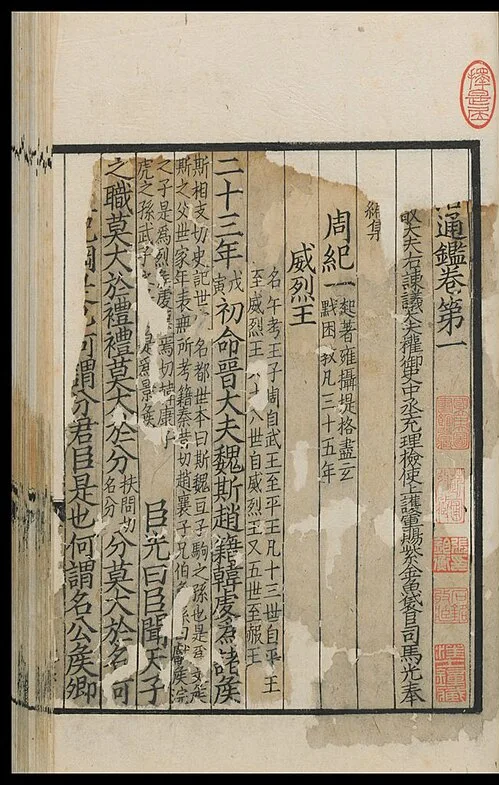
The Zizhi tongjian is a universal chronicle compiled in the eleventh century. For the sixth century, it compiles from the Zhou Shu, the Sui Shu and the Bei Shi.
Its value here is chronological. Sima Guang arranges his material year by year and sometimes month by month. This makes the chronicle the natural place to look for the sequence of events. It is where the ordering of the two engagements of 552 would be checked. The months assigned to those engagements differ between modern accounts.
The chronicle has no value as attestation. It stands more than five centuries after the events. It contains nothing the earlier works do not, unless it can be shown to have used a source now lost.
Bibliographical details
References are given by chapter, not by page, as is usual for the dynastic histories.
The passage
突闕土門襲擊柔然,大破之。
柔然頭兵可汗自殺,
其太子庵羅辰及阿那瑰從弟登注俟利、登注子庫提並帥眾奔齊,
餘眾復立登注次子鐵伐為主。
土門自號伊利可汗,
號其妻為可賀敦,
子弟謂之特勒,別將兵者皆謂之設。
Tumen of the Göktürks attacked the Rouran and defeated them utterly.
The Rouran khan Toubing killed himself.
His crown prince Anluochen, Anagui's cousin Dengzhu Qili and Dengzhu's son Kuti all led their people to flee to the Qi,
and the rest of the people raised Dengzhu's second son Tiefa to be their lord.
Tumen styled himself Yili Khan,
called his wife khatun,
called his sons and younger brothers tegin, and called all who led troops separately shad.
[1] Zizhi tongjian (Comprehensive Mirror in Aid of Governance), juan 164
鐵勒將伐柔然,突厥酋長土門邀擊,破之,盡降其眾五萬餘落。
土門恃其強盛,求婚於柔然,
柔然頭兵可汗大怒,使人詈辱之曰:「爾,我之鍛奴也,何敢發是言!」
土門亦怒,殺其使者,遂與之絕,而求婚於魏;
魏丞相泰以長樂公主妻之。
The Tiele were about to attack the Rouran, and the Göktürk chieftain Tumen intercepted them and defeated them, and received the submission of all their people, more than fifty thousand camps.
Relying on his strength, Tumen asked the Rouran for a marriage,
and the Rouran khan Toubing was greatly angered and sent a man to abuse him with the words: “You are my forging slave. How dare you say this!”
Tumen too was angry. He killed the envoy and broke with them, and asked the Wei for a marriage.
The Wei chancellor Tai gave him the princess Changle as his wife.
[1] Zizhi tongjian (Comprehensive Mirror in Aid of Governance), juan 164
癸未,頡利可汗進至渭水便橋之北,遣其腹心執失思力入見,以觀虛實。
思力盛稱「頡利、突利二可汗將兵百萬,今至矣。」
上讓之曰:「吾與汝可汗面結和親,贈遺金帛,前後無算。
汝可汗自負盟約,引兵深入,於我無愧?
汝雖戎狄,亦有人心,何得全忘大恩,自誇強盛?
我今先斬汝矣!」
思力懼而請命。
蕭瑀、封德彝請禮遣之。上曰:「我今遣還,虜謂我畏之,愈肆憑陵。」乃囚思力於門下省。
上自出玄武門,與高士廉、房玄齡等立騎逕詣渭水上,與頡利隔水而語,責以負約。
突厥大驚,皆下馬羅拜。
俄而諸軍繼至,旌甲蔽野,頡利見執失思力不返,而上挺身輕出,軍容甚盛,有懼色。
是日,頡利來請和,詔許之。上即日還宮。
乙酉,又幸城西,斬白馬,與頡利盟於便橋之上。突厥引兵退。
On the day guiwei Ilig Khan advanced to the north of the Bian Bridge on the Wei river and sent his confidant Zhishi Sili to be admitted to an audience, in order to see how things stood.
Sili loudly declared: “The two khans, Ilig and Tuli, are leading a million troops, and they have now arrived.”
The emperor reproached him: “I concluded an alliance of peace and kinship with your khan face to face, and the gifts of gold and silk I sent him, before and after, were beyond counting.
Your khan himself has turned his back on the covenant and led troops deep into my land. Does he feel no shame before me?
Though you are Rong and Di, you too have a human heart. How can you forget my great kindness altogether and boast of your strength?
I shall cut you down first, here and now!”
Sili was afraid and begged for his life.
Xiao Yu and Feng Deyi asked that he be sent back with courtesy. The emperor said: “If I send him back now, the enemy will say I fear them and will encroach all the more.” So he put Sili in prison in the Chancellery.
The emperor himself went out through the Xuanwu Gate and, with Gao Shilian, Fang Xuanling and others, all mounted, rode straight to the bank of the Wei. He spoke with Ilig across the water and reproached him for breaking the covenant.
The Göktürks were greatly startled and all dismounted and bowed in ranks.
Soon the armies arrived one after another, with banners and armour covering the plain. Ilig saw that Zhishi Sili did not return and that the emperor had come out lightly, in person, with a most splendid array of troops, and he looked afraid.
On that day Ilig came and asked for peace, and the emperor by decree granted it. The emperor returned to the palace the same day.
On the day yiyou the emperor went again to the west of the city, slew a white horse and swore a covenant with Ilig on the Bian Bridge. The Göktürks led their troops away.
[2] Zizhi tongjian (Comprehensive Mirror in Aid of Governance), juan 191
四夷君長詣闕請上為天可汗,
上曰:「我為大唐天子,又下行可汗事乎?」
群臣及四夷皆稱萬歲。
是後以璽書賜西北君長,皆稱天可汗。
庚辰,行軍副總管張寶相帥眾奄至沙缽羅營,俘頡利送京師,蘇尼失舉眾來降,漠南之地遂空。
突厥頡利可汗至長安,夏,四月,戊戌,上御順天樓,盛陳文物,引見頡利,數之曰:
「汝藉父兄之業,縱淫虐以取亡,罪一也;
數與我盟而背之,二也;
恃強好戰,暴骨如莽,三也;
蹂我稼穡,掠我子女,四也;
我宥汝罪,存汝社稷,而遷延不來,五也。
然自便橋以來,不復大入為寇,以是得不死耳。」
頡利哭謝而退。
The rulers of the four barbarian quarters came to the palace gate and asked the emperor to be Heavenly Khan.
The emperor said: “I am the Son of Heaven of the great Tang. Should I also lower myself to perform a khan's duties?”
The ministers and the rulers of the four quarters all cried “Ten thousand years!”
After this, in the sealed letters sent to the rulers of the north-west, the emperor was always called Heavenly Khan.
On the day gengchen the deputy commander Zhang Baoxiang led his troops and came suddenly upon the camp of Shaboluo. He took Ilig captive and sent him to the capital, and Suni led all his people in submission, and the land south of the desert was left empty.
Ilig Khan of the Göktürks arrived at Chang'an. In summer, in the fourth month, on the day wuxu, the emperor took his seat in the Shuntian Tower, displayed his regalia in full array, received Ilig in audience and counted his faults, saying:
“You relied on the achievement of your father and brother and gave free rein to excess and cruelty and so brought ruin on yourself: that is the first offence.
Many times you swore a covenant with me and then turned your back on it: that is the second.
You relied on strength and loved war, and bones lay exposed like grass in the wild: that is the third.
You trampled my crops and carried off my sons and daughters: that is the fourth.
I pardoned your offences and kept your state in being, and you delayed and did not come: that is the fifth.
Yet since the Bian Bridge you have not again invaded in force as a raider, and for that reason you will escape death.”
Ilig wept, gave thanks and withdrew.
[3] Zizhi tongjian (Comprehensive Mirror in Aid of Governance), juan 193
春,正月,李靖帥驍騎三千自馬邑進屯惡陽嶺,夜襲定襄,破之。
突厥頡利可汗不意靖猝至,大驚曰:「唐不傾國而來,靖何敢孤軍至此!」
其從一日數驚,乃徙牙於磧口。
李世勣出雲中,與突厥戰於白道,大破之。
甲辰,李靖破突厥頡利可汗於陰山。
先是,頡利既敗,竄於鐵山,餘眾尚數萬
遂勒兵夜發,世勣繼之,軍至陰山,遇突厥千餘帳,俘以隨軍。
靖使武邑蘇定方帥二百騎為前鋒,乘霧而行,去牙帳七里,虜乃覺之。
頡利乘千里馬先走,靖軍至,虜眾遂潰。
靖斬首萬餘級,俘男女十餘萬,獲雜畜數十萬,殺隋義成公主,擒其子疊羅施。
斥地自陰山北至大漠,露布以聞。
In spring, in the first month, Li Jing led three thousand picked horsemen from Mayi, advanced and camped at the Eyang ridge, attacked Dingxiang by night and broke it.
Ilig Khan of the Göktürks had not expected Jing's sudden arrival and was greatly alarmed. He said: “If the Tang had not come with the whole state, how would Jing dare to come this far with a lone army!”
His followers took fright several times a day, and he moved his camp to Qikou, the mouth of the desert.
Li Shiji came out from Yunzhong, fought the Göktürks at Baidao and thoroughly defeated them.
On the day jiachen Li Jing defeated Ilig Khan of the Göktürks at the Yinshan.
Before this, after Ilig had been defeated, he had fled to Iron Mountain, with tens of thousands of his people still left,
so Jing drew up his troops and set out by night, with Shiji following. The army reached the Yinshan, met more than a thousand Göktürk tents and took them captive to go with the army.
Jing sent Su Dingfang of Wuyi with two hundred horsemen as the vanguard. They advanced in the fog, and only when they were seven li from the khan's tent did the enemy notice them.
Ilig rode a thousand-li horse and fled first. When Jing's army arrived, the enemy host broke.
Jing cut off more than ten thousand heads, took more than a hundred thousand men and women captive, seized several hundred thousand head of mixed livestock, killed the Sui princess Yicheng and captured her son Dieluozhi.
He pushed the land back from the north of the Yinshan to the great desert and reported by an open dispatch.
[3] Zizhi tongjian (Comprehensive Mirror in Aid of Governance), juan 193
References
Articles resting on this source 213
Anagui · Anbei Protectorate · Aoshe Shad · Ashide Wumo Chur · Assembly at Mount Yanzhi (609) · Awusili Irkin · Baga · Bagha Khan · Bagha Shad · Baghatur Khan · Baidao Plain · Banquet of the Wine Fountain (647) · Battle of Baidao (583) · Battle of Dzungaria, 552 · Battle of Huaihuang, 552 · Battle of Jingyang (626) · Battle of Mount Dajin (600) · Battle of Mount Mulai (553) · Battle of the Iron Mountain (630) · Battle of Zhoupan (582) · Beihai · Beilou Pass · Bilge Khan's Tent Banquet (725) · Börü Khan · Buli Shad · Bumin Khan · Captives and the Unfree · Capture of Apa (587) · Capture of Ilig Khan (630) · Cefu yuangui · Chiji Shad · Chunyu Tan · Culture of the Turkic Peoples · Dali City · Death of Princess Dayi · Death of Tulan Khan · Defection of Töles (628) · Dengzhu · Dieluozhi · Dingxiang · Diplomacy of the Steppe Empires · Diqincha · Drums and Banners for the Khans · Dubo · Dujin Garrison · Duliu · Dusuliu · Edict of Emperor Wen against the Göktürks (583) · Embassy of Cui Junsu (608) · Embassy of Yu Qingze (584) · Empress Yujiulü · Envoys and Embassies · Eyang Ridge · Fall of Heshana Khan (611) · Fall of Tardush (603) · Felt · First Göktürk Khaganate · Furs and Musk among the Turkic Peoples · Gao Huan · Göktürk Aid to Li Yuan (617) · Göktürk–Wei Campaign against Tuyuhun (556) · Gouzhu Pass · Grape Wine in Central Asia · Hebei · Hegemony Wars in Northern China · Heng'an · Heshana Khan · History of the Turkic peoples · Horse Market at the Western Shouxiang City (727) · Horse Sacrifice · Ilig Khan · Ilig Khan's Dance at the Weiyang Palace (633) · Iron Mountain · Ishbara Khan · Issik Khan · Jade Gate · Jin River · Jingyang · Jiuquan · Jujian Tegin · Kang Shaoli · Kang Sumi · Khan (Khagan) · Killing of Heshana Khan (619) · Kirghiz embassy of 648 · Kuhanzhen · Kujie Valley · Kurykan · Kutluk Tegin · Lady Xiang · Liaohai · Lingzhou · Livestock Raids · Mayi · Mount Dajin · Mount Mulai · Mukan Khan · Mukan's Destruction of Dengshuzi (553–555) · Mukan's Eastern and Northern Wars · Murder of Shishu Huxi · Murder of Tong Yabgu (630) · Night Attack on Dingxiang (630) · Niri Khan · Nishu Bagha Shad · Northern Qi · Pan Die · Pei Ju · Pingliang · Poliuhan Baling · Poshi Tegin · Post and Communication · Princess Anyi · Princess Qianjin · Princess Taihe · Princess Xinyi · Proclamation of Bumin Khan (552) · Qikou · Qinyu Shad · Que Dadu Shad · Raid on Yanmen (621) · Ransom of the Chinese from the Göktürks (631) · Raw Materials and Trade among the Turkic Peoples · Rehan Tegin · Revolt of the Six Garrisons · Revolt of the Tiele (627) · Rise of Anagui Khan · Rouran Domination of the Turkic Peoples · Rouran Khaganate · Rudan Khan · Rudan Tegin · Sanmi Mountain · Seating at the Feast · Shanshan · Sheep · Shegui Khan · Shiboqu Azhan · Shishu Huxi · Shiwei · Shuozhou · Si Yabgu Khan · Sijie Irkin · Silifa · Skull Cup · Submission of Ishbara (585) · Submission of Yiwu (630) · Sui Variety Shows for Yami Khan (606–610) · Suni Shi · Tahan · Taizong's Speech on the Signs of Ruin (628) · Tanhan Khan · Taspar Khan · Taspar's Appointment of the Lesser Khans (572) · The Attack on Yami Khan (599) · The Bargain with Mukan (562–563) · The Chile Song · The Court Debate of 630 · The Göktürk Campaign of 622 · The Göktürk Campaign of 625 · The Göktürk Civil War · The Göktürk–Rouran Wars · The Göktürk–Sui wars, 582–603 · The great snow of 627 · The Marriage of Princess Qianjin (580) · The New Year on the Steppe · The Qi Court in Exile (577–580) · The Qingmen Executions (555) · The Raid on Youzhou (578) · The Rouran Marriage Refusal (546) · The Siege of Jiuquan (578) · The Standoff at Binzhou (624) · The Succession of 587 · The Sui Campaign of 599 · The Sui Court in Exile at Dingxiang (620) · The Ten Steeds of 647 · The Turkic War of Independence · The Uyghur Demand for the Prince's Dance (762) · The Wei bridge, 626 · Tiele · Tiele Revolt (605) · Töles Khan · Tong Yabgu · Trade Routes of the Steppe · Tribute Missions and Bestowals · Tuğ · Turkic Songs at the Tang Court · Tutuk · Uyghur Farming · Warfare of the Steppe Empires · Wei Jie · Western Göktürk Khaganate · Western Wei embassy of 545 · Women among the Turkic Peoples · Woye · Xiazhou · Xueyantuo Khaganate (Syr Tardush) · Yami Khan · Yang Su's Northern Campaign (601–602) · Yangdi's Visit to Yami Khan (607) · Yangsu Tegin · Yinshan · Yintou Tegin · Yiwu · Yiwu Tudun Shad · Youzhou · Yueban · Yukuk Shad · Yulin · Yunzhong · Yushe Shad · Zhenzhu Tong Irkin · Zhishi Sili · Zhoupan · Zihe Garrison
What links here138
- Persons
- Alp Inanch · Aoshe Shad · Ashide Wumo Chur · Awusili Irkin · Baghatur Khan · Börü Khan · Buli Shad · Chiji Shad · Dieluozhi · Diqincha · Dusuliu · Issik Khan · Jujian Tegin · Kang Shaoli · Kang Sumi · Kuhanzhen · Kutluk Tegin · Lady Xiang · Nishu Bagha Shad · Pei Ju · Princess Anyi · Princess Qianjin · Princess Taihe · Qinyu Shad · Que Dadu Shad · Rehan Tegin · Rudan Khan · Rudan Tegin · Shishu Huxi · Si Yabgu Khan · Sijie Irkin · Silifa · Suni Shi · Tanhan Khan · Yami Khan · Yintou Tegin · Yiwu Tudun Shad · Yukuk Shad · Yushe Shad · Zhao Fan · Zhenzhu Tong Irkin · Zhishi Sili
- States
- First Göktürk Khaganate
- Battles & Events
- Assembly at Mount Yanzhi (609) · Banquet of the Wine Fountain (647) · Battle of Baidao (583) · Battle of Jingyang (626) · Battle of Mount Dajin (600) · Battle of Mount Mulai (553) · Battle of the Iron Mountain (630) · Battle of Zhoupan (582) · Bilge Khan's Tent Banquet (725) · Capture of Apa (587) · Capture of Ilig Khan (630) · Death of Princess Dayi · Death of Tulan Khan · Defection of Töles (628) · Edict of Emperor Wen against the Göktürks (583) · Embassy of Cui Junsu (608) · Embassy of Yu Qingze (584) · Fall of Heshana Khan (611) · Fall of Tardush (603) · Göktürk Aid to Li Yuan (617) · Göktürk–Wei Campaign against Tuyuhun (556) · Ilig Khan's Dance at the Weiyang Palace (633) · Killing of Heshana Khan (619) · Kirghiz Embassies to the Tang (842–848) · Murder of Shishu Huxi · Murder of Tong Yabgu (630) · Night Attack on Dingxiang (630) · Proclamation of Bumin Khan (552) · Raid on Yanmen (621) · Ransom of the Chinese from the Göktürks (631) · Revolt of the Tiele (627) · Submission of Ishbara (585) · Submission of Yiwu (630) · Taizong's Speech on the Signs of Ruin (628) · Taspar's Appointment of the Lesser Khans (572) · The Attack on Yami Khan (599) · The Bargain with Mukan (562–563) · The Court Debate of 630 · The Göktürk Campaign of 622 · The Göktürk Campaign of 625 · The Marriage of Princess Qianjin (580) · The Qi Court in Exile (577–580) · The Qingmen Executions (555) · The Raid on Youzhou (578) · The Rouran Marriage Refusal (546) · The Siege of Jiuquan (578) · The Standoff at Binzhou (624) · The Succession of 587 · The Sui Court in Exile at Dingxiang (620) · The Uyghur Demand for the Prince's Dance (762) · Tiele Revolt (605) · Western Wei embassy of 545 · Yang Su's Northern Campaign (601–602) · Yangdi's Visit to Yami Khan (607)
- Places
- Baidao Plain · Beihai · Beilou Pass · Dali City · Dingxiang · Dujin Garrison · Eyang Ridge · Hebei · Heng'an · Iron Mountain · Jade Gate · Jin River · Jingyang · Jiuquan · Kujie Valley · Liaohai · Lingzhou · Mayi · Mount Dajin · Mount Mulai · Pingliang · Qikou · Sanmi Mountain · Shuozhou · Xiazhou · Yinshan · Yiwu · Youzhou · Yulin · Yunzhong · Zhoupan
- Institutions and Titles
- Baga · Drums and Banners for the Khans · Skull Cup
- Customs & Pastimes
- Seating at the Feast · The Chile Song
- Sources
- Cefu yuangui · Zhou Shu (Book of Zhou)
Cite this article
Yavuz, Emre-E. “Zizhi tongjian (Comprehensive Mirror in Aid of Governance).” Turkic Atlas, revised 8 November 2026. https://turkicatlas.org/sources/zizhi-tongjian/
Last revised: 8 November 2026


