
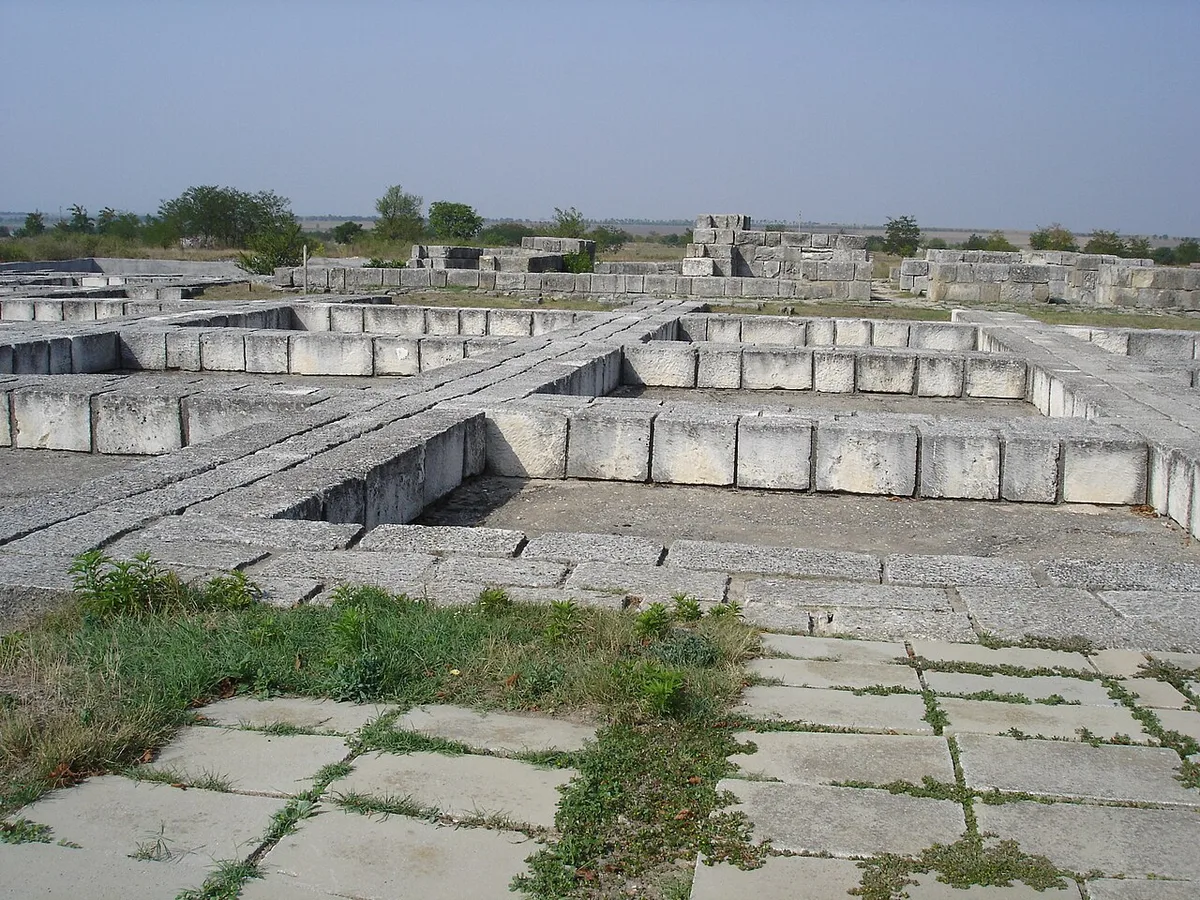
Pliska was the first capital of the Bulgar state that the Danube Bulgars founded in the northeastern Balkans. The state was recognised by treaty in 681, and the capital was set up at Pliska, near present-day Aboba.[1] The second capital of the state was Preslav.[2]
The court of the khans
In 811 the Byzantine emperor Nikephoros I took Pliska with massacres and plunder. The Bulgar khan Krum then trapped and killed him in the mountains. Krum had won victories in 808 and 809, and in the latter year Nikephoros raided Pliska.[3]
Under Krum (803–814) several Byzantine military commanders served at his court in Pliska. Under Omurtag (814–831) and Malamir (831–836) the court employed such commanders as well.[4] The palaces of Pliska had baths. Some scholars take the baths for a privilege of the ruler alone, which the khans withheld from their warriors.[5]
Excavations
The first excavations at Pliska began in 1899. Karel Škorpil took the initiative, and the Russian Archaeological Institute in Constantinople joined him under its director Feodor Uspenski.[6]
Marks on the stones
Marks that look like runic letters stand on the stone blocks of the fortress and the palaces, on bricks and on clay vessels. The great majority date from the ninth century, above all from the reign of Omurtag.[2] The practice went on after the conversion. In Pliska the signs were cut into the walls of the great church and onto the road that leads from the east gate to it.[7] More than a thousand such marks have been counted at Pliska and the other sites of the first Bulgar state.[8] Together they form the Proto-Bulgarian sign corpus.
A seven-armed bronze rosette from Pliska has a mark at its centre and two marks on each arm. It has been taken for a cavalry badge, for a charm of the sun, the moon and the five planets, for a sacred calendar, and for a seal in Greek vowels.[9]
The marks of Pliska are not read. Several scholars take them for the Old Turkic runiform script, and others take the texts of Pliska for Greek writing with signs of Asian origin.[10] The runiform alphabet of Murfatlar and Pliska has also been classed as an alphabet of its own.[11]
References
- ^ Golden 1992, p. 247
- ^ a b Dončeva-Petkova 2000, p. 175–176
- ^ Golden 1992, p. 249
- ^ Stepanov 2010, p. 23
- ^ Stepanov 2010, p. 41
- ^ Dončeva-Petkova 2000, p. 175
- ^ Dončeva-Petkova 2000, p. 176
- ^ Dončeva-Petkova 2000, p. 177
- ^ Dončeva-Petkova 2000, p. 178–179
- ^ Dončeva-Petkova 2000, p. 178
- ^ Tryjarski 1993, p. 47
Literature
- Peter B. Golden, An Introduction to the History of the Turkic Peoples (1992)
- Tsvetelin Stepanov, The Bulgars and the Steppe Empire in the Early Middle Ages: The Problem of the Others (2010)
- Lüdmila Dončeva-Petkova, Orta Çağ Bulgaristanı'ndan Runik İşaretler ve Birleşmeler (2000)
- Edward Tryjarski (Turkish translation: Emine Gürsoy-Naskali), Asya ve Avrupa’daki Runik Yazıların Anonimliği, Farklılığı ve Yayılımı (1993)
What links here2
- States
- Danube Bulgaria
- Sources
- Murfatlar inscriptions
Cite this article
Yavuz, Emre-E. “Pliska.” Turkic Atlas, revised 8 November 2026. https://turkicatlas.org/places/pliska/
Last revised: 8 November 2026


