
20 articles
Controversies
Debates in the scholarship, and who argued what.
- Archaeogenetics of the Steppe Empires What ancient DNA from Mongolia has shown about the Xiongnu, the Göktürk period and the Uyghur period since 2018, and what a genome cannot show: language, name or allegiance.
- Climate and the steppe empires What tree rings, ice cores and lake sediments say about the weather of the steppe between the Xiongnu and the Uyghurs, and what has been argued from it.
- The Bökli question Two words in the Kül Tegin inscription, bökli and čölgil. Some scholars think they name Korea at the sunrise. Others argue they are two states, and the second is not Korean at all.
- The Göktürks and the Xiongnu Comparison of the Göktürks and the Xiongnu in title, rite, rank and war, and the positions on whether the Ashina came out of the Xiongnu.
-
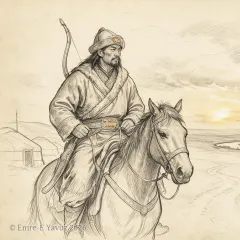 The Huns and the Xiongnu Debate on whether the Huns who entered Europe in the 370s continue the Xiongnu of Inner Asia. It is argued from the name, Chinese and Sogdian notices, archaeology, language and genetics.
- The Khakas name debate Debate of 1992 on Xiajiasi, the Chinese name that gave the word Khakas to Russian scholarship. Two scholars named Kyzlasov read it as a medieval Khakas state, three others as a spelling of Kirghiz.
- The Khazar–Ashkenazi hypothesis The claim that Ashkenazi Jews descend wholly or largely from the Khazars: who made it, on what grounds, and what historical and genetic research has found. Positions, not findings.
- The Kirghiz descent from Li Ling Claim of the Yenisei Kirghiz to descend from the Han general Li Ling. The Tang court, whose house traced its line to his grandfather, accepted it in 843 and entered their khan in its clan register.
- The Kirghiz origin debate minimal Debate on where the Kirghiz first lived and whether they were Turkic from the start. The Xin Tang Shu gives a country west of Yiwu and one north-west of the Uyghurs.
- The language of the Xiongnu What the Xiongnu spoke, argued from four words in a Chinese chronicle and some fifty glossed terms: the Turkic proposals, the Yeniseian hypothesis, the Iranian stratum.
- The making of Tengrism The scholarship that turned a word in the Orkhon inscriptions into a religion with a pantheon. Four generations built the picture, and each added something the Göktürk sources do not carry.
- The origin of the Avars Debate on the origin of the Avars of Europe. Their khagans and nobility most likely came from the Rouran; the pseudo-Avar, Hephthalite, Ogur and Yueban theories are the main alternatives.
- The origin of the Old Turkic script Where the runiform letters come from, argued since 1893. An Aramaic ancestor, the tamgas of the steppe, or both. The argument runs on letter shapes, and shapes do not decide it.
- The origin of the title Khan Debate on the origin of the title khan. Some scholars make Shelun of the Rouran its first bearer about 400, others a Xianbei chief of the third century. The word is derived from Mongolic and Iranian.
- The steppe before the Xiongnu The Eurasian steppe before the first empire: the Bronze Age cultures of South Siberia, the horse and the coming of nomadism, the Early Nomads, the Scythians and Saka.
-
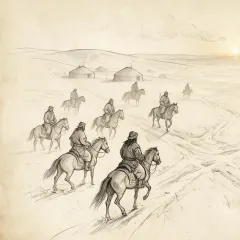 The Turkic ethnogenesis debate Who has claimed what about the origin of the Turkic peoples and the descent of the Göktürks. Set out as positions, not findings.
- The Turkish–Korean friendship narrative A modern account of brotherhood between Turks and Koreans, built after 1950 out of the Korean War, one word of the Orkhon inscriptions and a set of school textbooks. Its history is twentieth-century.
- The Yenisei Kirghiz and the Kyrgyz minimal Debate on whether the Kyrgyz of the Tian Shan descend from the Yenisei Kirghiz. Four accounts differ on migration, language and name; two national accounts settle the Kirghiz in the Tian Shan early.
-
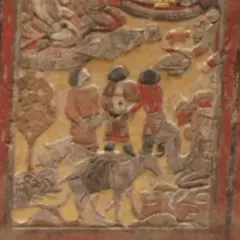 Turkic-Sogdian Synthesis minimal Mixed civilisation of Göktürks and Sogdians. It began with the silk trade on the Chinese frontier and became a fusion of ruling strata after 560. The Sogdians lent the khaganate script and envoys.
- Xiongnu: Making the First Steppe Empire Why a steppe empire appeared north of China in the third century BC, and whether China made it. The frontier models, the state-or-chiefdom argument, and the case from the steppe.
Image credits
- The Huns and the Xiongnu: The Huns and the Xiongnu in a modern illustration. © Emre-E Yavuz 2026
- The Turkic ethnogenesis debate: The Turkic ethnogenesis debate in a modern illustration. © Emre-E Yavuz 2026
- Turkic-Sogdian Synthesis: Back panel of the funerary couch of An Jia, a Sogdian sabao at the Zhou court who died in 579. Two men kneel facing each other inside a yurt, a gilded vessel between them; others drink before the tent, and a laden camel and a donkey rest below. The scene is taken to show An Jia at talks with a Göktürk chief. Shaanxi History Museum, Xi’an. Photograph: Gary Todd, 2019, CC0 (detail).

