
11 articles
Languages
Languages and scripts.
- Chinese transcriptions of Turkic How the Chinese annals write Göktürk names, titles and a few explained words in characters chosen for their sound. The variant spellings, the glosses and the limits of reconstruction.
- Oghur Turkic The r and l branch of the Turkic family, known from tribal names, the Danube Bulgars, old Hungarian loanwords and Volga inscriptions. Chuvash is its one living language.
- Oghuz and Kipchak speech in Kashgari What Mahmud al-Kashgari says in the 1070s of the speech of the Oghuz and the Kipchak: where he places them, the sound changes he names, the words he marks as theirs and the limits of his knowledge.
- Old Turkic The Turkic language of the runiform inscriptions and the manuscripts that follow them. The oldest Turkic that can be read, and the stage against which every later Turkic language is measured.
- Old Uyghur The Turkic of the manuscripts of eastern Xinjiang and Gansu, from the ninth century on, in Uyghur, Manichaean, Brahmi and other scripts. The largest body of early Turkic by volume.
- The Hunnic language The language of the Huns of Europe, known only from personal and tribal names, a river name and a few words in Greek and Latin writers. Its classification is argued.
- The Khalaj language Turkic language of the Khalaj, spoken today in central Iran. It keeps an initial h, long vowels and a dative in -kA that other Turkic languages lost, and so bears on the reconstruction of Old Turkic.
- The Khazar language Language of the Khazar Khaganate, known only from titles, names and a few remarks of geographers. It looks Turkic. Whether it was Oghur or Common Turkic is argued.
-
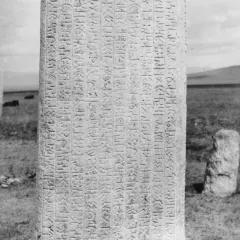 The Old Turkic script The alphabet of the steppe inscriptions: some forty signs, written right to left. It fits Turkic sounds more exactly than any script the Göktürks could have borrowed unchanged.
- The Sogdian language Eastern Middle Iranian language of the Zarafshan cities, carried along the trade roads to Gansu. The Göktürk chancery wrote in it, and its alphabet became the Uyghur one.
- The Turkic languages The whole family, from the Yenisei to the Balkans. Two primary branches, some forty living languages and as many again that died, and the order of their entry into the record.
Image credits
- The Old Turkic script: Runiform lines on the south face of the first Tonyukuk stone in the Nalaikh valley, photographed in June 1909. G. J. Ramstedt and Sakari Pälsi, 1909, Finnish Heritage Agency, record, CC BY 4.0.

