
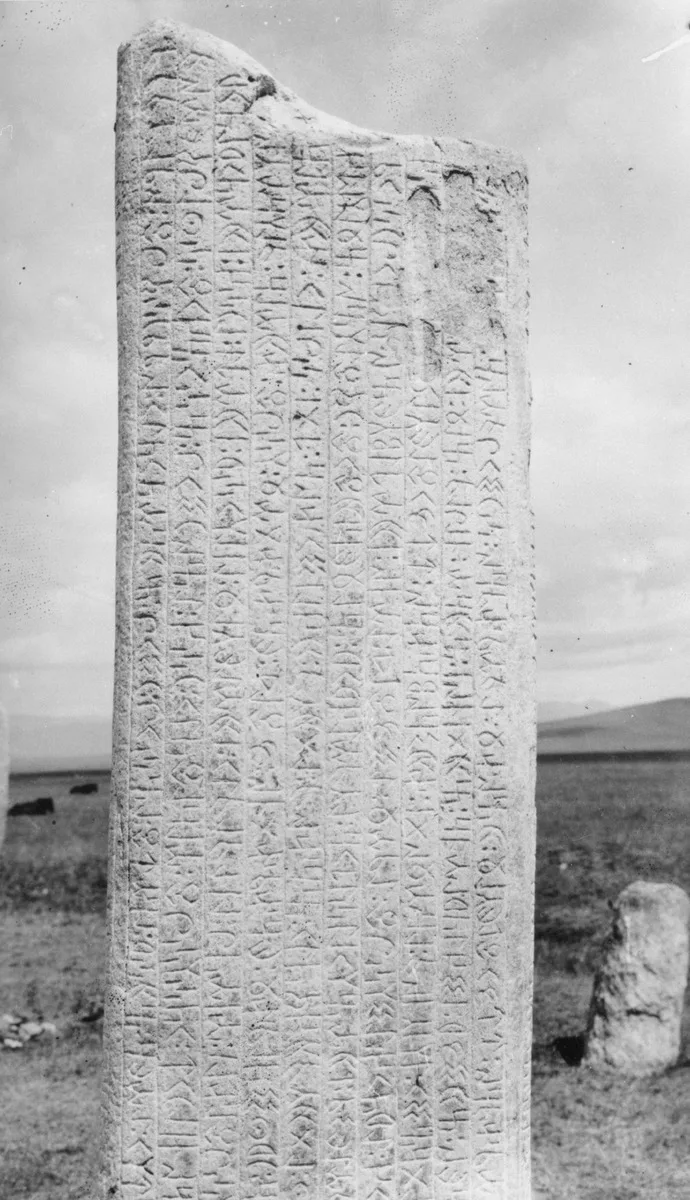
The Old Turkic script is an alphabet of some forty signs, written from right to left, in which the steppe wrote its own language on stone, on rock faces, on paper and on objects of daily use.[1] It is called runiform because the angular shapes, cut for stone, look like Germanic runes. The resemblance is only one of appearance. The two great Orkhon stones use 38 letters. The Tonyukuk stone adds two syllable signs, aş and baş, which it uses once each, so that the total reaches forty.[2][3][4] The alphabet is also called the Orkhon alphabet or the Göktürk alphabet. The language of the Orkhon stones has been called Old Turkic, Kök Turkic, Runic Turkic, Orkhon Turkic and Old Oghuz.[5]
Two things about it are unusual. Both matter for its history. It fits the Turkic sound system exactly, down to distinctions that no neighbouring script marks. It is also already complete when it first appears on a dated monument.
The signs and their use
The script writes consonants and vowels, but not evenly. Four vowel signs cover the vowels of the language in pairs. That makes eight vowels, or nine once the opposition of length has been given up and long ä survives as a vowel of its own.[6][1] A vowel is often left unwritten where the reader can supply it from the word.
The unwritten vowels follow a rule. The vowels a and ä are understood to stand throughout a word, though not at its end, wherever nothing is written. Any other vowel in a later syllable stays unwritten when the vowel before it is of the same class of frontness and roundedness, whatever its height. Vowels that close a word are always written out.[7] The signs mark height only among the unrounded vowels and frontness only among the rounded ones. Most texts therefore write ä with the sign of a. Some inscriptions of the Yenisei have signs of their own for e and ä.[8][9]
The consonants carry the load instead. Most consonants have two signs, one used in words with back vowels and one in words with front vowels. The letter itself therefore tells the reader which half of the vowel harmony the word belongs to. Not every inscription keeps this rule: in some Altai texts the back and the front forms of the consonant signs are used without consistency.[10] A single sign says more than a letter in an alphabet that does not do this. It says which consonant, and it says what kind of word it stands in.
A few signs write whole clusters: lt, nt, nç and others. This is a device for cutting fewer strokes into hard stone.[11] The Yenisei texts also have ligatures that join two or three letters in one sign, among them one for ñy and one for the word alp.[12] Seven consonants have only one sign each: ç, m, ñ, ŋ, p, š and z.[11] Words are separated by a colon-like divider rather than a space. How the divider was used is still poorly understood.[13] Lines run right to left, with the reading of a monument beginning on its east face.[14]
The result is a script made for this language and for no other.
The usual description has a counter-argument. A manuscript fragment sets each runiform sign beside a letter of the manuscript script, written as vowel plus consonant.[15] Some scholars take the table to show a script that is at its core a syllabary. They grant at once that the comparison is imprecise, since the sound values of the runiform signs were uncertain.[15]
A second view rejects the syllabic description. The script has signs that combine a consonant with a vowel, among them those for ok, ök and ık. They have been taken for syllable signs. However, they stand beside explicit vowel letters. They can be separated from their vowel by l or r. The vowel they imply may come after the consonant as well as before it, as in the spelling of yılka with the ık sign. They show only the quality of the consonant beside particular vowels. They are consonant letters, and the script is an alphabet, neither a syllabary nor a system of the Indian kind in which every consonant carries a vowel.[16] In one more respect it stands alone. The Semitic and Indian scripts imply a vowel after the consonant. This one implies a vowel before it, so that a sign for t by itself can stand for at or ut.[17] A third description sits between the two. It calls the system a mixture of syllabic and alphabetic writing, because most consonant signs stand for a vowel followed by the consonant, and only under certain conditions for the consonant alone.[18]
The corpus
The script is known from four kinds of object. The great stone monuments of the Orkhon valley carry the longest texts and the only dated ones: the Kül Tegin and Bilge Khan stones of 732 and 735 and the Tonyukuk inscription before them.[19] The Yenisei epitaphs are far more numerous and shorter, and they are rarely datable. Their age is not known for certain, and some of them may be older than the Orkhon stones.[20] The Talas and Altai inscriptions carry the script west and north of the khaganate’s heartland. The Irk Bitig is the one long text on paper, in the same letters written in a quick hand.[21]
The inscriptions have been counted region by region, and the counts differ in date and in what they include. An overview of 2004 gave some two hundred inscriptions for all regions together.[22] In Mongolia, where the Second Khaganate and the Uyghur steppe empire stood, 182 inscriptions at 101 sites had been recorded by 2022, counting even the smallest rock texts.[23] The same author gave nearly 170 for the time of the Göktürks and the Uyghurs in 2021.[24] A count of the year 2000 gave 56 runic texts, about ten of them found since 1990.[25] Fifteen short rock texts were added between 2018 and 2021 alone.[23] For the upper Yenisei basin a figure of about 250 is quoted, which includes inscribed objects.[26] A count of 1993 gave more than 160.[27] Beside the usual Yenisei alphabet, a second runiform alphabet of the Sayan and Altai uplands, called South Yenisei, is known from some seventeen short texts. None of them has been read with confidence.[28][29] In the Altai Republic 101 inscriptions had been counted by 2012, most of them cut into rock. The first was found in 1819 near the Chaarys river.[30] Expeditions since 2003 have documented about ninety of them and published a catalogue in 2012.[31][32] In Kyrgyzstan more than thirty inscriptions were known about 2000, nearly all of them cut in stone.[33] Seventeen stand in the valley of the Talas, twelve of them as epitaphs on river stones at one place and the others as short texts that visitors scratched into rock.[34] In 1998 eight more were found on boulders at Kök-Say in the Kochkor valley.[35] Counts of about 2000 give fourteen inscriptions for Kazakhstan and seventeen for the Fergana valley, the latter mostly on jars and potsherds.[36] One reader holds that the script reached the Tian Shan by way of the Altai, because the signs of the Kyrgyz stones are closest to those of the Altai stones.[32] Other readable inscriptions come from the north-east of Chinese Turkestan.[22]
Most are epitaphs. Some are graffiti on prominent rocks beside the main roads. Many of the Mongolian texts are official. Most of the others were set up by commoners, some of them evidently held in high regard.[37]
Runiform inscriptions have also been found in the Khazar lands between the Caucasus, the Ural river and Ukraine, and further west. They date from the second half of the first millennium and have been ascribed to the Khazars, the Avars, the Pechenegs and the Bulgars. No reading proposed for them has been satisfactory.[20] Two systems are told apart there, a Khazar script and a late Avar script, and neither is deciphered.[38] A runiform word once read in the Khazar letter from Kiev is now taken for a later Hebrew note.[39] At Pliska, Madara, Preslav and other sites of the first Bulgar state, more than a thousand marks that look like runic letters have been counted. About thirty of them recur. Whether they are letters, property marks or magic signs is not settled.[40]
Inscribed objects show that the script was not only monumental. They include spindle whorls, mirrors, vessels, bricks, coins and a sabre.[37][41][33] Somebody who cut letters into a spindle whorl expected somebody else to read them. Manuscripts in the script survive from the ninth century on, among the Old Uyghur finds of Xinjiang and Gansu. A few of them are in Middle Iranian languages.[42] Runiform writing was used for Middle Persian and Parthian texts as well, all of them Manichaean.[39] Among the 76 documents of the archive found on Mount Mugh, one is said to be in Turkic, written in runiform script on leather. If that is right, it is a document of about 720 and older than the manuscripts of the ninth century.[43] The Berlin expedition found at Toyoq near Qocho a leaf with a longer text in the runiform script. It also found a fragment of the alphabet, with the names or values of the signs written in Manichaean script, and Manichaean fragments in runiform Turkic came from the oasis as well.[44]
The decipherment
The inscriptions were known to travellers in the Yenisei basin from the eighteenth century. Nobody could read them.[45] Exiled Finns and Russian archaeologists found more. Drawings and facsimiles in Finnish and Russian publications made them accessible to scholars in 1892.[46][47] Vilhelm Thomsen read them in 1893. He worked from the recurrence of the names of the Göktürks and the Chinese in the text, and from the Chinese face of the Kül Tegin stone. He published the full decipherment in 1896.[48][49] By his own account he found the key to the alphabet on 25 November 1893 and reported the result to the Royal Danish Academy on 15 December of that year.[50][51] In the same account he first fixed the vowels, from sequences in which a sign stood between two copies of another sign. He then fixed the consonants, starting from the words Kül Tegin, Tengri and Türk. The Chinese face confirmed that the Chinese name Tujue stood for the Göktürks, but it gave no parallel text, because the Chinese text is much shorter and written in another style.[52] Wilhelm Radloff had been racing him with the same material. Radloff brought out the first edition of the texts within the year.[53]
The consequence for Göktürk history is direct. Everything the Göktürks say in their own voice has been readable for a little over a century. Every history of the steppe written before that had only what its neighbours wrote about it.
Origin of the letters
There are several theories about the origin of the letters. The question is not closed.
The first theory derives the alphabet from Aramaic. The Aramaic letters were carried east along the trade roads and passed on by Sogdian scribes, and the letter shapes were adapted to the chisel.[48] One Turkological handbook calls this the most widely held theory. It adds that the signs for double consonants and syllables do not look like joined pairs of letters, as the ligature theory of the decipherer would have it.[54] The second theory derives the letters from the tamgas, the property and clan marks that were already cut into rock and burned into hides across the steppe. The tamgas were reshaped into a set of sound-signs. The third takes both. An alphabet known through Sogdian gave the idea and part of the inventory, and the tamgas gave shapes for the rest.
The fourth theory looks neither to Sogdian nor to the tamgas for the model. Some letters resemble those of the early Semitic alphabets, and the complications of the script in the voiceless sibilants recall Semitic spelling. A Semitic-based script, one used for instance in the Caucasus, where Turkic presence appears to have been early, may therefore have been known to whoever devised the letters.[7] Beside these theories, some signs have been taken for pictures. The sign for ay, moon, looks like a half moon. The sign for ok, arrow, looks like an arrow. One of the signs for b, which writes äb, house, looks like a tent.[55] The sign for er, man, looks like a person.[56] A further argument against a Semitic origin rests on the names of the letters. Semitic letter names begin with the consonant and end in a vowel, as in ba, bi, bu. The Old Turkic signs have values that begin with a or e and end in the consonant: ab, eb, ad, ed, ak, ek.[56] A manuscript fragment from Turfan that the Berlin expedition published gives the names of the signs in Manichaean script in just this form: ad, az, an, eŋ, end, elt.[56]
The arguments turn on shape alone. For that reason they do not settle the question. A letter that looks like a tamga may come from it, may resemble it by accident, or may have been chosen because it was already familiar.
The design of the script says more about who devised it than its shapes do. It marks front and back harmony in the vowels and in most consonants, with separate signs for back and front b, y and others. It also writes the front rounded vowels ö and ü. The neighbouring Semitic, Caucasian and East Asian writing traditions have neither.[57] It marks no tones. It provides for the closed syllables that Turkic prefers. At each point of articulation it makes a plain two-way distinction between its consonants.[58] It was in popular use over the whole range of the early Turkic peoples, as far as remote parts of Siberia, and not outside it. The Tangut and the Khitan likewise made and used scripts of their own.[17] On these grounds the script is held to have been devised by Turkic groups for a language of the Turkic type. No inscription or manuscript has yet been found in which it writes a Mongolic, Tungusic or Uralic language.[58] Its first home may have lain not in Mongolia but in the south of central Siberia, where it was in wide use among the common people, as grave inscriptions and scratched marks over a vast area show.[13] The debate over the origin of the letters names the positions and the men who hold them. On one assessment, the origin cannot be settled as long as no older Turkic monument has been found that stands closer to a Sogdian model.[59]
The age of the script
The script was not necessarily the Sogdians’ gift. It was in use under the First Khaganate, well before the dated stones of the eighth century. Four things support that view.
The first is a Chinese notice about the Göktürks of the sixth century. The Zhou Shu, describing their customs, says that their written characters resemble those of the Hu, 其書字類胡. In the same breath it says that they do not know the calendar and mark the year by the greening of the grass.[60] The sentence says two things at once. These people write, and what they write is not Chinese. A comparison needs two objects, and the observer had one in front of him.[60]
The second is the state of the script when it first appears on a dated monument. It is complete, regular, and fitted to Turkic phonology in a way that takes generations of use to arrive at, not years. A script that had been adopted shortly before 700 would show the marks of adoption. The Orkhon stones show a settled orthography instead.
The third is the spread. Runiform texts stand on the Orkhon, along the Yenisei, in the Talas valley and in the Altai, in country that never lay under one chancery at one time. A writing system does not cover that ground in a generation.
The fourth is what the dated monuments date. The Orkhon stones are dated because they are stelae raised at state funerals. Large funerary stelae are a practice of the Second Khaganate. The earliest dated runiform texts belong to that period. This dates the practice of raising inscribed stones. It does not date the script.
No runiform text has been securely dated to the First Khaganate. A jug from the fortified village of Lombitepe in Uzbekistan lay in a layer of the sixth or seventh century and has seven runiform signs on its handle. The dating rests on the layer and on the shape of the signs, and the reading of the signs as a wish of three words is that of its editor.[61] By contrast, the oldest monument the Göktürk state raised, the Bugut inscription of about 584, is written in Sogdian script and in the Sogdian language. The stone is otherwise Göktürk in every respect.[62]
Neither fact decides the matter. A chancery writing to the outside world in Sogdian, the language of the merchants and of the western courts, says nothing about what was cut at home into rock and wood. The Zhou Shu’s sentence stands. It is older than Bugut.[60]
The opposite view takes Bugut at face value. One edition of the Orkhon texts draws the same conclusion. It holds three faces of the stone to be Sogdian and the fourth Sanskrit, so that no face is in Turkic. On this view, the stone shows that the Göktürks still had no script of their own at the end of the sixth century.[63] The khaganates formed in Mongolia are held to have written first in the Sogdian script, with which the Sogdians had introduced them to settled civilisation. They are held to have taken up the runiform script only under the Second Khaganate, in the return to the Turkic way of life that the Tonyukuk inscription urges against foreign religions and foreign culture.[64] The first draft of the Orkhon texts may even have been in Sogdian letters. The Kül Tegin inscription has bir uguš alpagu on ärig, which can be taken as a slip for bir uguš alpagut ärig. The slip is easy if the numeral on, ten, and the ending -t looked alike, as they do in Sogdian letters and do not in runiform ones. The parallel passage of the Bilge Khan inscription, put into writing later, has no such error.[64]
The end of the script
The Uyghur khaganate used the runiform script on its own monuments through the eighth century and into the ninth. Beside it, and then instead of it, came the Uyghur script proper, derived from Sogdian. It suited paper and a brush better than a chisel, and the Buddhist and Manichaean literature adopted it.[65] A leaf of a Manichaean book from Qocho with a Turkic text in this script has its lines running from bottom to top on one side and from top to bottom on the other. Its editors held that the script was written from left to right and read in vertical lines.[66] The Uyghur script became by far the commonest script of Old Turkic, used by the adherents of every religion in Eastern Turkestan. The Manichaeans and the Christians also wrote the language in their own scripts. The Uyghur script wrote rather different Turkic dialects until Islam replaced it. It is therefore not a proof of the Uyghur language, although it served that language best.[67] On one assessment, the change from the runiform script to the Uyghur script was a step back, because the Uyghur letters render the sounds of Turkic less well.[68] Indian scripts and the Tibetan script served less.[69] Arabic followed with Islam.
The runiform letters held on longest in the Yenisei basin, where the epitaphs continue after the Orkhon monuments stop. The upper Yenisei is the country of the Kirghiz and the Chik, and most of the inscriptions found there are in the same script as the Orkhon stones.[70] The Xin Tang Shu says that the writing and language of the Kirghiz are exactly those of the Uyghurs.[71] That means the runiform script, not the later Uyghur script. The Yenisei inscriptions are the proof that the Kirghiz used it.[72] By the time the eleventh-century dictionary of Mahmud al-Kashgari describes the Turkic world, the script of the steppe monuments is no longer in general use. The alphabet Kashgari gives for Turkic has eighteen letters. He calls it the script of all documents and correspondence of the khans and sultans, from Kashgar to Upper China.[73] It is the Uyghur script. Only the Turkic words of the dictionary itself stand in Arabic letters.[74]
Consequences for the record
A people that writes about itself is a people that can be read against what its neighbours say about it. The Chinese annals describe the Göktürks from the outside, with the interests of a court that fought them. The inscriptions answer in the first person. They blame the Göktürk begs and the Göktürk people for the fifty years of subjection as sharply as they blame China.[14] No other steppe power before them left that.
References
- ^ a b Tekin 1968, p. 21
- ^ Tekin 2003, p. 20
- ^ Guzev 2000, p. 211
- ^ Cumagulov 1993, p. 99–100
- ^ Tekin 2003, p. 17–20
- ^ Erdal 2004, p. 45
- ^ a b Erdal 2004, p. 38
- ^ Erdal 2004, p. 42
- ^ Tekin 2003, p. 21, 23
- ^ Useev 2013, p. 103
- ^ a b Tekin 2003, p. 20–21
- ^ Sertkaya 1993, p. 69–71,74
- ^ a b Erdal 2004, p. 41
- ^ a b Kül Tegin inscription
- ^ a b von Gabain 2025, p. 135
- ^ Erdal 2004, p. 38–39
- ^ a b Erdal 2004, p. 40
- ^ Tekin o. J., p. 24–25
- ^ Kül Tegin inscription; Tekin 1968, p. 10–11
- ^ a b Erdal 2004, p. 4
- ^ Irk Bitig
- ^ a b Erdal 2004, p. 6–7
- ^ a b Badam 2024, p. 25
- ^ Badam 2021, p. 7
- ^ Battulga 2000, p. 47
- ^ Erhan 2011, p. 5
- ^ Sertkaya 1993, p. 67
- ^ Kızlasov 1990, p. 116,129
- ^ Kızlasov 1990, p. 127–128
- ^ Useev 2013, p. 102
- ^ Nevskaya 2012, p. 39–40
- ^ a b Karaman Dezember 2021, p. 35
- ^ a b Çetin 2000, p. 69
- ^ Alimov 2017, p. 130
- ^ Alimov 2000, p. 5–6
- ^ Alimov 2000, p. 5
- ^ a b Erdal 2004, p. 7
- ^ Vásáry 1993, p. 52, 57–59
- ^ a b Zieme 2000, p. 377
- ^ Dončeva-Petkova 2000, p. 177
- ^ Sadıkov 2000, p. 303–304
- ^ Erdal 2004, p. 7,40
- ^ Sadıkov 2000, p. 305
- ^ von Le Coq 1913, p. 5, 18
- ^ Tekin 1968, p. 12
- ^ Erdal 2004, p. 22
- ^ Tekin 1968, p. 13
- ^ a b Thomsen 1896
- ^ Tekin 1968, p. 13–14
- ^ Thomsen 1993, p. 15, 235
- ^ Vasilʼev 1993, p. 61–62
- ^ Thomsen 1993, p. 5–8
- ^ Radloff 1894–1895, parts 1–3
- ^ Tekin o. J., p. 23
- ^ Erdal 2004, p. 29,40
- ^ a b c Tekin o. J., p. 24
- ^ Erdal 2004, p. 39
- ^ a b Erdal 2004, p. 39–40
- ^ Barthold 2004, p. 17
- ^ a b c Zhou Shu (Book of Zhou), juan 50
- ^ Sadıkov 2000, p. 297–299
- ^ Bugut inscription
- ^ Tekin o. J., p. 10
- ^ a b Erdal 2004, p. 40–41
- ^ Erdal 2004, p. 37
- ^ von Le Coq 1913, pl. 5
- ^ Pelliot 1930, p. 352–353
- ^ Barthold 2004, p. 48
- ^ Erdal 2004, p. 37–38
- ^ Erdal 2004, p. 4,7
- ^ Xin Tangshu (New Book of Tang), juan 217
- ^ Barthold 1927, p. 22
- ^ Dīvān Lughāt al-Turk; al-Kāshgharī 1072–1074, p. 72–74
- ^ Dīvān Lughāt al-Turk; al-Kāshgharī 1072–1074, p. 50
Sources
- Kül Tegin inscription
- Bilge Khan inscription
- Tonyukuk inscription
- Irk Bitig
- Zhou Shu (Book of Zhou), juan 50
- Bugut inscription
- Dīvān Lughāt al-Turk
Literature
- Vilhelm Thomsen, Inscriptions de l'Orkhon déchiffrées (1896)
- Wilhelm Radloff, Die alttürkischen Inschriften der Mongolei (1894–1895, parts 1–3)
- Talat Tekin, Irk Bitig: The Book of Omens (1993)
- Emre-E. Yavuz, The Gokturk Empire: 2nd Edition (2025)
- Peter B. Golden, An Introduction to the History of the Turkic Peoples (1992)
- Maḥmūd al-Kāshgharī, Dīwān Lughat al-Turk (1072–1074)
- V. V. Barthold, Kirgizy: istoričeskij očerk [Киргизы: исторический очерк] (1927)
- Annemarie von Gabain, Eski Türk Edebiyatı (2025)
- Marcel Erdal, A Grammar of Old Turkic (2004)
- Talât Tekin, A Grammar of Orkhon Turkic (1968)
- Albert von Le Coq, Chotscho. Facsimile-Wiedergaben der wichtigeren Funde der ersten Königlich Preussischen Expedition nach Turfan in Ost-Turkistan (1913)
- Talât Tekin, Orhon Türkçesi Grameri (2003)
- Talât Tekin, Orhon Yazıtları. Kül Tigin, Bilge Kağan, Tunyukuk (o. J.)
- Vilhelm Thomsen, Çözülmüş Orhon Yazıtları (mit: Orhon ve Yenisey Yazıtlarının Çözümü: İlk Bildiri) (1993)
- V. V. Barthold, Orta Asya Türk Tarihi Dersleri (Orta Asya Türk Tarihi Hakkında Dersler) (2004)
- Paul Pelliot, Sur la légende d'Uɣuz-khan en écriture ouigoure (1930)
- Azzaya Badam, Moğolistan’da 2018–2021 Yılları Arasında Bulunan Runik Yazıtlar (2024)
- Azzaya Badam; Gerelmaa Namsrai; Bayartuul Batjav, Govi-Altay Aymağındaki Runik Yazıtlar ve Tamgalar (2021)
- Tsendiyn Battulga, Moğolistan’da Yeni Bulunan Göktürk Yazıtları (2000)
- Aydın, Erhan, Yenisey Yazıtlarında Geçen Unvanlar ve Unvan Niteleyicileri (2011)
- Osman Fikri Sertkaya, Yenisey Yazıtlarının Yayınlarındaki Bazı Okuma ve Anlamlandırmaların Düzeltilmesi, Yeni Okuma ve Anlamlandırma Teklifleri (1993)
- Leonid R. Kızlasov; İgor L. Kızlasov, Sayan-Altay Türklerinin Yeni Runik Yazısı (1990)
- Nurdin Useev, Altay Cumhuriyeti Yazıtlarından A 78 (Kurgak I) Yazıtı ya da Eski Türklerde Kurbanlık Yazısı (2013)
- Irina Nevskaya, An Old Turkic Inscription Found in the Vicinity of the Village Jabogan of the Republic Altai: Its Paleographic Analisys and Reading (türkisch: Altay Cumhuriyeti Jabogan Kasabası Çevresinde Bulunan Eski Türkçe Bir Yazıt: Metin ve Paleografik İnceleme) (2012)
- Çumagulov, Çetin, Göktürk Harfli Yazıtların Kırgızistan’daki Araştırılması, Muhafazası ve Bugünkü Durumu (2000)
- Rysbek Alimov, Talas Yazıtları: İşaret Kadrosuyla İlgili Bazı Düzeltmeler (2. Talas Yazıtı Örneğinde) (2017)
- Rısbek Alimov, Kırgızistan’da Yeni Bulunan Runik Harfli Eski Türk Yazıtları Hakkında Ön Bilgiler (2000)
- Ahmet Karaman, Dağlık Altay Yazıtlarında İleri Ögeler (Dezember 2021)
- István Vásáry, Doğu Avrupa'nın Runik Alfabe Sistemleri Üzerine (1993)
- Peter Zieme, Runik Harfli Birkaç Pasaj Üzerine Kimi Yorum Önerileri (2000)
- Lüdmila Dončeva-Petkova, Orta Çağ Bulgaristanı'ndan Runik İşaretler ve Birleşmeler (2000)
- Kasımcan Sadıkov, Özbekistan'da Bulunan Göktürk Harfli Yeni Metinler (2000)
- Viktor G. Guzev, Göktürk Yazısının Kendiliğinden Doğma (Otokton) Menşei Varsayımını Esaslandıran Deliller (2000)
- D. D. Vasilʼev, Göktürk Yazı Kültürünün Asya’nın Merkezinden Doğu Avrupa’ya Yolu (1993)
- Çetin Cumaguloviç Cumagulov, Vilhelm Thomsen'in Çalışmaları ve Kırgızistan'da Bulunan Göktürk Yazıtları (1993)
What links here25
- Persons
- Kursich
- Places
- Khöshöö Tsaidam
- Languages
- Old Turkic · Old Uyghur · The Sogdian language
- Customs & Pastimes
- Culture of the Turkic Peoples
- Sources
- Altın Köl Inscriptions · Bugut inscription · Epitaph of Qarï Čor Tegin (Xi'an) · Irk Bitig · Issyk inscription · Kül Tegin inscription · Murfatlar inscriptions · Nalaikh Inscription · Protobulgarian sign corpus · Rock inscriptions found in Mongolia, 2018 to 2021 · Runiform finds in Mongolia, 1990 to 1999 · Runiform inscriptions of the Khazar lands · Sogdian inscriptions of the Talas valley · Szarvas needle case inscription · Treasure of Nagyszentmiklós · Yenisei inscriptions
- Controversies
- The origin of the Old Turkic script
Cite this article
Yavuz, Emre-E. “The Old Turkic script.” Turkic Atlas, revised 8 November 2026. https://turkicatlas.org/languages/old-turkic-script/
Last revised: 8 November 2026

