
How a family of smiths in the Altai broke the empire that had ruled the steppe for a century and a half. The path follows the sources in order: the probe of 542, the embassy that first treated the Ashina as a power, the intercepted rising that gave Bumin an army, the refusal that made the war, and the two battles that ended it. Bumin's own article is the spine; the others open it out.
1/7
Bumin Khan
552
The founder, and the decade that made him: read this first, and come back to it at the end.
In 542 Bumin succeeded his father Tuwu at the head of the Ashina, a clan of metalworkers in the Altai who stood under the Rouran. An assembly of the clan's inner circle raised him to his father's title, Great Yabgu. He was yabgu for ten years and khan for one. From those ten years the sources record a raid into Chinese territory, an embassy from the Western Wei, a victory over the Tiele, a refused marriage and a war. In 552 he took the title Illig Khan, and within months he was dead. Nearly everything known of him comes from Chinese histories compiled eighty years or more after his death. The earliest statement about him in a Turkic language was carved for his descendants in 732.
 First Göktürk Khaganate
 Ashina
2/7
Göktürk raid of 542
542
One of the winter raids on the Wei frontier, and why it does not count as the start of the war.
In the winter of 542 Göktürk horsemen crossed a frozen river into the territory of the Western Wei. The acting governor, Yuwen Ce, had brought the population inside fortified places in advance, and when the raiders advanced, stores of timber were fired. The Göktürks took the fires for a large army and withdrew in disorder, leaving animals and people behind. The Zhou Shu names no commander. The raid is attributed to Bumin, who led the Ashina from 542 onward; the source does not say so. It was not the first Göktürk incursion into Wei lands, for the same passage speaks of raids every winter. The raid did not open the war, which dates from the break with the Rouran in 546.
- Ashina
 Western Wei
3/7
Western Wei embassy of 545
545–546
The first time a Chinese state addressed the Ashina as a party in their own right.
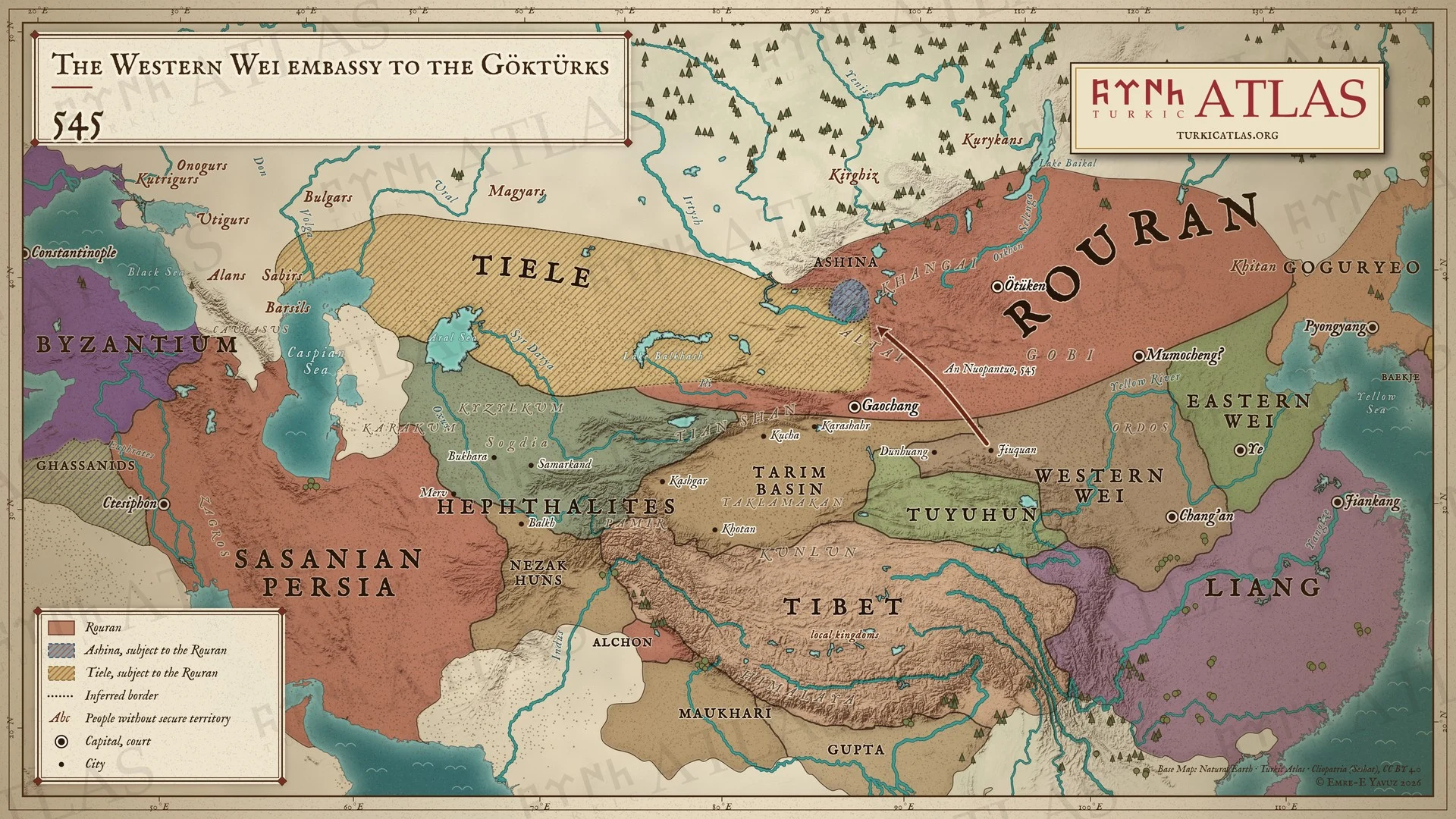
Northern China was divided, and each of its rival courts had reason to seek allies against the other and against the Rouran. In 545 Yuwen Tai, the chancellor of the Western Wei, sent a mission to the Göktürks under An Nuopantuo, a Sogdian. Bumin received it with open satisfaction at being approached by a great state. His people had already come to the frontier to buy silk and to seek relations with China, and in 546 Bumin sent an embassy of his own, with gifts. For the first time a Chinese state had addressed the Ashina as a party in their own right and not as part of the Rouran realm. The alliance begun in 545 was sealed six years later with the Wei princess Changle and lasted, through the Northern Zhou, for thirty years.
4/7
Defeat of the Tiele, 546
546
Fifty thousand submit to Bumin, and the second man in the khaganate is a subject.
In 546 the Tiele, who ranged west of the Altai across Dzungaria, moved against the Rouran. Their groups were scattered over a wide belt of steppe and had to assemble before they could strike, and the Ashina lay close enough to learn of the plan. Bumin intercepted them on the march and defeated them. No source gives the strength of either force, but on the modern estimates the Ashina were outnumbered several times over. More than fifty thousand Tiele tents submitted to Bumin, about a quarter of a million people at five to a tent. Anagui, the Rouran khan, had not sent a soldier. His subject now held a following many times the size of the Ashina a year before.
- Ashina
5/7
Anagui
520–552
The overlord, seen from the side he stood against: the refusal, the insult, the walls.
In 546 Bumin asked Anagui, the Rouran khan, for one of his daughters. A son-in-law of the Yujiulü, Anagui's house, stood inside the dynasty and within reach of the throne. Anagui's envoy carried his answer to the Altai: "You are my blacksmith slave. How do you dare to say such a thing?" Both halves of the insult were accurate in their way: the Ashina were smiths who had supplied the khan with weapons, and "slave" named their rank beneath him. Bumin killed the envoy. A few years before the end Anagui had his capital, Mumocheng, fortified with a double line of walls and kept an elite guard there. When Bumin took the empire he did not take the city, and Anagui's walls were the first thing the Göktürks left behind.
 Rouran Khaganate
6/7
The Turkic War of Independence
546–552
The six years between the refusal and the spring of 552, and what the silence in the record covers.
After the break of 546 the record is silent for four years. The size of the army Bumin led in 552 suggests that he spent them gathering support among other Turkic groups, but how he won it, and which groups joined, is not recorded. On one reading he rallied the Tiele federation in these years, allegedly forty tribes, and paid for the war with the trade in iron and ironware. In 551 he married Changle, a princess of the Western Wei house. Yuwen Tai, the Wei chancellor, knew which was the smaller party and gave her anyway, because a Göktürk at the Rouran's back was worth more to him than a Rouran at peace. Early in 552 two battles decided the war, and by March at the latest it had reached its culmination.
- Ashina
- Rouran Khaganate
7/7
Battle of Huaihuang, 552
552
The last Rouran army, the death of the khan, and Bumin's entry into Ötüken.
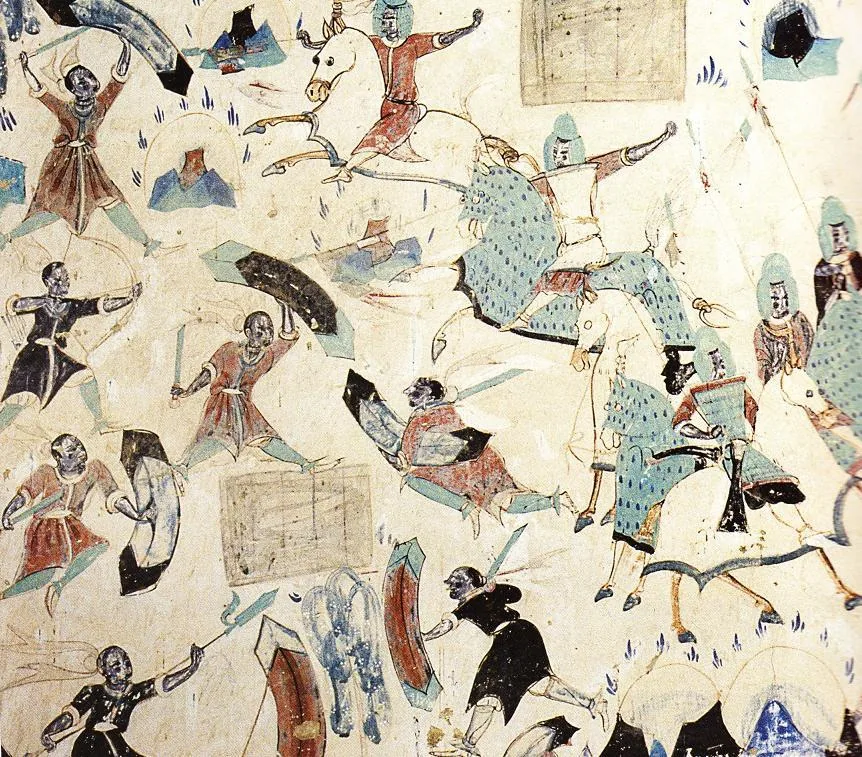
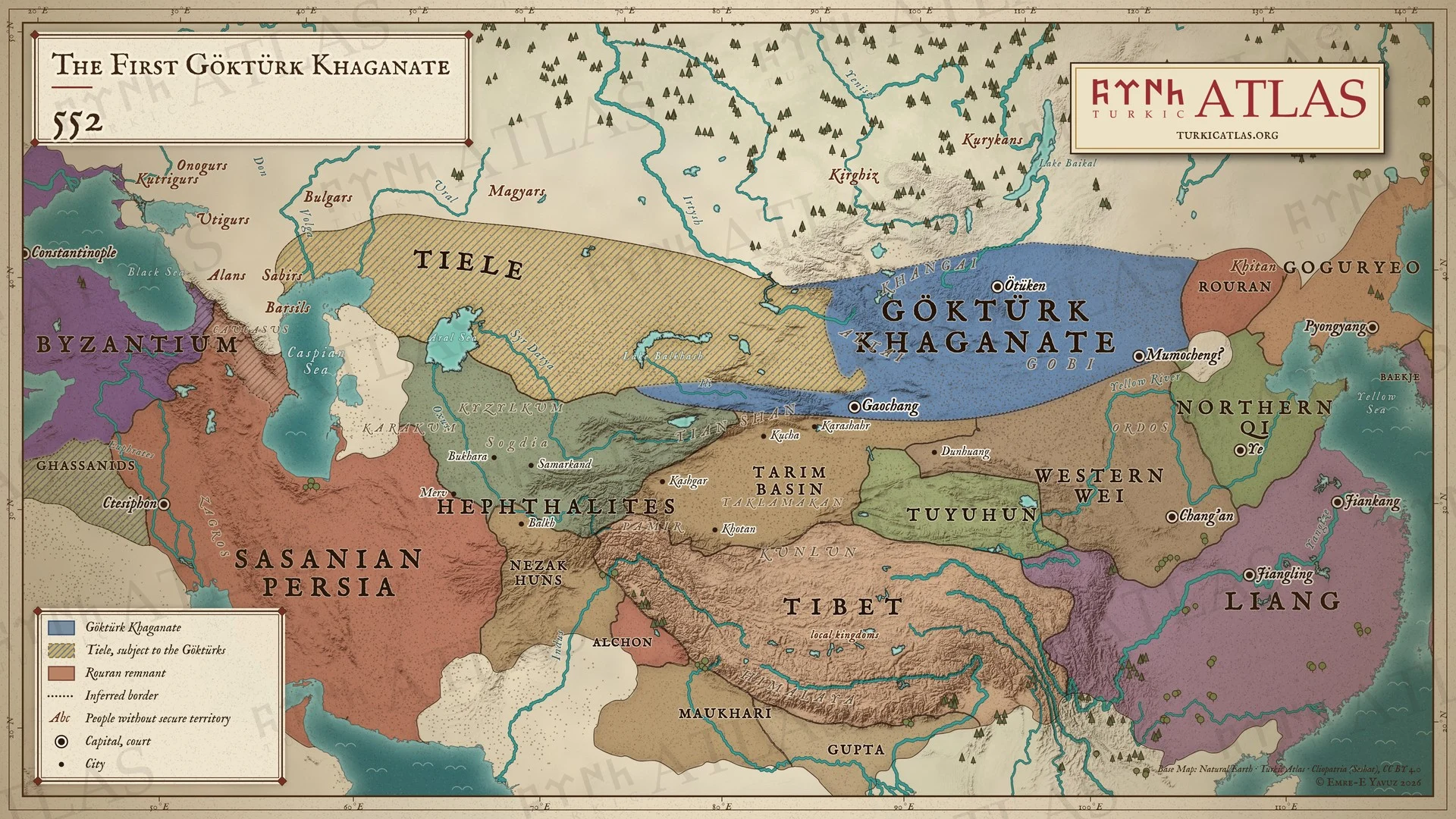
After the victory in Dzungaria the Göktürks turned east. North of Huaihuang, near the Chinese frontier, a second and larger Rouran army met them and was destroyed. Huaihuang was one of the Six Garrisons of the Northern Wei, and the battle there shows where the Rouran centre of gravity lay in 552: close to China and far from the Altai. Bumin marched on Mumocheng, the Rouran capital, with his Göktürks and his Tiele. Before he arrived or after, Anagui took his own life, according to the Chinese account. His nobles and his sons scattered, some south into the Northern Qi and some west across the steppe. In April 552 Bumin entered Ötüken and took the title Illig Khan, and the First Göktürk Khaganate dates from that month.
- Ashina
- Rouran Khaganate
© Emre-E Yavuz 2026© Emre-E Yavuz 2026
