
20 artículos
Controversias
Debates de la investigación, y quién sostuvo qué.
Esta página y el menú están en español. De 20 artículos, 9 existen en español; el resto está en inglés y así se indica.
- Arqueogenética de los imperios de la estepa Lo que el ADN antiguo de Mongolia ha mostrado desde 2018 sobre los xiongnu, la época göktürk y la época uigur, y lo que un genoma no puede mostrar: lengua, nombre o lealtad.
- Climate and the steppe empires What tree rings, ice cores and lake sediments say about the weather of the steppe between the Xiongnu and the Uyghurs, and what has been argued from it.
- The Bökli question Two words in the Kül Tegin inscription, bökli and čölgil. Some scholars think they name Korea at the sunrise. Others argue they are two states, and the second is not Korean at all.
- Los göktürk y los xiongnu Comparación de los göktürk y los xiongnu en el título, el rito, el rango y la guerra, y las posiciones sobre si los Ashina salieron de los xiongnu.
-
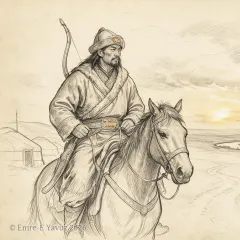 Los hunos y los xiongnu Debate sobre si los hunos que entraron en Europa en la década de 370 continúan a los xiongnu de Asia Interior. Se discute a partir del nombre, de noticias chinas y sogdianas, de la arqueología, de la lengua y de la genética.
- El debate sobre el nombre de los jakasios Debate of 1992 on Xiajiasi, the Chinese name that gave the word Khakas to Russian scholarship. Two scholars named Kyzlasov read it as a medieval Khakas state, three others as a spelling of Kirghiz.
- The Khazar–Ashkenazi hypothesis The claim that Ashkenazi Jews descend wholly or largely from the Khazars: who made it, on what grounds, and what historical and genetic research has found. Positions, not findings.
- La ascendencia de los kirguises desde Li Ling Pretensión de los kirguises del Yeniséi de descender del general han Li Ling. La corte Tang, cuya casa remontaba su linaje al abuelo de Li Ling, la aceptó en 843 e inscribió al khan kirguís en el registro del clan imperial.
- El debate sobre el origen de los kirguises breve Debate on where the Kirghiz first lived and whether they were Turkic from the start. The Xin Tang Shu gives a country west of Yiwu and one north-west of the Uyghurs.
- The language of the Xiongnu Qué hablaban los xiongnu, argumentado a partir de cuatro palabras de una crónica china y unos cincuenta términos glosados: las lecturas túrquicas, la lectura yeniseica, el estrato iranio.
- La formación del tengrismo La erudición que convirtió una palabra de las inscripciones del Orjón en una religión con panteón. Cuatro generaciones construyeron el cuadro, y cada una añadió algo que las fuentes göktürk no contienen.
- El origen de los ávaros Debate sobre el origen de los ávaros de Europa. Sus kaganes y su nobleza procedían con la mayor probabilidad de los rouran; las lecturas de los pseudoávaros, de los heftalitas, de los ogures y de los yueban se sitúan a su lado.
- The origin of the Old Turkic script Where the runiform letters come from, argued since 1893. An Aramaic ancestor, the tamgas of the steppe, or both. The argument runs on letter shapes, and shapes do not decide it.
- El origen del título de khan Debate sobre el origen del título de khan. Una lectura hace de Shelun, de los rouran, su primer portador hacia el año 400; otra, de un jefe xianbei del siglo III. La palabra se deriva del mongólico y del iranio.
- The steppe before the Xiongnu La estepa euroasiática antes del primer imperio: las culturas de la Edad del Bronce de Siberia meridional, el caballo y la llegada del nomadismo, los Nómadas Tempranos, los escitas y los saka.
-
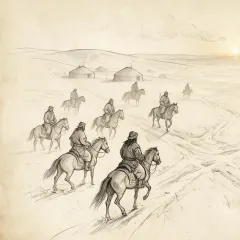 El debate sobre la etnogénesis túrquica Quién ha sostenido qué sobre el origen de los pueblos túrquicos y la ascendencia de los göktürk. Expuesto como posiciones, no como hallazgos.
- The Turkish–Korean friendship narrative A modern account of brotherhood between Turks and Koreans, built after 1950 out of the Korean War, one word of the Orkhon inscriptions and a set of school textbooks. Its history is twentieth-century.
- Los kirguises del Yeniséi y los kirguises actuales breve Debate on whether the Kyrgyz of the Tian Shan descend from the Yenisei Kirghiz. Four accounts differ on migration, language and name; two national accounts settle the Kirghiz in the Tian Shan early.
-
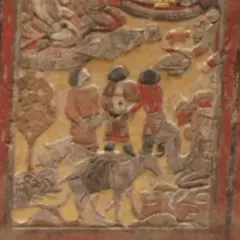 Turkic-Sogdian Synthesis breve Mixed civilisation of Göktürks and Sogdians. It began with the silk trade on the Chinese frontier and became a fusion of ruling strata after 560. The Sogdians lent the khaganate script and envoys.
- Xiongnu: Making the First Steppe Empire Por qué un imperio de la estepa apareció al norte de China en el siglo III a. C., y si lo hizo China. Los modelos de frontera, la cuestión de Estado o jefatura, y el caso desde la estepa.
Créditos de las imágenes
- Los hunos y los xiongnu: The Huns and the Xiongnu in a modern illustration. © Emre-E Yavuz 2026
- El debate sobre la etnogénesis túrquica: The Turkic ethnogenesis debate in a modern illustration. © Emre-E Yavuz 2026
- Turkic-Sogdian Synthesis: Back panel of the funerary couch of An Jia, a Sogdian sabao at the Zhou court who died in 579. Two men kneel facing each other inside a yurt, a gilded vessel between them; others drink before the tent, and a laden camel and a donkey rest below. The scene is taken to show An Jia at talks with a Göktürk chief. Shaanxi History Museum, Xi’an. Photograph: Gary Todd, 2019, CC0 (detail).

