
- 400
- 500
- 600
- 700
- 800
- 900
- Rouran 400–554
- First Göktürk 552–630
- Tang rule 630–682
- Second Göktürk 682–744
- Uyghur 744–840
- Kirghiz 840–924
- Huns 370–469
- Western Göktürk 552–659
- Türgesh 699–766
- Karluk 766–800
- Khazar 650–969
The Turkic-Sogdian synthesis was the mixed civilisation that grew out of the meeting of the Göktürks and the Sogdians, the Iranian-speaking merchants of the Zarafshan valley. It began at the frontier of China with envoys and silk. The Göktürks took Sogdiana in 560. After that, the synthesis became a fusion of the ruling strata of both peoples.[1]
Beginnings at the frontier
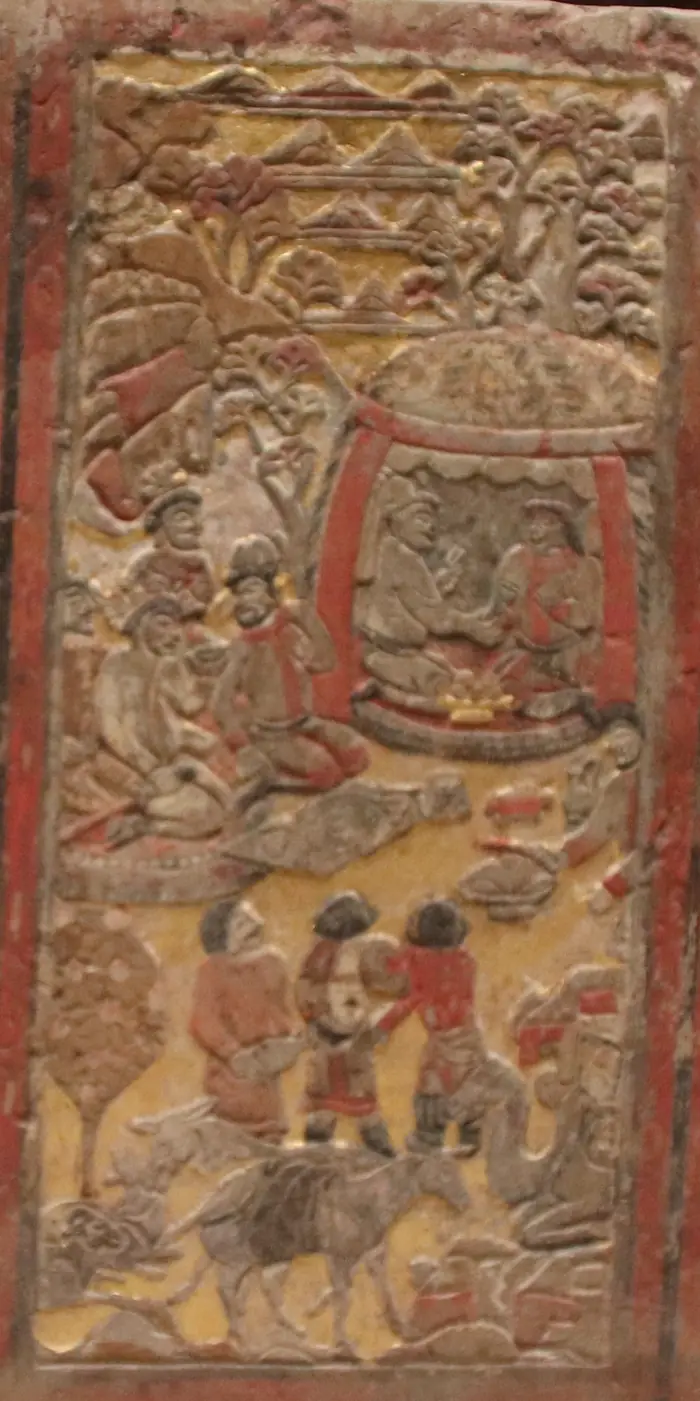
The first Göktürks in Chinese history come to the border to trade for silk and floss.[2] In 545 Yuwen Tai sent An Nuopantuo, a hu of Jiuquan, to them. The Göktürks congratulated one another that the envoy of a great state had come.[2] His name is Sogdian: Anāhitā-banda, the servant of Anāhitā. The first text that mentions the Göktürks thus also mentions a Sogdian and the silk trade. An Jia was sabao of the Sogdians under the Northern Zhou. He died in 579 and presents himself in his tomb as a diplomat.[3] The reliefs of his funerary couch show scenes of trade with the nomads and of Sogdians at work as envoys.[3]
On the couch of An Jia, the nomad ruler in the tent has long hair down his back, the mark of a Göktürk.[4] The sarcophagus of Shi Jun, buried at Xi’an in 580, shows the older order. Shi Jun comes with his caravan to a king in a yurt. The king wears a winged crown and no long hair. He has been understood as a ruler of the Hephthalites.[4] The tombs of 579 and 580 thus show a Sogdian leader before a Göktürk ruler and another before a Hephthalite one.[4]
Fusion after 560
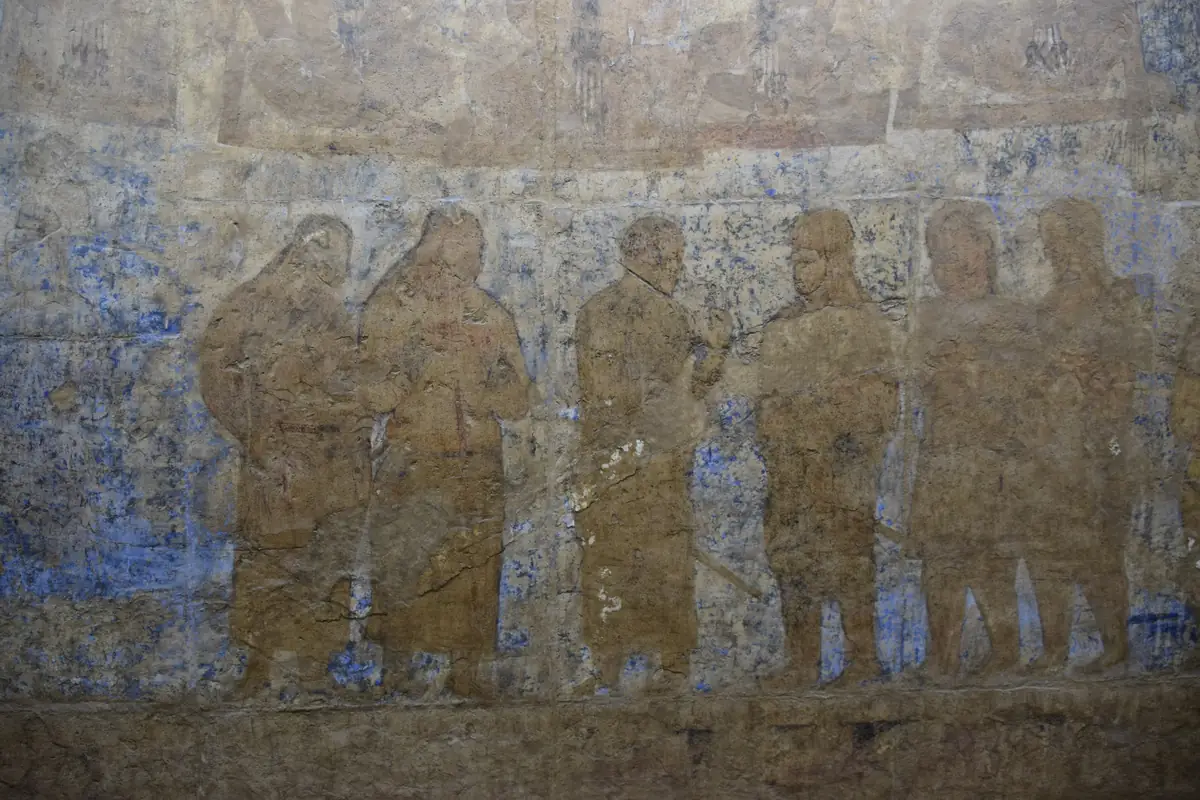
The conquest of Sogdiana in 560 joined the two peoples in one state.[1] A king of Panjikent at the end of the seventh century was a Göktürk. His successor Dēwāštīč, Iranian in name, was of Göktürk descent.[1] The only Sogdian marriage contract preserved unites a Göktürk and a noble Sogdian woman.[1] In the great painting of Afrasiab at Samarkand, Göktürk warriors sit in a circle at the feet of a king while envoys approach in procession.[1] The cities and the countryside stayed Iranian-speaking. In the mountains of Chach, in Tukharistan and in Semirech’e, the Göktürk element became ethnically important. It remained culturally under Sogdian domination.
Script, envoys and trade
The Sogdian gift that lasted longest was writing. The Göktürks wrote Turkic in the Sogdian alphabet, which was adapted step by step to Turkic sounds. Their earliest inscription is the Bugut inscription of the late sixth century, and it is in the Sogdian language.[1] Sogdians also handled the khaganate’s diplomacy. Maniakh led Istemi’s envoys to Persia to sell silk. Khosrow burned the silk, and Maniakh went on through the Caucasus to Constantinople.[5] In the next embassy to the Romans, his son was given his father’s title and the second rank. The reason was that the father had been most dear and loyal to the yabgu.[5] The Kül Tegin inscription names the city-folk of Bukhara among the mourners of 732.[6]
Two views of the beginning
Some scholars hold that the Sogdian presence among the nomads is older than the Göktürks. It came out of the Sogdian communities of Gansu. The Göktürks inherited a relation that had been commercial from the start.[1] Others grant the Sogdians of Gansu but find them scattered along a road. In their view, the encounter that gave the Göktürks their script, their chancery and their merchants took place in Sogdiana. Sogdiana was a country of cities, which the Göktürks conquered and governed through its own men.
After the First Khaganate
The Chinese blamed the Sogdians for the fall of the eastern khaganate in 630. Ilig entrusted everything to the various hu and put his own people at a distance.[7] Sogdians of high rank in the Göktürk state went over to the Tang. In the Ordos, their Sogdo-Göktürk settlements became the six hu counties of 679. An Lushan came out of the same milieu. He was born in 703 to a Sogdian officer in the Göktürk armies and a Göktürk mother. Under the Uyghurs, the Sogdian influence went further than under the Göktürks. The Uyghurs took Manichaeism from the Sogdians, and with it the script, much of the vocabulary and the pattern of their towns. Words of religion are among the loans. The Manichaean texts of the Uyghurs name Zurvan as Azrua, a form understood as Sogdian. The word for the demon, imnu, and the word for the stupa, supurgan, have been taken to be Sogdian or Iranian. The Mongols later took them over from the Uyghurs.[8]
At Qocho, near Turfan, a bundle of Manichaean manuscripts lay in a vaulted room of one ruin complex. The manuscripts were partly in the Sogdian language and for the most part in Turkic.[9] Among the finds of the same complex was a leaf with a list of the court of the Uyghur khagan, written in Manichaean script and in Middle Persian.[10] The same complex also yielded a copper coin with a legend in Sogdian script. Its finder took it for a coin of a khagan of the Türgesh from the early eighth century.[10]
The Sogdian alphabet that the Göktürks adopted is the ancestor of the Uyghur, Mongol and Manchu scripts.[1]
References
- ^ a b c d e f g h de la Vaissière 2005a
- ^ a b Zhou Shu (Book of Zhou), juan 50
- ^ a b de la Vaissière 2005a, p. 208
- ^ a b c Kageyama 2007, p. 12
- ^ a b Menander Protector
- ^ Kül Tegin inscription
- ^ Jiu Tangshu (Old Book of Tang), juan 194
- ^ Laufer 1919, p. 572–574
- ^ von Le Coq 1913, p. 8
- ^ a b von Le Coq 1913, p. 9
Sources
- Zhou Shu (Book of Zhou), juan 50
- Menander Protector
- Jiu Tangshu (Old Book of Tang), juan 194
- Bugut inscription
- Kül Tegin inscription
Literature
- Étienne de la Vaissière, Sogdian Traders: A History (2005)
- Etsuko Kageyama, The Winged Crown and the Triple-crescent Crown in the Sogdian Funerary Monuments from China: Their Relation to the Hephthalite Occupation of Central Asia (2007)
- Berthold Laufer, Sino-Iranica. Chinese Contributions to the History of Civilization in Ancient Iran (1919)
- Albert von Le Coq, Chotscho. Facsimile-Wiedergaben der wichtigeren Funde der ersten Königlich Preussischen Expedition nach Turfan in Ost-Turkistan (1913)
What links here3
- Peoples
- History of the Turkic peoples · Sogdians
- Institutions and Titles
- The Economy of the Steppe Empires
Cite this article
Yavuz, Emre-E. “Turkic-Sogdian Synthesis.” Turkic Atlas, revised 8 November 2026. https://turkicatlas.org/historiography/turkic-sogdian-synthesis/
Last revised: 8 November 2026


