
The sixth century from the side of the overlord: the khaganate that first used the title khagan, the Tiele who rose against it again and again, the khan who held it for thirty years between the Wei courts, and the two battles that ended it in a season.
1/11
Rouran Khaganate
400–554
A century and a half of rule, and what the Göktürks took over from it.
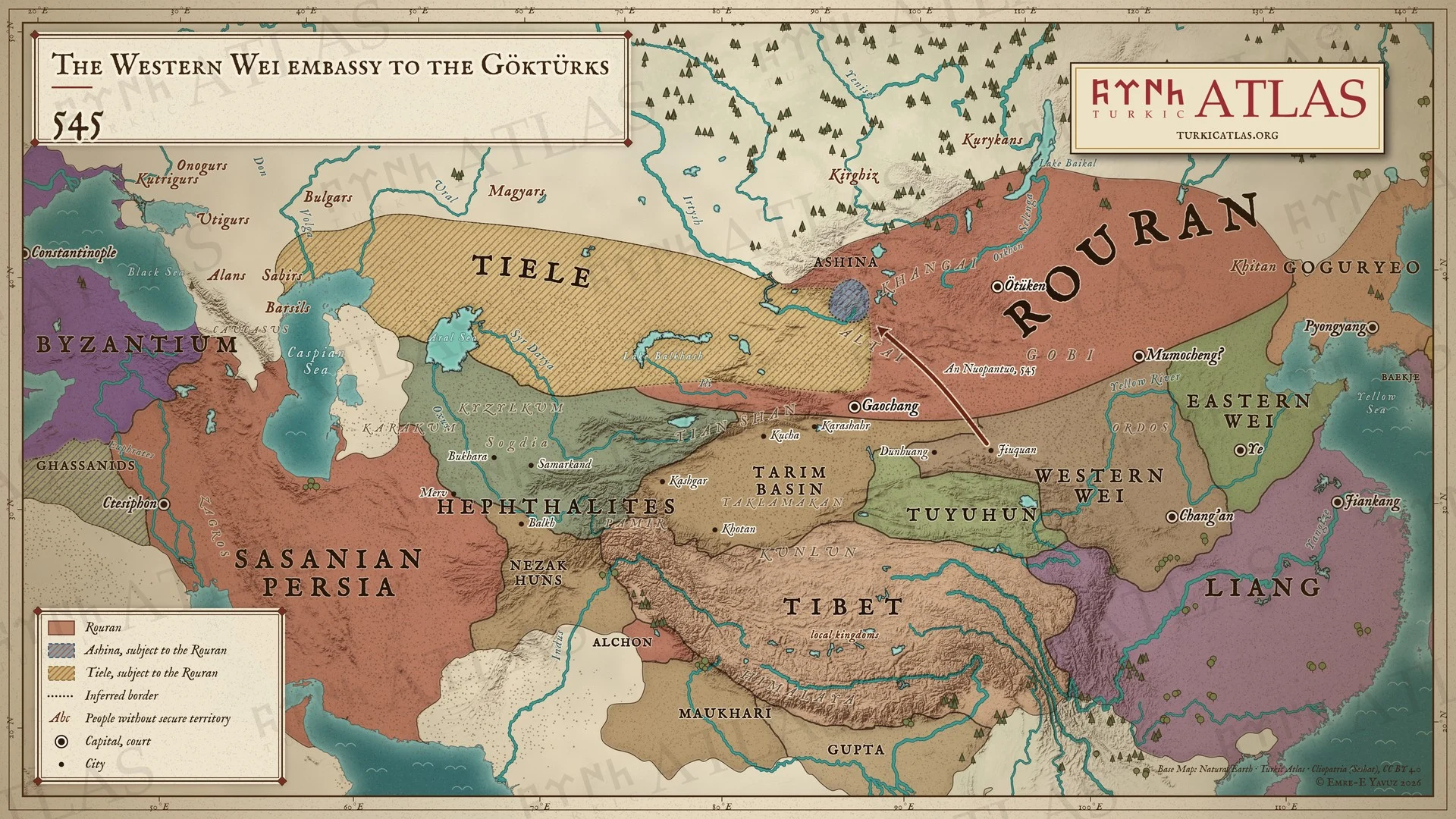
About 400 a fugitive named Shelun gathered a following in the Gobi, beat the Tiele and took the title khagan. His house, the Yujiulü, held the eastern steppe for a century and a half, from the Khingan range to the Seven Rivers. No Rouran text survives. The main witness is the Wei Shu, compiled for a state that fought them for a century. It describes a court with ranked officials, envoys and Chinese secretaries, and the Göktürks who inherited that court kept its order.
 Rouran Khaganate
2/11
Rouran Domination of the Turkic Peoples
400–552
How the khaganate ruled its Turkic subjects: the Tiele in the west and the Ashina, its smiths, in the Altai.
The Rouran ruled the Turkic-speaking peoples of the steppe from the top. Subject groups kept their own leaders and owed the khan service and tribute. According to the Sui Shu, a house surnamed Ashina fled with five hundred families from the Wei conquest of Gansu to the Rouran, in 439, and settled on the Golden Mountain, the Altai. There they worked iron and rendered it to the khan. Their leaders bore the title yabgu. For a century the Ashina appear in the record only as subjects, and they stayed out of every rising of the Tiele.
- Rouran Khaganate
 Ashina
3/11
Tiele
The federation that left in 487, rose in 508, was beaten in 520, and rose again in 546.
The Tiele were the largest Turkic-speaking population of the steppe, a loose federation west of the Altai that the Wei Shu calls Gaoche, "high carts". They stood under the Rouran as the Ashina did, and they rose again and again. In 487 more than a hundred thousand tents left the khaganate under Afuzhiluo. In 508 their leader Mietu beat and killed the Rouran khan Tahan, and for a decade they were free. In 546 they prepared to rise once more, and Bumin fell on them in Dzungaria before they had assembled.
4/11
Rise of Anagui Khan
520–546
520 to 546: from ten days on the throne to the man both Wei courts courted.
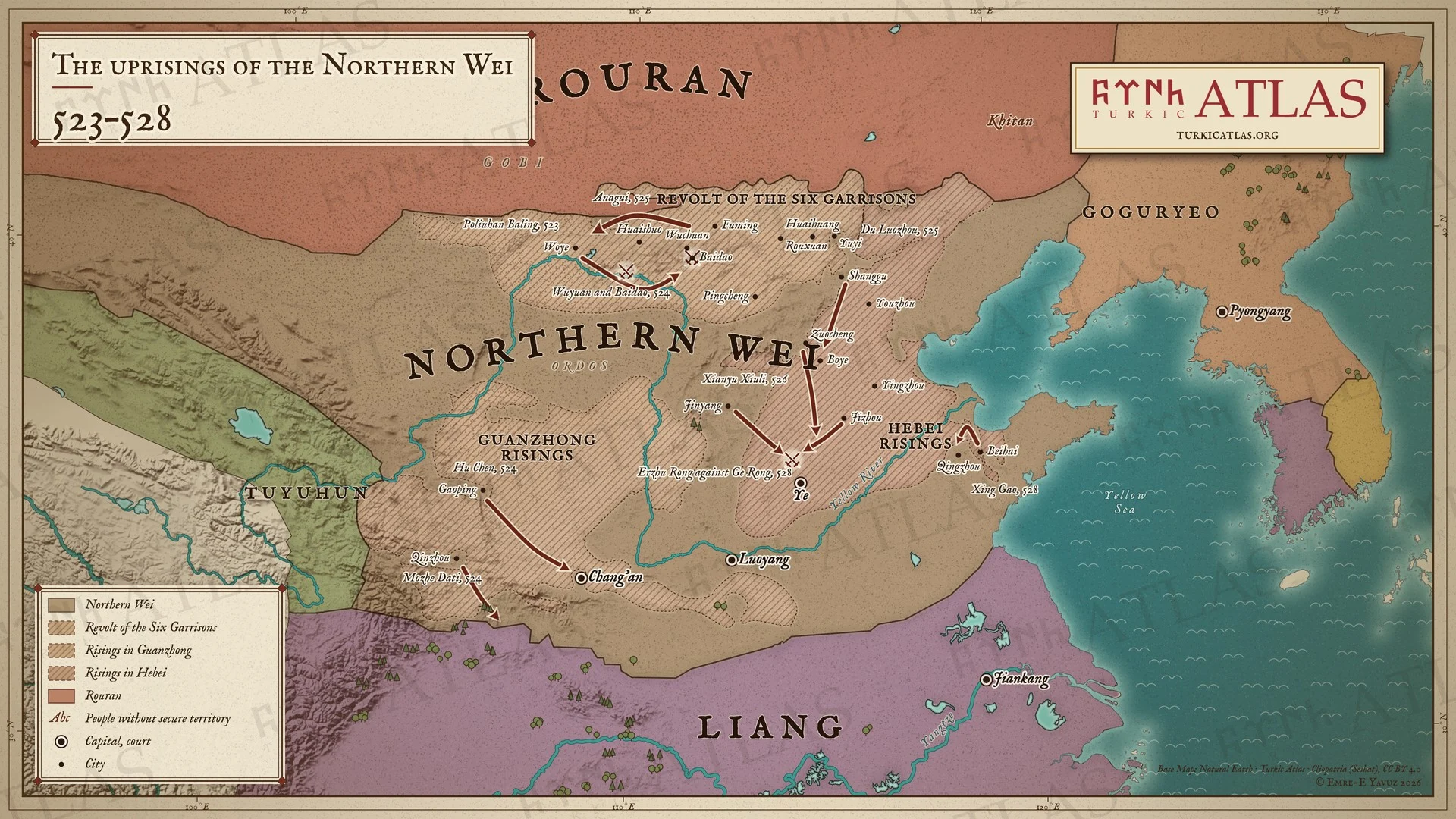
In 520 Anagui's mother and the great ministers set him on the throne after they had killed his brother Chounu. Ten days later his cousin Shifa drove him out, and he fled with a few horsemen to the Wei court at Luoyang. There he asked for troops, swore to serve the Wei, and gave the chief minister a hundred jin of gold. In 521 the Wei settled him at the Tuoruoxi springs north of the frontier, with builders, grain for seed and an escort. Four years later he led a hundred thousand men against the rebels of the Six Garrisons and took a new title, Chilian Toubing Doufa Khan.
5/11
Revolt of the Six Garrisons
523–530
525: the khan who had raided the Wei frontier fights its rebels for the Wei.
In a year of hunger the Rouran raided the northern frontier of the Wei. Soon afterwards the garrisons along the great bend of the Yellow River rose under Poliuhan Baling of Woye, and the Wei armies sent north failed one after another. The court turned to Anagui. Early in 525 he marched west from Wuchuan with a hundred thousand men, and in the sixth month he broke Baling and beheaded his general Kongque. From the armies of that war came Gao Huan and Yuwen Tai, who divided the Wei between them in 534.
 Northern Wei
- Rouran Khaganate
6/11
Empress Yujiulü
† 540
538: a Rouran daughter as empress of the Western Wei, her tents facing east.
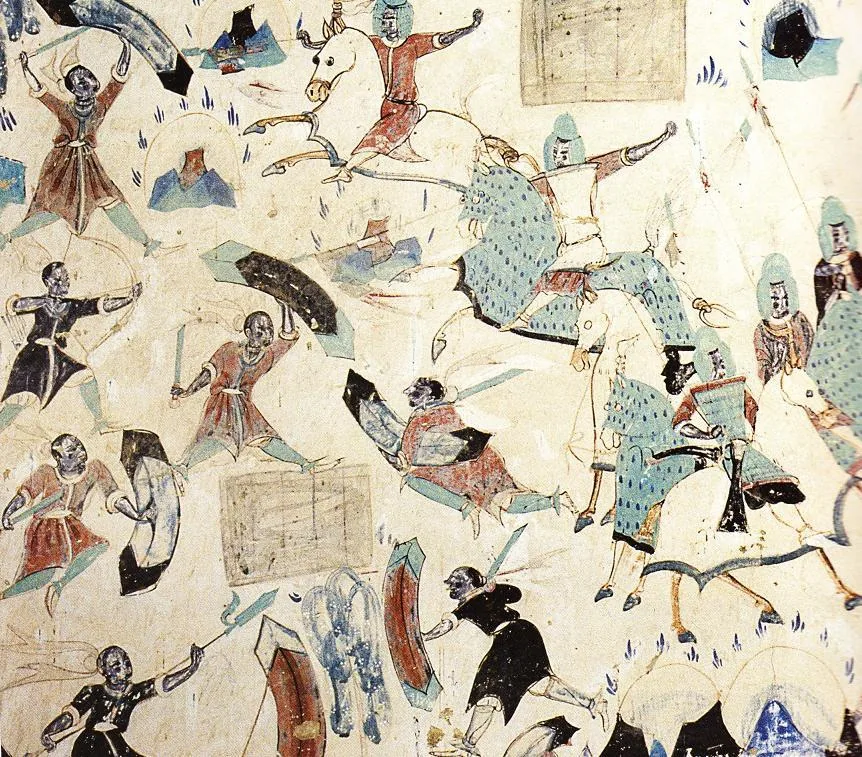
In 538 Anagui's eldest daughter came south as empress of the Western Wei, with seven hundred carts, ten thousand horses and a thousand camels. Her tents faced east, because the Rouran held the east in honour. Until she had seen the lord of Wei, she told the Wei escort, she was still a Rouran woman. She was fourteen. Two years later she died after giving birth, and the eastern court told her father that the western emperor had killed her.
 Western Wei
- Rouran Khaganate
7/11
Eastern Wei
534–550
540 to 546: the east wins the khan with three marriages.
The eastern court answered with marriages. In 541 a princess of its imperial clan went north as the wife of Anagui's son Anluochen. In 542 his granddaughter, Princess Linhe, came to Jinyang as the wife of Gao Huan's son. In 546 Gao Huan himself took Anagui's favourite daughter, in the year in which Bumin broke the Tiele in Dzungaria. From then on the Rouran appear among the bearers of tribute in almost every year of the eastern annals.
8/11
Anagui
520–552
The last khan: the refusal of 546, the walled capital, and his death.
In 546 Bumin broke the Tiele for the Rouran and asked Anagui for a daughter as his reward. Anagui answered that Bumin was his blacksmith slave and asked how he dared say such a thing. Bumin killed the envoy. In his last years Anagui fortified a capital, Mumocheng, with a double wall; archaeology has not found it. Six years after the refusal his armies had been beaten twice, and by the Chinese account he took his own life.
- Rouran Khaganate
9/11
Battle of Dzungaria, 552
552
The first of the two engagements.
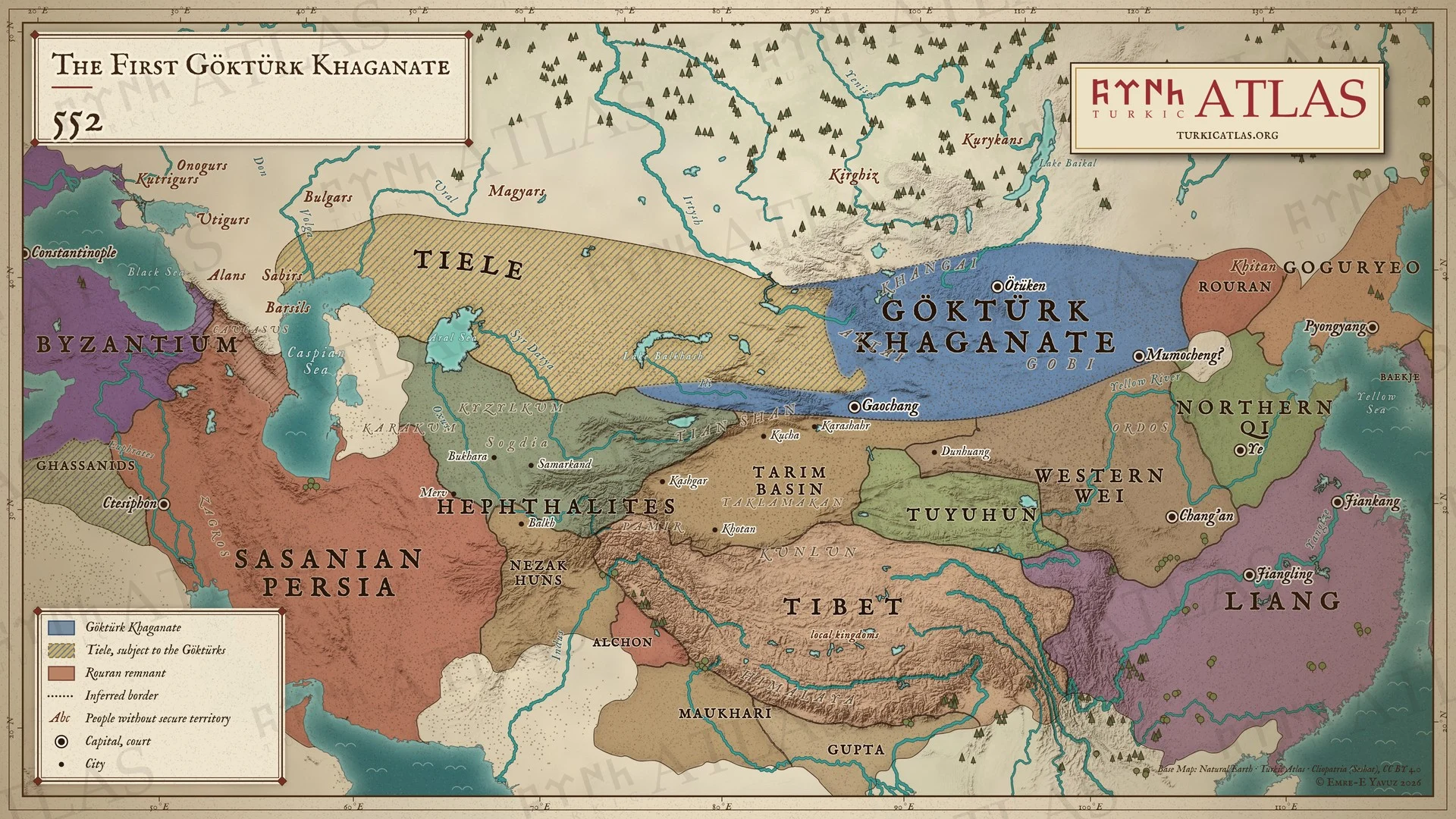
Early in 552 a Rouran army went west and met the Göktürks in Dzungaria, the old country of the Tiele. It was beaten without much trouble. Bumin's army now included the Tiele federation and the other Turkic groups he had gathered in the six years since the break. After the victory the Göktürks turned east, toward Mumocheng, the Rouran capital.
- Ashina
- Rouran Khaganate
10/11
Battle of Huaihuang, 552
552
The second, and the end.
A second and larger Rouran army met the Göktürks north of Huaihuang, one of the old Six Garrisons, and was destroyed. It was the ground on which Anagui had fought for the Wei in 525. By the Chinese account Anagui took his own life. His nobles and his sons scattered, some south into the Northern Qi and some west across the steppe. Bumin entered Ötüken and in April 552 took the title Illig Khan.
- Ashina
- Rouran Khaganate
11/11
Issik Khan
552–553
The aftermath: the exiles in China, the Ordos, and the last victory in January 554.
Bumin died within months, and Issik succeeded him. The Rouran nobles who had fled to the Northern Qi did not mean to stay refugees; late in 552 the Qi attacked Göktürk territory on their behalf and achieved nothing the sources record. Under Issik the last army the Rouran could raise was broken on the Ordos. The last Göktürk victory over the remnant is dated to January 554. The house that had ruled the steppe for a century and a half no longer existed as a power.
 First Göktürk Khaganate
- Ashina
© Emre-E Yavuz 2026© Emre-E Yavuz 2026© Emre-E Yavuz 2026
