
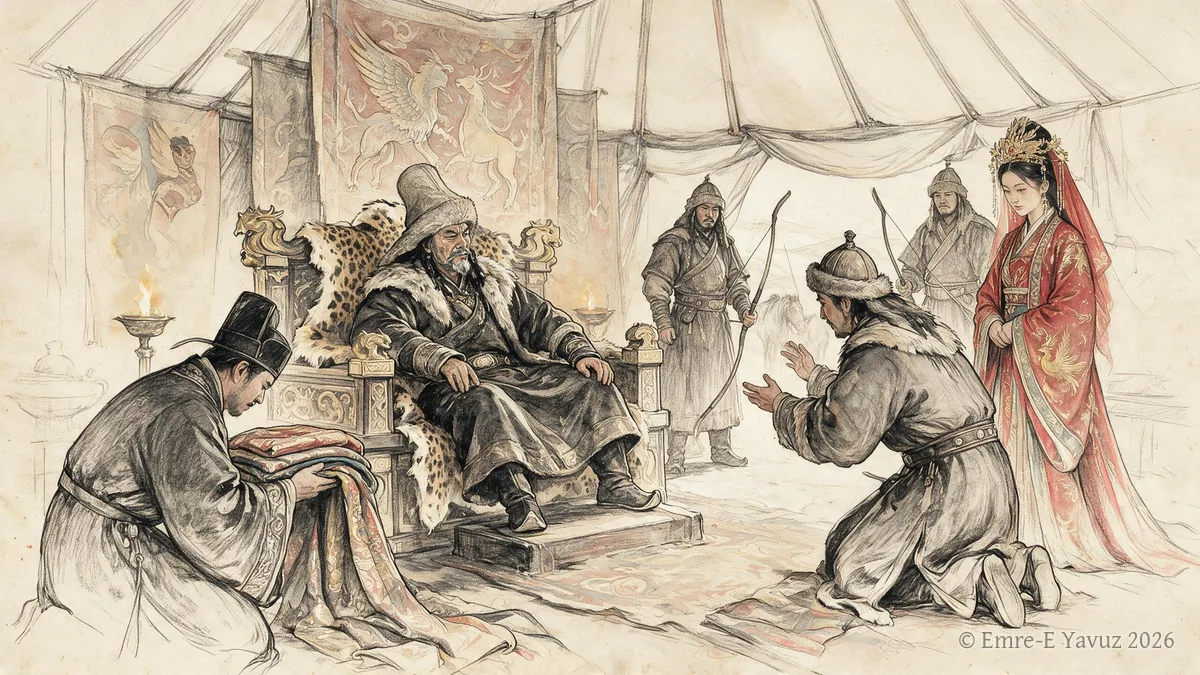
Anagui became khan of the Rouran in 520 and lost the throne ten days later.[1] He came back a year later with the gifts and the protection of the Northern Wei.[1] Within five years he was fighting the Wei’s rebels for them. Within twenty years both halves of the divided Wei were competing for his daughters.[2] The same year opened the war that ended him.[3]
Background
The house of the Yujiulü had been at war with its western subjects for a generation. In 508 the Gaoche killed the khan Futu, and in 516 his son Chounu broke them and killed their king.[1] Some scholars give this western victory to Anagui after his accession instead. The Wei Shu gives it to Chounu.[4]
Ten days and the flight south (520)
At the beginning of the Zhengguang era Chounu was beaten by the Azhiluo, the western Gaoche. On his return his mother and the great ministers killed him.[1] They set up his younger brother Anagui.[1] Ten days later Anagui’s cousin Shifa attacked him with several tens of thousands of men, and the civil war began.[1] Anagui fled south to the Wei with his brother Yijufa and a few horsemen.[1]
In the tenth month of 520 the emperor Xiaoming received him at Luoyang before the assembled court.[1] Anagui asked for troops and horses to go back. He promised to avenge his mother if she was dead, and he swore to serve the Wei with the tribute of the four seasons.[1] He was made duke of Shuofang and king of the Rouran.[1] The court hesitated to let him go. Anagui gave the chief minister Yuan Cha a hundred jin of gold, and the decision went his way.[1]
Return (521–522)
In the north his cousin Poluomen had meanwhile broken Shifa and been raised as khan.[1] The Gaoche under Yifu then broke Poluomen, who surrendered to the Wei at Liangzhou. Several tens of thousands of Rouran came out to receive Anagui.[1] In the tenth month of 521 the great ministers proposed a settlement.[1] Anagui was to be placed at the Tuoruoxi springs north of Huaishuo, outside the frontier. Poluomen was to be placed in the old commandery of Xihai north of Dunhuang, inside it.[1] Garrison troops and builders from Woye, Huaishuo and Wuchuan went with them.[1] Anagui had no stores. Two thousand hu of hemp seed and dried rations from Shuozhou were therefore carried to him on government camels.[1] Poluomen plotted to go over to the Hephthalites and was captured.[1] In the winter of 522 Anagui asked for millet for seed and received ten thousand shi.[1]
Raid and the Six Garrisons (523–527)
In 523, a year of hunger, Anagui raided across the frontier.[1] He seized the envoy sent to reason with him. He drove off two thousand people and tens of thousands of animals and went north.[1] The Wei general Li Chong pursued him three thousand li and did not catch him.[1]
In 524 the Six Garrisons rose in revolt under Poliuhan Baling of Woye.[5] In the spring of 525 the Wei court sent Anagui gifts and its commission, and he led a hundred thousand men from Wuchuan west towards Woye.[1] In the sixth month he broke Baling and beheaded his general Kongque.[5] More than two hundred thousand of the rebels went over to the Wei commanders.[6] Anagui’s people had recovered. That year he took a new title, Chilian Toubing Doufa Khan, which the Wei Shu glosses as “grasping”.[1] In 527 the emperor thanked him for his loyalty and told him to hold his men back from plunder; the chapter adds that the court feared he might turn.[1]
Between the two Wei courts (534–546)
In 534 the Wei broke in two, and both halves wanted him.[7] At his court sat Chunyu Tan, a Chinese envoy whom he had kept and made director of his writing.[7] Anagui had been to Luoyang and admired the Chinese state. He created offices in its image.[7] Chunyu Tan taught him to write to the Chinese courts as an equal.[7]
The Western Wei moved first. Yuwen Tai married a Wei princess to Anagui’s brother Tahan. The emperor Wen took Anagui’s eldest daughter as his empress.[8] She reached the capital in the first month of 538 with seven hundred carts, ten thousand horses and a thousand camels.[9] The empress died in childbirth in 540, and the Eastern Wei told Anagui that the west had killed her.[10] He went over to the east.[7]
The east bound him with three marriages. A Wei princess went north to his son in 541.[7] In 542 his granddaughter, Princess Linhe, went to Jinyang as the wife of a son of Gao Huan.[7] In 546 Gao Huan himself married Anagui’s daughter.[7] By 546 the house of Anagui was married into both halves of China.
Aftermath
In the same year the Tiele prepared to rise against the Rouran. Bumin broke them before they had assembled.[3] Bumin asked for a daughter of the khan, and Anagui called him his blacksmith slave.[3] Six years later the khan who had been courted by both Chinese courts was dead, and his khaganate with him.[3]
References
- ^ a b c d e f g h i j k l m n o p q r s t u v w x y Wei Shu, juan 103
- ^ Wei Shu, juan 103; Bei Shi (History of the Northern Dynasties), juan 98
- ^ a b c d Zhou Shu (Book of Zhou), juan 50
- ^ Yavuz 2025
- ^ a b Wei Shu, juan 9
- ^ Zizhi tongjian (Comprehensive Mirror in Aid of Governance), juan 150
- ^ a b c d e f g h Bei Shi (History of the Northern Dynasties), juan 98
- ^ Zizhi tongjian (Comprehensive Mirror in Aid of Governance), juan 158; Bei Shi (History of the Northern Dynasties), juan 13
- ^ Bei Shi (History of the Northern Dynasties), juan 13
- ^ Bei Shi (History of the Northern Dynasties), juan 13; Bei Shi (History of the Northern Dynasties), juan 98
Sources
- Wei Shu, juan 9, 103
- Zizhi tongjian (Comprehensive Mirror in Aid of Governance), juan 150, 158 (after Wei Shu, Zhou Shu, Sui Shu and Bei Shi)
- Bei Shi (History of the Northern Dynasties), juan 13, 98 (after Wei Shu, Zhou Shu and Sui Shu)
- Zhou Shu (Book of Zhou), juan 50
Literature
- Peter B. Golden, An Introduction to the History of the Turkic Peoples (1992)
- Emre-E. Yavuz, The Gokturk Empire: 2nd Edition (2025)
What links here1
- Foods
- Millet
Cite this article
Yavuz, Emre-E. “Rise of Anagui Khan.” Turkic Atlas, revised 8 November 2026. https://turkicatlas.org/events/rise-of-anagui-khan/
Last revised: 8 November 2026

