
The Church of the East was the Syriac church of the Persian world. It reached China and the Turks through the Sogdians, who carried it east together with Manichaeism.[1] A metropolitan see of the Turks was created around 782.[2] In the Uyghur lands of the tenth century, the Hudud al-Alam records five villages of the Sogdians, called Bek-Tegin. Christians, Zoroastrians and heathens lived in them.[3]
The Sogdian Christian texts of the east were written by scribes who were more and more at home in Turkic.[4] In Semirech’e the church lived beside Islam, despite reports of churches turned into mosques. As many tombstones show, it survived there at least into the fourteenth century.[2] William of Rubruck found in 1253 that the Nestorians of the region used the language and script of the old country of Organum in their services. This language has been identified with Sogdian in the land of Argu.[5]
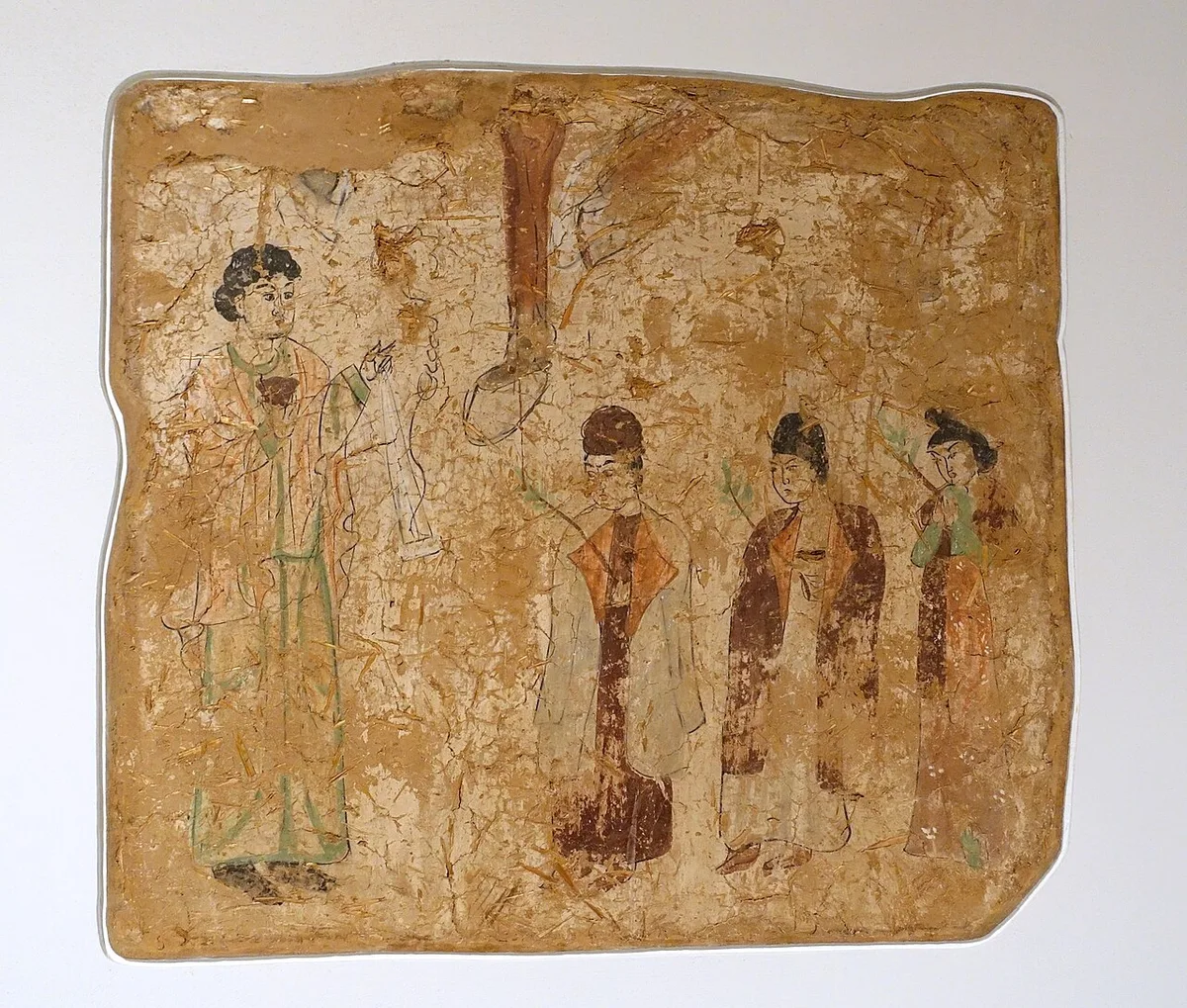
The Berlin expedition found Christian texts in Middle Persian, Sogdian, Syriac and Turkic in a ruin at Bulayiq, north of Turfan.[6] Among them is a fragment of a Psalter in Middle Persian, which its editors dated to the fifth century.[7] In a ruined temple at Qocho, wall paintings show a figure swinging a censer before three persons who carry leaf branches. They also show the legs of a horse whose rider’s stirrup survives. On another wall a rider carried a pole ending in a cross.[8] The excavators took the paintings for those of a Christian congregation, because none of the figures wears the white Manichaean dress. The same cross, however, also occurs on a badly damaged Manichaean painting. The ruin yielded neither an inscription nor a manuscript.[8]
A history of Central Asia places an earlier mission in the first half of the seventh century. In 644, it says, Elijah, the metropolitan of Merv, converted a large number of Turks. Among them was a Turkic khan with all his army beyond the Oxus, in Tokharistan.[9] The account rests on a study of 1925 that is not in the collection, and it names no source text. Whether the khan belonged to the Göktürks or was a lord of Tokharistan is not settled.[9]
References
Sources
Literature
- Étienne de la Vaissière, Sogdian Traders: A History (2005)
- Albert von Le Coq, Chotscho. Facsimile-Wiedergaben der wichtigeren Funde der ersten Königlich Preussischen Expedition nach Turfan in Ost-Turkistan (1913)
- B. A. Litvinsky; Zhang Guang-da; R. Shabani Samghabadi (ed.), History of Civilizations of Central Asia, Vol. III (1996)
What links here4
- Persons
- Boyla Kutlug Yargan
- Battles & Events
- Göktürk prisoners with the cross (591)
- Sources
- Suji inscription
Cite this article
Yavuz, Emre-E. “Church of the East.” Turkic Atlas, revised 8 November 2026. https://turkicatlas.org/religions/church-of-the-east/
Last revised: 8 November 2026


