
- 400
- 500
- 600
- 700
- 800
- 900
- Rouran 400–554
- First Göktürk 552–630
- Tang rule 630–682
- Second Göktürk 682–744
- Uyghur 744–840
- Kirghiz 840–924
- Huns 370–469
- Western Göktürk 552–659
- Türgesh 699–766
- Karluk 766–800
- Khazar 650–969
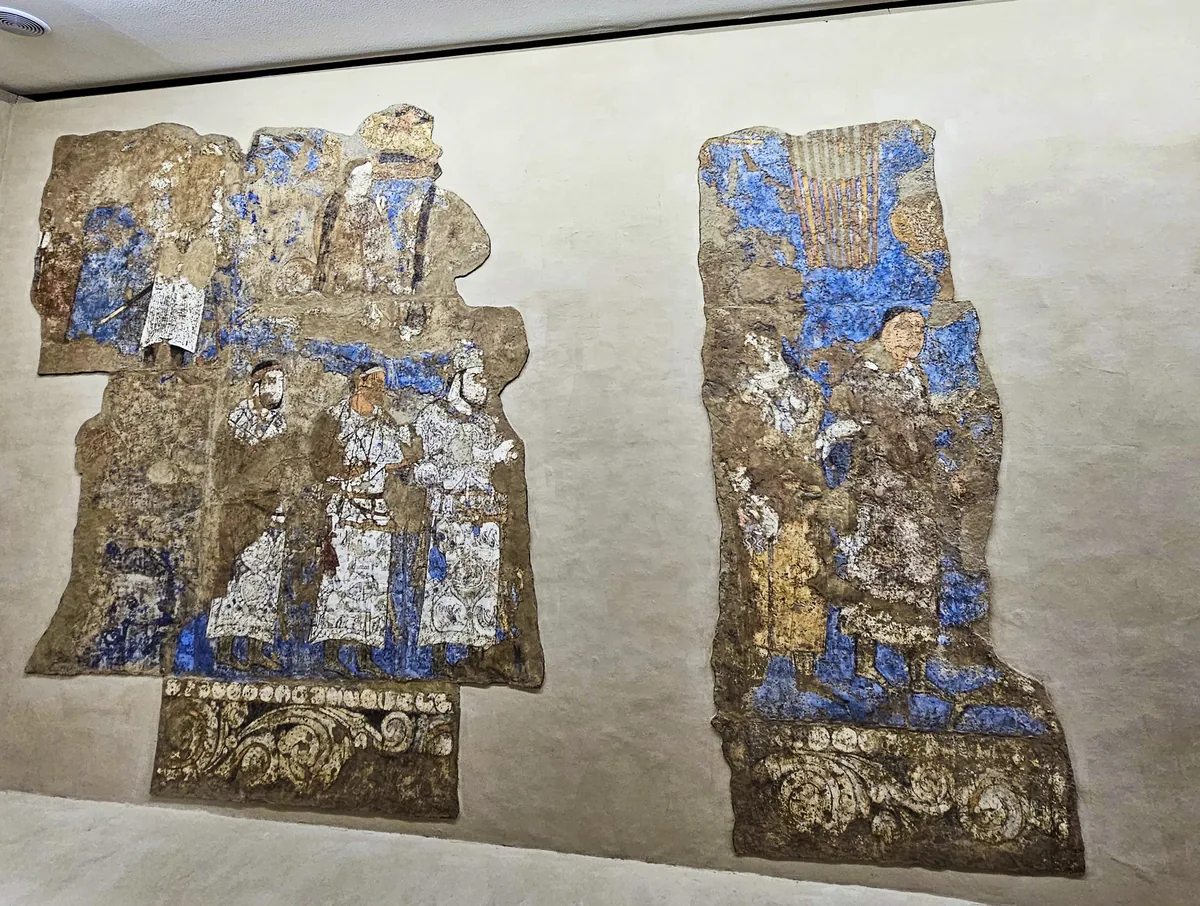
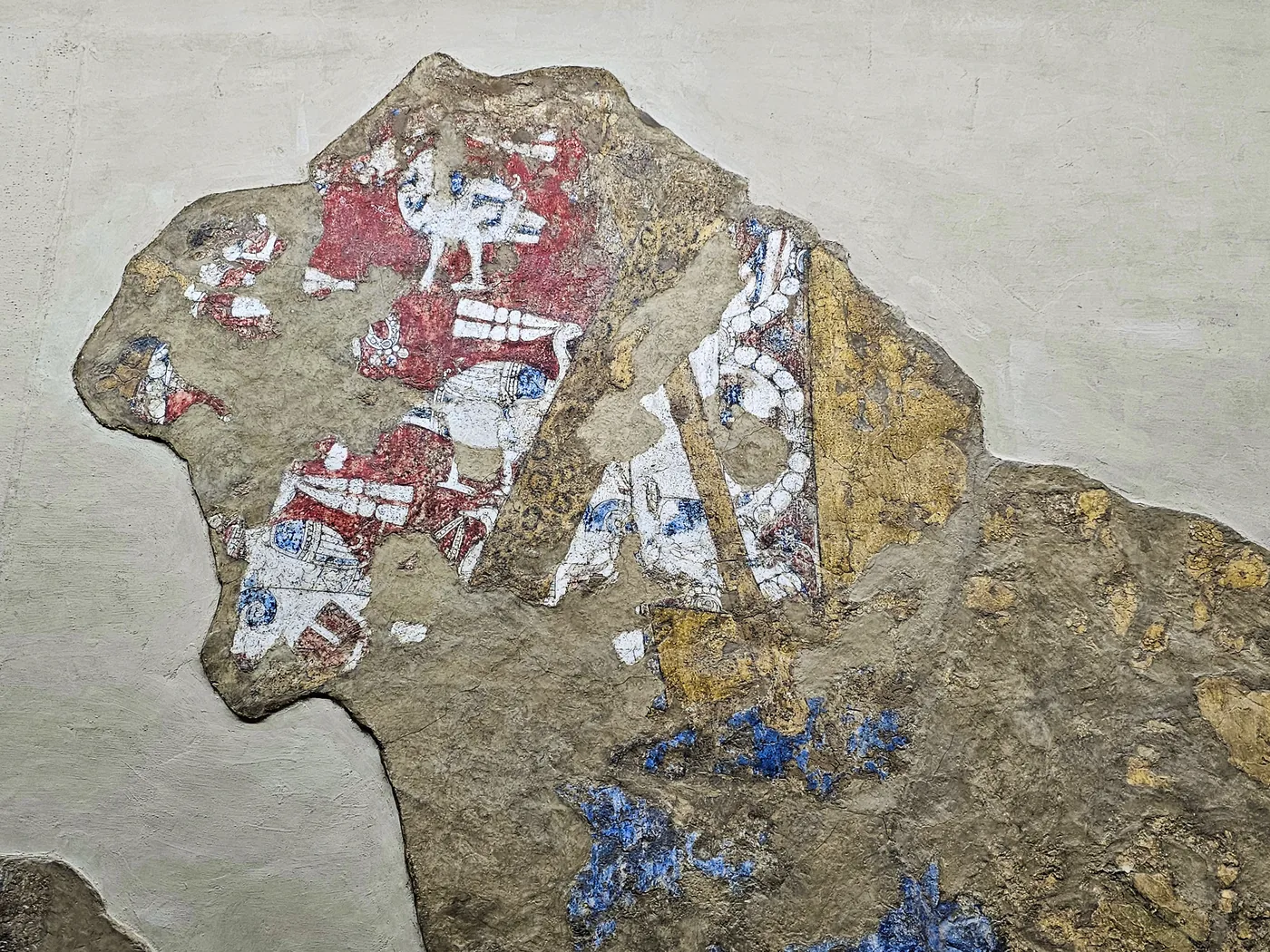
The Afrasiab paintings are the wall paintings of a single hall in old Samarkand. The hall was found in 1965 and has been known since as the Hall of the Ambassadors.[1] The paintings show embassies arriving before the Sogdian king Varkhuman in the years after the Tang had defeated the western Göktürks. Long-haired Göktürks stand guard among them.[2] The paintings are a source of a rare kind. They are a picture made inside the period, in a room whose walls can still be read one against another.
Discovery and site
The paintings were uncovered in 1965 on the Afrasiab mound, the site of Samarkand before the Mongol period. The mound bears the name of the legendary king Afrasiab.[1] The mound covers some 289 hectares, and a road to the airport had been laid across it in 1962.[3]
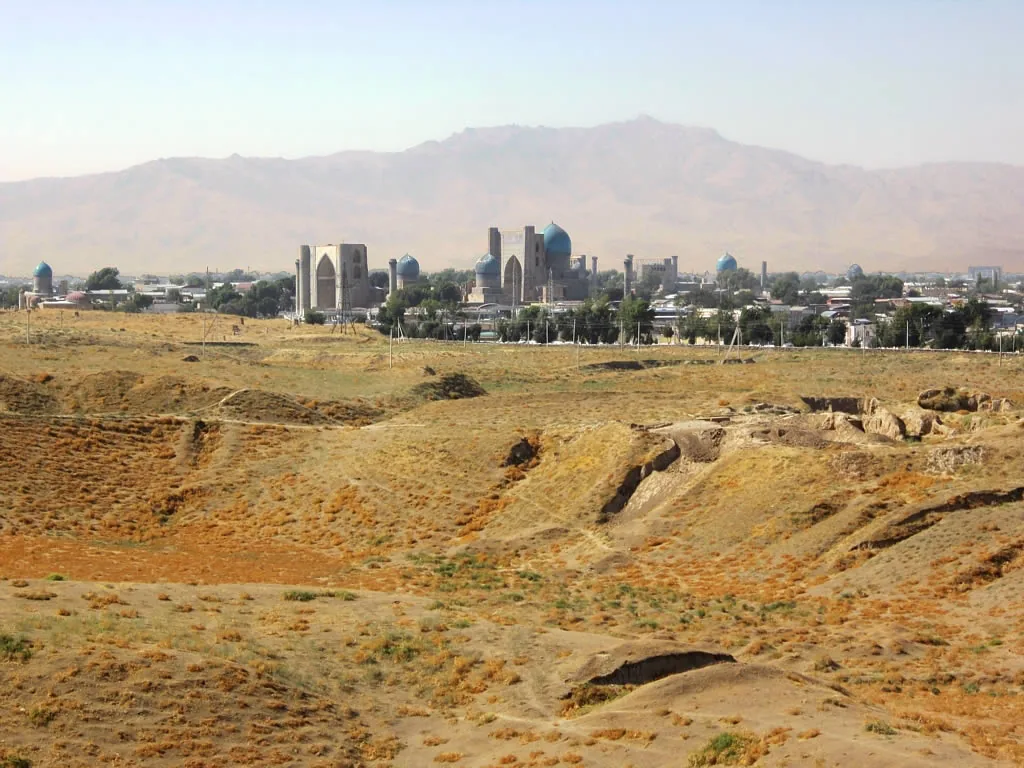
The hall was excavated as Hall 1 in Area 23. It lies far from the citadel, inside the third and last rampart that surrounded the city before the Arab conquest.[4] Its construction began before the third rampart was built around it.[4] Some scholars take it to be part of a royal palace complex of the middle of the seventh century.[3] Others take it to be the residence and reception hall of an official, reserved for occasions like the one on its west wall.[4]
The room
Hall 1 is a square room of eleven metres by eleven.[3] Its only entrance is in the east wall and faces the principal west wall. The paintings stand above a continuous wall-bench that projects slightly on the west side.[1] Two superimposed friezes of figures survive, up to a height of about a metre and a half. The upper parts of the walls were destroyed when the ceiling collapsed. The collapse sealed the room in the tenth century.[1] The subject matter is distributed by direction. This distribution is itself an argument, because the walls face the parts of the world they show.[1]
Date and patron
The king of the paintings is Varkhuman of Samarkand, the Kang country of the Chinese histories. The Tang Huiyao records that in 658 the Tang officer Dong Jisheng made the king’s city the seat of the Kangju Area Command and appointed the king, Fuhuman, as its governor.[5] The Xin Tang Shu places the same appointment in the Yonghui era, 650 to 655.[6] Fuhuman is the Chinese form of Varkhuman.[4] In the same Yonghui years, the Tang Huiyao adds, Kang repeatedly sent envoys. They reported that the Arabs were attacking Kang and making it pay levies.[5]
The completion of the paintings is placed around 660.[1] In those years one or both of the western Göktürk khans, Mishe and Buzhen, served as Tang protectors-general in Sogdiana. The Tang had broken the Western Göktürk Khaganate in 658 and 659.[7] Between 658 and 661 the Tang set up more than a hundred area commands and prefectures reaching into Central Asia.[8] Some scholars tie the paintings to Varkhuman’s appointment of 658 and date them shortly after it, while others reject the link.[4]
Inscriptions
The paintings contain two series of Sogdian writing. The first series, in Sogdian and Bactrian cursive, was written on the walls when the paintings were finished, as explanatory labels.[4] The longest label runs down the robe of the ambassador from Chaganian, in Tokharistan south of Sogdiana. It gives his speech to king Varkhuman.[2] Visitors added the second series after the first occupants had left the building. One of these later hands wrote Varkhuman’s name on the neck of a figure on the west wall.[4]
The west wall
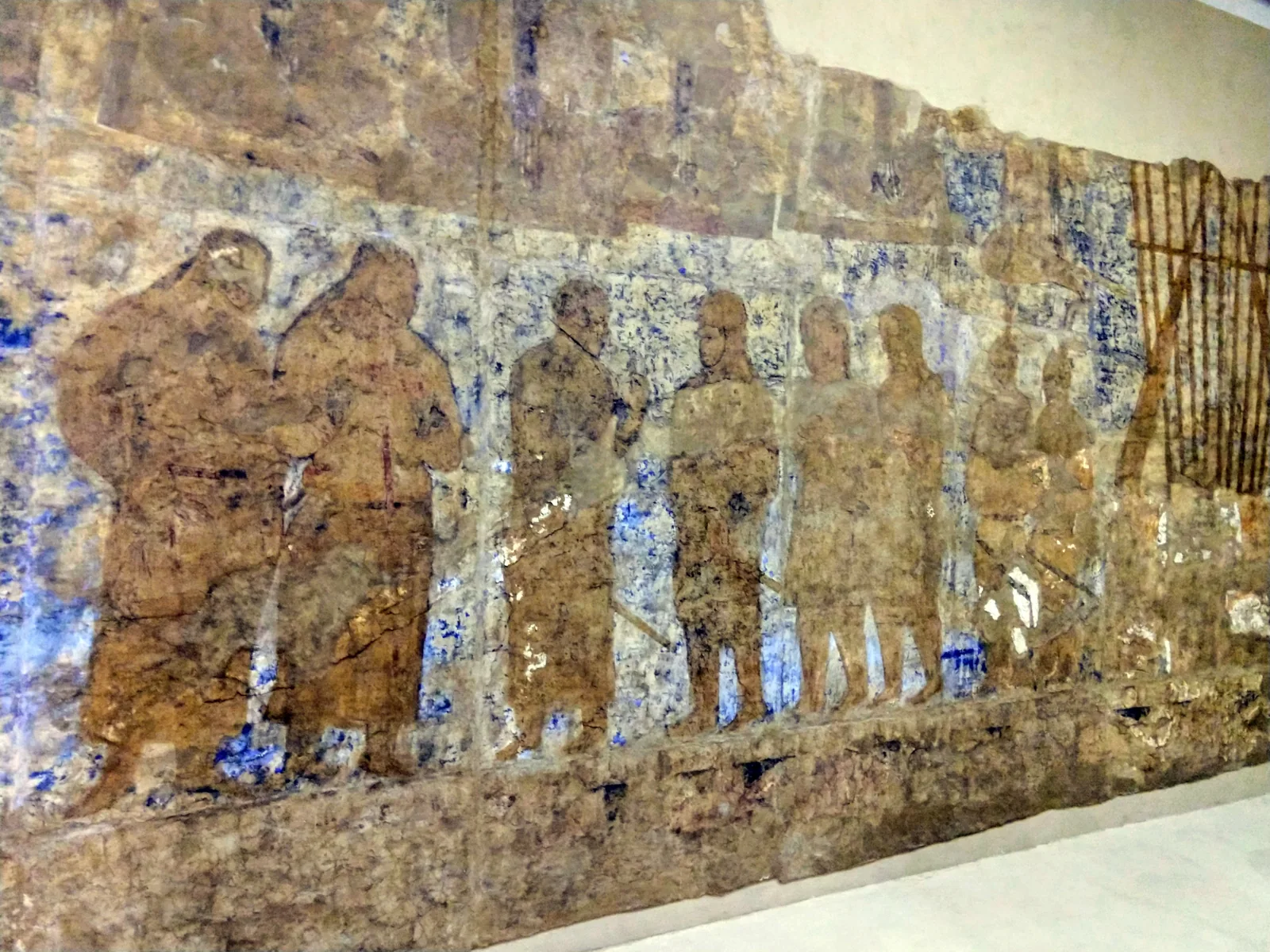
The west wall faces the entrance and shows the principal scene. Its upper part, destroyed with the ceiling, showed one or perhaps two towering figures.[2] In the preserved lower part, three superimposed files of gift-bearers converge from left and right on a central file of figures ascending towards the lost image. The gift-bearers come from the region and from abroad.[2] At the bottom left stand Varkhuman and the dignitaries of the region with their gifts. At the bottom right stand foreign dignitaries from Korea, from China and from China’s dependencies.[2] Foremost among the regional envoys, in the second frieze on the left, stands the ambassador of Chaganian with his speech on his robe.[2] The perspective of the composition is unusual for Sogdian painting and may be a Chinese import.[4]
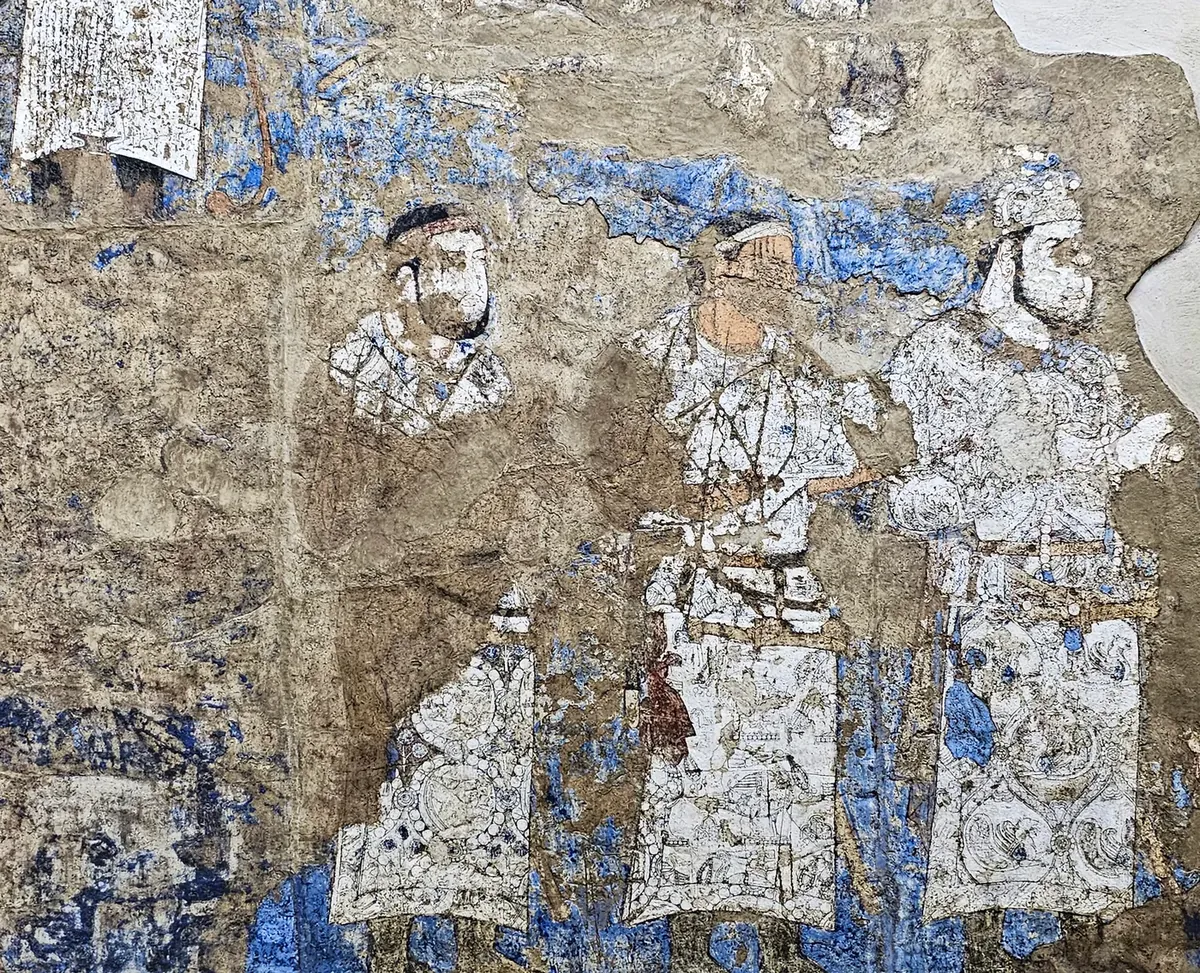
Between them are the Göktürks, and their position is the point. Long-haired Göktürks, and not native Sogdians, serve as the guards who usher the gift-bearers in.[2] Further Göktürks with long hair fill the second and third friezes. Many of them are grouped in camps, sitting cross-legged with their backs to the viewer, below the destroyed figure above them.[2] A Sogdian household painted its own principal wall and gave the doorkeeping to the Göktürks. Some scholars compare their office to that of the Persians and Medes who lead the foreign delegations before the enthroned king on the Apadana reliefs of Persepolis, a thousand years earlier.[4]
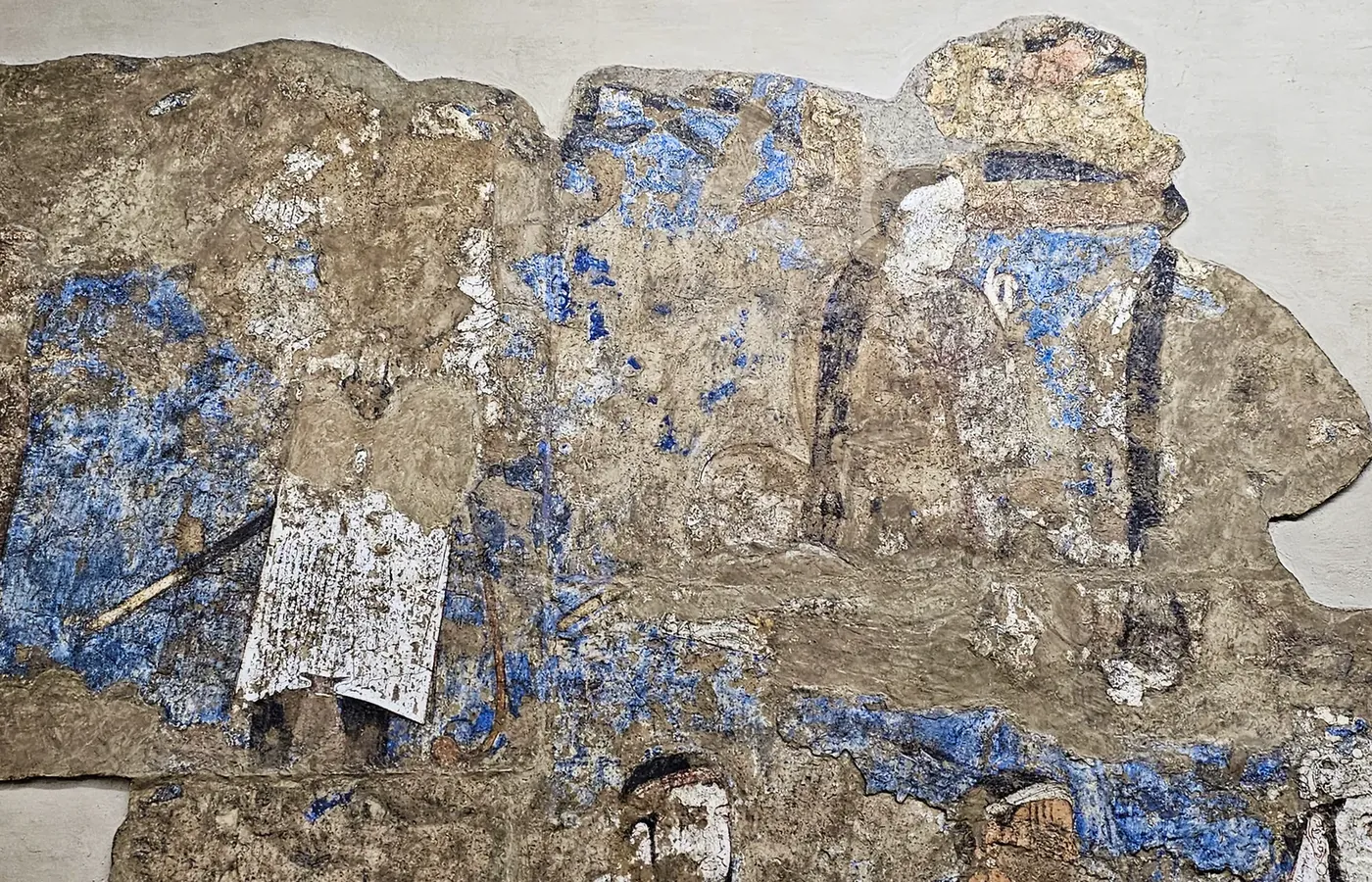
A second description of the same wall has the Göktürk warriors seated in a circle at the feet of a king or a lost deity. Chinese envoys and Sogdian nobles approach in procession.[9] The two accounts agree on who is in the room. They differ on what the seated group is doing, and the destroyed upper register is the reason.
The occasion is generally identified with the Sogdian New Year, Nowruz.[1] The calendar complicates this. In seventh-century Iran the drift of the calendar had moved Nowruz from the first day of spring to the month of Ādur and the summer solstice. There it coincided with the official opening day of taxation.[2] Some scholars therefore take the procession of gift-bearers on the west wall to be a New Year of tribute and taxes, owed to the powers that honoured the painting.[10] There are several views of who stood in the lost upper register. One proposal puts there not the Chinese emperor in person but his deputy, the Tang protector-general of Sogdiana.[8]
The figures in feathered caps
Two figures on the west wall wear round-collared jackets, ring-pommel swords and headdresses crowned with a pair of feathers. The headdress is the jougwan of the Chinese records. Goguryeo tomb paintings show it, and so do Chinese depictions of foreign envoys, in royal tomb murals and at Dunhuang.[11]
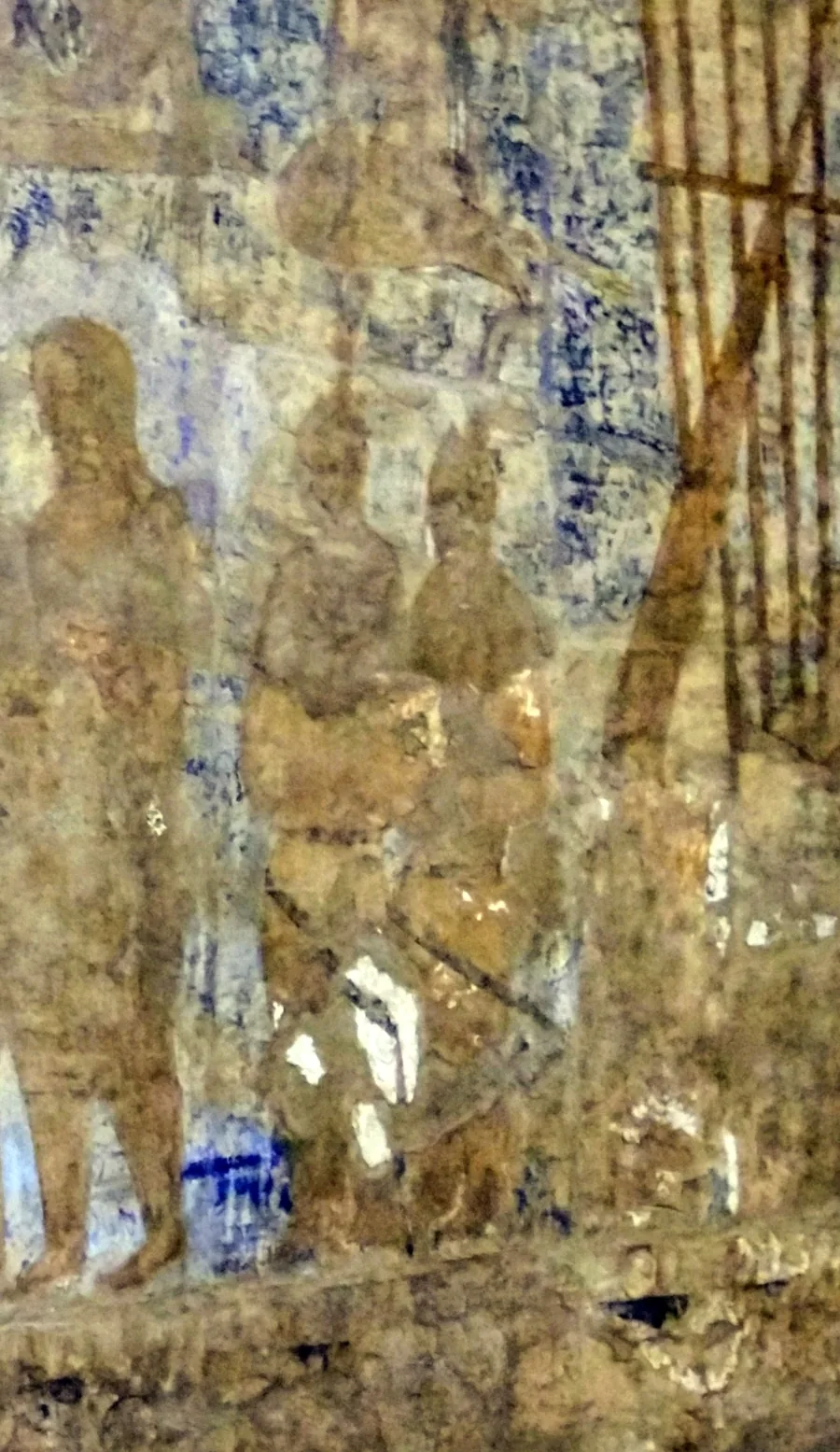
Who the two are is argued. Anazawa Wako holds that the two emissaries in jougwan were most probably of Goguryeo origin. Roh Taedon identifies them as envoys from Goguryeo seeking military allies with a Tang war coming. Kim Won-yong first took them for men of Silla, without excluding Goguryeo.[11] A further doubt runs underneath all three: whether the figures record an actual embassy that came to Samarkand or reproduce a stereotyped image of Koreans in general.[11]
This is the one proposed pictorial contact between the Göktürk world and the Korean peninsula. It stands at the same level of certainty as the textual one. The Bökli question treats the textual side. The modern use made of both is set out in its own article.
The north wall
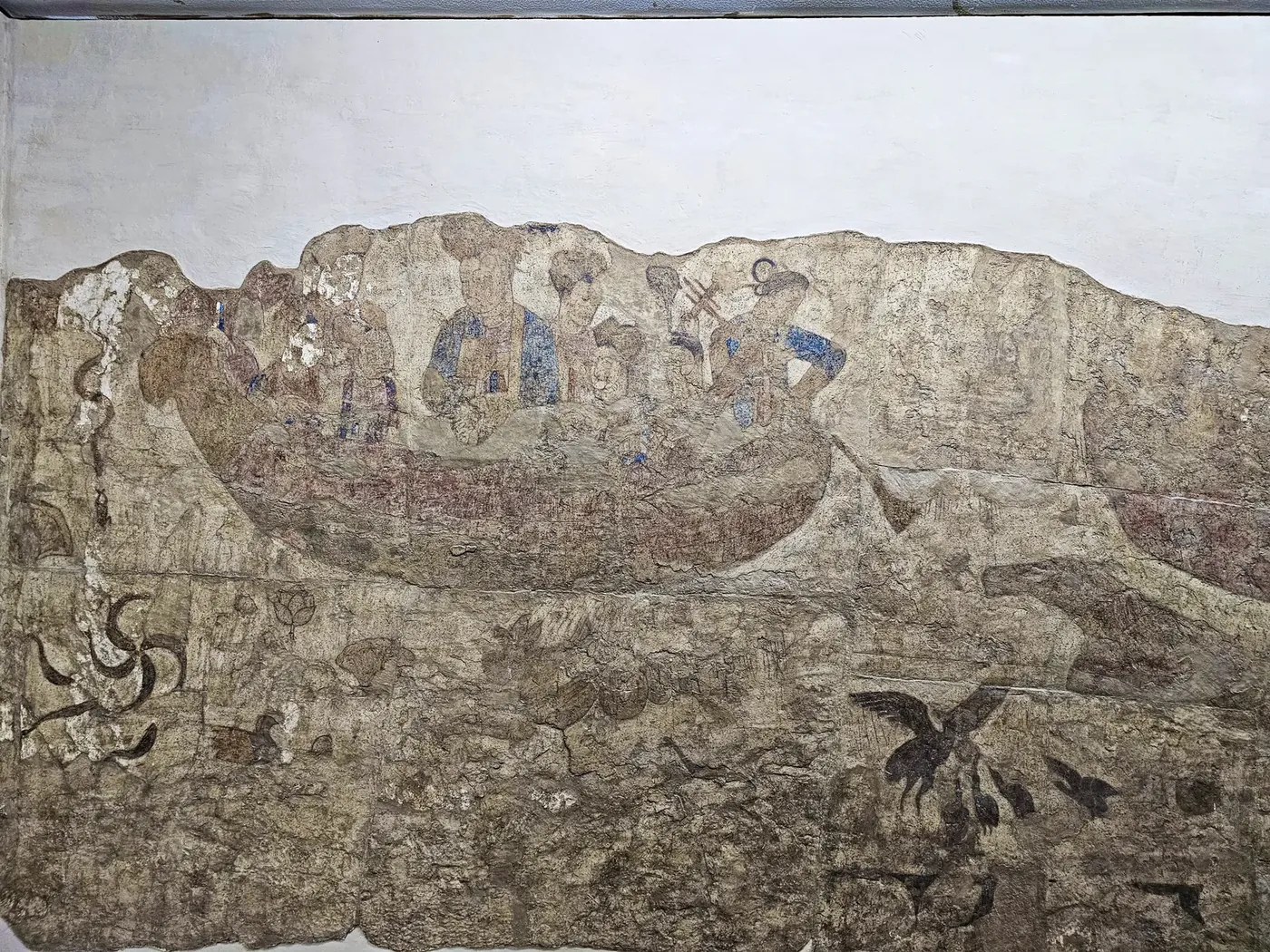
The north wall shows China. One widely followed interpretation identifies its theme as the Duanwu or Dragon-Boat festival. In the seventh century this festival fell at the summer solstice, like the Sogdian New Year of the time.[8] China’s royal couple are shown taking part in the festival, on the very day of the Sogdian New Year.[8] The wall shows Chinese artistic elements throughout.[4]
The south wall
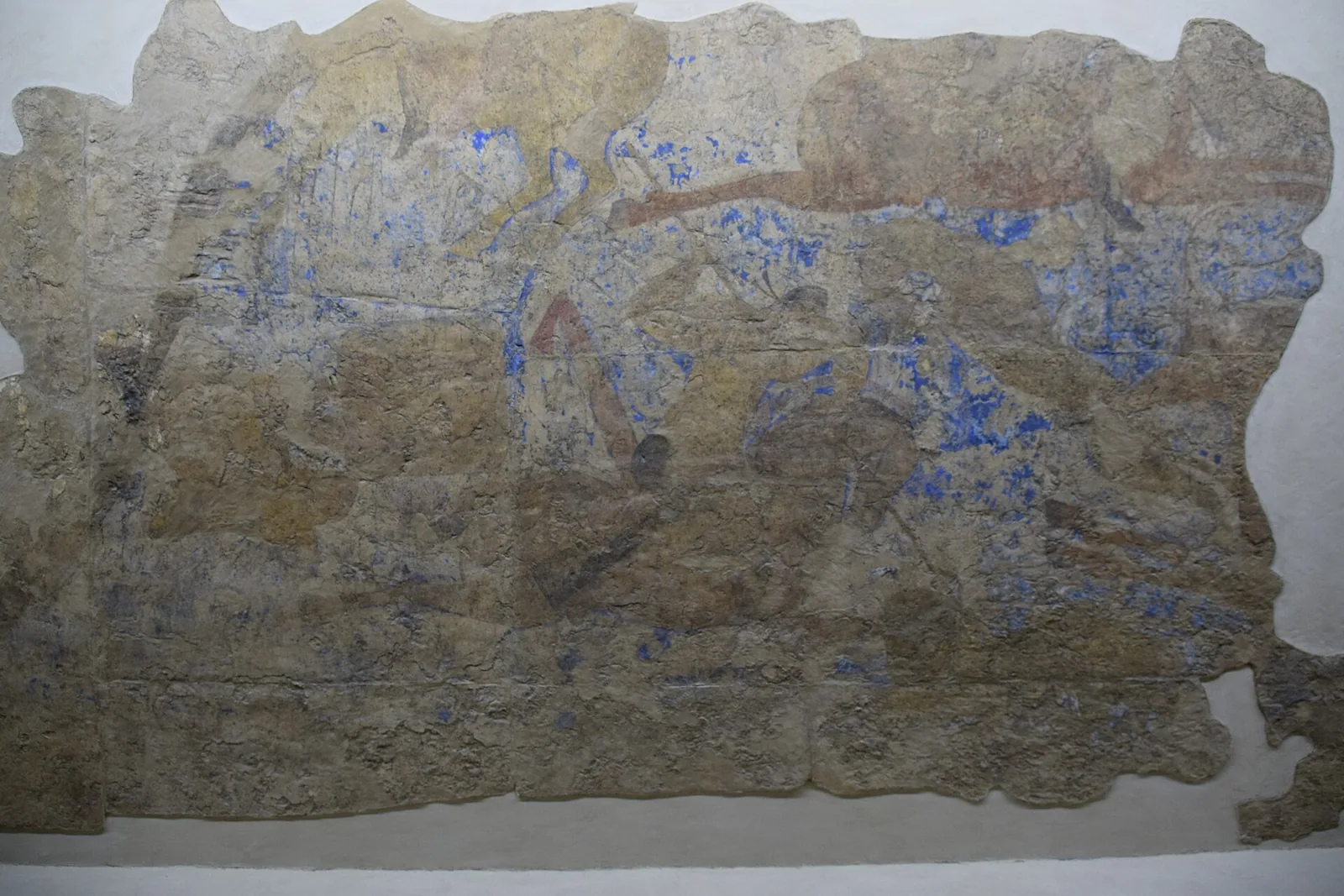
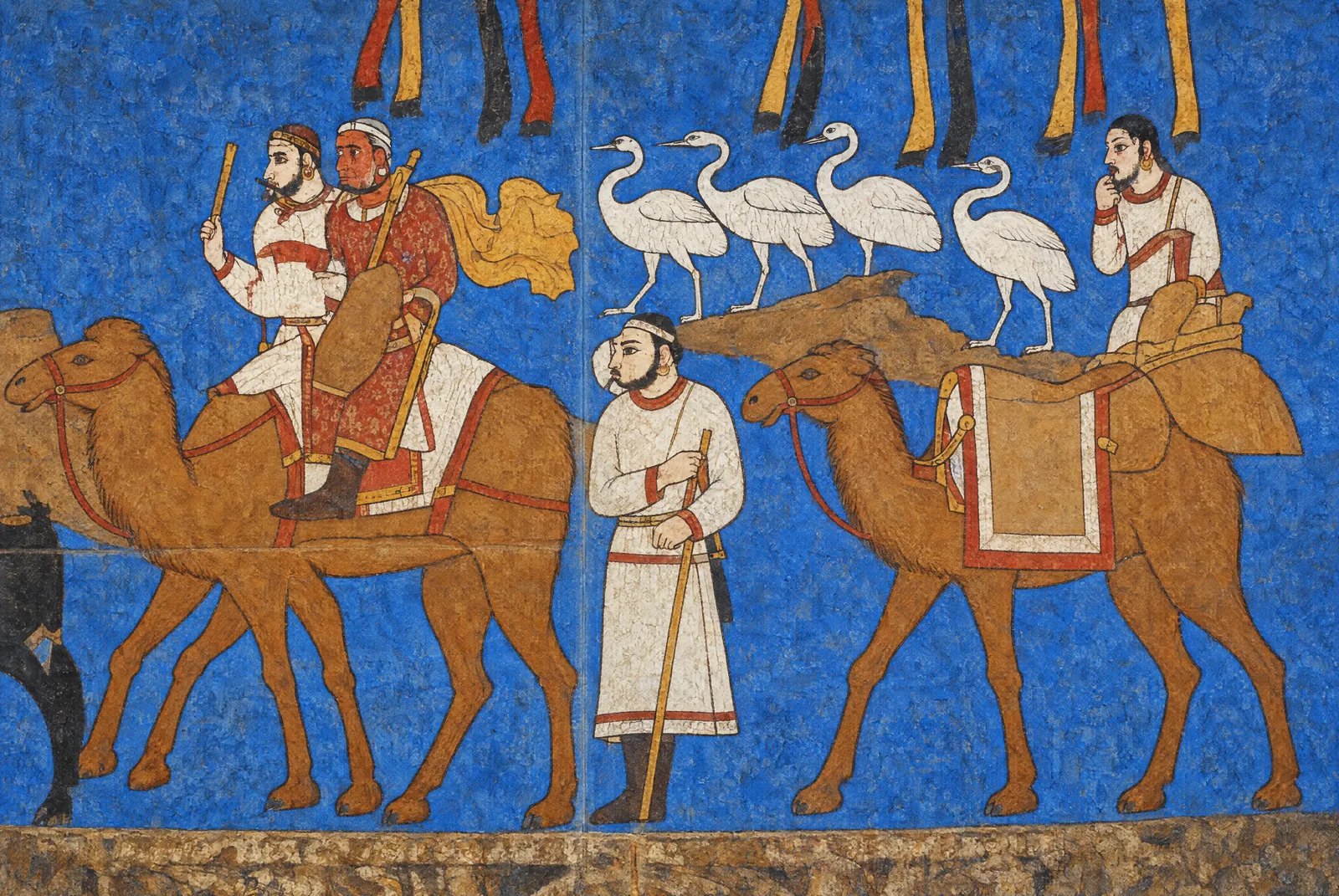
The south wall is the best preserved and the most brilliant in colour, painted against an intense lapis-blue ground.[12] Here the figures move in a single horizontal flow, as in the narrative friezes of other Sogdian halls. Riders on a small white elephant lead a procession of gift-bearers.[12] Four richly dressed women on horseback follow. Then come two Chaganian dignitaries riding side-saddle as they prepare to dismount from their camels. After them come two men and a woman on foot, leading a trained horse and two pairs of white geese.[12] The procession makes for a small guarded building at the far left.[12] At its rear is an outsized Varkhuman on horseback, followed by his mounted troops. He welcomes the envoys from Chaganian after their long journey and escorts them to the south gate of Samarkand.[12] Of the upper register only the hooves of many horses and fragments of stirrups survive.[4]
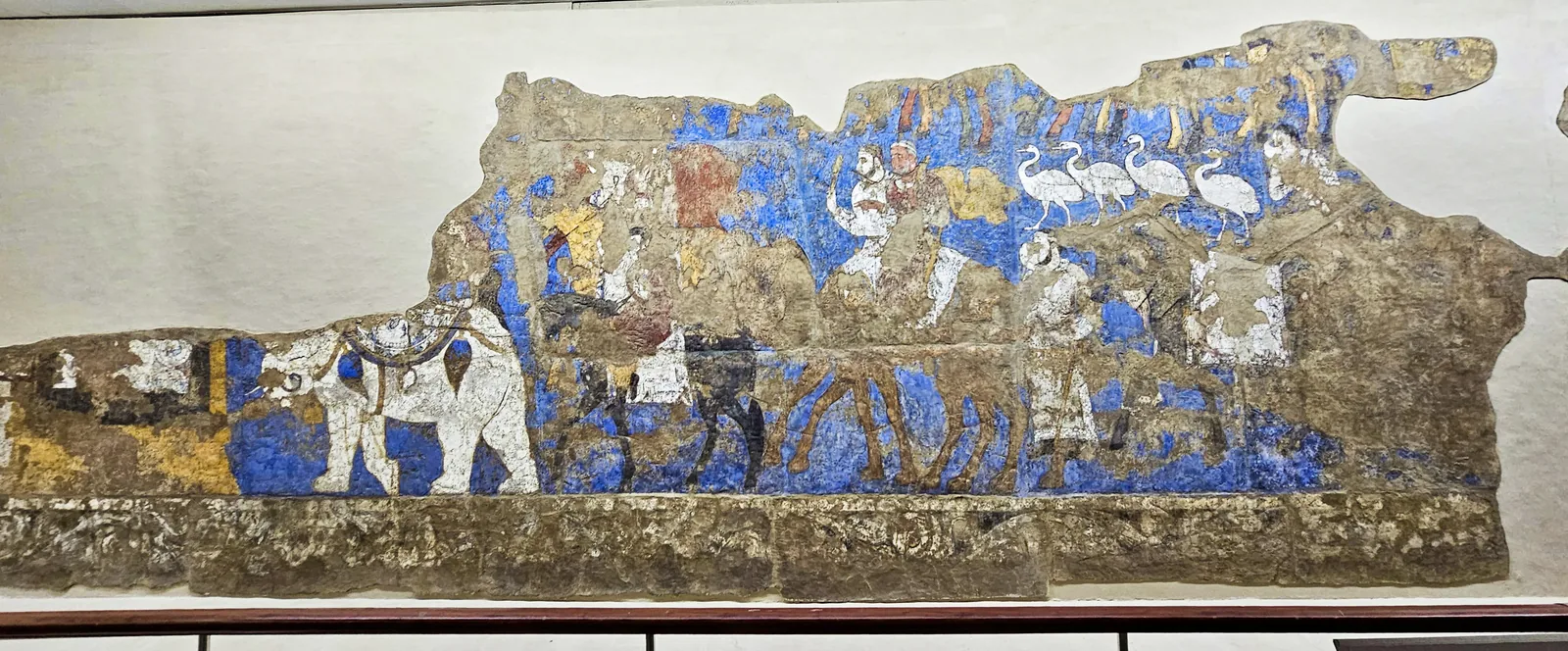
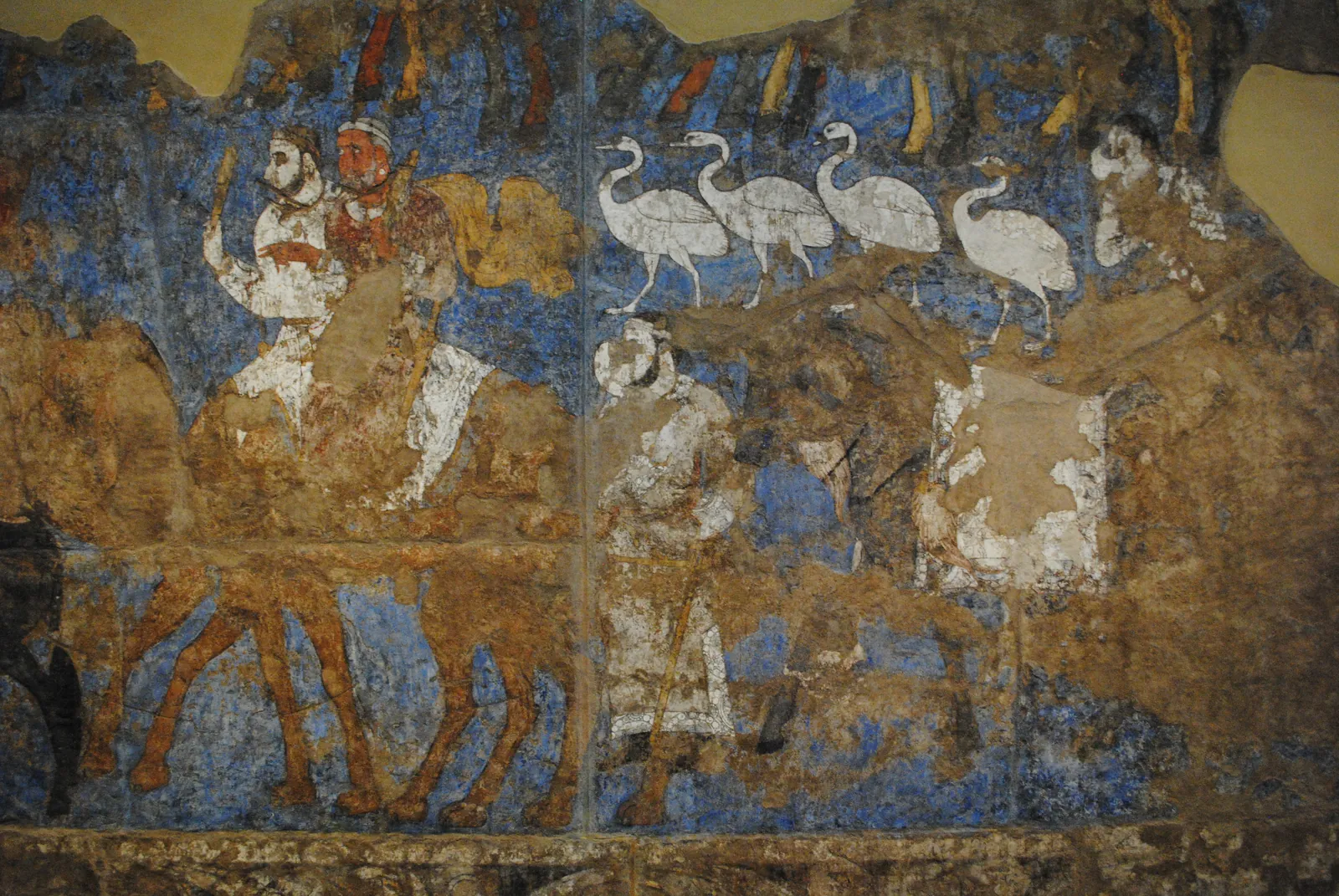
 Original
Reconstruction
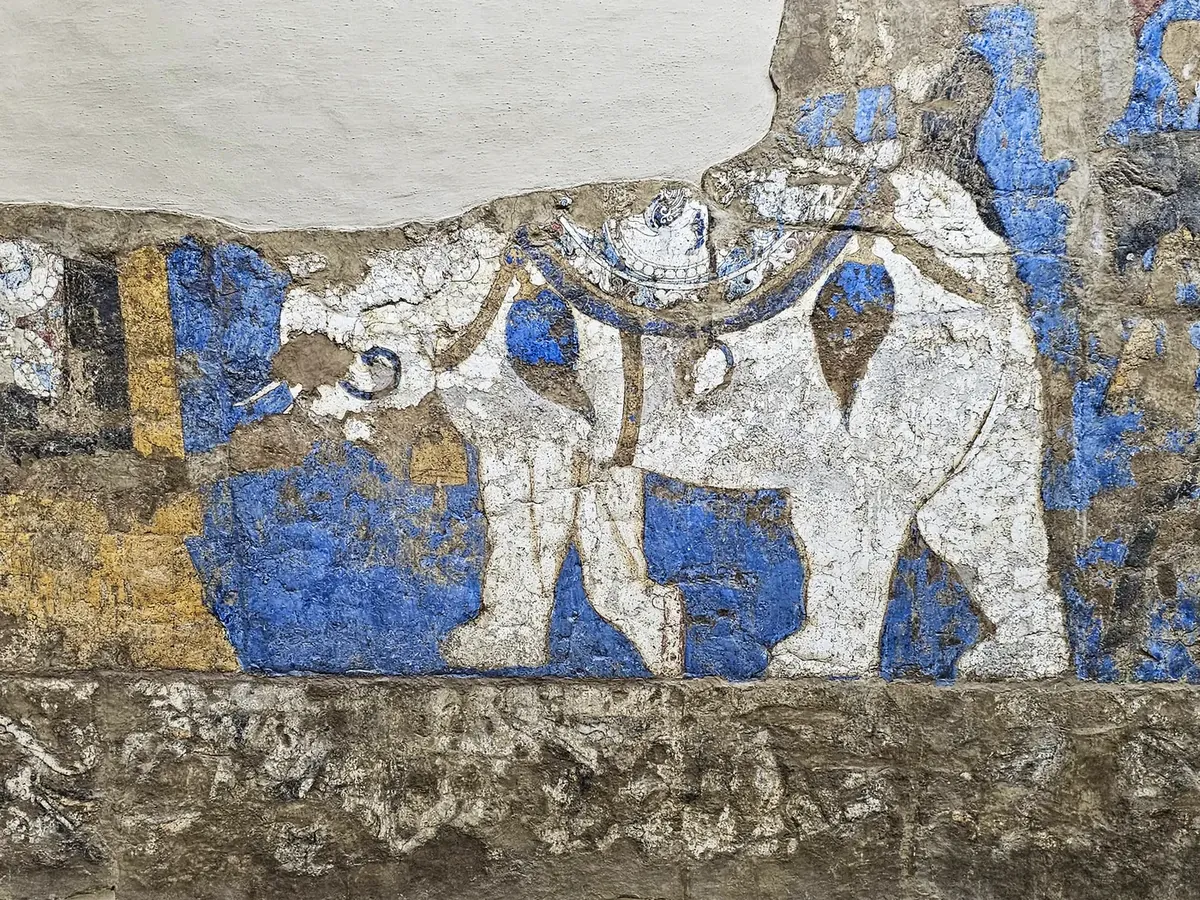
The east wall
The east wall, which holds the entrance, is poorly preserved.[1]
Imagery and belief
The hall is exceptional among Sogdian paintings for what it leaves out: gods, demons and supernatural beings.[12] Mythical creatures appear only as repeated patterns on textiles. The most notable is the dog-bird, the senmurv, on the robe of Varkhuman. It is modelled on the royal robes of the Sasanian kings.[13] The same pattern covers the coat and trousers of Khosrow II in his great equestrian relief at Taq-e Bostan.[13] The Sogdians of the seventh century had largely kept their Zoroastrian faith despite the Manichaean, Christian and Buddhist missions among them.[13] Some scholars explain the absence of gods by the secular purpose of the occasion, a New Year on which revenue was collected for the great powers.[10]
Painted halls in Sogdiana
The Chinese histories describe another such hall. In its account of He, the Sogdian principality of Kushaniya, the Xin Tang Shu writes that to the left of the city stood a storeyed building. Its north side was painted with the ancient emperors of China, its east side with the Göktürks and the Brahmans, and its west side with the kings of Persia, Fulin and others. The ruler went there every morning to bow and then withdrew.[6] The Kushaniya hall is not the Afrasiab hall, and its directions differ. The description shows that halls painted with the rulers of the world by direction were known in Sogdiana under the Tang.[6]
Göktürks and Sogdians
Beyond the Korean question, the fresco is one item in a run of evidence for the fusion of Sogdians and Göktürks in the ruling strata of the sixth and seventh centuries. A Sogdian marriage contract unites a Göktürk and a noblewoman. Panjikent had a Göktürk king at the end of the seventh century. At Krasnaya Rechka, couples lie buried with their horses after the Göktürk manner. On the wooden frieze of Kuyruk-tobe, the figures wear Göktürk dress.[9]
Preservation and reconstruction
The paintings were removed from the hall to the nearby museum, where they remain.[2] Their colours have faded since the excavation. An early photograph shows the head of a Chaganian envoy on the south wall before its colours degraded.[13] The figures are numbered after a publication of 1975. Drawn reconstructions of the missing parts have been published beside tracings of what survives.[4] Original and restored parts have to be told apart wherever the paintings are reproduced.[4]
Value as a witness
The painting bears witness to itself: that it exists, what is on it, and how it was made. Its date comes from the room, from the Chinese record of Varkhuman’s appointment and from the political situation the wall depicts, not from the image.[1] What the figures mean is interpretation, and the interpretations differ. What is not interpretation is the place the painters gave the Göktürks: at the door, among the envoys, inside the king’s own hall.
References
- ^ a b c d e f g h i Azarpay 2014, p. 49
- ^ a b c d e f g h i j Azarpay 2014, p. 50
- ^ a b c Centre 2001
- ^ a b c d e f g h i j k l m Azarpay 2014, p. 56
- ^ a b Tang Huiyao (Institutional History of the Tang), juan 99
- ^ a b c Xin Tangshu (New Book of Tang), juan 221
- ^ Azarpay 2014, p. 50–51
- ^ a b c d Azarpay 2014, p. 51
- ^ a b de la Vaissière 2005a
- ^ a b Azarpay 2014, p. 54
- ^ a b c Lena 2008
- ^ a b c d e f Azarpay 2014, p. 52
- ^ a b c d Azarpay 2014, p. 53
Sources
- Tang Huiyao (Institutional History of the Tang), juan 99
- Xin Tangshu (New Book of Tang), juan 221 (after Jiu Tangshu)
Literature
- Guitty Azarpay, The Afrasiab Murals: A Pictorial Narrative Reconsidered (2014)
- Étienne de la Vaissière, Sogdian Traders: A History (2005)
- Kim Lena, Goguryeo People Wearing Jougwan in Tang Chinese Art (2008)
- Republik Usbekistan / UNESCO World Heritage Centre, Samarkand – Crossroads of Cultures. Nomination Documentation (603rev) (2001)
Articles resting on this source 1
What links here4
- Persons
- Afrasiab
Cite this article
Yavuz, Emre-E. “Afrasiab paintings.” Turkic Atlas, revised 8 November 2026. https://turkicatlas.org/sources/afrasiab-murals/
Last revised: 8 November 2026


