- 400
- 500
- 600
- 700
- 800
- 900
- Rouran 400–554
- First Göktürk 552–630
- Tang rule 630–682
- Second Göktürk 682–744
- Uyghur 744–840
- Kirghiz 840–924
- Huns 370–469
- Western Göktürk 552–659
- Türgesh 699–766
- Karluk 766–800
- Khazar 650–969
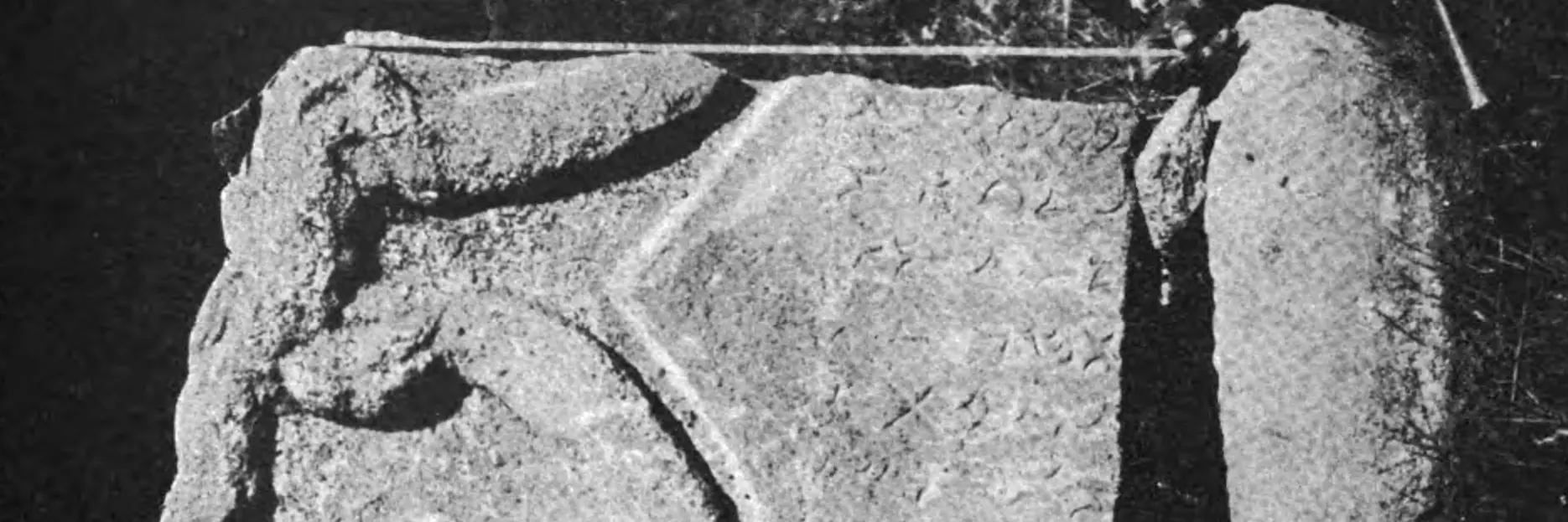
The stele stood east of the main street of the Uyghur capital on the Orkhon. The city had long been in ruins when a Russian mission found the stone in 1889. Further fragments came up in 1890 and 1891.[1]
Three faces
The stele carries three texts: one in Chinese, one in Sogdian and one in Old Turkic.[1] In 1909 the language of the third text was determined to be Sogdian and not Uyghur.[2] Of the three, the Chinese is by far the best preserved, and it is the one that has been read.[1] Rubbings were given to members of the Zongli Yamen to decipher. Their results were published in the Russian collection of Chinese inscriptions from the Orkhon monuments, and the Chinese face has since been translated into European languages several times.[1] What survives of the Sogdian and of the Old Turkic has been edited separately and amounts to much less.[1] The runiform text is badly worn. Only five lines at the head of the stone can be read, and each of them lacks its first letter. In Radloff’s restoration they read: “This is the writing of the Uyghur khagan Alp Bilge Täŋri, who has found qut in heaven.”[3]
The stone appears to have been cut in the early decades of the ninth century.[1] One list of the monuments of the Turkic period dates it to 825.[4]
Reliability
Two things in the history of the Uyghur Khaganate rest on this stone and on nothing else.
The first is the conversion to Manichaeism. The Chinese dynastic histories do not mention it. It mattered enormously to the Uyghurs and not at all to China, and the histories select accordingly. Without the Karabalghasun inscription and a handful of Turfan documents, the single most consequential decision of Bögü Khan’s reign would be invisible.
The Chinese face also holds a gap that a later reading has partly filled. In the part about the introduction of Manichaeism, a lacuna of two characters is followed by the characters hi-si-to. The translators of 1913 rendered them as “complete virtue” and said that they did so for want of anything better. A reading of 1929 takes them as the end of a Chinese transcription of the Iranian word mayistag, “master”, the third of the five grades of the Manichaean church. The Chinese catechism translated in 731 lists those grades: twelve teachers, seventy-two bishops, three hundred and sixty masters, the elect and the hearers.[5]
The second is the restoration of the Uyghur state under the founder of its second dynasty. Only the inscription sets it out.[1]
The Uyghur collaborator
A Uyghur helped to write the Chinese face. The Chinese transcribe his title as Yinanzhu. He may well have seen the events he records, or heard of them from men who had. That is closer to the events than any of the Chinese histories gets.
The authors of stelae of this kind paid close attention to veracity. Their accounts can normally be taken as factual, even where the manner is epic rather than historical.
References
Literature
- Colin Mackerras, The Uighur Empire According to the T'ang Dynastic Histories (1972)
- Étienne de la Vaissière, Sogdian Traders: A History (2005)
- Wilhelm Radloff, Die alttürkischen Inschriften der Mongolei (1894–1895, parts 1–3)
- Albert von Le Coq, Chotscho. Facsimile-Wiedergaben der wichtigeren Funde der ersten Königlich Preussischen Expedition nach Turfan in Ost-Turkistan (1913)
- Hüseyin Namık Orkun, Eski Türk Yazıtları (1994)
- Talât Tekin; Mehmet Ölmez, Türk Dilleri: Giriş (2003)
- Paul Pelliot, Neuf notes sur des questions d'Asie Centrale (1929)
Articles resting on this source 10
Ancestor Cult · Bögü Khan · Huaixin's campaign against the Kirghiz · Kün Tengri · Manichaean Diet of the Uyghurs · Old Uyghur · Ordu-Balık · Orkhon valley · Uyghur Khaganate · Yaglakar
What links here9
- Persons
- Bayanchur Khan · Bögü Khan
- States
- Uyghur Khaganate
- Conflicts
- Uyghur–Kirghiz War
- Battles & Events
- Huaixin's campaign against the Kirghiz
- Places
- Ordu-Balık · Orkhon valley
- Religions
- Manichaean Diet of the Uyghurs
- Sources
- Tariat inscription
Cite this article
Yavuz, Emre-E. “Karabalghasun inscription.” Turkic Atlas, revised 8 November 2026. https://turkicatlas.org/sources/karabalghasun-inscription/
Last revised: 8 November 2026

