
A shorter path for readers who want to know what the terms carry before they read the narratives: the title every ruler bore and how it is written, the second title of the western wing, the ruling family's name, and the modern debate about where all of them came from.
1/4
Khan (Khagan)
400–969
The title, its forms, its history, and the ranks around it.
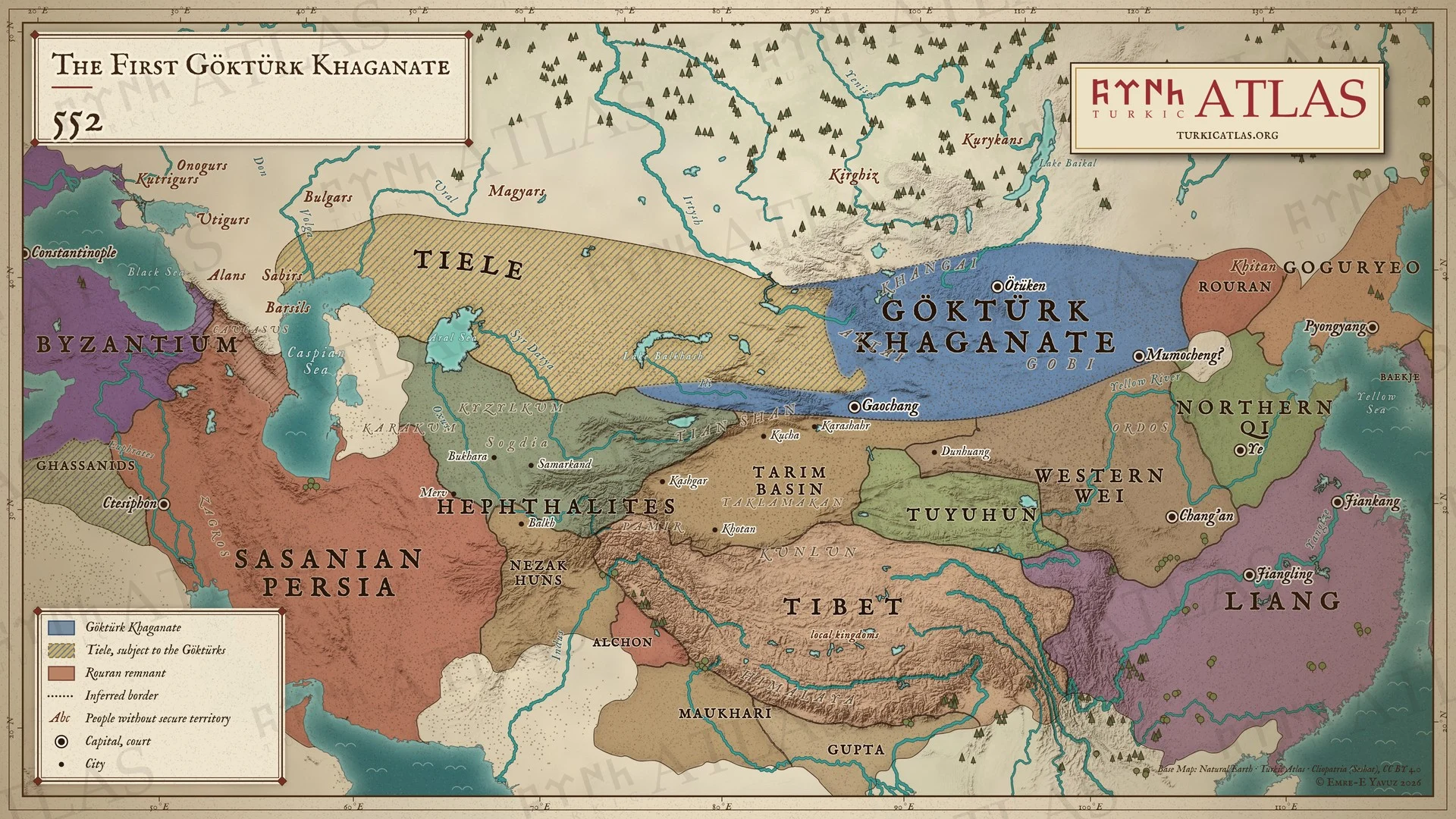
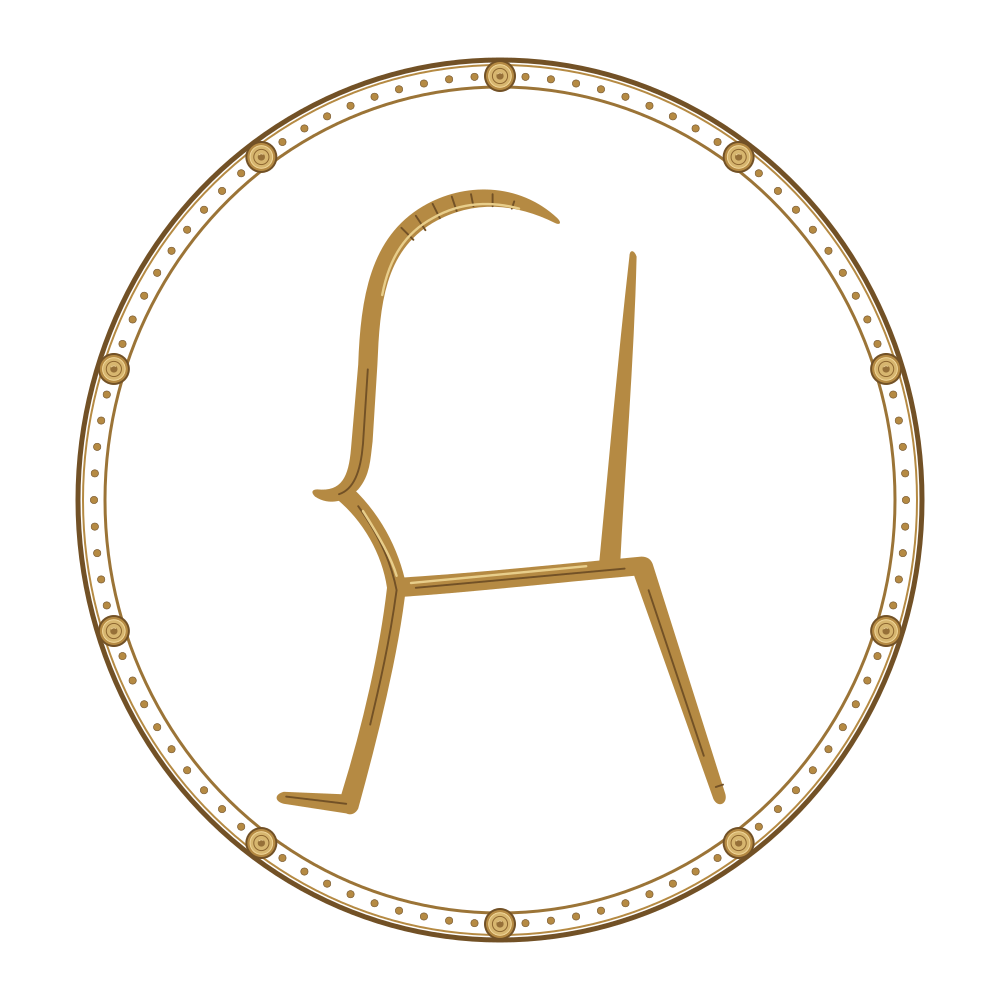
The title of the supreme ruler of the steppe, written 可汗 and read khagan, is first recorded among the Xianbei, in 261 and again in 278. About 400 the Rouran founder Shelun adopted it. Its origin is unknown; a derivation that makes it Rouran fails against those dates. In 552 Bumin took the title from the Rouran with their empire; the Zhou Shu writes his style 伊利可汗, Illig Khan. Beneath the khan stood the yabgu and the shad, and the begs, the lords of tribes, whose consent he needed. Whether the shorter khan was a lower rank in the sixth century is not settled; the inscriptions of the eighth write only kagan. The long form passed to the Uyghurs, the Khazars, the Avars and the Mongols, the short one to every later ruler of the Turkic and Mongol world.
 First Göktürk Khaganate
2/4
Yabgu
The title of the west, and where it came from.
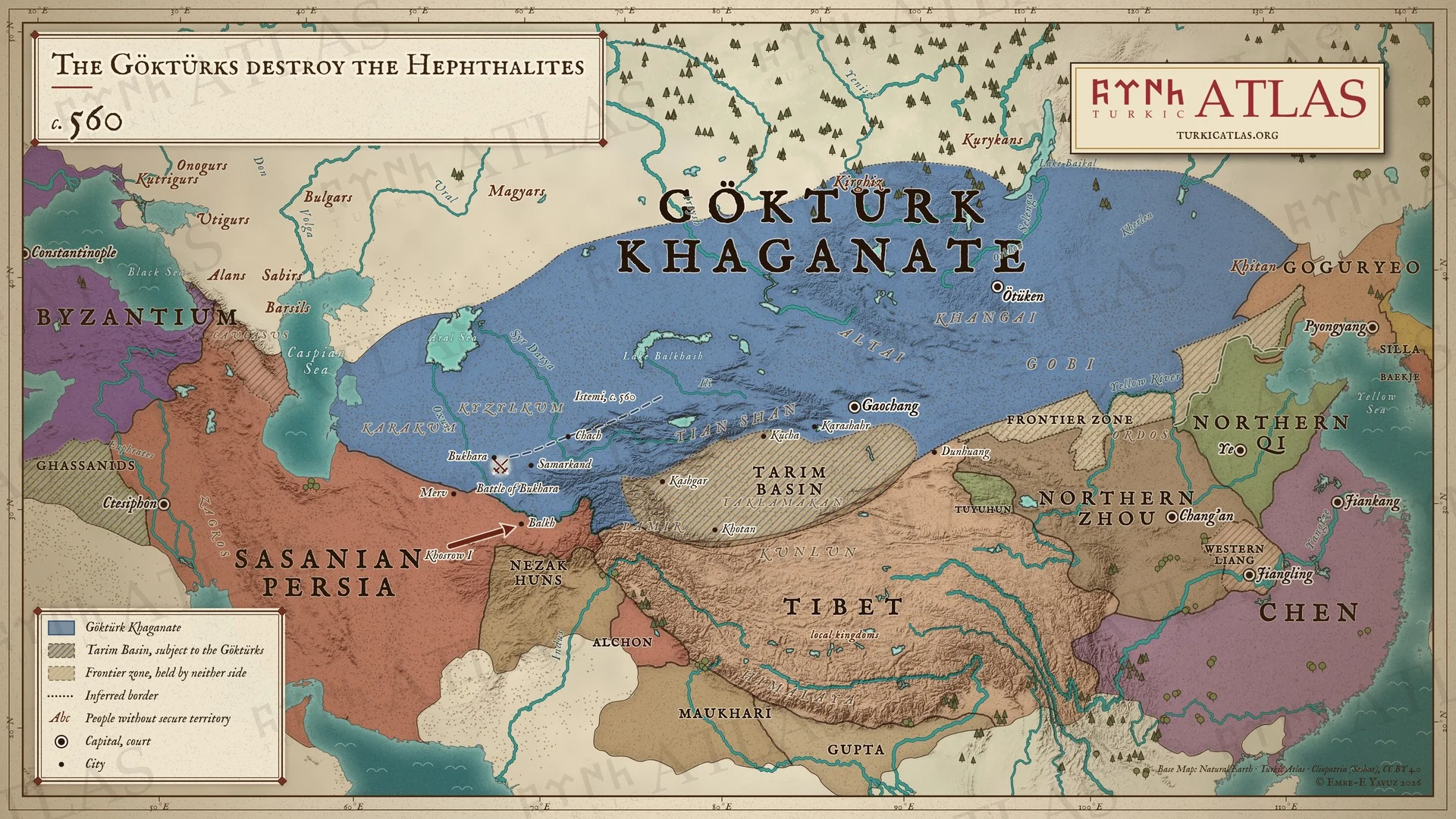
The yabgu stood second in the Göktürk order, below the khan and above every other office. Before 552 it was most likely the Ashina's own title under the Rouran, and at the founding it passed to the junior line. Istemi, Bumin's brother, held the west with it until his death about 576. He campaigned to the Oxus, destroyed the Hephthalites together with Persia and sent Maniakh to Constantinople, and in all of it he was yabgu, not khan. Menander calls him the king of the Göktürks and once the Chagan; the Chinese histories treat his command as subordinate. Whether the word itself is Turkic or borrowed is still argued. The title stayed with the west, and rulers from the Oxus to the Volga still bore it after the khaganate had ended.
- First Göktürk Khaganate
3/4
Ashina
439–969
The name of the house and the three accounts of its origin.
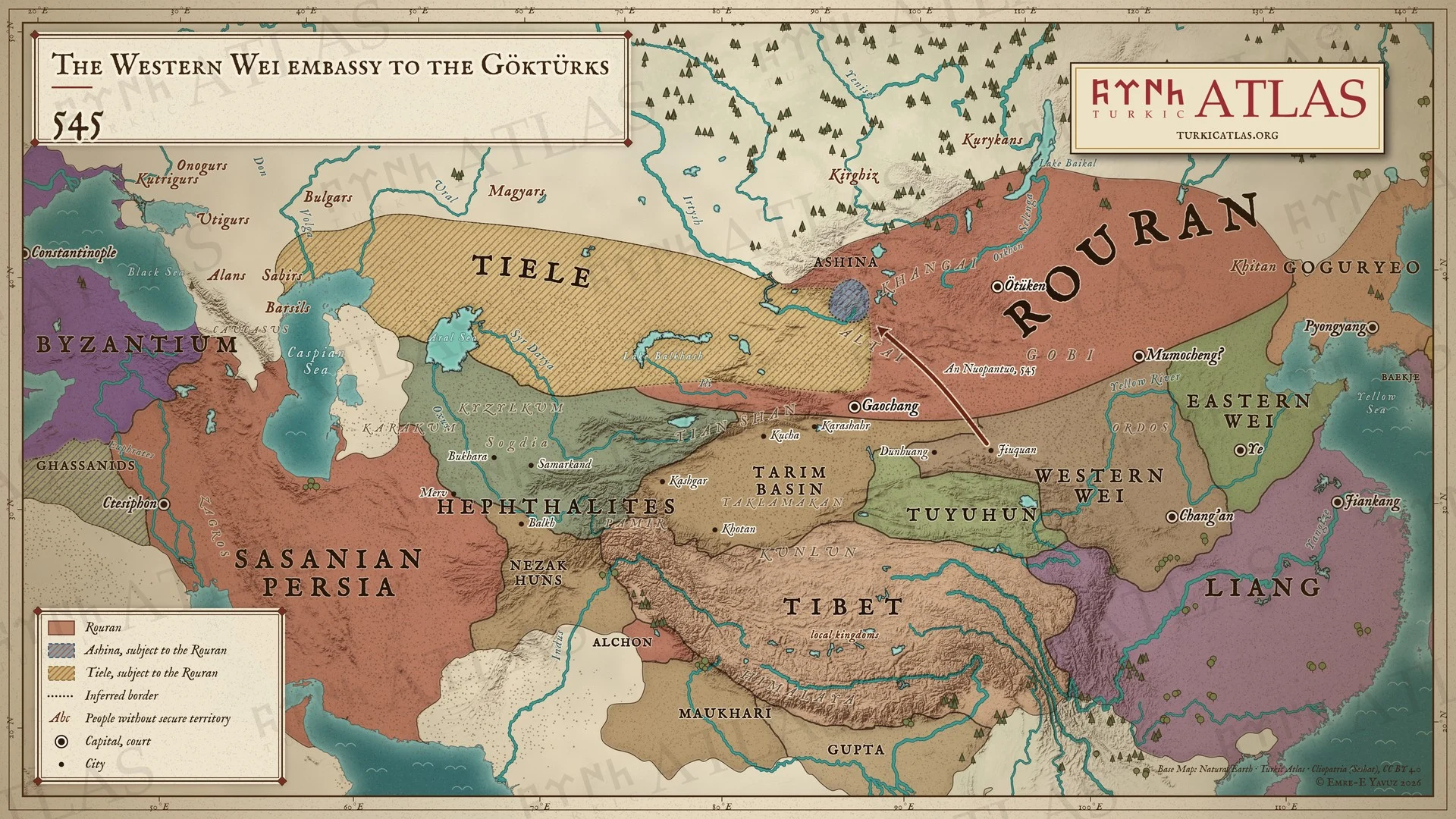
The Chinese histories write the name of the Göktürk ruling house 阿史那, Ashina, and its meaning is unknown. They give the house several origins, and these do not agree. The Zhou Shu makes the Göktürks a branch of the Xiongnu. The Sui Shu tells of a boy, sole survivor of a destroyed people, whom a she-wolf fed; in a cave north-west of Gaochang she bore ten sons, and Ashina, the ablest, became their ruler. It also has the ancestors of the Göktürks flee from Pingliang to the Rouran with five hundred families when the Wei crushed the Northern Liang of Gansu in 439, and work iron on the Golden Mountain. The Kül Tegin inscription, the family's own account, says nothing of Gansu, the wolf or the Xiongnu. Everything else about where the Ashina came from was written by their neighbours.
 Ashina
4/4
The Turkic ethnogenesis debate
Every continuity claim as a position, with its holder and its grounds.
The Zhou Shu makes the Göktürks a branch of the Xiongnu; the Kül Tegin inscription begins them with Bumin and says nothing of descent. The oldest continuity claim makes the Xiongnu Turkic: one reading takes their ruler's title, Chengli Gutu Chanyu, for three Turkic words, a second reads their language as Yeniseian, a Siberian family. Joseph de Guignes (1756) wrote the first great Xiongnu ruler's name as Mei-Tei; in Turkish translation it became Mete Han. Sergei Klyashtorny (1994) argued from the non-Turkic look of the names Bumin, Istemi, Mukan and Taspar for early Iranian contact. A study led by Xiao-Min Yang (2023) found Empress Ashina, Bumin's granddaughter, 97.7 per cent north-east Asian in ancestry. One genome cannot show a great-grandparent's language. The Göktürks begin where the sources begin them, with a family of smiths in the Altai in the 540s.
© Emre-E Yavuz 2026© Emre-E Yavuz 2026© Emre-E Yavuz 2026
