
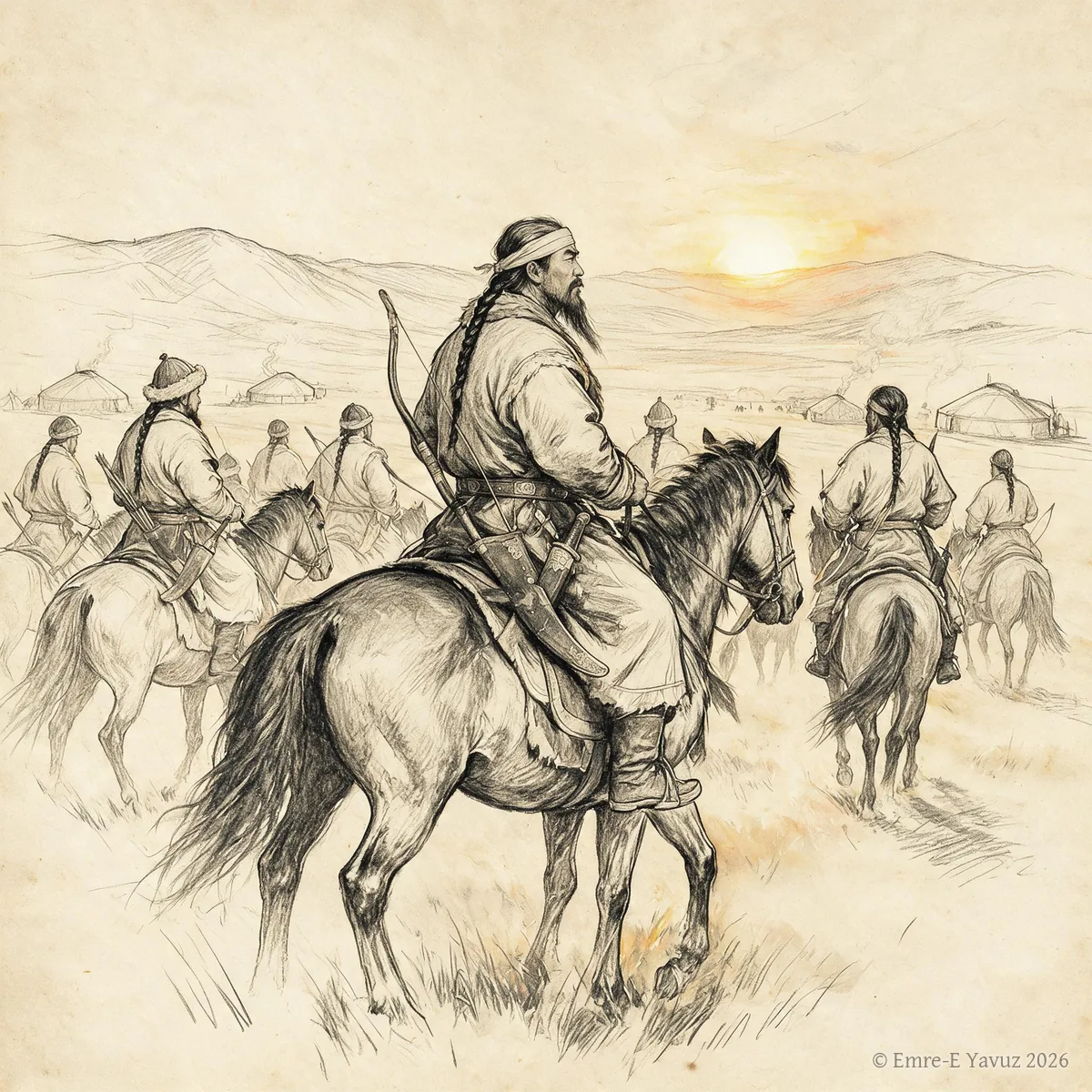
The yabgu stood second in the Göktürk order, below the khan and above everything else.[1] For the first half-century of the khaganate, the office had one holder who mattered. With it he held the whole west.
The office in the sources
The Zhou Shu lists the great offices. It puts the yabgu first, then the shad, then the tegin, then the ilteber, then the tudun. It says that, with the lesser offices, there were twenty-eight ranks in all, every one of them hereditary.[1] The Sui Shu gives the same order.[2] Twenty-eight hereditary grades are not a war band. They are an administration, and the Chinese observers recorded them as one.
The Kül Tegin inscription names the office from the other side. İltiriš had set the broken people in order again. In that order he organised the Tölis and the Tarduš and gave them a yabgu and a shad.[3] The two titles come as a pair and are given together. They are the commands of the two wings.[4]
The Tariat inscription of the Uyghur steppe empire lists the tribes that stood under a yabgu. On its north face, the third line names the tribes under the yabgu, and the fourth line those under the shad.[5]
Istemi
Istemi is the reason the title matters. He was the brother of Bumin. At the founding he took the western command, and he held it until his death about 576. He campaigned to the Oxus and beyond. With Persia he destroyed the Hephthalites. He sent Maniakh to Constantinople and received Zemarchos. In all of this he is yabgu and not khan. The Roman reports never use the title. Menander calls Istemi the king of the Göktürks and their leader, and once the Chagan. He treats Istemi as a sovereign.[6] Menander’s name for him, Silziboulos or Dizaboulos, has itself been understood as the title joined to a name, Sir Yabgu. The Chinese histories give him the title and treat the western command as subordinate.
Both views are defensible, and the difference between them is the central question of the khaganate’s history. A yabgu who conducts his own foreign policy across three thousand kilometres is either a viceroy of unusual latitude or a co-ruler under a modest style. Which of the two he was, the division after 584 answered retroactively.
The title before 552
The yabgu may be the Ashina’s own title before they were khans. It is the rank they held under the Rouran, carried into the new order and handed to the junior line. The word, on this account, is first attested among the Turkic peoples and not, as has been argued, among Indians, Iranians or Chinese. Attempts at a foreign etymology, it adds, have produced nothing usable. That is a position and not a finding. The competing derivations are real and are held by serious people.
What is not in dispute is the pattern of use. The title travels with the west. It is Istemi’s, then his successors’. After the khaganate it is still carried by rulers from the Oxus to the Volga: by Tong Yabgu in the Göktürk west, and by the yabgus of peoples who had been inside the Göktürk order and kept its vocabulary after it ended.
Rank and its limits
The yabgu could not become khan by holding the office. Rank in the Göktürk order ran by the Töre and by birth in the Ashina house. An office, however great, conferred a command and not a claim. That is why Istemi’s line had to make its claim by other means when the succession broke in 581, and why the civil war that followed was fought over who was entitled rather than over who was strongest. Turkic Atlas sets out the ranks together under the title of khan.
The title lived on at the Karakhanid court. The Kutadgu Bilig of 1069–1070 names yavğu among the honorary ranks a servant can reach, and it tells such a man to keep faith with his lord however much power he holds.[7] It also quotes a “Yavgu of Böke” among its sages.[8] Like the other sages of the book, he is a title, not a known person.[9]
References
- ^ a b Zhou Shu (Book of Zhou), juan 50
- ^ Sui Shu (Book of Sui), juan 84
- ^ Kül Tegin inscription; Tekin 1968, p. 373, 385, 394
- ^ Kül Tegin inscription
- ^ Aydın 2013, p. 18
- ^ Menander Protector
- ^ Kutadgu Bilig; Dankoff 1983, couplets 4069, 4137
- ^ Kutadgu Bilig; Dankoff 1983, couplet 5523
- ^ Dankoff 1983, p. 8–11
Sources
- Kül Tegin inscription
- Zhou Shu (Book of Zhou), juan 50
- Sui Shu (Book of Sui), juan 84
- Menander Protector
- Kutadgu Bilig
Literature
- Emre-E. Yavuz, The Gokturk Empire: 2nd Edition (2025)
- Peter B. Golden, An Introduction to the History of the Turkic Peoples (1992)
- Fikret Turan, Eski Türkçeden Orta Türkçeye Askeri Rütbe ve Unvanlar / Military Ranks and Titles From Old Turkic to Middle Turkic (2018)
- Talât Tekin, A Grammar of Orkhon Turkic (1968)
- Erhan Aydın, Tariat Yazıtı’nın kuzey yüzünün 5. satırı üzerine yeni okuma ve anlamlandırma önerileri (2013)
What links here43
- Persons
- Are Khan · Istemi · Si Yabgu Khan · Sparzeugun · Tuwu
- States
- First Göktürk Khaganate · Karluk Yabgu State · Oghuz Yabgu State · Second Göktürk Khaganate · Yabgus of Tokharistan · Yenisei Kirghiz Khaganate
- Conflicts
- Göktürk Expansion along the Silk Road · Rouran Domination of the Turkic Peoples · The Caucasus campaign, 627–629 · Uyghur–Kirghiz War
- Battles & Events
- Abrui and Shir-i Kishvar · Meeting of Heraclius and Ziebel (627) · The Succession of 587
- Places
- Huo
- Peoples
- Nezak Shahs · Tiele
- Lineages
- Ashina
- Institutions and Titles
- Army of the Steppe Empires · Baghatur · Chepetukh · Fulin Khan · Great Khan · Khan (Khagan) · Külüg Chur · Shad · Sifa · Tegin · The Twenty-Eight Ranks · Tölis and Tardush · Tudun
- Sources
- Kartlis Tskhovreba · Kül Tegin inscription · Sebeos · Tariat inscription · Tonyukuk inscription
- Controversies
- The Göktürks and the Xiongnu
Cite this article
Yavuz, Emre-E. “Yabgu.” Turkic Atlas, revised 8 November 2026. https://turkicatlas.org/institutions/yabgu/
Last revised: 8 November 2026

