
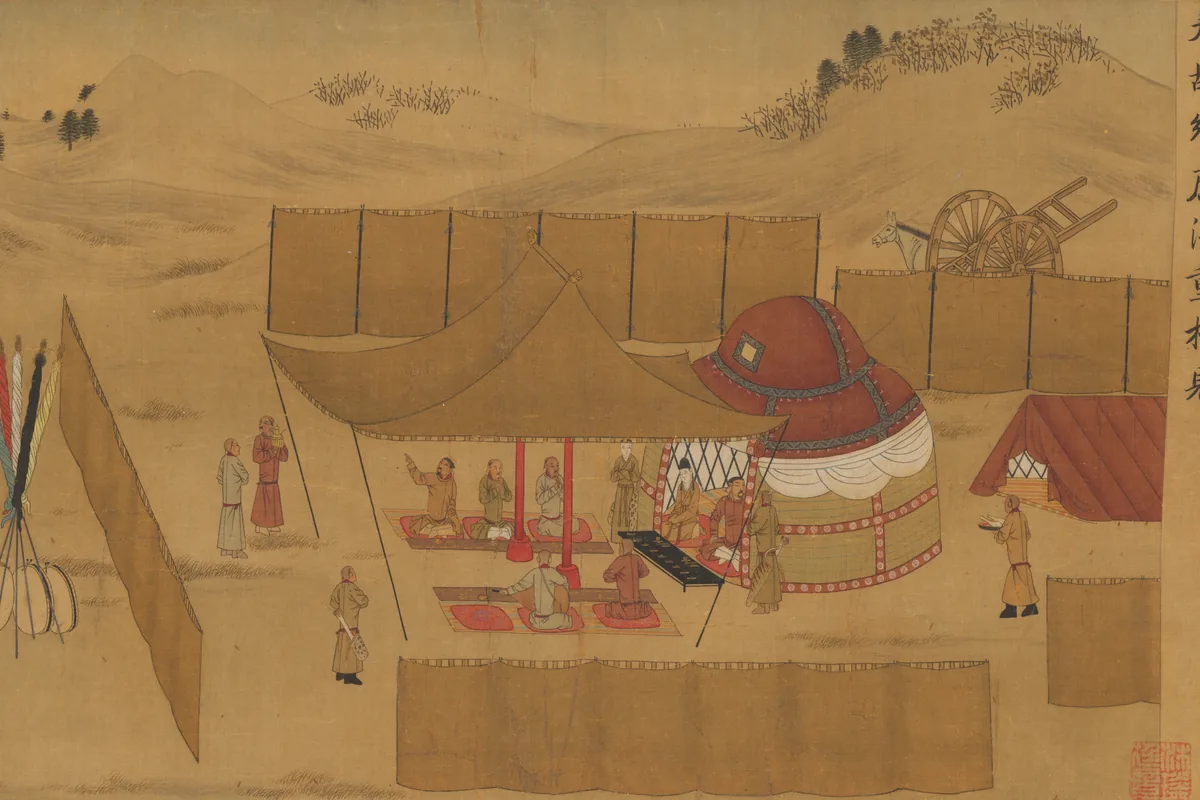
The felt tent is the dwelling of the steppe peoples in the Chinese records, from the Xiongnu to the Kirghiz.[1] The histories call it a qionglu, a domed tent, and often add the word for felt.[2] They tell which way its door faced, who slept in it, how a stranger entered it and how a khan received his guests in it. Mahmud al-Kashgari, who wrote his dictionary in the 1070s, gives Turkic words for the tent and its parts.[3]
The words
The Chinese histories name the tent with two words. 穹廬, qionglu, is the domed tent. 氈帳, zhanzhang, is the felt tent.[2] The Zhou Shu says of the Göktürks that they lived in 穹廬氈帳, domed felt tents, and moved with water and grass.[4] The Sui Shu uses the same four characters.[5]
Other peoples have the same words. The Han Shu has qionglu for the Xiongnu and for the Wusun.[6] The Hou Han Shu has it for the Wuhuan, and so does a Wei history that the Sanguozhi quotes.[7] For the Rouran the Nan Qi Shu writes 穹廬氈帳, the Liang Shu writes 穹廬 and the Song Shu writes 氈帳.[8] The Chinese authors used the same words for the dwellings of every people beyond the frontier. The words therefore do not show how the tents of one people differed from the tents of another.
The princess Xijun, whom the Han sent to the Wusun king as a bride, put the tent into a line of verse.[9] The Han Shu says that she had a palace of her own built and lived in it.[9] Her song, which the same chapter records, says: “A domed tent is my room, and felt is my wall.”[9] The Han emperor heard the song and pitied her. Every second year he sent envoys to her with hangings and brocade.[9]
The tent of the Göktürk khan
The Zhou Shu names the place where the khan stayed, Mount Dujin. His tent opened to the east, it says, out of reverence for the place where the sun rises.[4] The Xin Tang Shu adds that a golden wolf’s-head standard stood at the gate of his camp and that he always sat facing east.[10] The Sui Shu gives the reason for the wolf’s head: it showed that the Göktürks did not forget where they came from.[5] The standard is the tuğ, and the wolf is treated in Asena the She-Wolf. The colours of the khanate’s standards are discussed in Colours and Directions. The east door is set beside the cult of the sun in Kün Tengri.
The pilgrim Xuanzang saw such a tent when he visited Tong Yabgu near Suyab. The khan lived in a great tent adorned with golden flowers, whose glitter dazzled the eyes.[11] The officers of the court sat in two rows on long mats in front of it, all in brocade, and the rest of the guard stood behind them.[11] The Life of the pilgrim remarks that even the lord of a felt tent could be dignified and splendid.[11] The khan came out of the tent and greeted Xuanzang thirty paces from it.[11] Inside, the Göktürks set out no couches. They held that wood contains fire, so they revered it and did not sit on it, and they spread thick mats on the ground. For the monk alone they set up an iron folding seat with a cushion.[11] The visit is told in Xuanzang’s visit to Tong Yabgu.
In 607 the Sui emperor Yang visited the camp of Yami Khan.[12] The Zizhi tongjian says that the emperor wished to impress the Göktürks and had Yuwen Kai make a great tent that seated several thousand.[13] The Sui Shu has the emperor feast Yami and 3,500 of his chiefs in a great tent that held a thousand people.[5] The tent was therefore Chinese work, put up to impress.[13] For the same visit Yuwen Kai built a travelling palace on wheels and a walled enclosure of boards covered with cloth.[13] Yami for his part offered tents for the emperor’s stay. The emperor visited Yami in his tent, and the empress visited the princess Yicheng in hers.[13] The emperor wrote a poem on the occasion: “The felt tents rise to meet the wind, the domed tents open toward the sun.”[5] The poet is the emperor, and the camp is Yami’s. The visit is told in The emperor’s visit to Yami.
At a death the tent held the body. The Zhou Shu says that the dead man lay in the tent. His sons and kin killed sheep and horses and set them before it as a sacrifice.[4] They rode seven times round the tent, and each time they came to the door they cut their faces with a knife and wept, until blood and tears ran together.[2] The rite is told in Riding Round the Dead and Göktürk Face-Cutting.
The Zhou Shu also records a storm that wrecked the tents of the khan Mukan. Zhou envoys had waited for years at his camp for the bride he had promised.[14] Then wind and thunder blew down his tents and did not stop for ten days.[14] Mukan took it for a punishment from Heaven. He sent his daughter off with full ceremony, and she became the Zhou empress Ashina.[14]
Tents of the earlier peoples
A Han envoy once reproached the Xiongnu because fathers and sons lay in the same tent.[15] Zhonghang Yue, the Han eunuch who had gone over to the chanyu, answered him with a defence of the Xiongnu way of life.[15] The Han Shu tells how the chanyu Wuzhuliu refused a Han request for a strip of land that ran into Han territory opposite Zhangye. The lords of the Xiongnu’s western border made their domed tents and their carts from the timber of that mountain, he said, and the land had been his forefathers’.[16] The tent was therefore built with a frame of wood, and the wood came from particular mountains.[16] See also Wagons of the Steppe Peoples.
The Hou Han Shu says that the Wuhuan made their houses of domed tents, with the door opening to the east, toward the sun.[17] The Wei history in the Sanguozhi says that the tents all faced east.[18] Early in the reign of the emperor Guangwu the Wuhuan lived so close to the frontier that, in the words of the Hou Han Shu, they left their domed tents in the morning and reached the walled towns by evening.[17]
In 538 the eldest daughter of the Rouran khan Anagui came south as the bride of the Western Wei emperor.[19] The Bei Shi says that her tents and mats all faced east, because the Rouran honoured the east.[19] At the Black Salt Lake the Wei prince Yuan Fu asked her to face south. She answered that she had not yet seen the lord of Wei and was still a Rouran woman. The Wei guard faced south, she said, and she faced east.[19] Her story is told in Empress Yujiulu.
The Wei Shu says of the Hephthalites that they had no towns and made their houses of felt. They moved to cool country in summer and to warm country in winter.[20] The king’s wives lived in separate camps, two or three hundred li apart. The king went on a round, one place a month, and in the cold of winter he stayed three months without moving.[20] The Liang Shu, which calls the people Hua, says that they lived in felt tents with the door opening to the east.[21]
Entering the tent
The Xiongnu had a rule that a Han envoy could not enter the chanyu’s tent unless he gave up his staff of office and had his face marked with black ink.[15] Wang Wu, a man of Beidi who knew the customs of the Hu, did both and was admitted. The chanyu liked him.[15] Yang Xin would not give up his staff. The chanyu received him outside the tent.[15] The rule is set among the other rules for envoys in Envoys and Embassies.
At a Gaoche wedding the host received his guests without any order of seats. They sat in groups in front of the domed tent and feasted and drank all day.[22] In 758 the Uyghur khan Bayanchur sat on a couch in his tent, in a reddish-yellow robe and a foreign cap.[23] He left the Tang prince Li Yu standing outside the tent.[23] The two scenes are told in The Gaoche Wedding and Seating at the Feast.
Tents of women and of the court
When the Tang princess Taihe came to the Uyghurs in 822, the khan went up into a tower and sat facing east.[23] A felt tent was put up for the princess at the foot of the tower.[23] The Xin Tang Shu calls it a hanging of wool.[24] She came out before the tower in Hu dress and bowed toward the west. Then she went back into the felt tent and put on the dress of a katun.[25] The katun afterwards had a camp of her own, and two ministers went in and out of her tent.[25] When the Chinese envoys left, she feasted them in her tent, and they lingered and wept for the whole day.[23] The wider position of women at the steppe courts is in Women among the Turkic Peoples.
The Kirghiz
The Xin Tang Shu describes the camp of the ruler Are of the Kirghiz. It stood on Green Mountain, with a palisade where a wall would be and felts joined into a tent, which was called midizhi. The other chiefs lived in small tents.[24] In winter the Kirghiz lived in houses roofed with bark.[24] The camp is also treated in Ordu.
Kashgari’s words for tents
Mahmud al-Kashgari lists several Turkic words for the tent. Alaču is a large tent.[26] Čatir is a tent, and the Oghuz say čašir.[27] Käräkü is the tent of the Turkmen and the winter house of the settled people.[28] A proverb that he quotes says of a man that he saw trouble and loaded his tent on his back.[28]
The parts of the tent have words too. A tent band is arıγ in the Barsγan dialect.[29] The tent skirt is sapıγ.[30] Quršaγ is a coil of woven wool wound around a tent, the äw quršaγı.[31] Sıruqluq yıγač is a piece of wood to be made into a tent pole.[32] The felt around the tent is treated with the other fabrics of the dictionary in Felt, Cloth, Leather and Wood in Kashgari’s Dictionary.
For the kings of the Turks Kashgari describes a canopy of silk, under which they seek shade in the summer heat and protection from rain and snow. He names it in the explanation of a verse about a battle.[33] Kashgari’s words come from the Turkic peoples of his own time, three centuries after the last Göktürk khan. They do not show what the Göktürks called their tents.
A Chinese prince in a domed tent
The Xin Tang Shu tells that the Tang crown prince Li Chengqian had servants dressed as Göktürks and set up a camp of felt tents for them under five wolf’s-head standards. He pitched a domed tent and lived in it himself.[34] The history counts the camp among the acts that ended in his fall in 643.[34] The camp is told in Li Chengqian’s Göktürk Camp.
The tent door in the nineteenth century
The Altaian accounts of the nineteenth century give the tent door the same direction in one rite. For the sacrifice of a horse to Ülgen the Altaians set up a new tent, larger and higher than an ordinary one. It was covered with felts and rugs, and its door faced east.[35] The rite is told in Horse Sacrifice. Whether the east door of the rite goes back to the tent of the Göktürks is not known.
Gaps in the sources
The Chinese histories name the tent and say a little of its use. They give no description of its frame, its size, the number of its felt layers, the way it was struck and loaded, or the smoke opening. Among the sources of the Turkic Atlas there is no report of an excavated tent. The felt itself survives in frozen graves of the Altai, which Felt describes. Kashgari’s words name some parts and give no picture of the whole.
References
- ^ Han Shu, juan 94; Zhou Shu (Book of Zhou), juan 50; Xin Tangshu (New Book of Tang), juan 217
- ^ a b c Zhou Shu (Book of Zhou), juan 50; Sui Shu (Book of Sui), juan 84
- ^ Dīvān Lughāt al-Turk
- ^ a b c Zhou Shu (Book of Zhou), juan 50
- ^ a b c d Sui Shu (Book of Sui), juan 84
- ^ Han Shu, juan 94; Han Shu, juan 96
- ^ Hou Han Shu, juan 90; Sanguozhi, juan 30
- ^ Nan Qi Shu, juan 59; Liang Shu, juan 54; Song Shu, juan 95
- ^ a b c d Han Shu, juan 96
- ^ Xin Tangshu (New Book of Tang), juan 215
- ^ a b c d e Life of Xuanzang, juan 2
- ^ Sui Shu (Book of Sui), juan 84; Zizhi tongjian (Comprehensive Mirror in Aid of Governance), juan 180
- ^ a b c d Zizhi tongjian (Comprehensive Mirror in Aid of Governance), juan 180
- ^ a b c Zhou Shu (Book of Zhou), juan 9
- ^ a b c d e Shiji, juan 110; Han Shu, juan 94
- ^ a b Han Shu, juan 94
- ^ a b Hou Han Shu, juan 90
- ^ Sanguozhi, juan 30
- ^ a b c Bei Shi (History of the Northern Dynasties), juan 13
- ^ a b Wei Shu, juan 102
- ^ Liang Shu, juan 54
- ^ Wei Shu, juan 103; Tongdian, juan 197
- ^ a b c d e Jiu Tangshu (Old Book of Tang), juan 195
- ^ a b c Xin Tangshu (New Book of Tang), juan 217
- ^ a b Jiu Tangshu (Old Book of Tang), juan 195; Xin Tangshu (New Book of Tang), juan 217
- ^ Dīvān Lughāt al-Turk; al-Kāshgharī 1072–1074, p. 157
- ^ Dīvān Lughāt al-Turk; al-Kāshgharī 1072–1074, p. 309
- ^ a b Dīvān Lughāt al-Turk; al-Kāshgharī 1072–1074, p. 336
- ^ Dīvān Lughāt al-Turk; al-Kāshgharī 1072–1074, p. 106
- ^ Dīvān Lughāt al-Turk; al-Kāshgharī 1072–1074, p. 287
- ^ Dīvān Lughāt al-Turk; al-Kāshgharī 1072–1074, p. 348
- ^ Dīvān Lughāt al-Turk; al-Kāshgharī 1072–1074, p. 373
- ^ Dīvān Lughāt al-Turk; al-Kāshgharī 1072–1074, p. 192
- ^ a b Xin Tangshu (New Book of Tang), juan 80
- ^ Verbitskii 1893, p. 46
Sources
- Zhou Shu (Book of Zhou), juan 9, 50
- Sui Shu (Book of Sui), juan 84
- Xin Tangshu (New Book of Tang), juan 80, 215, 217 (after Jiu Tangshu)
- Shiji, juan 110
- Han Shu, juan 94, 96 (after Shiji)
- Hou Han Shu, juan 90
- Sanguozhi, juan 30
- Nan Qi Shu, juan 59
- Song Shu, juan 95
- Liang Shu, juan 54
- Bei Shi (History of the Northern Dynasties), juan 13 (after Wei Shu, Zhou Shu and Sui Shu)
- Wei Shu, juan 102, 103
- Tongdian, juan 197 (after Sui Shu and Zhou Shu)
- Life of Xuanzang, juan 2
- Jiu Tangshu (Old Book of Tang), juan 195
- Zizhi tongjian (Comprehensive Mirror in Aid of Governance), juan 180 (after Wei Shu, Zhou Shu, Sui Shu and Bei Shi)
- Dīvān Lughāt al-Turk
Literature
- Maḥmūd al-Kāshgharī, Dīwān Lughat al-Turk (1072–1074)
- Vasilii Ivanovich Verbitskii, Алтайские инородцы (Altai Foreigners) (1893)
What links here2
- Customs & Pastimes
- Colours and Directions · Culture of the Turkic Peoples
Cite this article
Yavuz, Emre-E. “The Felt Tent.” Turkic Atlas, revised 12 November 2026. https://turkicatlas.org/institutions/felt-tent/
Last revised: 12 November 2026

