
- 400
- 500
- 600
- 700
- 800
- 900
- Rouran 400–554
- First Göktürk 552–630
- Tang rule 630–682
- Second Göktürk 682–744
- Uyghur 744–840
- Kirghiz 840–924
- Huns 370–469
- Western Göktürk 552–659
- Türgesh 699–766
- Karluk 766–800
- Khazar 650–969
The Dīvān is a dictionary of the Turkic languages, written in Arabic for Arabic readers. It is the fullest account of the Turkic world that survives from before the Mongol period. Its author gathered the material on the road, among the peoples whose speech he was recording, and dedicated the book to the caliph in Baghdad.[1] The book is more than a lexicon because a foreign reader has to be told things that a native reader would never need explained. The entries therefore contain tribes, brands, a calendar, a map, proverbs, verse and recipes alongside the words.
The author
Maḥmūd ibn al-Ḥusayn ibn Muḥammad, called al-Kāshgharī, was born at Barsghan near Lake Issyk-Kul in the first half of the eleventh century. He was a son of the Karakhanid house, which then ruled in Central Asia and Transoxiana.[1] He travelled, as he says himself, among the Turkic peoples “throughout their cities and their steppes, learning their dialects and their rhymes”.[1]
Two things met in him that rarely meet. He was a Turk of noble birth, and he was a Muslim schooled in the Arabic humanities. His aim was to explain the first tradition in the terms of the second.[1] By his time the Turks had become the ruling power of the Islamic world, and he says so in the opening: God had caused the Sun of Fortune to rise in the Zodiac of the Turks.[1] He dedicated the book to the caliph al-Muqtadī, who reigned from 1075 to 1094. Its immediate purpose was to explain to the Abbasid court the language and customs of its own Seljuk overlords.[1]
The date
Kashgari dates himself more than once inside the book, and the dates do not quite agree. Under the entry bars he writes that the year in which he wrote the book was Muharram 466, that is September or October 1073, and that the year of the serpent was beginning.[1] Under nagh he writes that the year in which he wrote the book was ‘69, the year of the dragon.[1] The dedication fixes the other end of the range, since al-Muqtadī did not begin to reign until April 1075.[1] The work therefore took shape between 1073 and 1077 and was presented after 1075.
Structure
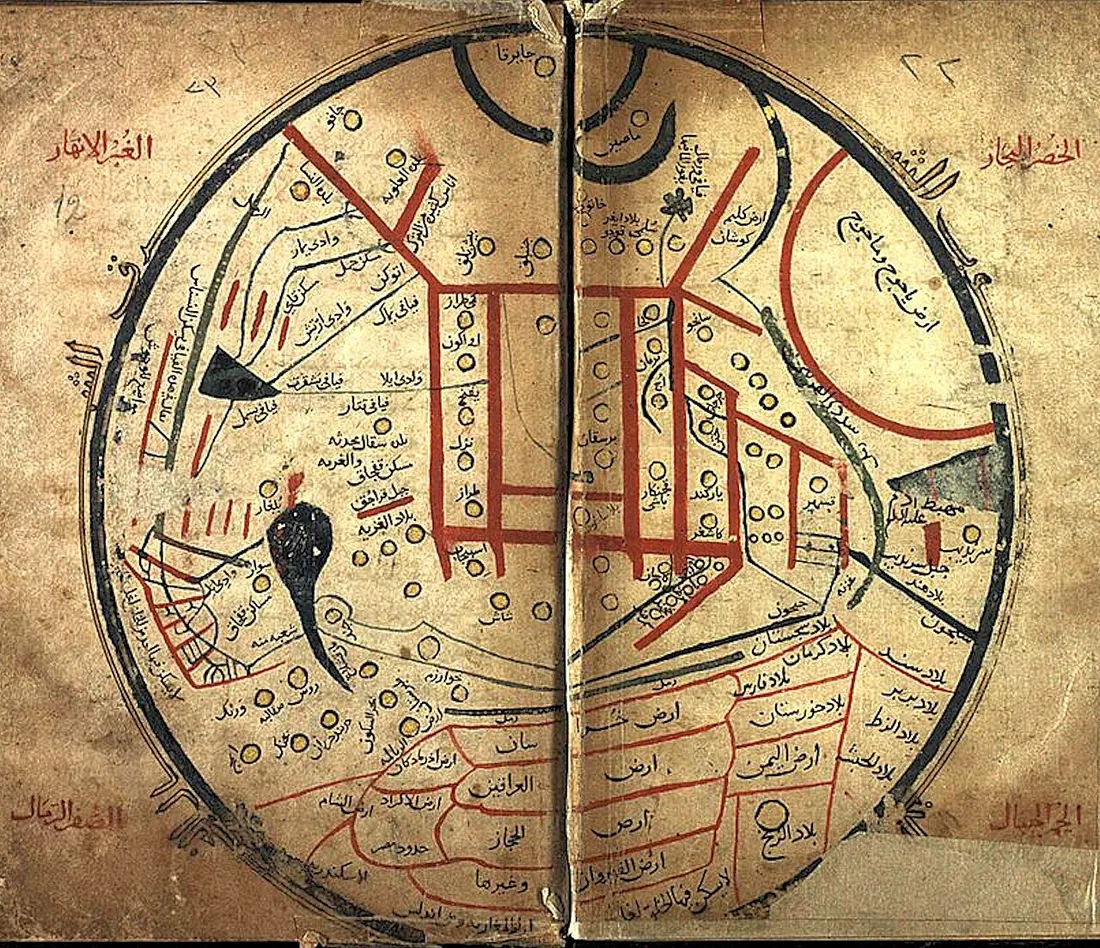
An introductory section sets out the principles of Turkic lexicography and dialectology. It also contains a world map showing where the dialect groups lie.[1] The bulk of the book is the lexicon. It is ordered not alphabetically but by an elaborate system of root patterns, modelled on the great Arabic dictionaries.[1] Under that system, words sharing a suffix fall together. Kashgari could therefore break off into grammar wherever the pattern invited it. A long section in the second book sets out the entire verbal system.[1]
He calls the language he describes Turkiyya. It is essentially the speech of the Chigil tribe of the Karakhanid confederation.[1] He marks words peculiar to the Karakhanid court as Khāqāniyya.[1] Two dialect groups get equal weight. One is that of the Turks proper, Chigil and Tukhsi among them. The other is that of the Turkmän or Oghuz, which often takes in the Kipchak as well.[1] The Seljuks belonged to the Oghuz tribe of Qïnïq, and most of what the book says about tribal organisation concerns the Oghuz.[1]
Kashgari also quotes forms from dialects other than his own. The Dīvān is therefore the earliest evidence for other early varieties of Turkic.[2] He gives koymaŋız and kıymaŋız as Oghuz and Kipchak forms of the negated second-person plural imperative. He adds that the Oghuz and Kipchak use koy- where others use kod-.[3] These forms show that d had already become y in at least some dialects in the second half of the eleventh century.[4] He ascribes the first-person past bardum, ‘I went’, to the Argu, against bardam among the Oghuz and bardım among the other Turks.[5] Mahmud was not a field researcher in the modern sense, so how far he can be trusted on the dialects is not settled. His evidence appears convincing. Most of what he says about the dialects has not yet been matched with modern and comparative data.[2]
Contents beyond the lexicon
Four things in particular stand in the Dīvān and in no earlier Turkic source.
The first is the tribes and their brands. A treatise on the Oghuz subtribes gives each one with its tamga, the mark burned on its herds.[1]
The second is the animal calendar. Under the entry for the tiger, bars, the twelve names of the animal cycle stand complete. The entry also tells how the reckoning was introduced at the Ili.[1] This is the only place where the whole list can be read in Turkic before the modern period. The inscriptions give only the years they happen to date.
The third is the folk etymologies. Narrative sections explain important words by story, and most of them hang on the Central Asian Alexander legend. The longest stands under türkmän.[1]
The fourth is the life of the people. Kinship and social order, recipes, folk remedies, popular belief and custom are scattered through the entries, because a word cannot be glossed for a stranger without them.[1] Among the foods stands ayrān, glossed “churned milk”, the oldest record of ayran.[6] Following the Arabic lexicographers, Kashgari also illustrates his entries with sentences, proverbs and verse. This is the largest body of early Turkic poetry outside the inscriptions.[1]
The manuscript
The Dīvān survives in one manuscript and in no other.[1] The manuscript came to light in Istanbul before 1917. Ali Emiri Efendi bought it, and it was first printed under the editorship of Kilisli Rifat. Everything known of the work rests on that single copy.[1] The copy is not the author’s own. It is somewhat later.[2]
Reliability
The governing fact is the date. Kashgari attests eleventh-century Karakhanid usage, and the khaganates ended in 744. Between the Orkhon monuments and the Dīvān lie three centuries, a change of religion and a change of script. The Turkic centre of gravity also moved from the Orkhon to Transoxiana.
A word carried back across that gap may well be old, but the crossing is not thereby demonstrated. The Dīvān is the earliest witness to a great many things. The word qam for the ritual specialist is one of them.[1] Being the earliest witness to a thing is not the same as showing the thing to be ancient. Where the inscriptions and the Dīvān agree, the agreement counts. Where only the Dīvān has a word, Turkic Atlas says so when it uses the word.
References
Literature
- Emre-E. Yavuz, The Gokturk Empire: 2nd Edition (2025)
- Maḥmūd al-Kāshgharī, Dīwān Lughat al-Turk (1072–1074)
- Marcel Erdal, A Grammar of Old Turkic (2004)
Articles resting on this source 68
Afrasiab · Animism · Argu · Ayran · Balasaghun · Beg · Bread · Captives and the Unfree · Culture of the Turkic Peoples · Diplomacy of the Steppe Empires · Envoys and Embassies · Er At · Falconry · Feasts in Kashgari's Dictionary · Felt, Cloth, Leather and Wood in Kashgari's Dictionary · Fourteen (Köčürmä Oyun) · Funeral Games of the Caucasian Huns · Göktürk Games · History of the Turkic peoples · Hunting among the Göktürks · Iye · Kam (Turkic Shaman) · Kamos · Kara-Khanid Khanate · Khalaj · Kipchak · Kirghiz Iron and Gold · Knucklebones · Kumys · Kunçuy · Kut · Metals and Metalworking in Kashgari's Dictionary · Millet · Millet Beer · Oghur Turkic · Oghuz · Oghuz and Kipchak speech in Kashgari · Old Turkic · Old Uyghur · Ötüken · Peri · Polo · Qurut · Sacred Mountains · Salt among the Turkic Peoples · Scapulimancy · Shamanism · Sogdians · Soul Words · Stakes and Wagers · Tengrism · Terken · The Battue · The Iron Oath · The New Year on the Steppe · The Old Turkic script · The Turkic languages · The twelve-year animal cycle · Töre · Tuğ · Turkic Songs at the Tang Court · Tutmaç · Umay · Water Cult · Wood and Woodworking · Wrestling · Yada Stone · Yol Tengri
What links here38
- Persons
- Afrasiab
- States
- Kara-Khanid Khanate
- Institutions and Titles
- Felt, Cloth, Leather and Wood in Kashgari's Dictionary · Metals and Metalworking in Kashgari's Dictionary · Salt among the Turkic Peoples · The Iron Oath · The twelve-year animal cycle
- Religions
- Kam (Turkic Shaman) · Tengrism
- Languages
- Oghuz and Kipchak speech in Kashgari · Old Turkic · Old Uyghur · The Khalaj language · The Turkic languages
- Customs & Pastimes
- Er At · Falconry · Feasts in Kashgari's Dictionary · Fourteen (Köčürmä Oyun) · Hunting among the Göktürks · Knucklebones · Polo · Stakes and Wagers · The Battue · The New Year on the Steppe · Turkic Songs at the Tang Court · Wrestling
- Sources
- Kutadgu Bilig
Cite this article
Yavuz, Emre-E. “Dīvān Lughāt al-Turk.” Turkic Atlas, revised 8 November 2026. https://turkicatlas.org/sources/divanu-lugatit-turk/
Last revised: 8 November 2026


