
Yami was the khan who made the eastern Göktürks a client state of China. The Sui Shu preserves the memorials in which he said so himself.[1] In 607 he wrote to the emperor that he was no longer a khan of the old frontier kind but the emperor’s subject. He asked leave to dress his people in Chinese clothes.[1] His reign closed the civil war and opened the twenty-seven years that ended in 630. He is the traitor of this history. Every step of his rise was taken against his own house, and China paid for every one of them.
Tuli Khan under Tulan
He was a son of Ishbara. After his father’s death he held a command in the north under Tulan with the title Tuli Khan.[1] A second tradition gives him another father. The Tongdian calls him the son of Chuluohou, Ishbara’s younger brother, who reigned as Bagha Khan.[2] In the Zizhi Tongjian the Sui envoy Zhangsun Sheng says the same to the emperor.[3] The editors of the Sui Shu note that its own biography of Zhangsun Sheng has this reading too.[1] His motive was there from the start. It was revenge for his father and the overthrow of the khan, who was trying to restore the independence of the Turkic peoples from the Chinese.[4] In 597 he sent to the Sui asking for a princess.[1] The court had a use for him. The Zhou princess Qianjin, now called Dayi, was Ishbara’s widow and Tulan’s wife. She had written a poem on a screen mourning the fall of the Chen. She had been caught intriguing with the western khan Niri, and she had a hu lover.[1] The emperor Wen wanted her dead and feared Tulan would refuse. The official Pei Ju told Yami’s envoys that the marriage would be granted when the princess was killed.[1] Yami agreed and slandered her again. Tulan in a rage killed her in the tent.[1] The court sent Yami’s men to the ministry of rites to be taught the six rites of marriage. It gave him the princess Anyi, a woman of the imperial clan.[5] The bargain was Pei Ju’s correct reading of the situation. Its price was the elimination of Qianjin.[5] Yami had a woman of his own house killed by her husband’s hand to buy a Chinese wife.
The Sui Shu is explicit about the purpose. The emperor wished to divide the northern barbarians. Therefore he treated Yami with special generosity.[1] Three ministers went to him as envoys one after another. The Göktürks sent three hundred and seventy embassies to the court.[1] Yami had lived in the north. On the strength of the marriage he moved south to the old garrison of Dujin, and he was showered with gifts.[1] Tulan said in anger: “I am the great khan, and I am worse off than Rangan!” He stopped his tribute and raided the frontier.[1] At every attack the Chinese armies were in the right place, because Yami and Pei Ju were corresponding.[4] A commander of the khaganate was telling a foreign court where its armies would be.
Flight to China (599)
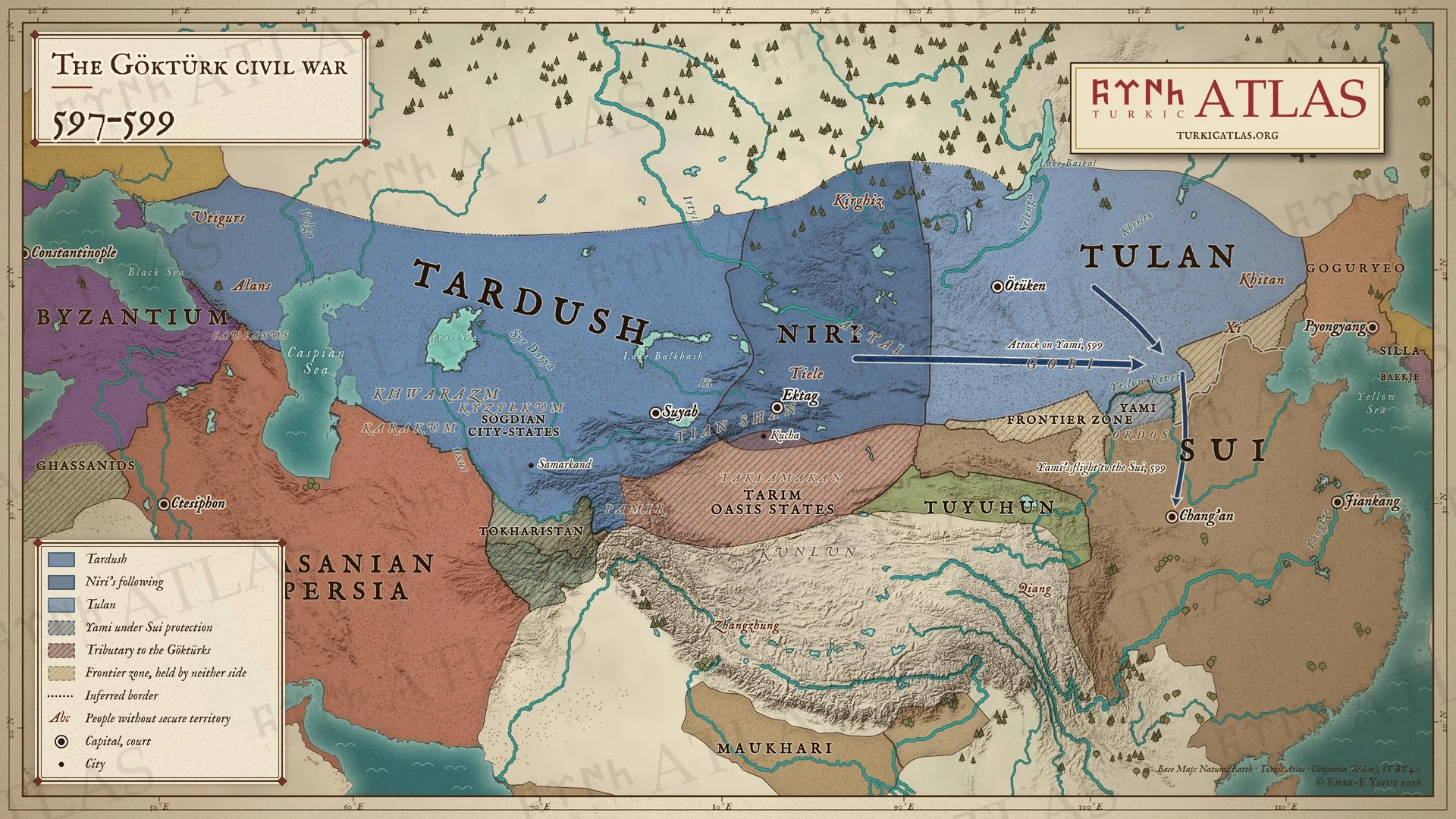
In 599 Tulan and Datou, that is Tardush, attacked Yami together. They killed all his brothers, sons and nephews, crossed the river and entered Weizhou. Yami fled by night to the court with five horsemen and the Sui envoy Zhangsun Sheng.[1] The emperor had him argue his case against Tulan’s envoy. He judged Yami in the right and treated him well.[1] Tulan’s brother Dusuliu abandoned his wife and children and came over with him. The emperor had the two play at dice and lose treasures to them to console them.[1] That summer the Sui generals Gao Jiong and Yang Su broke Tardush. Yami was made Yilizhendou Qimin Khan, “which in Chinese means wise and strong”.[1] He sent a memorial of thanks, “my former wicked heart is now wholly removed”. The emperor built the walled town of Dali in Shuozhou for him to live in.[1] Anyi had died, and he was given a second princess of the clan, Yicheng. Many of the tribes came over to him.[1] When Tulan attacked again, the emperor brought him inside the frontier. He then settled him south of the river between the prefectures of Xia and Sheng.[1] Conscripts dug a ditch several hundred li long between the two arms of the river. The whole enclosure became Yami’s pasture.[1] Yicheng was the Chinese woman who would bring the Göktürks down within thirty years.[4]
Tulan’s death and the war with Tardush
In 599, before the Sui army sent against Tulan had left the frontier, Tulan was killed by his own followers. Tardush proclaimed himself Bujia Khan, and the state fell into chaos.[1] Tardush met the Sui general Shi Wansui at Mount Dajin and fled without fighting. His nephew Silifa attacked Yami from east of the desert and was driven back with Sui help.[1] Yami’s memorial of thanks survives. In it the Great Sui sage emperor, the Mojuan Khan, nourishes the people as heaven covers and earth carries.[1] The tribes come to the sage khan with red hearts, some south into the long wall, some to Baidao, men, sheep and horses filling the valleys. “Rangan is like a withered tree that puts out branches again, like dry bones that grow flesh again; for a thousand generations he will herd sheep and horses for the Great Sui.”[1] In 601 Yang Su led Yami north against the tribes that had submitted and rebelled.[1] A Göktürk irkin named Awusili crossed south with others and carried off six thousand of Yami’s people and more than two hundred thousand animals. Yang Su recovered them.[1] The same year the Tiele beat the western khan Niri and the yabgu. Tardush’s state fell into chaos. The Xi (奚) and Xi (霫) tribes came over, and Tardush fled to the Tuyuhun.[1] Yami took over his people and sent tribute yearly.[1]
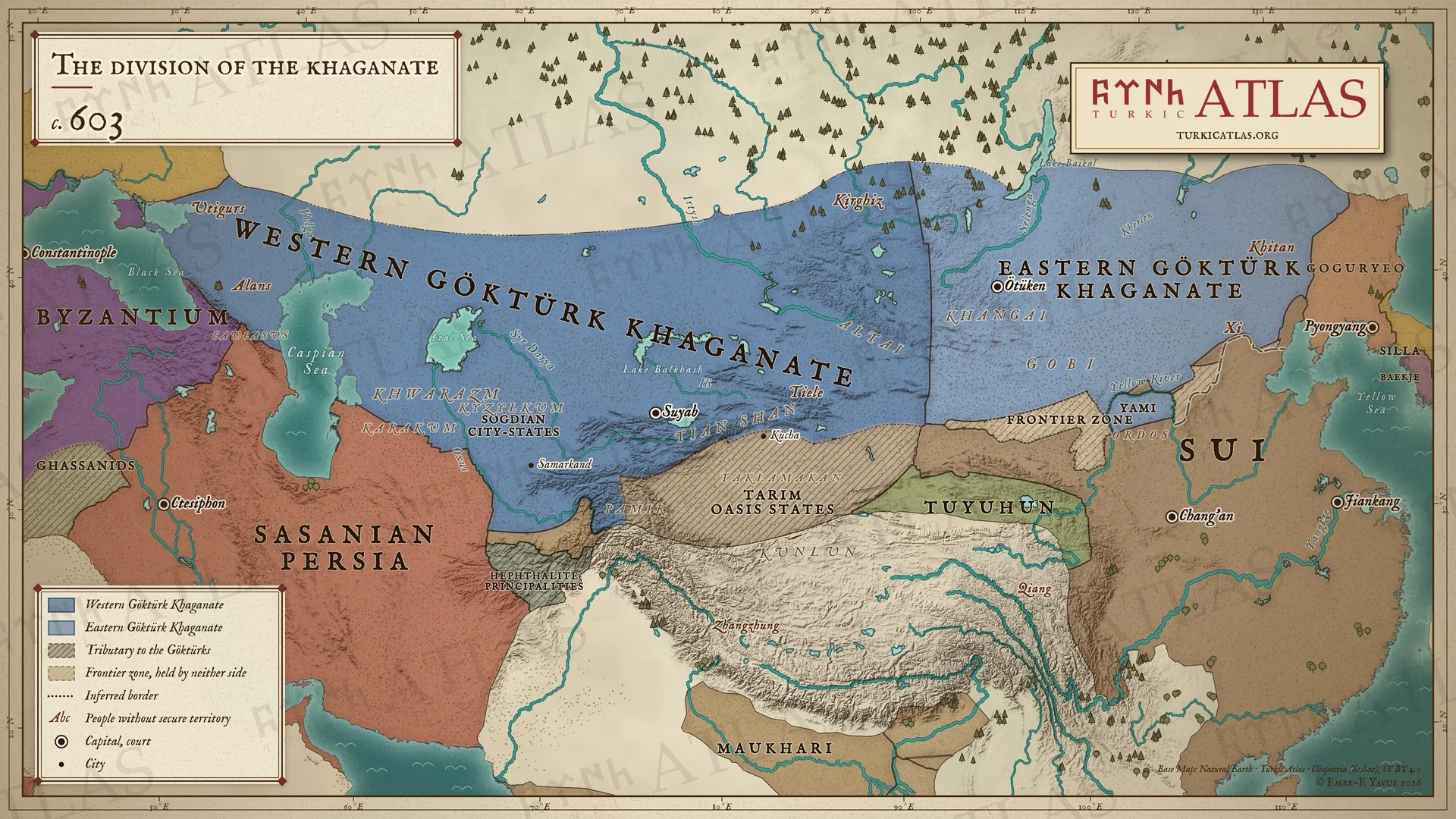
The decisive confrontation fell in 603.[4] Tardush had beaten Yami in 602. The next year Yami marched into Ötüken with Chinese troops and took the title of khan. He thereby broke, as the civil war had, the taboo on armies in the sacred land.[4] He then defeated Tardush. He chose not to return to Ötüken but to settle at the mouth of the eastern Gobi. The decision was both strategic and symbolic of his bond to China.[4] The realm was finally divided in 603.[4] Under the khaganate, Turkic Atlas takes the same date for the division.
Client of the Sui (603–609)
In the fourth month of 607 the emperor Yangdi came to Yulin. Yami and the princess Yicheng came to the travelling palace and presented three thousand horses. The emperor gave twelve thousand pieces of silk.[1] Yami’s memorial is the fullest statement a Göktürk khan ever made of his dependence.[1] The sage former emperor had pitied him and given him Anyi. He had kept him alive when his brothers had wanted to kill him and he had looked up and seen only sky and down and seen only earth. He had made him great khan.[1] Now he was no longer a khan of the old frontier kind but the emperor’s subject. He asked that he and his people be allowed the dress and laws of the great state, “one with the Chinese”.[1] The ministers advised granting it.[1] Yangdi refused. His decree spoke of the wisdom of the former kings who did not seek to change the customs of the barbarians, cut hair and tattooed bodies, felt and leather each suiting its people.[1] He wrote to Yami that the north beyond the desert was not yet quiet and he would still need to fight. A loyal and filial heart, he wrote, did not require a change of clothes.[1] The paradox is that it was the Chinese rulers themselves who kept Yami from a complete adoption of Chinese court culture, fearing it would weaken the Göktürks as soldiers.[4]
The emperor feasted Yami and three thousand five hundred chiefs in a tent for a thousand. He gave two hundred thousand pieces of silk.[1] He issued a decree on Yami’s merits, “who in the past left his people in distress and came over to virtue”. The decree granted him a state carriage, horses, drums and banners, exemption from being announced by name, and a place above the princes.[1] Then Yangdi went north to Yami’s own camp. Yami offered the cup kneeling. The emperor wrote a poem on the tents opening to the sun and the Chanyu bowing his head, which the chapter preserves.[1] A Koguryŏ envoy was at Yami’s camp. Yami, “in sincere service to the state”, did not hide the foreign contact.[1] The envoy was brought before the emperor and told that his king should come to court the next year or the emperor would go with Yami to visit his land.[1] The line runs from this envoy in the khan’s tent to the Sui’s wars on Koguryŏ.[4] Yami escorted the emperor to Dingxiang. The next year he came to court at the eastern capital and was received with greater honour still.[1] To this belongs his campaign against the rebellious Khitan on his overlord’s behalf. The reign looks like an unprecedented rapprochement with China.[4]
Death (609)
He died of illness. The emperor suspended court for three days and installed his son Duojishi as Shibi Khan. Shibi asked to marry the princess and was allowed to, according to Göktürk custom.[1] The Sui Shu tells the death in the same year as the court visit, which its sequence places in 608. The usual date is 609.[4]
Assessment
Looking back in 631, the Tang emperor Taizong said that Yami had lost his state and fled to the Sui. The Sui emperor had spared no grain or silk to set him up, and his descendants should have thought of repaying it.[6] Instead Shibi had besieged the emperor at Yanmen. Those who had set up the house had been slaughtered by Xieli’s brothers. The speech asks: “was not Xieli’s ruin the fruit of ingratitude?”[6] That is the Chinese moral. It is not the only interpretation. The reign was the low point of Göktürk sovereignty. Yami owed the emperor his throne, his wives, his town and his pasture, and asked to owe him his clothes as well. Shibi’s reversal was the correction the state needed.[4] The eastern khans after 603 were weakened at home and largely intimidated by the Sui.[7] Yami ended the civil war by ending the independence of the east. That is treason against his own people. Everything his sons did was an attempt to undo it.
References
- ^ a b c d e f g h i j k l m n o p q r s t u v w x y z aa ab ac ad ae af ag ah ai aj ak al am an ao ap Sui Shu (Book of Sui), juan 84
- ^ Tongdian, juan 197
- ^ Zizhi tongjian (Comprehensive Mirror in Aid of Governance), juan 178
- ^ a b c d e f g h i j k l Yavuz 2025
- ^ a b Sui Shu (Book of Sui), juan 84; Yavuz 2025
- ^ a b Jiu Tangshu (Old Book of Tang), juan 194
- ^ Golden 1992
Sources
- Sui Shu (Book of Sui), juan 84
- Jiu Tangshu (Old Book of Tang), juan 194
- Tongdian, juan 197 (after Sui Shu and Zhou Shu)
- Zizhi tongjian (Comprehensive Mirror in Aid of Governance), juan 175, 178 (after Wei Shu, Zhou Shu, Sui Shu and Bei Shi)
Literature
- Emre-E. Yavuz, The Gokturk Empire: 2nd Edition (2025)
- Peter B. Golden, An Introduction to the History of the Turkic Peoples (1992)
What links here69
- Persons
- Awusili Irkin · Dusuliu · Ilig Khan · Ishbara Khan · Lady Poshi · Pei Ju · Princess Anyi · Princess Qianjin · Princess Yicheng · Shibi Khan · Silifa · Suni Shi · Tardush · Töles Khan · Tulan Khan · Yintou Tegin
- States
- First Göktürk Khaganate · Sui
- Battles & Events
- Assembly at Mount Yanzhi (609) · Battle of Mount Dajin (600) · Battle of Zhoupan (582) · Capture of Ilig Khan (630) · Death of Princess Dayi · Death of Tulan Khan · Embassy of Cui Junsu (608) · Fall of Tardush (603) · Raid on Yanmen (621) · Smbat Bagratuni's war with the khan · Sui Variety Shows for Yami Khan (606–610) · The Archery Match at the Wu'an Hall (599) · The Attack on Yami Khan (599) · The siege of Yanmen, 615 · The Sui Campaign of 599 · Yang Su's Northern Campaign (601–602) · Yangdi's Visit to Yami Khan (607)
- Places
- Baidao Plain · Dali City · Dingxiang · Dujin Garrison · Heng'an · Jin River · Kujie Valley · Lingzhou · Ötüken · Qikou · Shuozhou · Xiazhou · Yiwu · Yulin · Yunzhong
- Peoples
- Tuyuhun
- Institutions and Titles
- Baghatur · Diplomacy of the Steppe Empires · Drums and Banners for the Khans · Göktürk Dress and Hair · Great Khan · Levirate · Seasonal Pastures · Tegin · Tölis and Tardush
- Religions
- Following in Death
- Languages
- Chinese transcriptions of Turkic
- Customs & Pastimes
- The Göktürk Feast · The New Year on the Steppe · Turkic Songs at the Tang Court
- Controversies
- The Göktürks and the Xiongnu
Cite this article
Yavuz, Emre-E. “Yami Khan.” Turkic Atlas, revised 8 November 2026. https://turkicatlas.org/persons/yami-khan/
Last revised: 8 November 2026

