
The founding generation of the khaganate: the family that ruled it, the three sons who reigned in turn, and the assembly at which the house broke. The path begins with the lineage and ends with the state as a whole, so that the persons in between are read as members of something.
1/7
Ashina
439–969
The family, its names, and the three incompatible accounts of where it came from.
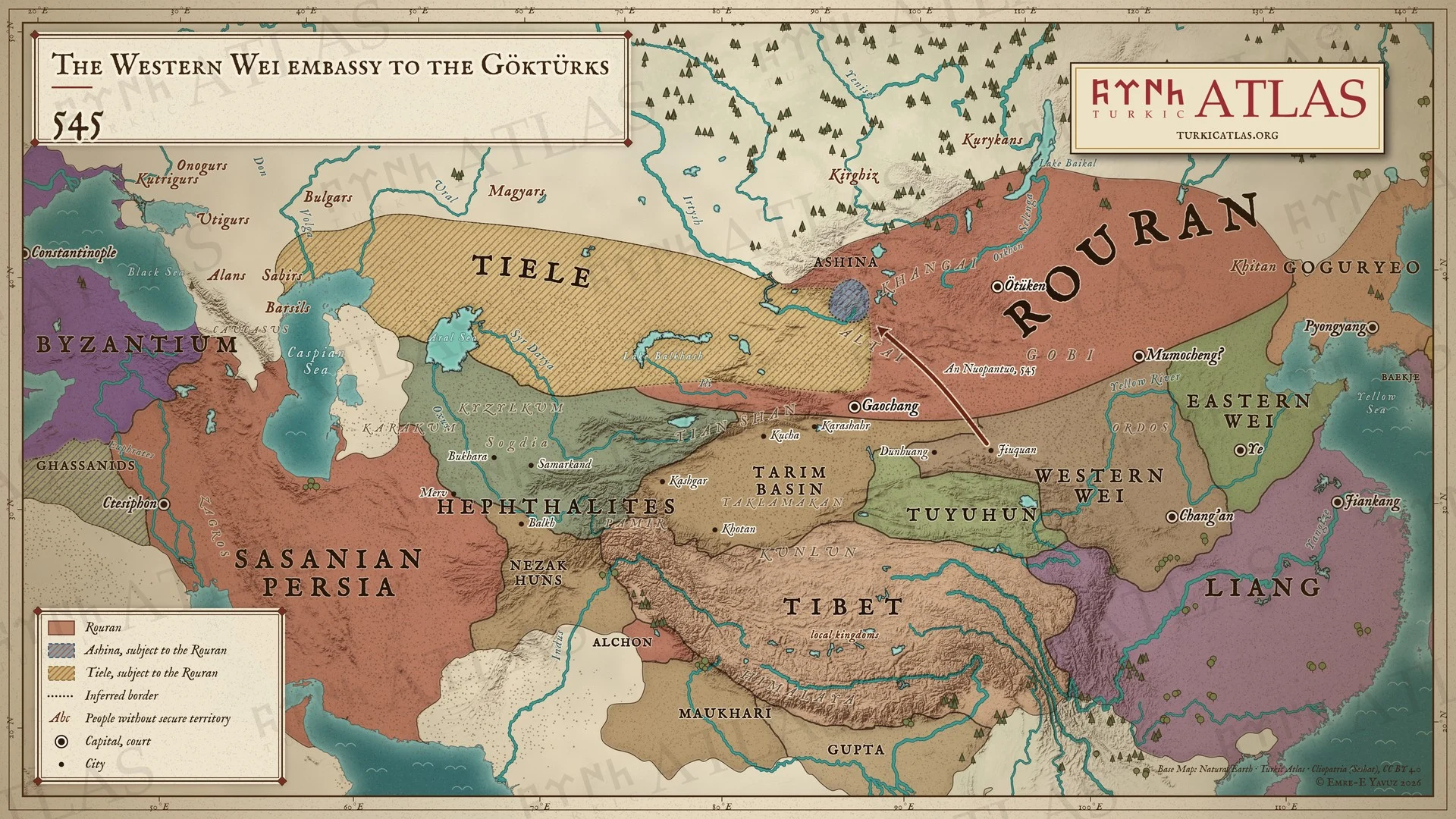
The Ashina were the ruling house of the Göktürks; before 546 they were a few hundred households in the Altai who worked iron for the Rouran. Their name is a family name, not a tribal one, and its meaning is not known. The Chinese histories give three accounts of the family's origin. The Zhou Shu makes the Göktürks a branch of the Xiongnu. A legend tells of a she-wolf who bore ten sons in a cave north-west of Gaochang, and of Ashina, the ablest of them, who became their ruler. The Sui Shu has the Ashina flee from Gansu to the Rouran with five hundred families after the Wei crushed the Northern Liang in 439, and work iron on the Golden Mountain for generations. The inscriptions of the Göktürks say nothing of the Xiongnu, the wolf or Gansu.
 Ashina
2/7
Bumin Khan
552
The founder's single year as khan.
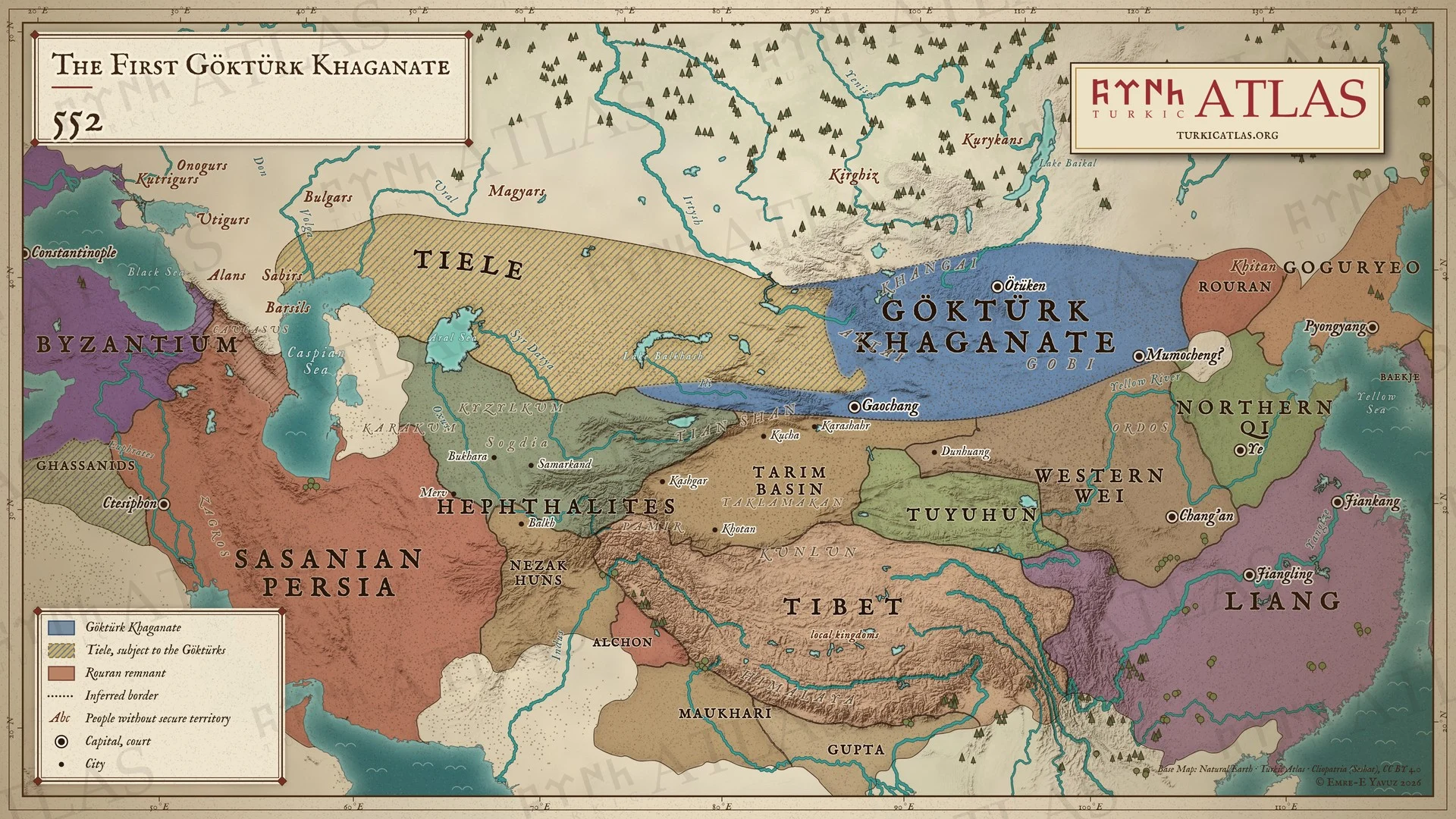
In April 552 Bumin entered Ötüken and took the title Illig Khan. He did not dismantle the Rouran state. Its structures passed to him largely intact, with a different house at their head, and the centre of the new realm lay at Ötüken, as the Rouran centre had. On the usual reading Bumin died within the same year; the month and the manner of his death are not recorded. His son Issik succeeded him, and after Issik his brothers Mukan and Taspar. Bumin's brother Istemi held the western wing and did not contest the succession. The Kül Tegin inscription, carved in 732, names Bumin and Istemi together as the ancestors who took the throne over the Göktürks.
 First Göktürk Khaganate
- Ashina
3/7
Issik Khan
552–553
The eldest son finishes the Rouran on the Ordos and dies within the year.
Issik, Bumin's eldest son, succeeded his father in 552, and his uncle Istemi, who held the west, did not contest the succession. The Rouran nobles who had fled to the Northern Qi did not mean to stay refugees. In the second half of 552 the Qi attacked Göktürk territory on their behalf and achieved nothing the sources record. In February 553 the Qi emperor forced Dengzhu, the leader of the exiles, to march against the Göktürks. Issik overtook his army on the Ordos, the steppe within the great bend of the Yellow River, and destroyed it. He died the same year, of an illness according to the Sui Shu, which adds that he passed over his son Ishbara for his brother. His one year was enough to finish what Bumin had begun.
- First Göktürk Khaganate
- Ashina
4/7
Mukan Khan
553–572
Nineteen years: the Kirghiz, the Khitan, the war with the Qi, a daughter for an emperor.
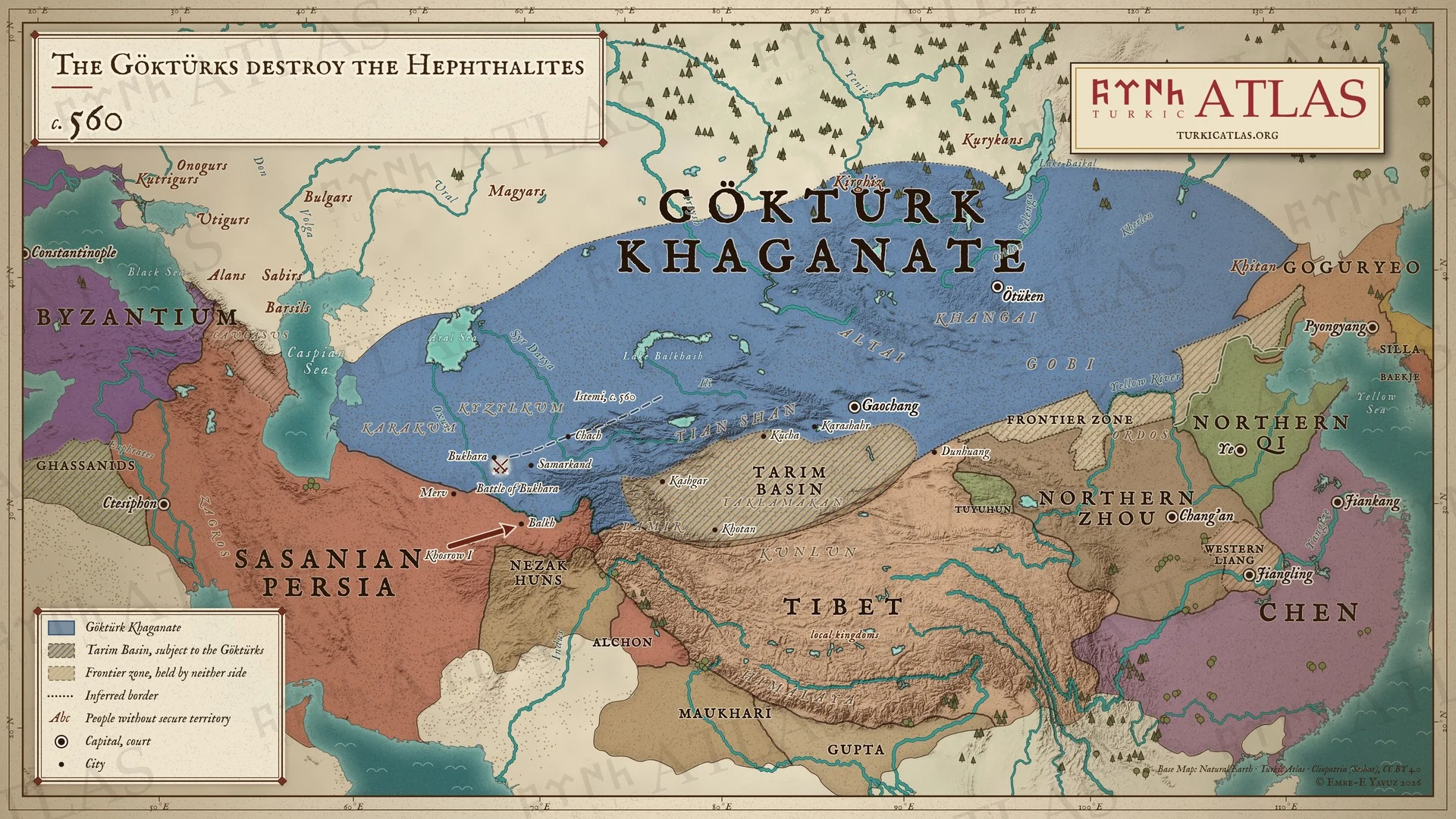
Mukan, Bumin's second son, took the throne when Issik died in 553 and held it for nineteen years. The Zhou Shu describes his face as more than a foot broad and very red, his eyes as like glass, and his nature as hard, violent and bent on war. Under him the Kirghiz on the upper Yenisei were annexed and the Khitan driven east. With the Northern Zhou he made war on the Qi: in 563 he brought a hundred thousand horse, and early in 564 the allies attacked Jinyang and failed. In 568, after wavering once more towards the Qi and a portent of wind and thunder, he let his daughter go to the Zhou emperor Wu, and she became empress. He died in 572, and the throne passed not to his son Töremen but to his brother Taspar.
- First Göktürk Khaganate
- Ashina
5/7
Taspar Khan
572–581
The khaganate at its greatest extent, a Buddhist khan, and a wish the nobility refused.
Taspar, the youngest of Bumin's sons, reigned from 572 to 581 over the khaganate at its greatest extent. The Zhou and the Qi competed for his alliance and emptied their treasuries to serve him, and he called the Chinese emperors his sons. A Chinese monk, Huilin, told him that the Qi were rich and strong because they had the Buddha's law. The khan built a monastery, sent to the Qi for sutras and fasted, but his people did not follow him. He died in 581 and left a wish: the throne should go to Töremen, Mukan's son, and not to his own son Amrak. A khan of the Göktürks had no right to name his successor, and the nobility refused the wish.
- First Göktürk Khaganate
- Ashina
6/7
Göktürk Succession Crisis (581)
581–582
The assembly at Ötüken, the election, the abdication, and the road to civil war.
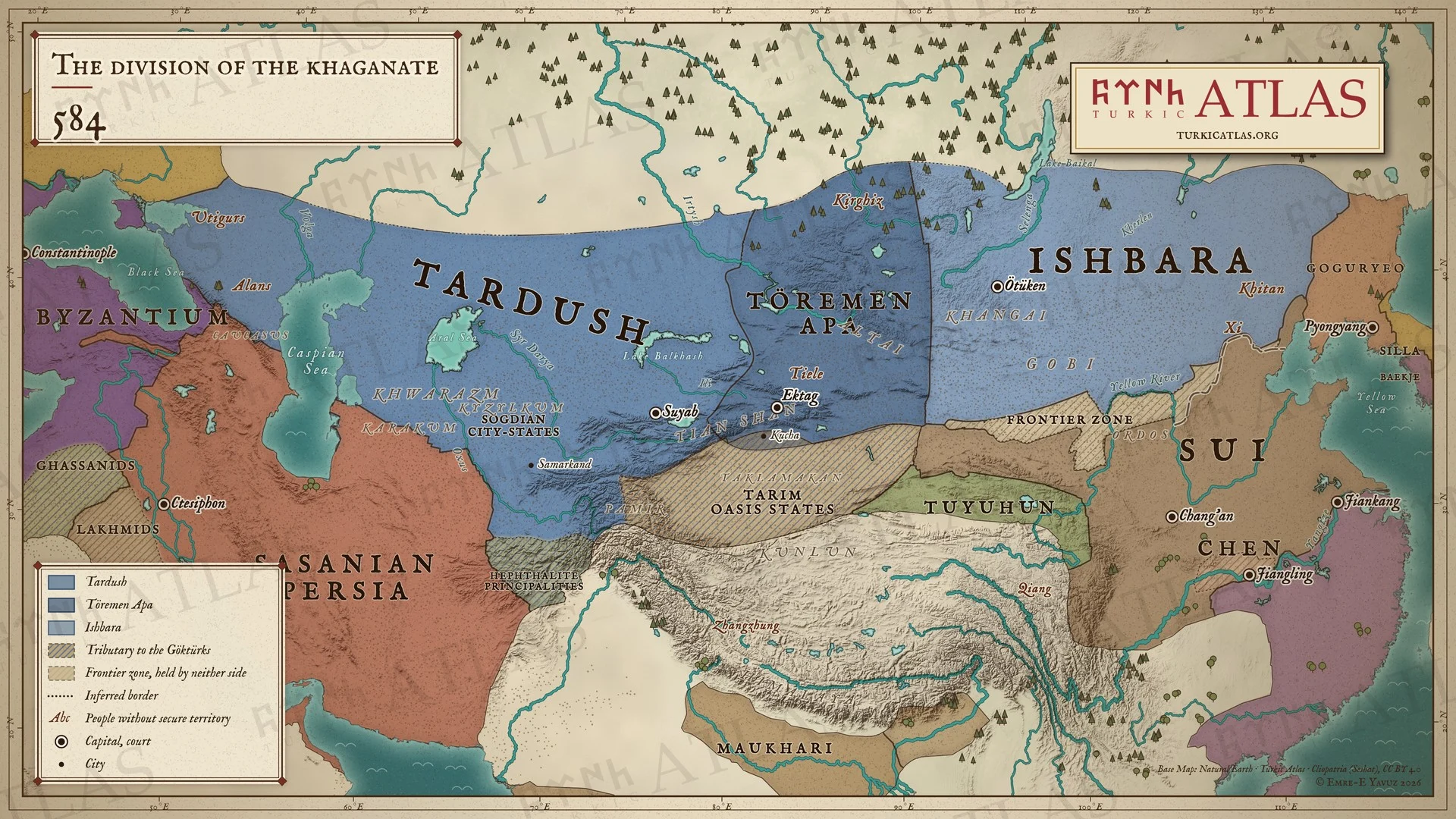
When Taspar died in 581, the nobles of the Göktürks gathered at Ötüken in assembly. Ishbara, the son of Bumin's eldest son Issik, objected on two grounds. A khan had no right to name his successor, and Töremen's mother had not been a Göktürk and had, he claimed, been of low rank. He threatened revolt if Töremen were chosen, and the assembly elected Taspar's son Amrak instead. Töremen rejected the election and raised his following, and within the year Amrak abdicated in Ishbara's favour. Töremen, from now on Apa Khan, went to war against Ishbara, and Tardush, Istemi's son and yabgu of the west, took his side. The quarrel turned into the civil war of 584 to 603, which divided the khaganate for good.

7/7
First Göktürk Khaganate
552–630
The whole state, from 552 to 630, with the sources it rests on.
Bumin founded the khaganate in 552, and from Ötüken it grew into an empire that reached Central Asia and the approaches to Iran and Byzantium. Members of the Ashina house held its eastern and western wings. After the succession struggles and civil war of the late sixth century the wings became separate khaganates; the eastern fell to the Tang in 630 and the western in the 650s. Most of what is known comes from Chinese histories, above all the Zhou Shu of 636, written for states that fought the Göktürks. Menander Protector is the contemporary and independent witness for the west, and the Bugut inscription, in Sogdian, the only monument of the khaganate itself. The one account in a Turkic language, the Kül Tegin inscription, was carved two centuries later and is evidence first for eighth-century memory.
- First Göktürk Khaganate
© Emre-E Yavuz 2026© Emre-E Yavuz 2026© Emre-E Yavuz 2026© Emre-E Yavuz 2026
