
Taspar Khan was the youngest son of Bumin and the fourth khan of the Göktürks, from 572 to 581.[1] He took the throne exactly twenty years after his father’s death. The Zhou Shu says that the state had been rich and strong since Mukan’s day and had set its mind on overriding China.[1] Istemi still held the west, and Mukan had closed the north and east. The Zhou and the Qi competed for the new khan’s alliance and emptied their treasuries to serve him.[2] He is remembered for three things. He divided his authority among lesser khans, he took up Buddhism, and he made a wish about his succession that the nobility refused and that broke the house.
Khaganate under Taspar
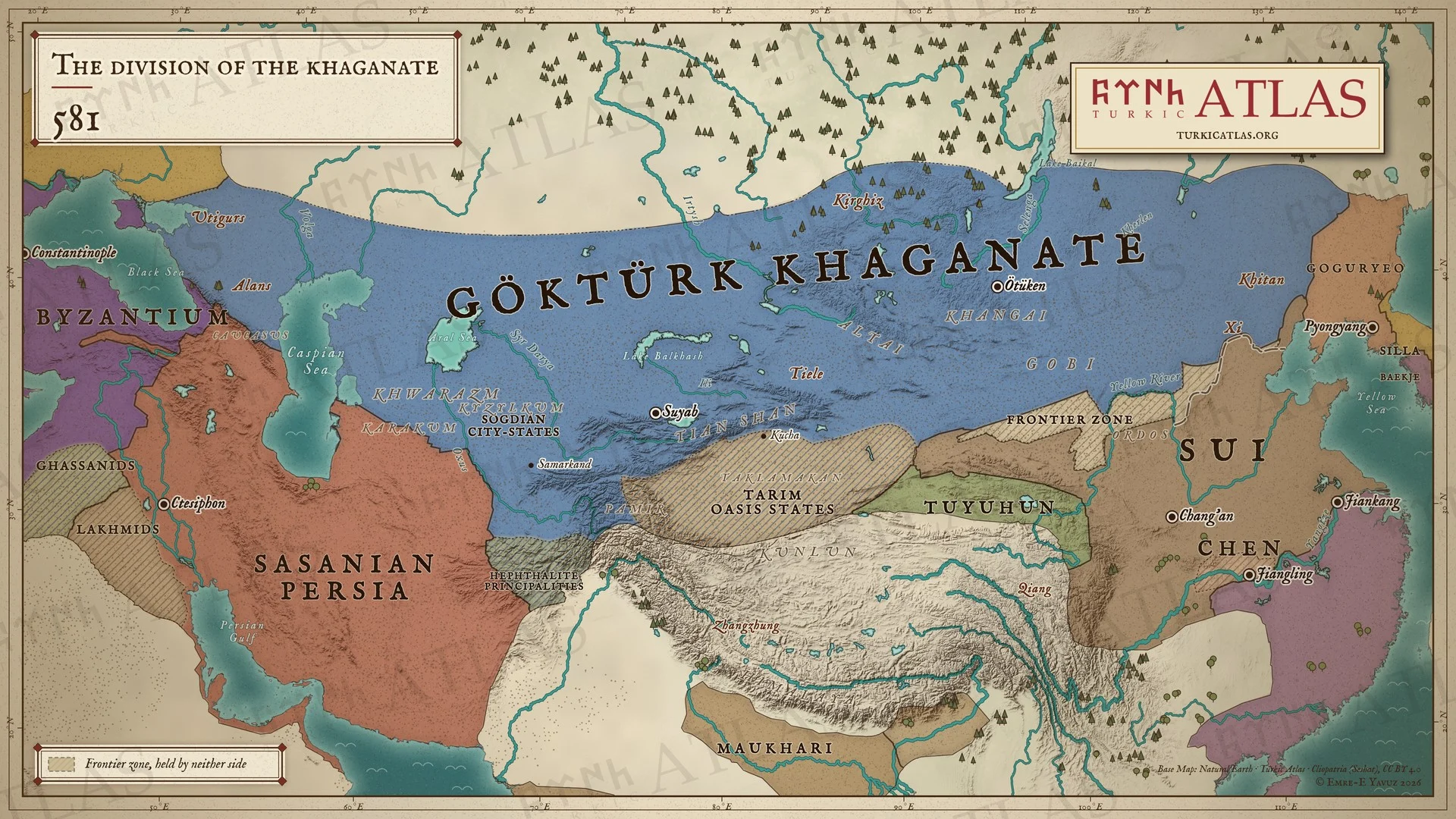
One estimate puts the eastern and western territories together at six to seven million square kilometres in Taspar’s time, larger than the Ottoman empire a thousand years later. The changes he made in the hierarchy can be seen as a response to that scale. He set his nephew Ishbara over the east as Erfu Khan and a son of his brother Rudan Khan over the west as Buli Khan. Both deputies bore the title.[2] The khan’s power was less autocratic than it looks from outside. It was relegated down the Ashina hierarchy, and Turkic Atlas sets out the ranks under the title. The step had a consequence Taspar did not intend. The lesser khan he had made in the east was the man who, nine years later, refused his last wish.
He called the Chinese emperors his sons. As long as my two boys in the south are filial, the Zhou Shu has him tell his followers, why should I fear to lack anything?[1] Elsewhere he is made to tell the warring Zhou and Qi to stop fighting each other. That is not in the Zhou Shu.[3] The tone is that of a ruler who had two Chinese states as clients and knew it.
Qi resistance (577–580)
In 577 the Zhou invaded the Qi and, without Göktürk help this time, took nearly the whole of it.[4] Taspar had officially renewed the Zhou alliance, as his brother had done. Now the Zhou held almost the entire frontier of the khaganate, and he changed sides in secret.[4] The motive may have been the balance of power. Taspar would have decided to keep China divided rather than let one state unite it, and those who hold this find no other reason for him to risk thirty years of trust. The sources themselves state no motive.
The instrument was Gao Shaoyi, a prince of the Qi house. He had fought the Zhou conquest, been beaten by the Zhou general Shenju, and fled with three thousand followers to Taspar’s court.[4] He had first given them leave to turn back rather than serve a barbarian.[4] In the summer of 578 Gao Baoning, a kinsman holding out in Ying province, wrote to Ötüken. He asked Shaoyi to take the Qi imperial title and asked Taspar for help. Zhou agents saw seventy horses sent, while Taspar prepared an army.[4] Shaoyi declared himself emperor of the Qi in exile. In April 578 the Zhou emperor Wu died, and the Göktürks moved into Youzhou in the far north-east. At the same time Shaoyi and a peasant leader named Lu Changqi attacked Jicheng.[4] The Zhou struck back and Lu was killed. Shaoyi withdrew into Göktürk territory, and the Göktürks went on raiding and plundered Suzhou among other places.[4]
Then Taspar gave him up. The new Zhou emperor, Xuan, offered the khan a princess, Qianjin, on condition that Shaoyi be surrendered.[4] A Zhou agent arranged a hunt in the Ötüken forest, and by this ruse Shaoyi was seized and, with Taspar’s consent, handed over.[4] The Göktürks and the Zhou made peace after half a year of fighting.[4] Shaoyi was exiled to Sichuan, where he wrote letters to his wife cursing the barbarians for their treachery.[4] The Zizhi tongjian dates Gao Baoning’s memorial and Shaoyi’s proclamation to the twelfth month of 577. It has Taspar seize Shaoyi on a feigned hunt at the southern border.[5] The surrender may have been the act of a khan who no longer believed in the Qi cause and would not risk a full war with the strengthened Zhou. The two-track policy ended with it in 580. The Zhou now held the whole frontier, and the Ashina had to live with it.
Buddhism
The Qi exiles brought something else to Ötüken. At an undated point in his reign the Chinese monk Huilin, carried off from the Qi, told Taspar that the Qi were rich and strong because they had the Buddha’s law. He taught the khan the doctrine of cause and retribution.[2] The khan believed him and built a monastery. He sent to the Qi for the Vimalakīrti, the Nirvāṇa and the Avataṃsaka sutras.[2] He fasted, walked the rounds of the stupa and regretted not having been born in China.[2] The khan’s request for the sutras has been dated to 572. That was the year in which Göktürk gifts reached the Qi court and the Zhou were persecuting Buddhism.[6] The sources do not say whether the books were put into the khan’s own language or whether he read them himself.[6] In the same decade a Gandharan monk, Jinagupta, lived a little over ten years, from 575 to 585, at the court of Taspar and his successor. In 581 ten Chinese monks who had been to India joined him, and together they studied Sanskrit works and translated them into Chinese.[7] His people did not follow him into the Buddha’s law. No member of the Ashina, no beg and no commoner is recorded as converting in these years, and the Göktürks kept to Tengri.
Some scholars treat the conversion as a mistake. It was, they argue, a conversion to a religion that did not fit his people’s way of life at all. They hold that the Chinese Buddhism Taspar received brought Chinese ideas with it that were a danger to the steppe. That is a position, and it is recorded as one. The one Göktürk monument of the century speaks for the other side. The Bugut inscription was set up about 584 in Sogdian script. It is held to have been made for Taspar and to be Buddhist in content. If so, the khan’s faith was not a private aberration but the public face the khaganate chose to show.[8] The first published interpretation, however, sets the stone up for Mahan Tegin, a younger brother of Mukan. The link to Taspar therefore rests on the later interpretation alone.[9] His religion was Buddhism, though what the sources show is the conversion of one man.
Death and the assembly of 581
Taspar died in 581, of an illness, after a reign that the Sui Shu counts at ten years.[2] He left an empire that had withstood every crisis of thirty years. No rebellion of subject peoples, no economic trouble and no social tension is on record. He also left a wish. He wanted his successor to be Töremen, Mukan’s son, and not his own son Amrak.[2] A khan of the Göktürks had no right to name his successor. The succession ran laterally, so that no single line should keep the throne.[2] The nobility gathered at Ötüken in assembly. The lesser khan Ishbara objected that Töremen’s mother had been neither Göktürk nor noble, and he threatened revolt if Töremen were chosen.[2] The assembly chose Amrak, but Töremen rose, and Amrak abdicated in Ishbara’s favour. The war that followed divided the khaganate for good.[2] Turkic Atlas sets out the rule that Taspar’s wish offended against under Töre. It tells what came of the wish under the crisis.
Assessment
The Chinese remembered a khan who called emperors his sons. One valuation calls him, at the moment Gao Shaoyi reached his court, the most influential man in Eurasia and the mightiest ruler in the world. It adds at once that he had perhaps not earned the reputation, having stepped into his brother’s footprints. The judgement passed on the reign is that his playing of the Zhou against the Qi, clumsily, began the khaganate’s slow dissolution, and that the assembly at his death opened a new chapter. Both are valuations, not findings. The sources show a khan who ruled the largest state of his age for nine years without losing any of it, and whose one attempt to shape what came after him failed on the day he died.
References
- ^ a b c Zhou Shu (Book of Zhou), juan 50
- ^ a b c d e f g h i j Sui Shu (Book of Sui), juan 84
- ^ Yavuz 2025
- ^ a b c d e f g h i j k Yavuz 2025, p. 308–309
- ^ Zizhi tongjian (Comprehensive Mirror in Aid of Governance), juan 173; Zizhi tongjian (Comprehensive Mirror in Aid of Governance), juan 174
- ^ a b Ecsedy 1968, p. 161
- ^ Sinor 1990, p. 314
- ^ Bugut inscription
- ^ Çağatay 1976, p. 247
Sources
- Zhou Shu (Book of Zhou), juan 50
- Sui Shu (Book of Sui), juan 84
- Zizhi tongjian (Comprehensive Mirror in Aid of Governance), juan 173, 174 (after Wei Shu, Zhou Shu, Sui Shu and Bei Shi)
- Bugut inscription
Literature
- Emre-E. Yavuz, The Gokturk Empire: 2nd Edition (2025)
- Ildikó Ecsedy, Trade-and-War Relations between the Turks and China in the Second Half of the Sixth Century (1968)
- Denis Sinor (ed.), The Cambridge History of Early Inner Asia (1990)
What links here49
- Persons
- Amrak · Börü Khan · Bumin Khan · Emperor Wu of Northern Zhou · Empress Ashina · Ishbara Khan · Mukan Khan · Princess Qianjin · Rudan Khan · Ta-bu-he-zu · Töremen Apa
- States
- First Göktürk Khaganate · Northern Qi · Northern Zhou · Xiongnu
- Battles & Events
- Abrui and Shir-i Kishvar · Göktürk Succession Crisis (581) · Taspar's Appointment of the Lesser Khans (572) · The Göktürk–Zhou alliance · The Marriage of Princess Qianjin (580) · The Qi Court in Exile (577–580) · The Raid on Youzhou (578) · The Siege of Jiuquan (578)
- Lineages
- Ashina
- Institutions and Titles
- Army of the Steppe Empires · Border Markets · Diplomacy of the Steppe Empires · Fulin Khan · Great Khan · Khan (Khagan) · Levirate · Raw Materials and Trade among the Turkic Peoples · The Western and Southern Khans · Töre · Toy · Warfare of the Steppe Empires
- Religions
- Buddhism among the Göktürks · Turkic Mythology
- Sources
- Bugut inscription
- Controversies
- The Göktürks and the Xiongnu
Cite this article
Yavuz, Emre-E. “Taspar Khan.” Turkic Atlas, revised 8 November 2026. https://turkicatlas.org/persons/taspar-khan/
Last revised: 8 November 2026

