
Dengizich was a son of Attila and the last of his house to lead the Huns against Rome.[1] Jordanes calls him king of the Huns.[2]
Bassiana
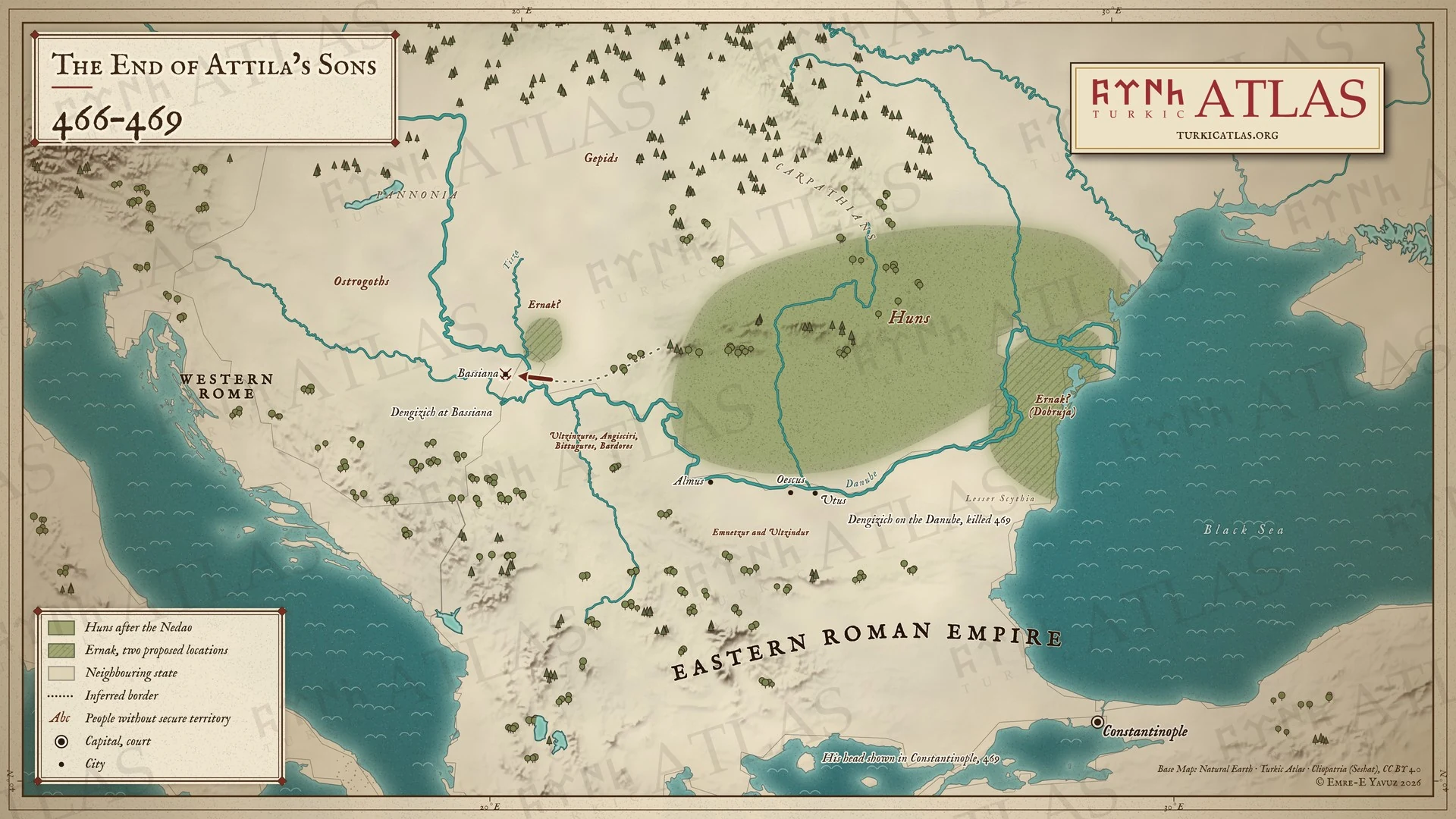
After the Nedao the Ostrogoths held Pannonia. They attacked the Sadages there. Jordanes writes that Dintzic, king of the Huns and son of Attila, then gathered the few peoples who still remained under his rule. These were the Ultzinzures, the Angisciri, the Bittugures and the Bardores. Dintzic laid siege to Bassiana, a city of Pannonia, and plundered its land.[3] The Goths turned against him and drove the Huns from their borders so ingloriously that, Jordanes says, those who remained have feared the arms of the Goths from that day on.[4] The war belongs to the years between 463 and 466.[5]
The embassy to Leo
About 466 Attila’s sons sent an embassy to the emperor Leo. They asked for peace and for a market on the Danube, as had once been the custom.[6] Leo refused, because the Huns had done the Romans too much harm to be granted trade.[6][7] When the envoys returned, the brothers disagreed. Dengizich wanted war with the Romans. His brother Ernak opposed it, because wars at home kept him busy.[6] One dating puts the embassy in 468 or 469.[8] Another puts it in 467 and has Dengizich and Ernak approach Leo together.[9]
The last war
Dengizich went to war alone. He took up position on the bank of the Danube. Anagastes, the son of Arnegisclus, commanded the river frontier in Thrace. He sent to ask why Dengizich wanted war, and Dengizich sent the messengers away with contempt. He sent envoys to the emperor and declared that he would make war unless land and money were given to him and his people. Leo answered that he would do everything for them if they would accept his rule.[10] The demand for land and money may have been a request for admittance to the empire. Leo’s conciliatory answer acknowledges that request. A settlement of an important Hun group would then have followed but for Dengizich’s contempt for the envoys of Anagastes. He had first made a vain attempt to reconquer Pannonia.[11] His last major attempt to cross the Danube came in 468.[12]
In 469 Anagastes defeated and killed him.[13] Marcellinus Comes records that the head of Dinzic, son of Attila, king of the Huns, was brought to Constantinople. The Easter Chronicle adds that it was carried in procession through the Middle Street and fixed on a pole at the Wooden Circus. According to the Chronicle, the whole city came out to see it.[13][14] His death marked the end of Hunnic power.[12] The Huns who were left south of the Danube lost their identity or joined the Bulgar raiders.[13]
Name
The name Priscus heard at Attila’s court, Dengizich, is the authentic form. Jordanes’s Dintzic renders a Germanic pronunciation.[15] The name may be a regular transcription of Turkic taŋïz-ïq, little lake.[16] A different derivation is from the Turkic word for sea.[17]
References
- ^ Maenchen-Helfen 1973, p. 165–168
- ^ Jordanes; Mierow 1915, § 272, p. 129
- ^ Jordanes; Mierow 1915, § 272, p. 129–130
- ^ Jordanes; Mierow 1915, § 273, p. 130
- ^ Maenchen-Helfen 1973, p. 164
- ^ a b c Priscus; Müller 1851, fr. 36, p. 107
- ^ Maenchen-Helfen 1973, p. 165–166
- ^ Thompson 1948, p. 156
- ^ Sinor 1990, p. 198
- ^ Priscus; Müller 1851, fr. 38, p. 108
- ^ Sinor 1990, p. 199
- ^ a b Yavuz 2025, p. 104
- ^ a b c Maenchen-Helfen 1973, p. 168
- ^ Thompson 1948, p. 157
- ^ Maenchen-Helfen 1973, p. 407
- ^ Maenchen-Helfen 1973, p. 405
- ^ Golden 1992, p. 92
Sources
Literature
- Karl Müller (ed.), Fragmenta Historicorum Graecorum, Bd. IV (darin: Menandri Protectoris fragmenta, griechisch mit lateinischer Übersetzung) (1851)
- Charles Christopher Mierow, The Gothic History of Jordanes in English Version, with an Introduction and a Commentary (1915)
- Otto J. Maenchen-Helfen, The World of the Huns: Studies in Their History and Culture (1973)
- E. A. Thompson, A History of Attila and the Huns (1948)
- Peter B. Golden, An Introduction to the History of the Turkic Peoples (1992)
- J. B. Bury, History of the Later Roman Empire from the Death of Theodosius I to the Death of Justinian, vol. I (1923)
- Emre-E. Yavuz, The Gokturk Empire: 2nd Edition (2025)
- Denis Sinor (ed.), The Cambridge History of Early Inner Asia (1990)
What links here17
- States
- Hunnic Empire
- Battles & Events
- Battle of the Nedao
- Peoples
- Angisciri · Bardores · Bittugures · Goths · Huns · The Great Empires of the Steppe · Ultzinzures
- Languages
- The Hunnic language
Cite this article
Yavuz, Emre-E. “Dengizich.” Turkic Atlas, revised 8 November 2026. https://turkicatlas.org/persons/dengizich/
Last revised: 8 November 2026

