
- 400
- 500
- 600
- 700
- 800
- 900
- Rouran 400–554
- First Göktürk 552–630
- Tang rule 630–682
- Second Göktürk 682–744
- Uyghur 744–840
- Kirghiz 840–924
- Huns 370–469
- Western Göktürk 552–659
- Türgesh 699–766
- Karluk 766–800
- Khazar 650–969
The Huns were the nomadic people who crossed the Don in the 370s and broke the Alans and the Goths north of the Black Sea. In the following eighty years they built the Hunnic Empire. Under Attila it ruled from the Caucasus to the confines of France and Denmark.[1] After Attila’s death in 453 the empire broke apart. With the death of his son Dengizich in 469 the dominance of the Huns came to an end.[2]
The Huns of Europe have been identified with the Xiongnu of Inner Asia since the eighteenth century.[3] On the best view the identification holds and the elite of both was Turkic-speaking.[4] The evidence of the name, the Chinese and Sogdian texts, the archaeology, the language and genetics is set out in The Huns and the Xiongnu.
Name
- ΟὖννοιGreekPriscus
- HuniLatinAmmianus Marcellinus
- ChionitaeLatin
The Greek historians call them Οὖννοι, the Latin writers Huni or Hunni.[5][6] Priscus more often calls them Scythians, a generic word for all the nomad peoples united under Attila, while “Huns” in his text means the Huns.[7] The Chinese 匈奴, the Sogdian xwn, the Latin Chionitae, the Middle Persian Hyōn, the Indian Hūṇa and the Greek Οὖννοι read best as variants of one name.[8] Later Byzantine writers used “Huns” in an archaising sense for any nomads of the steppe, and the word therefore cannot always be taken literally. Hunnic groups nonetheless went on existing in several parts of the steppe.[9]
Origin and arrival
About 370, at the time of the great migrations in Inner Asia, a group of nomad warriors left the region of the Altai and Transbaikalia and moved far to the west. They were the warriors who later formed the Hunnic empire in Europe.[10] Their route is not recorded. Like every later steppe people, they crossed the Eurasian steppe belt, perhaps driven by changes in climate, problems of population and political unrest in their homeland in the Altai.[10] The core tribe of the Huns, the original Hun-nu, were migrants from Central Asia. Ethnically the core was of Turkic descent and formed the basis of the later Oghuric Turkic peoples, the Bulgars among them.[11] The tribes that formed the core of the European Huns may have come together in Kangju, between the Syr Darya and the Ili, and moved west about 350, under pressure from groups associated with the Rouran.[12] A different explanation begins not in Mongolia but in the basin of the Kuban, where the Huns lived when the Goths first knew them.[13]
Ammianus Marcellinus, who wrote the last book of his history about 395, calls them a people “but little known from ancient records, dwelling beyond the Maeotic Sea near the ice-bound ocean”, who “exceed every degree of savagery”.[5][14] The Goths told another story. In Jordanes the Huns are the offspring of witches whom a Gothic king had driven into the wilderness and of the unclean spirits who found them there. At first they were a stunted people of the swamps, with a speech that barely resembled human language. Hunters of this people followed a hind across the Maeotic marshes and found Scythia beyond them.[15] The hind is a variant of the story of a guiding animal told across Eurasia.[16] Among the Tabgach a horse with the voice of a bull, among the Fuyu fish and tortoises that formed a bridge, among the Oghuz a fish in the Aral Sea, and among the Turks a white dog take the part of the guide.[17] It has been argued that the historian Eunapius took the tale for fact and handed it on to Priscus, from whom it reached the Latin and Byzantine writers.[18] According to one view, the horrified Goths told the tale of the witches about the ferocity of their masters.[19]
In the 370s the Huns subdued the Alans of the Don and broke the Gothic realm of Hermanaric. The Goths fled to the Danube. The conquest of the Goths covers the war.[20] The Huns broke into the Ukraine in the 370s. From about 376 they ruled a large area of the steppe and stood on the lower Danube.[21]
The Huns in Europe, 376 to 469
For two decades after the fall of the Gothic realm the Huns appear as raiders and as allies. In 377 the Goths, hard pressed in the Balkans, won some of the Huns and Alans with the hope of great booty.[22] The Huns did not fight at Adrianople. After 380 they returned beyond the Danube.[23] By 384 they held large parts of the Hungarian plain with their Alan allies. Eastern Hungary was Hun land.[24] In 392 the eastern government settled a group of Huns in Thrace, the only time that Huns were admitted into the empire. Huns of Thrace fought for the emperor Theodosius at the Frigidus in 394.[25]
In the summer of 395 the Huns crossed the Caucasus.[26] One group ravaged Armenia, Cappadocia and Syria. Another group, under Basich and Kursich, rode down the Tigris and the Euphrates as far as Ctesiphon. The Persians beat it, and it went home by the Caspian Gates. The raid became a gigantic slave hunt.[27] In 395 the Huns launched their first great offensive against the eastern empire. They took Thrace and Armenia, laid waste Cappadocia and came as far as Syria and Antioch. Another army advanced against Persia almost to Ctesiphon and suffered a heavy defeat.[28] Priscus heard of the expedition of Basich and Kursich, “leaders sprung from the royal Scythians”, from the western envoy Romulus. In a famine they had crossed a desert and a marsh and, after fifteen days, mountains into Media. They had come back by a place where flame burns out of a rock by the sea.[29] Their raid has also been dated to about 415 to 420.[30] Stone fragments with runic writing were found in illicit digging in Syria between 2013 and 2015 and published in 2019. They commemorate one Apa Kurçik. He has been identified with the Hun leader who invaded through the Caucasus in 395 and 396. On this identification, the text, if authentic, would prove the use of a script identical with the Orkhon script long before the Göktürks.[31]
In the first decade of the fifth century the Hun king Uldin killed the rebel Gainas. He fought for the western commander Stilicho against Radagaisus in 406. He invaded Thrace in 408.[32] Hun horsemen served the empire: a small corps of them, the Unnigardae, defended the cities of Libya in the time of Bishop Synesius.[33] In 427 the Romans recovered Pannonia, which the Huns had held for almost fifty years.[34] The western commander Aetius, once a hostage among them, relied on Hun auxiliaries from 425 to 439. In 439 the Romans marched against the Visigoths with Huns under his lieutenant Litorius.[35][36]
Under Rua and then under Bleda and Attila the Huns became a great power. The treaty of Margus doubled the tribute that the Romans paid them.[37] In the Balkan wars of the 440s the eastern field armies were beaten in the Chersonese and on the Utus.[38][39] Attila had Bleda killed about 445 and from then on ruled alone.[40][41] His campaigns in the West, the invasion of Gaul in 451 and the invasion of Italy in 452, ended without the tribute he wanted from the western court.[42] His aim was to force the Romans to pay tribute regularly. The campaigns were the typical attempts of nomads to gain a steady source of supplies and income. In this he failed.[43] He died early in 453.[44] About a year later the subject peoples under the Gepid king Ardaric rose against his sons and broke the empire in the battle of the Nedao.[45][46]
Way of life
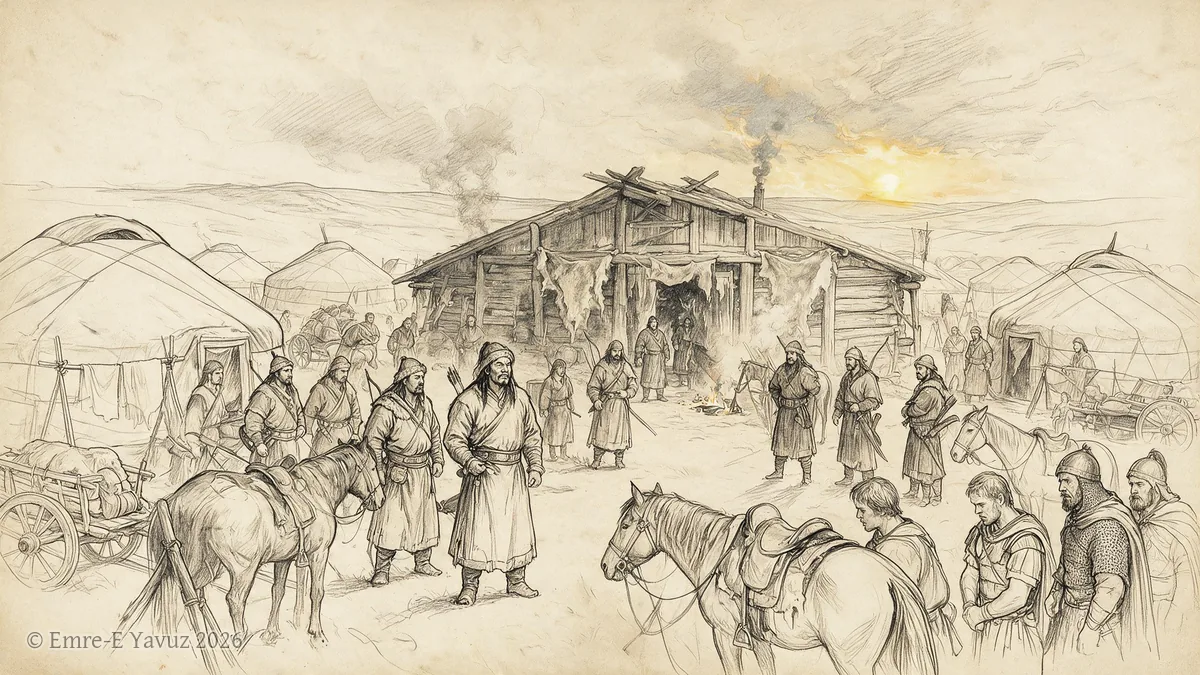
Ammianus gives the first description. The Huns, he writes, cut the cheeks of their children deeply with iron at birth, so that the beard grows thin through the scars, and they grow old beardless. They are compact and strong, with thick necks, and so ugly that they might be taken for two-legged beasts. They need neither fire nor cooked food, but eat the roots of wild plants and the half-raw flesh of any animal, which they warm a little between their thighs and the backs of their horses.[47] They avoid buildings like tombs, and not even a reed hut is found among them. They wear linen or the skins of field mice sewn together, and do not take off a tunic until it falls to rags. They are almost glued to their hardy, ugly horses. On horseback they buy and sell, eat and drink, and sleep bent over the horse’s neck.[48] No one among them ploughs. They wander without fixed homes, with the wagons in which they live. In these wagons their wives weave their clothes and bear and raise their children. None of them can say where he comes from.[49]
Ammianus never saw a Hun. His account is accepted except where it can be disproved.[50] The scarred cheeks were mourning wounds, which Ammianus misunderstood. Like many peoples, the Huns cut their own flesh in grief.[51] Jordanes repeats Ammianus almost word for word and adds that the Huns were short, quick in movement, alert horsemen, broad-shouldered and ready with bow and arrow.[52][53]
In the material life of the fourth century the Huns belonged to a lower stage of pastoralism. Agriculture was entirely unknown to them.[54] By the middle of the fifth century the great majority still lived much the same nomadic life as their ancestors. Sheep were their mainstay, though no source mentions them.[55] The subject villages north of the Danube supplied millet, medos and a barley drink, kamos. Attila’s residence was a village of wooden houses, built for him by Goths or Romans.[56][57] The weakly marked profile and the small eyes that the sources describe point to a Mongoloid strain whose strength cannot be determined. Many Huns were of mixed descent.[58]
Society
Ammianus says that the Huns were subject to no royal restraint, but content with the disorderly leadership of their chief men, and that they held council on horseback.[59] In the 390s there was evidently no ruler strong enough to impose his will on all the tribes.[60] Later one family made the leadership hereditary in successive generations of brothers, Rua, Octar and Mundzuc, and then Mundzuc’s sons Bleda and Attila.[61] Both Attila and his father were well born, which proves a hereditary aristocracy.[62] Attila ruled through a circle of leading men, the logades. After 447 he was obeyed without condition.[63] He wore neither diadem nor crown. His dress was plain, and he drank from a wooden cup.[64]
Priscus, who dined twice at Attila’s table in 449, describes the order of the court.[65] When Attila rode into his village, rows of girls walking under long white linen sheets sang Scythian songs. The wife of Onegesius came out with servants carrying food and wine, which is the highest honour among the Scythians. Attila ate from a silver tray held up to him without dismounting.[66] At the banquet each guest was handed a cup at the threshold, to pray before sitting down. The seats stood along the walls, with Attila on a couch in the middle. The place on his right was the first in honour, and the place on his left the second. Attila’s cup-bearer brought him wine, and he greeted his guests one by one in the order of their rank. Each rose and stood until he had drunk and returned the cup.[67] The guests ate from silver dishes, while Attila ate only meat, from a wooden plate. When the torches were lit, two Scythians recited verses they had made on his victories and his valour in war. Some guests were stirred by the memory of their wars, and the old men wept.[68] At a dinner given by Attila’s wife Kreka, each of the leading men rose and handed the envoys a full cup “with Scythian courtesy”. He embraced and kissed the one who had drunk, and took the cup back.[69]
Women appeared in public and were held in unexpected dignity. A widow of Bleda ruled a village that Priscus passed through.[70][71] The Huns took many wives. Attila married again on Priscus’s journey, “although he had many other wives, the laws of the Scythians permitting it”. Jordanes says that he married Ildico “after innumerable wives, as was the custom of his race”.[72][73] Slavery was little developed. The slaves were captives of war, and no native Hun slave is known.[74] Most captives were sold to Roman dealers, and a captive could win his freedom by fighting for his master, as a Greek merchant of Viminacium did.[75]
The Huns did not destroy or drive out the peoples they conquered. They demanded tribute and recognition of their rule. The subjects kept their own rulers, fought beside the Huns and received a share of the booty.[28] The Hunnic Empire covers the structure of the realm.
Religion
Ammianus says that the Huns were bound by no reverence for any religion or superstition, and burned with an immense desire for gold.[76] The judgement was not based on firsthand knowledge.[77] As a people the Huns were as pagan in the middle of the fifth century as when they crossed the Don.[78] Influenced by the syncretism of Tengrism, they showed greater religious tolerance than the Romans.[79] Attila tolerated both his Catholic and his Arian subjects.[80]
Before the battle on the Catalaunian Plains, Jordanes writes, Attila’s soothsayers examined the entrails of cattle and certain lines in scraped bones.[81] The reading of scraped shoulder blades was a practice of eastern origin. That the Huns had shamans is shown by the word kam in the names of two high-ranking men, Atakam and Eskam.[82] At Attila’s banquet a guest told Priscus that seers had foretold the fall of Attila’s house and its restoration through his son Ernak.[69] Attila held a sword to be the sword of Mars, sacred to the kings of the Scythians. The Huns, like many peoples from Mongolia to Gaul, worshipped the god of war in the form of a sword.[83][84] They probably also worshipped images in human form.[85] The princely graves of the period add a motif. Apart from one find, the only animal figure on their weapons, harness, belts, neck rings and headbands is the bird of prey, mostly the head alone.[86] The exception is a pair of golden temple pendants from Verchne-Jabločno on the Don, which show a tree with a bird, flanked by ibexes above and stags below.[87] The pattern has been taken as the sign of a belief in a supreme god in the form of an eagle, set in the crown of a world tree.[88] No text of the period states such a belief. It is inferred from the motif.[89]
When Attila died, the Huns plucked out their hair and gashed their faces, “that the renowned warrior might be mourned, not by effeminate wailings and tears, but by the blood of men”. They laid his body in a silk tent and rode round it in circles singing a dirge. They held a strava over his tomb and buried him at night.[90] The death of Attila covers the funeral.
Language
All that is known of the Hunnic language are names, a river name and a few words. The sources give the meaning of none of them.[91] Priscus distinguishes Hunnic from Gothic and Latin at Attila’s court.[92] Jordanes gives the Hunnic name of the Dnieper, the Var, which was the old Iranian name of the river.[93][94] Priscus records two words for drinks, medos and the barley drink kamos. Jordanes records the strava, the feast over Attila’s tomb, which may be a Slavic word that he or Priscus took for Hunnic.[72][95][96] The core tribe of the Huns spoke an early form of Oghuric, one of the four great branches of the Turkic languages.[97] To judge by the tribal names, a great part of the Huns spoke a Turkish language, while the personal names give a more mixed picture.[98] Other scholars find the evidence too slight to classify the language at all.[99]
Warfare
Ammianus describes the Huns going into battle in wedge-shaped masses with a savage noise. They scatter suddenly on purpose and do great slaughter. They are so quick that they are never seen storming a rampart. At a distance they fought with missiles tipped with sharpened bone. At close quarters they fought with swords, and while the enemy watched the blades they threw nooses of twisted cloth over him.[100] At the Nedao, Jordanes writes, the Huns fought with bows.[101]
The bow was the weapon of the Huns. It was a reflexed composite bow of about 140 to 160 centimetres, with a wooden core, sinew on the back, horn on the belly and seven bone plates, its limbs of unequal length. The Germanic peoples never adopted it.[102][103] Their arrowheads were mostly of iron. The bone points of Ammianus were an exception.[104] Most Huns were lightly equipped. By contrast, many nobles wore heavy armour.[105] Their horses, which the veterinary writer Vegetius ranked first among war breeds for patience, endurance and resistance to cold, had great hooked heads and manes hanging below the knees.[106] On campaign they camped behind their wagons. Attila retreated into such a camp after the battle on the Catalaunian Plains.[107] The siege engines with which they took cities were built by Roman prisoners or deserters.[108]
The Hun armies were smaller than the sources say. A raiding party of the fourth and fifth centuries rarely numbered more than about 1,200 warriors.[109] The 500,000 men of Attila’s army in Gaul were at most a fifth of that figure, and probably fewer.[110] The Hun kings entrusted the army to their generals, often former tribal chiefs. The discipline they enforced was decisive for the success of the Huns.[111]
Archaeology
No skull from Hungary can be called Hunnic beyond doubt. Skulls of Mongoloid and mixed type, however, appear there with the coming of the Huns. The Huns were racially mixed.[112] Three men’s graves of the period with deformed skulls, at Szekszárd, Gyöngyösapáti and Szirmabesenyő, were once taken for Hunnic on the anthropological diagnosis of the 1950s.[113] A later measurement found no Mongoloid admixture in any of the skulls from them.[114]
Binding the head of an infant with bands, which gives the tower-shaped skull, was not a custom of the Huns alone. The Sarmatians and Alans of the lower Volga took it up about 200 AD. In typical graves of their third and fourth centuries, before the Huns came, seven or eight in ten of the skulls are deformed.[115] Where the custom was so common it cannot have marked rank.[116] The oldest graves with the custom lie in the Tian Shan, in the cemetery of Kenkol and others of its group, and their date is uncertain.[117][118] The finds from the Talas, by way of Lake Borovoe near Petropavlovsk, the Volga and the Ural, to the Don, the Dnieper and Hungary have been counted as the line of the Huns’ advance. It rests on bows, three-edged arrowheads, sabres and gold plaques.[119] If that is right, the bows of Carnuntum, Mainz and Simmering and the finds at Nizhny Baskunchak and Malyi Karaman were not the bows of the Scythians and the Alans.[120] After the Hunnic advance it spread to the Crimean cities and the plain of the middle Danube. With the Alans driven from the steppe, it reached the valleys of the north Caucasus, where it probably lasted into the seventh century.[121] Among the Germanic peoples under Hunnic rule the Gepids and the Crimean Goths kept it into the sixth century, men and women alike. Lombards, Thuringians and Burgundians practised it less, on women only, and gave it up soon after the realm fell.[122] The Avars, who came to the plain later, did not practise it.[123]
Some of the prominent Huns cremated their dead.[124] Others doubt it. Of the graves of the period that show traces of fire, burnt bone has been found in only one, at Münstermaifeld in the Eifel, which another survey does not count as Hunnic. Elsewhere the fire reached the grave goods, and the body may have been buried apart while its goods were burnt on a pyre.[125][126]
The surest Hunnic objects are bronze cauldrons, cylindrical or bell-shaped on a conical foot, with rectangular handles, technically crude. They have been found from Hungary to the region of Perm, the Altai and Khwarezm. Many were deposited in or near water, which points to their use in ceremonies.[127] Not every cauldron was an offering. They were also cooking vessels, and broken pieces lie in the abandoned Roman forts of Sucidava and Intercisa.[128][129] The cauldrons cannot be derived from the Scythian and Sarmatian cauldrons. They link the Huns with the area of the Xiongnu confederacy on China’s northern borders.[130] Others derive the mushroom-shaped knobs on the handles from the knobs on the handles of late Sarmatian cauldrons. It derives the tall cylindrical body from the smaller cauldrons of the Ordos. A handle of the Ordos type lay in a princely grave at Noin Ula dated to about the birth of Christ.[131] Seventeen cauldrons of the tall kind are known, from Bijsk in the Altai and Perm to Chalon-sur-Saône, whose findspot is doubtful. They are counted the leading form of the fifth century. No cast cauldron of the kind is known from the time after the realm fell.[132]
Diadems of gold sheet over bronze, set with inlaid stones, come from graves of the Hunnic period.[133] In the four graves whose contents are known, at Sipovo, Berjozovka, Verchne-Jabločno and Kara-Agač, they lay with women, in graves without weapons and with amber beads, a mirror or a spindle whorl.[134] The diadem crowned a cap or a veil. Some were worn with golden pendants at the temples. It belonged to the festive dress of women of high standing and was no mark of rule.[135]
The richest single graves of the period lie in a belt from the steppes of Kazakhstan to the Hungarian plain, Silesia and the middle Rhine.[136] None dates before about 400 or after the middle of the fifth century. This puts all of them in the years of the widest Hunnic reach. They have neither known forerunners nor a continuation.[137] They cannot be assigned to one people. The men and women in them belonged to the leading class of the realm, in which Huns, Alans and Germanic nobles stood side by side.[138] The men carried a slender single-edged blade for fighting on horseback beside the long sword, a weapon that the Franks later took over as the sax.[139] Their bow was the reflex bow with bone plates. Its arrows had three-edged iron heads, which had replaced bone and bronze in the steppe from about the birth of Christ.[140] The lasso that Ammianus describes leaves no trace in the ground.[141] Protective gear is nearly absent. The graves hold no shield bosses and no helmets with metal bands, and mail only in two eastern graves, probably of Persian or Kerch make. The Roman officer’s helmet of Concești was probably booty.[141]
The saddle was of wooden boards. In finds from Borovoje in Kazakhstan to Mundolsheim near Strasbourg its front bow carried triangular gold plates, mostly stamped with a scale pattern, and only in men’s graves.[142] The graves hold no stirrup. The riders drove their horses with a whip and not with spurs.[143] Men wore earrings, found in pairs, and a leather belt decorated with gold, from which three or more straps sometimes hung.[144] Four graves, at Jakuszowice near Kraków, Pécs-Üszög, Novogrigorjevka and Borovoje, held a bow cut from thin gold sheet round a core of not more than a millimetre. It was made for the burial and is no insignia.[145] Much of the other gold, on harness, belts and shoe gear, is paper-thin foil, fixed with few rivets and unfit for daily use. It seems to have been made for the burial too.[146]
Women of the realm, Germanic women among them, were buried with mirrors of an eastern type, with a loop at the centre, cast of tin-rich white bronze. In the Danube lands the mirrors were broken on purpose before the burial. In all, 23 such graves of the fifth and sixth centuries are known, 22 of them Germanic. The rite is unknown in the east.[147] A sign of a circle divided into four or eight parts stands on mirrors of the Sarmatian period, and on mirrors and sword-belt beads of the Hunnic period and of the late Hunnic period, 480 to 550.[148] The sign may be a picture of the world with its four quarters.[149]
The components that are properly Hunnic in the European record have few parallels in the regions the Xiongnu dominated.[150] The debate on the Huns and the Xiongnu carries what this means for their origin.
The Huns after Attila
After the defeat at the Nedao the Huns were scattered. Attila’s younger son Ernak settled with his people at the far edge of Lesser Scythia, the Dobruja. His kinsmen took fortresses on the Danube. Many Huns went over into Roman territory, and the Sacromontisi and Fossatisii of Jordanes’s time were said to descend from them.[151] Dengizich fought on with the Ultzinzures, Angisciri, Bittugures and Bardores until he fell in 469.[152] Huns served as soldiers in the Roman armies. One of them, Chelchal, an officer under Aspar, turned the Goths against their Hun comrades in 467.[153][154] The Gepid Mundo, who made himself king of a robber band on the Danube in the sixth century, “traced his descent from the Attilani of old”.[155] The name outlived the people. In one survey a dozen or so peoples carry it beside their own. The Akatziri are called Akatzir Huns. Priscus gives the name to the Kidarites of Tokharistan and Gandhara, and Procopius gives it to the Hephthalites. The Sabirs, a probably Turkic-speaking people who reached the north Caucasus between 461 and 465, appear as Hun Sabirs or Sabir Huns.[156] The same account counts the “kingdom of the Huns” north of Derbent, a vassal of the Khazars when the Albanian bishop Israel visited it in 682, as the last identifiable Hun community. On the evidence of some names, its people spoke Turkic.[157]
The bulk of the nomadic Hun tribes streamed back to the steppe and were absorbed into new tribal groupings.[158] When the empire fell, several tribes became independent and stayed in eastern Europe, among them the Bulgars, the Utigurs and the Kutrigurs, who became part of the Turkic-speaking federation of the Onogurs. Some Huns stayed in Hungary, and others roamed the lands of the present Ukraine. Some kept their identity, and others were absorbed by their neighbours.[97] The Bulgarian princes’ list appears to claim an Attilid origin for the ruling house of the Bulgars.[159] Several ruling houses, the Bulgarian khans and the Hungarian Árpád dynasty among them, claimed descent from Attila. A verifiable genealogical line is hard to establish.[2]
Assessment
The Huns played an important part in European history for less than a hundred years.[160] Their attacks drove the Germanic peoples further into the empire. This led to Visigothic rule in Spain and Gaul, to the Vandal conquest of North Africa and in the end to the fall of Rome. More important for the history of the steppe peoples, they laid the foundation for a stronger presence along the western borders of Eurasia.[161] It has been argued that, after a brief period of power that culminated in the raids of Attila, they collapsed. In their view, they nevertheless brought elements of a state structure with them into western Eurasia.[162] Others doubt that Attila made history at all. In this view, the Huns perished like the Avars.[163]
References
- ^ Thompson 1948, p. 177
- ^ a b Yavuz 2025, p. 104
- ^ Thompson 1948, p. 1
- ^ Yavuz 2025, p. 90, 105
- ^ a b Ammianus Marcellinus; Rolfe 1939, xxxi.2.1, p. 381
- ^ Jordanes; Mierow 1915, § 121, p. 85
- ^ Thompson 1948, p. 10–11
- ^ Golden 1992, p. 58
- ^ Golden 1992, p. 106–107
- ^ a b Yavuz 2025, p. 89
- ^ Yavuz 2025, p. 90
- ^ Golden 1992, p. 86–87
- ^ Thompson 1948, p. 2, 21
- ^ Thompson 1948, p. 6
- ^ Jordanes; Mierow 1915, § 121–125, p. 85–86
- ^ Maenchen-Helfen 1973, p. 444
- ^ Roux 1994, p. 173
- ^ Rásonyi 1993, p. 44
- ^ Thompson 1948, p. 19–20
- ^ Ammianus Marcellinus; Rolfe 1939, xxxi.3.1–8, p. 395–401
- ^ Maenchen-Helfen 1973, p. 26, 444
- ^ Ammianus Marcellinus; Rolfe 1939, xxxi.8.4, p. 437
- ^ Maenchen-Helfen 1973, p. 29–30
- ^ Maenchen-Helfen 1973, p. 43, 46
- ^ Maenchen-Helfen 1973, p. 48–51
- ^ Maenchen-Helfen 1973, p. 52
- ^ Maenchen-Helfen 1973, p. 52, 55
- ^ a b Yavuz 2025, p. 91
- ^ Priscus; Müller 1851, fr. 8, p. 90
- ^ Thompson 1948, p. 30–31
- ^ Yavuz 2025, p. 92
- ^ Maenchen-Helfen 1973, p. 59–66
- ^ Maenchen-Helfen 1973, p. 255
- ^ Jordanes; Mierow 1915, § 166, p. 97
- ^ Thompson 1948, p. 33, 209
- ^ Jordanes; Mierow 1915, § 177, p. 100–101
- ^ Priscus; Müller 1851, fr. 1, p. 72
- ^ Thompson 1948, p. 84
- ^ Maenchen-Helfen 1973, p. 119–120
- ^ Jordanes; Mierow 1915, § 180–181, p. 101–102
- ^ Maenchen-Helfen 1973, p. 104–105
- ^ Maenchen-Helfen 1973, p. 141
- ^ Golden 1992, p. 91
- ^ Maenchen-Helfen 1973, p. 143–144
- ^ Maenchen-Helfen 1973, p. 145–147
- ^ Jordanes; Mierow 1915, § 260–262, p. 125–126
- ^ Ammianus Marcellinus; Rolfe 1939, xxxi.2.2–3, p. 381–383
- ^ Ammianus Marcellinus; Rolfe 1939, xxxi.2.4–6, p. 383
- ^ Ammianus Marcellinus; Rolfe 1939, xxxi.2.10, p. 385–387
- ^ Thompson 1948, p. 6–8
- ^ Maenchen-Helfen 1973, p. 361
- ^ Jordanes; Mierow 1915, § 127–128, p. 86–87
- ^ Mierow 1915, p. 163
- ^ Thompson 1948, p. 41–42
- ^ Maenchen-Helfen 1973, p. 169, 171
- ^ Priscus; Müller 1851, fr. 8, p. 83, 85
- ^ Maenchen-Helfen 1973, p. 179–180
- ^ Maenchen-Helfen 1973, p. 363–364
- ^ Ammianus Marcellinus; Rolfe 1939, xxxi.2.7, p. 383–385
- ^ Maenchen-Helfen 1973, p. 51
- ^ Thompson 1948, p. 162
- ^ Maenchen-Helfen 1973, p. 198
- ^ Maenchen-Helfen 1973, p. 125, 192
- ^ Maenchen-Helfen 1973, p. 271
- ^ Maenchen-Helfen 1973, p. 105
- ^ Priscus; Müller 1851, fr. 8, p. 85
- ^ Priscus; Müller 1851, fr. 8, p. 91–92
- ^ Priscus; Müller 1851, fr. 8, p. 92
- ^ a b Priscus; Müller 1851, fr. 8, p. 93
- ^ Thompson 1948, p. 167–168
- ^ Priscus; Müller 1851, fr. 8, p. 84
- ^ a b Priscus; Müller 1851, fr. 8, p. 83
- ^ Jordanes; Mierow 1915, § 254, p. 123
- ^ Thompson 1948, p. 45–46
- ^ Maenchen-Helfen 1973, p. 199–200
- ^ Ammianus Marcellinus; Rolfe 1939, xxxi.2.11, p. 387
- ^ Maenchen-Helfen 1973, p. 259
- ^ Maenchen-Helfen 1973, p. 262
- ^ Yavuz 2025, p. 101
- ^ Maenchen-Helfen 1973, p. 260–261
- ^ Jordanes; Mierow 1915, § 196, p. 106
- ^ Maenchen-Helfen 1973, p. 269–270
- ^ Jordanes; Mierow 1915, § 183, p. 102–103
- ^ Maenchen-Helfen 1973, p. 279–280
- ^ Maenchen-Helfen 1973, p. 296
- ^ Werner 1956, p. 72–73
- ^ Werner 1956, p. 63–64, 69
- ^ Werner 1956, p. 73, 81
- ^ Werner 1956, p. 69, 81
- ^ Jordanes; Mierow 1915, § 255–258, p. 123–125
- ^ Maenchen-Helfen 1973, p. 376
- ^ Priscus; Müller 1851, fr. 8, p. 86
- ^ Jordanes; Mierow 1915, § 269, p. 128
- ^ Maenchen-Helfen 1973, p. 424
- ^ Jordanes; Mierow 1915, § 258, p. 124
- ^ Maenchen-Helfen 1973, p. 425–426
- ^ a b Yavuz 2025, p. 105
- ^ Maenchen-Helfen 1973, p. 441
- ^ Thompson 1948, p. 151, 222–223
- ^ Ammianus Marcellinus; Rolfe 1939, xxxi.2.8–9, p. 385
- ^ Jordanes; Mierow 1915, § 261, p. 126
- ^ Maenchen-Helfen 1973, p. 221–227
- ^ Werner 1956, p. 47–48
- ^ Maenchen-Helfen 1973, p. 13
- ^ Maenchen-Helfen 1973, p. 251
- ^ Maenchen-Helfen 1973, p. 204–205
- ^ Jordanes; Mierow 1915, § 210, p. 109
- ^ Maenchen-Helfen 1973, p. 201
- ^ Thompson 1948, p. 48
- ^ Maenchen-Helfen 1973, p. 213
- ^ Yavuz 2025, p. 94
- ^ Maenchen-Helfen 1973, p. 364–366
- ^ Werner 1956, p. 14
- ^ Maenchen-Helfen 1973, p. 366
- ^ Werner 1956, p. 7, 16
- ^ Werner 1956, p. 7
- ^ Werner 1956, p. 8, 11
- ^ Ögel 1984, p. 93–94
- ^ Ögel 1984, p. 91–111
- ^ Ögel 1984, p. 103–105
- ^ Werner 1956, p. 13, 16
- ^ Werner 1956, p. 13, 17, 93
- ^ Werner 1956, p. 6, 15
- ^ Maenchen-Helfen 1973, p. 367
- ^ Werner 1956, p. 79
- ^ Maenchen-Helfen 1973, p. 325
- ^ Maenchen-Helfen 1973, p. 306, 318, 326–330
- ^ Werner 1956, p. 60
- ^ Maenchen-Helfen 1973, p. 326
- ^ Maenchen-Helfen 1973, p. 332, 337
- ^ Werner 1956, p. 59
- ^ Werner 1956, p. 58–60
- ^ Maenchen-Helfen 1973, p. 297–306
- ^ Werner 1956, p. 63, 66
- ^ Werner 1956, p. 62–64, 66
- ^ Werner 1956, p. 86–88
- ^ Werner 1956, p. 87, 91
- ^ Werner 1956, p. 2, 84–85
- ^ Werner 1956, p. 46, 95
- ^ Werner 1956, p. 47, 49
- ^ a b Werner 1956, p. 56
- ^ Werner 1956, p. 50–53
- ^ Werner 1956, p. 53–54
- ^ Werner 1956, p. 25, 83–84
- ^ Werner 1956, p. 49–50
- ^ Werner 1956, p. 55, 78
- ^ Werner 1956, p. 20–24
- ^ Harmatta 1987 (Jahr after dem Dateinamen; ungarisches Original 1983), p. 70
- ^ Harmatta 1987 (Jahr after dem Dateinamen; ungarisches Original 1983), p. 70–71
- ^ Savelyev 2020
- ^ Jordanes; Mierow 1915, § 265–266, p. 127
- ^ Jordanes; Mierow 1915, § 272, p. 129–130
- ^ Priscus; Müller 1851, fr. 39, p. 108–109
- ^ Maenchen-Helfen 1973, p. 167–168
- ^ Jordanes; Mierow 1915, § 301, p. 138
- ^ Sinor 1990, p. 199–200
- ^ Sinor 1990, p. 201
- ^ Golden 1992, p. 92
- ^ Golden 1992, p. 103
- ^ Thompson 1948, p. 214
- ^ Yavuz 2025, p. 104–105
- ^ Golden 1992, p. 112
- ^ Maenchen-Helfen 1973, xxiv
Sources
- Ammianus Marcellinus
- Priscus
- Jordanes (after Priscus and Ammianus Marcellinus)
- Sogdian Ancient Letters
- Sogdian inscriptions of the upper Indus
- Hou Han Shu, juan 89
Literature
- Emre-E. Yavuz, The Gokturk Empire: 2nd Edition (2025)
- Peter B. Golden, An Introduction to the History of the Turkic Peoples (1992)
- Otto J. Maenchen-Helfen, The World of the Huns: Studies in Their History and Culture (1973)
- E. A. Thompson, A History of Attila and the Huns (1948)
- John C. Rolfe, Ammianus Marcellinus, with an English Translation, vol. III: Books XXVII–XXXI (1939)
- Karl Müller (ed.), Fragmenta Historicorum Graecorum, Bd. IV (darin: Menandri Protectoris fragmenta, griechisch mit lateinischer Übersetzung) (1851)
- J. B. Bury, History of the Later Roman Empire from the Death of Theodosius I to the Death of Justinian, vol. I (1923)
- Charles Christopher Mierow, The Gothic History of Jordanes in English Version, with an Introduction and a Commentary (1915)
- Alexander Savelyev; Choongwon Jeong, Early Nomads of the Eastern Steppe and Their Tentative Connections in the West (2020)
- Nicola Di Cosmo, Ethnogenesis, Coevolution and Political Morphology of the Earliest Steppe Empire: The Xiongnu Question Revisited (2011)
- Étienne de la Vaissière, Sogdian Traders: A History (2005)
- Friedrich Hirth, Ueber Wolga-Hunnen und Hiung-nu (1899 (printed 1900))
- Uchida Ginpū 内田吟風, 匈奴西移年表:附・フンネン=匈奴に關する再考察 (1936)
- Uchida Ginpū 内田吟風, 月氏のバクトリア遷移に關する地理的年代的考證(下) (1938)
- Denis Sinor (ed.), The Cambridge History of Early Inner Asia (1990)
- Joachim Werner, Beiträge zur Archäologie des Attila-Reiches (1956)
- László Rásonyi, Tarihte Türklük (1993)
- Jean-Paul Roux, Türklerin ve Moğolların Eski Dini (1994)
- Bahaeddin Ögel, İslâmiyetten Önce Türk Kültür Tarihi. Orta Asya Kaynak ve Buluntularına Göre (1984)
- János Harmatta (Turkish translation: Hicran Akın), Doğu Avrupa’da Türk Oyma Yazılı Kitabeler (1987 (Jahr after dem Dateinamen; ungarisches Original 1983))
What links here72
- Persons
- Aetius · Anagastes · Attila · Balamber · Basich · Bleda · Charaton · Chelchal · Dengizich · Gaiseric · Galla Placidia · Hermanaric · Kursich · Octar · Rua · Theodoric I · Theodosius II · Thorismund · Uldin · Valamir · Valentinian III · Zercon
- States
- Byzantium · Hunnic Empire · Western Roman Empire · Xiongnu
- Conflicts
- Han campaigns against the Northern Xiongnu · Hunnic conquest of the Goths · Hunnic invasion of 395
- Battles & Events
- Siege of Naissus · Treaty of Margus
- Peoples
- Alans · Eurasian Nomads · Goths · History of the Turkic peoples · Hun (Tiele tribe) · Kutrigurs · Sabirs · The Great Empires of the Steppe · Turkic Tribes in Europe · Vandals
- Institutions and Titles
- Bone and Horn Working · Hunnic Cauldrons · Wagons of the Steppe Peoples
- Religions
- Göktürk Face-Cutting · Riding Round the Dead · Shamanism · Strava · Tengri · Turkic Mythology
- Languages
- The Turkic languages
- Foods
- Kamos · Kumys · Millet · Steppe Diet
- Customs & Pastimes
- Funeral Games of the Caucasian Huns · Wrestling
- Controversies
- The Huns and the Xiongnu · The Turkic ethnogenesis debate
Cite this article
Yavuz, Emre-E. “Huns.” Turkic Atlas, revised 8 November 2026. https://turkicatlas.org/ethnicities/huns/
Last revised: 8 November 2026

