
Attila was king of the Huns from the 430s until his death in 453.[1] For ten years he shared the rule with his brother Bleda. After Bleda’s murder he ruled alone.[2] He forced the eastern Roman empire to pay him ever larger sums in gold. He laid waste the Balkan provinces. He invaded Gaul in 451 and Italy in 452. He died on the night after his last wedding.[3] Jordanes calls him lord of all the Huns and almost the sole ruler of all the peoples of Scythia. He also describes him as “a man born into the world to shake the nations”.[4] Attila was the most powerful ruler the Huns ever had.[5]
Priscus came to his court with a Roman embassy in 449 and wrote down what he saw. He watched Attila judge lawsuits before his house and eat from a wooden plate at his own banquet.[6] Almost everything that is known of Attila as a man comes from that account, directly or through Jordanes.[7]
Name
Priscus writes the name Attelas, and the Latin writers write Attila.[8] The name may come from Gothic atta, ‘father’, with the diminutive ending -ila, so that it means “little father”.[8][9] A different explanation connects it with the Turkic name of the Volga, Atïl or Itil.[10] The Gothic derivation rejects the Volga etymology and other Turkic proposals.[11] A third explanation derives it from an Old Arin adjective atɨ-la, ‘quick-ish’. The adjective may have been an epithet at first. Its authors call the derivation plausible but by no means necessary.[12] The names of the Hun nobles that reach us in Germanic form may be Hunnic names in Gothic dress.[13] The Norse poems call him Atli. In Old English he is Ætla.[8]
Family
Attila’s father was Mundzuc, whom Priscus heard called Mundiouchos. Mundzuc’s brothers Octar and Rua ruled the Huns before Attila.[14] A third paternal uncle, Oebarsius, sat beside Attila on his couch at a banquet in 449.[15] In a message to the emperor in 449, Attila claimed that his father had kept intact the nobility he had received from his own father.[16] His family was well born. This shows that the Huns had a hereditary nobility before they came into Europe.[17]
His year of birth is not recorded. His beard was already sprinkled with grey in 449. He was therefore born not later than about 400.[17]
He had many wives, as the custom of his people allowed.[18][19] The queen whom Priscus visited was Kreka. She was the mother of three of his children. The eldest of them already ruled the Akatziri.[20] On the way north in 449, Attila stopped at a village to marry the daughter of a man named Eskam.[18] His last wife was Ildico.[19] His sons, Jordanes says, were almost a people of themselves.[21] Three are named: Ellac, the eldest; Dengizich; and Ernak, a younger son.[22][23] Priscus saw Attila show tenderness to Ernak alone.[15] By contrast, Jordanes says that Attila loved Ellac above all his children.[24]
Accession and the treaty of Margus
When Rua died, Priscus writes, the kingdom of the Huns passed to Attila.[25] Some calculations date Rua’s death to the spring of 434, others place it after the end of 435.[26][27] In one account, Rua died four years after Octar. His nephews Bleda and Attila, the sons of Octar’s younger brother Mundzuc, took the rule together.[28]
The brothers first made peace with Constantinople. They met the Roman envoys outside the town of Margus on the Danube. They would not dismount. The Romans, to keep their dignity, stayed in the saddle too.[25] The treaty of Margus doubled the yearly tribute from 350 to 700 pounds of gold.[25] The empire promised to receive no more fugitives from the Huns, to hand back those it held, and to keep the markets open on equal terms.[25] Two young men of the royal family, Mamas and Atakam, had fled. They were handed over at the fort of Carsum and crucified.[25] Then Attila and Bleda went off to subdue the peoples of Scythia. They made war on the Sorosgi.[25]
The brothers ruled separately, each over his own peoples. Bleda may have ruled the tribes in the east and Attila those in the west.[29] Another position is that it is not known which part fell to each.[30] Jordanes says that Bleda ruled “a great part of the Huns”.[31]
The wars with the eastern empire
In 441 the Huns struck while a Roman fleet was in Sicily for a war against the Vandals. Persia was attacking Armenia at the same time.[32] At a frontier market the Huns fell on the Roman merchants. When Constantinople protested, they answered with two charges. The bishop of Margus, they said, had crossed the river and robbed the royal graves. The empire, they said, still kept fugitives.[33] One interpretation of the Greek has the bishop rob the royal treasure instead of the graves.[34] The Huns crossed the Danube. They took Viminacium. The bishop of Margus feared that he would be handed over. He went to the Huns and betrayed his city to them by night.[35] “From that time,” Priscus writes, “the affairs of the barbarians grew greater and better day by day.”[35]
The Balkan wars that followed took Singidunum, Sirmium, Ratiaria and Naissus, the birthplace of Constantine.[36] Priscus found Naissus deserted in 449, its riverbank covered with the bones of the dead.[37] The Huns now had rams and other siege engines. The cities fell without great effort.[38] The engines were built for them by Roman prisoners or deserters.[39] After a Roman defeat in the Chersonese, the emperor Theodosius II sent Anatolius to make peace. The peace of Anatolius made the empire pay 6,000 pounds of gold in arrears at once. From then on it had to pay 2,100 pounds a year, three times the old tribute.[40] To raise the gold, Priscus writes, the senators were made to pay a levy by rank. Men of inherited wealth sold their wives’ jewels and their furniture in the market.[41]
The dates of these wars are argued. One chronology has a war in 441 and 442. It has a single great invasion in 447, which the peace of Anatolius ended in the autumn of that year.[42] A second chronology has a war from 441 to 443, ended by a first peace of Anatolius. It has a second invasion in 447, with further treaties in 448 and 450.[43] In 447 the Huns broke into the empire again. An earthquake had thrown down the walls of Constantinople.[44] They defeated and killed the general Arnegisclus on the river Utus and pushed south as far as Thermopylae. A Gallic chronicle counts seventy cities taken.[45][46] It was the greatest victory the Huns ever won. From then on Attila was king, commander and supreme judge, obeyed without condition.[47]
The death of Bleda
About 445 Attila killed his brother.[48] Jordanes says that Bleda, “who ruled over a great part of the Huns”, was killed by Attila’s treachery. He adds that Attila then united the whole people under his own rule.[31] The Gallic chronicler Prosper, under 444, writes that Attila killed Bleda, “his brother and partner in the kingdom”. He adds that Attila forced his peoples to obey him.[49] The chronicles give 444, 445 and 446, but the murder is placed in 445.[48][50]
One account tells that Bleda tried to trap Attila by inviting him to hunt a boar in a forest. Attila was surrounded by Bleda’s men, but he won them over to his side. They helped him kill his brother.[51] The same account notes that it is argued whether Bleda was really killed by his own kin. It also notes that rivalry between brothers was common in the semi-nomadic societies of the steppe.[52] Jordanes gives neither a hunt nor a place. He says only that Bleda was killed by treachery.[31]
The Akatziri
About the same time Attila brought the Akatziri, a people of the Black Sea steppe, under his rule. Priscus tells how. The Akatziri had many rulers, by peoples and clans. Theodosius sent them gifts to draw them away from Attila. His envoy gave the first gift to the wrong king. Kuridachus, the senior of the kings, received his gift second. He called Attila in against the others. Attila sent a large army. He killed some of the kings and forced the rest to submit. Attila invited Kuridachus to share the fruits of victory. Kuridachus suspected a trap and declined. His answer was that it was hard for a man to come into the sight of a god. If no one could look at the disc of the sun, how could anyone face the greatest of the gods unharmed?[53] Kuridachus therefore kept his own people. Attila made his eldest son king over the rest.[18] One calculation dates the war to 445, another to 448.[54][55]
The court
Priscus, who travelled with the embassy of 449, describes Attila at home.[56] He received the Romans sitting on a wooden seat in his tent, surrounded by a ring of guards.[57] His residence was a large village beyond the Danube. His houses were built of logs and planed boards inside a wooden enclosure with towers. The enclosure served for show and not for defence.[58] Girls walking in rows under long linen cloths met him with songs as he rode into the village. The wife of his chief minister Onegesius brought him food and wine. He ate it on horseback from a silver table held up by his men.[59]
Priscus saw him come out of his house with a grave face, rolling his eyes this way and that. He stood before his door with Onegesius. Many who had disputes came to him and received his judgement. Then he went in to receive the envoys of barbarian peoples.[20] Jordanes, drawing on the same source, gives his portrait. Attila was short, with a broad chest, a large head and small eyes. His beard was thin and sprinkled with grey. He had a flat nose and a dark complexion, “showing the evidences of his origin”. He was haughty in his walk. He was “a lover of war, yet restrained in action, mighty in counsel, gracious to suppliants and lenient to those who were once received into his protection”.[60]
At the banquet the guests ate from silver plates and drank from gold and silver cups. Attila ate only meat, from a wooden plate. He drank from a wooden cup. His clothes were plain. Neither his sword nor the fastenings of his shoes nor his horse’s bridle were adorned with gold or gems, as those of the other nobles were.[61] When evening came, two men stood before him and sang songs they had made of his victories and his courage in war. The old men wept.[61] Through the jesting that followed, Attila’s face did not move. Only when his youngest son came in did he look at him gently and pinch his cheek. A guest told Priscus that seers had foretold the fall of Attila’s family. They had also foretold that this son would restore it.[15]
He ruled through a circle of trusted men. They included Onegesius and his brother Scottas, Edeco, Berichus and his Roman secretary Orestes. Priscus calls them the leading men of the Scythians.[62] The logades article discusses the argument over what they were.[63] Each of them in turn kept armed guard round Attila on fixed days.[64] He used embassies to Constantinople to reward his favourites. They came home with Roman gifts.[65] His secretaries were Romans: Orestes from Pannonia, a Gaul and an Italian both named Constantius, and Rusticius from Upper Moesia.[66]
He held the rank of a Roman general and drew the pay that went with it. He said that the emperor’s generals were his slaves. His own men, he said, were the equals of the Roman emperors.[67] He wore no crown. His men did not take him for a god.[68] He believed himself chosen for the rule of the world after a herdsman brought him the sword of Mars.[69]
The plot of 449
In 448 or 449, Attila’s envoys Edeco and Orestes came to Constantinople with new demands: the fugitives, a strip of land five days’ journey wide south of the Danube, and a market at Naissus.[70] The eunuch Chrysaphius, the most powerful man at the court of Theodosius II, offered Edeco great wealth if he would kill Attila on his return. Edeco asked for fifty pounds of gold to win over his men.[64] He then revealed the plot to Attila. When the interpreter Bigilas came back with the gold, he was seized. He confessed when Attila threatened to kill his son.[71] Attila sent Orestes to Constantinople with the purse hung round his neck, to ask the eunuch whether he knew it. He also told the emperor that by paying tribute he had become his slave.[72] According to a modern account, a few years before his death Attila survived two attempts on his life by Onegesius and his brother Scottas.[73] In Priscus both men appear as his most trusted followers. The plot of 449 there is the work of Chrysaphius through Edeco.[74]
Anatolius and Nomus came the next year with gold. Attila met them on the river Drenco, and his attitude softened. He released Bigilas for fifty pounds. He freed many prisoners without ransom. He gave up the strip south of the Danube.[75]
The turn to the West
In 450 Theodosius died.[76] His successor Marcian refused to pay the tribute. His answer was that Attila would have gifts if he kept quiet, and would meet men and arms equal to his own if he threatened war.[77] In the same year Honoria, the sister of the western emperor Valentinian III, sent Attila her ring. Attila claimed her as his bride and demanded half the western empire as her inheritance. The western court answered that she was already married to another and that the empire belonged to men, not to women.[78] The story has been dismissed as the gossip of the Byzantine court.[79]
Attila turned west. Priscus gives three reasons: Honoria and her wealth, a quarrel over the Frankish throne, and the wish to oblige the Vandal king Gaiseric by attacking the Visigoths. In the quarrel over the Frankish throne, the elder son of the dead king called in Attila, and the younger son called in Aetius.[78] By contrast, Jordanes makes it a bribe from Gaiseric.[80] Scholars disagree on the motives. One position is that they cannot be known.[81] A second explanation sees a contest between Attila and Aetius for influence among the Franks. Rome would then have taken it for a bid for half the western empire.[82] A third explanation is that he wanted above all to remove Aetius, as John of Antioch says.[83] His aim would then have been to supplant Aetius as the western empire’s great general, not to dethrone Valentinian. Gaul was the richer country to plunder. An attack from the north did not threaten the emperor directly.[84]
Gaul and Italy
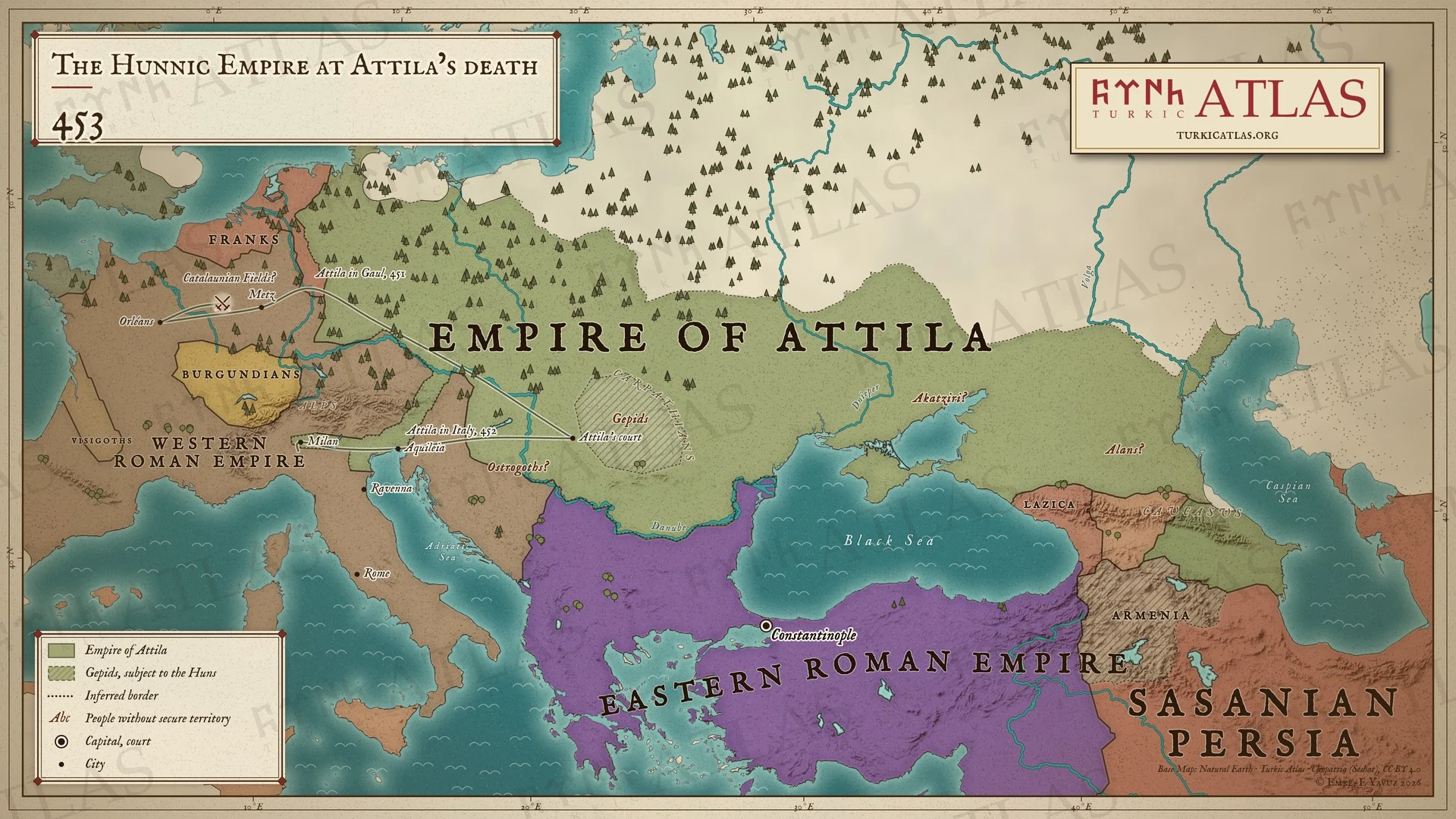
In 451 Attila marched into Gaul with a great army of Huns and subject peoples.[85] The campaign in Gaul ended on the Catalaunian Plains. There Aetius and the Visigothic king Theodorid met him in battle. The battle killed Theodorid and drove Attila into his wagon camp. He withdrew to the Danube.[86] In the early summer of 452 he invaded Italy.[87] In the Italian campaign he took Aquileia after a long siege. He then took Milan and Ticinum.[88] His own men, Priscus writes, turned him from Rome with the example of the Visigothic king Alaric. Alaric had not long survived his sack of the city.[89] At the river Mincius he met Pope Leo. He withdrew beyond the Danube.[90] Hunger and plague in his army and an eastern Roman force that crossed the Danube behind him did as much to bring him back.[91][92]
Death
Back home, Attila threatened Marcian with war if the tribute promised by Theodosius were not paid.[93] Early in 453 he married Ildico. On the night of the wedding, he died of a haemorrhage in his drunken sleep, without a wound.[19][94] His horsemen rode round his body in a silken tent and sang his deeds. His people held a strava over his tomb. They buried him at night with gold, silver and iron.[95] The article on the death of Attila continues the account. Within a year his sons had fallen out. The subject peoples broke their power at the Nedao.[96]
The extent of his rule
The Roman envoy Romulus, who knew him, told Priscus in 449 that no one who had ever ruled in Scythia or anywhere else had achieved so much in so short a time. He said that Attila had made himself master of all Scythia and extended his rule to the islands of the Ocean. He also said that Attila had made the Romans pay him tribute.[97] How far his rule reached is argued. In one picture, all the peoples between the Alps and the Baltic, and between the Caspian and a line somewhere east of the Rhine, recognised Attila and Bleda as their masters.[98] A second picture shows an empire from Central Asia to Gaul.[5] A third view holds that his power has been exaggerated. He was master of Pannonia and the lands round it, of the Huns, the Goths and the Gepids. For a few years he was more than a nuisance to the Romans, though at no time a real danger.[99][100] His campaigns aimed at regular tribute, not at conquest.[100] The Hunnic Empire article covers the realm as a whole.
Assessment
The judgements of modern historians differ as widely as the estimates of his power. Not everyone grants that he was a military genius. His two victories over the eastern army were won against a weak enemy. In Gaul, on ground of his own choosing and against suspicious allies, his generalship failed. His diplomacy united Aetius and the Visigoths against him. It also threw away Gaiseric as an ally.[101] The same judgement places his achievement in his grasp of Hun society. United under one absolute leader, the tribes became an instrument without equal for exploiting the peoples of central Europe. He received his empire almost ready-made from his predecessors. Rua had laid the foundations of his greatness.[102]
He was the most famous and the most feared Hun of all time.[51] His reputation has been argued over for centuries. He was long regarded as a destructive tyrant. He was also made the “scourge of God”, sent to punish the Christians and the settled peoples. The same explanation was later applied to the Mongols too.[103] Several ruling houses claimed descent from him, among them the Bulgarian khans and the Árpád dynasty of Hungary.[103] The Bulgarian princes’ list gives its first ruler as Irnik. Irnik has been equated with Attila’s son Ernak.[104] A verifiable line of descent from him cannot be established.[103]
References
- ^ Maenchen-Helfen 1973, p. 143–144
- ^ Jordanes; Mierow 1915, § 180–181, p. 101–102
- ^ Maenchen-Helfen 1973, p. 125, 143
- ^ Jordanes; Mierow 1915, § 178, 182, p. 101–102
- ^ a b Yavuz 2025, p. 447
- ^ Priscus; Müller 1851, fr. 8, p. 89, 92
- ^ Thompson 1948, p. 12–13
- ^ a b c Maenchen-Helfen 1973, p. 386
- ^ Savelyev 2020
- ^ Golden 1992, p. 90
- ^ Maenchen-Helfen 1973, p. 386–387
- ^ Bonmann 2025, p. 43
- ^ Maenchen-Helfen 1973, p. 389
- ^ Jordanes; Mierow 1915, § 180, p. 101
- ^ a b c Priscus; Müller 1851, fr. 8, p. 93
- ^ Priscus; Müller 1851, fr. 12, p. 97
- ^ a b Maenchen-Helfen 1973, p. 198
- ^ a b c Priscus; Müller 1851, fr. 8, p. 83
- ^ a b c Jordanes; Mierow 1915, § 254, p. 123
- ^ a b Priscus; Müller 1851, fr. 8, p. 89
- ^ Jordanes; Mierow 1915, § 259, p. 125
- ^ Priscus; Müller 1851, fr. 8, 36, p. 93, 107
- ^ Jordanes; Mierow 1915, § 262, 266, 272, p. 126–129
- ^ Jordanes; Mierow 1915, § 262, p. 126
- ^ a b c d e f Priscus; Müller 1851, fr. 1, p. 72
- ^ Thompson 1948, p. 72
- ^ Maenchen-Helfen 1973, p. 93–94
- ^ Yavuz 2025, p. 94
- ^ Maenchen-Helfen 1973, p. 86
- ^ Thompson 1948, p. 76–77
- ^ a b c Jordanes; Mierow 1915, § 181, p. 102
- ^ Thompson 1948, p. 79
- ^ Priscus; Müller 1851, fr. 2, p. 72–73
- ^ Maenchen-Helfen 1973, p. 110
- ^ a b Priscus; Müller 1851, fr. 2, p. 73
- ^ Thompson 1948, p. 80–84
- ^ Priscus; Müller 1851, fr. 8, p. 78
- ^ Yavuz 2025, p. 95
- ^ Maenchen-Helfen 1973, p. 201
- ^ Priscus; Müller 1851, fr. 5, p. 74
- ^ Priscus; Müller 1851, fr. 5, p. 74–75
- ^ Maenchen-Helfen 1973, p. 115–117, 124
- ^ Thompson 1948, p. 78–98, 216–219
- ^ Maenchen-Helfen 1973, p. 119–121
- ^ Maenchen-Helfen 1973, p. 119–121, 456
- ^ Yavuz 2025, p. 97
- ^ Maenchen-Helfen 1973, p. 125
- ^ a b Maenchen-Helfen 1973, p. 104–105
- ^ Maenchen-Helfen 1973, p. 85, 104
- ^ Thompson 1948, p. 88
- ^ a b Yavuz 2025, p. 96
- ^ Yavuz 2025, p. 96, 213
- ^ Priscus; Müller 1851, fr. 8, p. 82–83
- ^ Maenchen-Helfen 1973, p. 105
- ^ Thompson 1948, p. 95
- ^ Maenchen-Helfen 1973, p. 124
- ^ Priscus; Müller 1851, fr. 8, p. 81
- ^ Priscus; Müller 1851, fr. 8, p. 85
- ^ Priscus; Müller 1851, fr. 8, p. 85–86
- ^ Jordanes; Mierow 1915, § 182, p. 102
- ^ a b Priscus; Müller 1851, fr. 8, p. 92
- ^ Priscus; Müller 1851, fr. 7–8, p. 76–95
- ^ Thompson 1948, p. 163–165
- ^ a b Priscus; Müller 1851, fr. 7, p. 77
- ^ Priscus; Müller 1851, fr. 6, p. 76
- ^ Maenchen-Helfen 1973, p. 376
- ^ Priscus; Müller 1851, fr. 8, p. 90–91
- ^ Maenchen-Helfen 1973, p. 271, 274
- ^ Jordanes; Mierow 1915, § 183, p. 102–103
- ^ Priscus; Müller 1851, fr. 7, p. 76
- ^ Priscus; Müller 1851, fr. 8, p. 80, 95
- ^ Priscus; Müller 1851, fr. 12, p. 96–97
- ^ Yavuz 2025, p. 103
- ^ Priscus; Müller 1851, fr. 7–8, p. 77, 80, 88
- ^ Priscus; Müller 1851, fr. 14, p. 97–98
- ^ Bury 1923, p. 235
- ^ Priscus; Müller 1851, fr. 15, p. 98
- ^ a b Priscus; Müller 1851, fr. 15–16, p. 98–99
- ^ Maenchen-Helfen 1973, p. 130
- ^ Jordanes; Mierow 1915, § 184–185, p. 103
- ^ Thompson 1948, p. 131
- ^ Yavuz 2025, p. 99
- ^ Sinor 1990, p. 193
- ^ Sinor 1990, p. 192–193
- ^ Thompson 1948, p. 135–143
- ^ Jordanes; Mierow 1915, § 192–218, p. 105–112
- ^ Maenchen-Helfen 1973, p. 132–141
- ^ Jordanes; Mierow 1915, § 219–222, p. 112–113
- ^ Jordanes; Mierow 1915, § 222, p. 113
- ^ Jordanes; Mierow 1915, § 223, p. 113–114
- ^ Maenchen-Helfen 1973, p. 138–141
- ^ Yavuz 2025, p. 102–103
- ^ Priscus; Müller 1851, fr. 19, p. 99–100
- ^ Maenchen-Helfen 1973, p. 143
- ^ Jordanes; Mierow 1915, § 256–258, p. 124–125
- ^ Jordanes; Mierow 1915, § 259–263, p. 125–126
- ^ Priscus; Müller 1851, fr. 8, p. 90
- ^ Thompson 1948, p. 76
- ^ Maenchen-Helfen 1973, p. 125–126
- ^ a b Golden 1992, p. 91
- ^ Thompson 1948, p. 206–207
- ^ Thompson 1948, p. 205, 208–209
- ^ a b c Yavuz 2025, p. 104
- ^ Golden 1992, p. 92, 103
Sources
Literature
- Otto J. Maenchen-Helfen, The World of the Huns: Studies in Their History and Culture (1973)
- E. A. Thompson, A History of Attila and the Huns (1948)
- J. B. Bury, History of the Later Roman Empire from the Death of Theodosius I to the Death of Justinian, vol. I (1923)
- Charles Christopher Mierow, The Gothic History of Jordanes in English Version, with an Introduction and a Commentary (1915)
- Karl Müller (ed.), Fragmenta Historicorum Graecorum, Bd. IV (darin: Menandri Protectoris fragmenta, griechisch mit lateinischer Übersetzung) (1851)
- Peter B. Golden, An Introduction to the History of the Turkic Peoples (1992)
- Emre-E. Yavuz, The Gokturk Empire: 2nd Edition (2025)
- Alexander Savelyev; Choongwon Jeong, Early Nomads of the Eastern Steppe and Their Tentative Connections in the West (2020)
- Denis Sinor (ed.), The Cambridge History of Early Inner Asia (1990)
- Svenja Bonmann; Simon Fries, Linguistic Evidence Suggests that Xiong-nu and Huns Spoke the Same Paleo-Siberian Language (2025)
What links here68
- Persons
- Aetius · Anagastes · Ardaric · Bigilas · Bleda · Dengizich · Edeco · Ellac · Ernak · Gaiseric · Galla Placidia · Honoria · Ildico · Kreka · Marcian · Maximinus · Mundzuc · Octar · Onegesius · Orestes · Rua · Scottas · Theodoric I · Theodosius II · Thorismund · Valamir · Valentinian III · Zercon
- States
- Hunnic Empire · Western Roman Empire
- Battles & Events
- Battle of the Catalaunian Plains · Battle of the Nedao · Death of Attila · Embassy of Maximinus to Attila · Peace of Anatolius · Siege of Naissus · Treaty of Margus
- Places
- Aquileia · Margus · Naissus · Viminacium
- Peoples
- Akatziri · Alans · Angisciri · Bardores · Bittugures · Gepids · History of the Turkic peoples · Huns · Sorosgi · The Great Empires of the Steppe · Ultzinzures · Vandals
- Institutions and Titles
- Logades
- Religions
- Göktürk Face-Cutting · Riding Round the Dead · Strava · Sword of Mars · Turkic Mythology
- Languages
- The Hunnic language
- Foods
- Kamos · Steppe Diet
- Customs & Pastimes
- Seating at the Feast
Cite this article
Yavuz, Emre-E. “Attila.” Turkic Atlas, revised 8 November 2026. https://turkicatlas.org/persons/attila/
Last revised: 8 November 2026

