
Tanshihuai held more of the eastern steppe than any man between Bagatur and Bumin. He held it for about twenty-five years. He took the country the Xiongnu had lost. He beat back every Han attempt to break him. He refused the seal of a king when it was offered. He broke three Han armies on one day.[1] When he died, the whole of it came apart. That collapse is the part of his career that matters most for what came after.[2]
Birth and rise
The Hou Han Shu tells his beginning as a foundling story. His father Toulu-hou had served three years with the Xiongnu army. While he was away, his wife bore a son at home. When he came back, he thought it strange. He meant to kill the child. His wife said that one day, as she was walking, she had heard thunder and looked up, and a hailstone had fallen into her mouth. She had swallowed it, conceived, and borne the child after ten months. The child would be extraordinary, she said, and should be kept. The father would not listen and had him exposed. The mother told her own family in secret to take him in and rear him. They named him Tanshihuai.[1] Some scholars identify the name Tanshihuai with the Turkic and Mongolic title Tangsuk Khan, because of the hailstone his mother swallowed.[3] The birth after ten months has a counterpart in Turkic mythology, where a child is also born after ten months.[4]
At fourteen or fifteen he was brave and clever. A chief of another division carried off the cattle and sheep of his mother’s family. Tanshihuai rode after him alone. Nothing stood in his way. He brought back everything that had been taken. After that, the tribes feared him and submitted.[1] The chapter treats the next step as the real beginning. He laid down prohibitions and judged what was straight and what was crooked. Nobody dared to offend against him. Therefore they raised him up to be great chief.
The realm
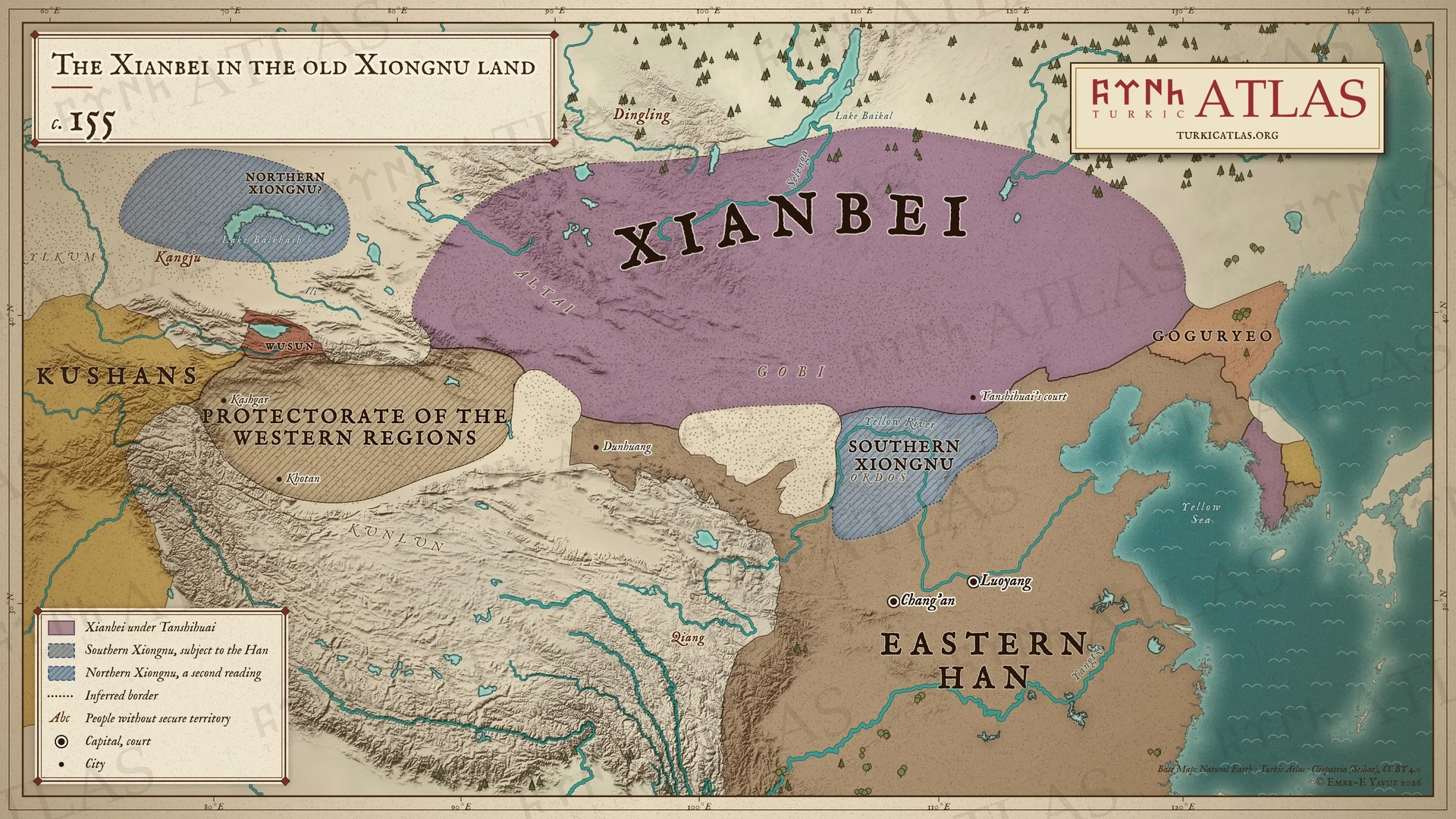
He set up his court at Mount Danhan on the Chuochou river, more than three hundred li north of Gaoliu.[1] His troops and horses were very strong. The great chiefs of the eastern and the western divisions all came over to him.[1]
Then he campaigned in every direction at once. He raided south along the Han frontier. He held off the Dingling in the north. He drove back Buyeo in the east. He struck the Wusun in the west. He took the whole of the old Xiongnu land, fourteen thousand li and more from east to west and seven thousand from north to south. The chapter adds a detail that is not about conquest but about what a steppe realm consists of: he gathered in the mountains and rivers, the marshes and the salt lakes.[1]
Some scholars put this realm in a wider frame. The Xianbei had absorbed some hundred thousand tents of the beaten northern Xiongnu. These Xiongnu then began to call themselves Xianbei. Tanshihuai occupied the lands of those who fled after the disaster of 155. He built a coalition out of what was left of the Xiongnu, the Wuhuan and the Xianbei. Predatory raiding was the mechanism that held together a polity which had no native tradition of central authority.[5]
The Han had dealt with the Xianbei long before him. In AD 49 the Xianbei first sent envoys.[1] After that the Xianbei leader Bian He sent troops against the northern Xiongnu year after year. He brought the heads to Liaodong and received rewards for them.[1][6] In AD 58 the Han governor of Liaodong paid Bian He again, this time to attack the Wuhuan leader Xinzhifen. The Xianbei chiefs then came to Liaodong to receive rewards, and the revenues of Qingzhou and Xuzhou paid 270 million coins a year.[1][6] On one account, this was almost three times the yearly gift to the Southern Xiongnu.[6] In the Yongchu period, under the emperor An, the Xianbei chief Yan Liyang came to court and received a king’s seal.[1] He was told to stay at Ningcheng under the Wuhuan commandant and to trade in the markets there.[1] The Han built two halls for hostages, and one hundred and twenty Xianbei clans each sent hostages.[1][7]
The refused seal
According to the chapter, the Han court had long suffered from him and could not control him. It therefore sent an envoy with a seal and cords and made him a king. The court intended to make a marriage treaty with him. Tanshihuai would not take the seal and cords. He raided more severely than before.[1][8] It is the one recorded case in this period of a steppe ruler turning down Chinese recognition outright. The heqin settlement had bought the Xiongnu seventy years of silk, grain and imperial brides. Tanshihuai refused the same bargain. According to another view, he refused because too few goods came with the title and the bride to hold his alliance of clans together. A Chinese seal and sash did little to raise a leader among the nomads.[9]
He then divided his land into three. The eastern division ran from Youbeiping east to Liaodong, touching Buyeo and the Huimo, and had more than twenty settlements. The central division ran from Youbeiping west to Shanggu and had more than ten. The western division ran from Shanggu west to Dunhuang and the Wusun and had more than twenty. A great chief was set over each division. All of them were subject to him.[1]
The campaign of 177
The Han tried force once more. Xia Yu reported in a memorial that the Xianbei had raided the frontier more than thirty times since the spring. He asked for the troops of the commanderies of Yu province to go out beyond the line. One winter and two springs, he wrote, would certainly destroy the Xianbei.
The court debated the proposal. The councillor Cai Yong spoke against it. The chapter quotes his memorial at length. It is the clearest Chinese assessment of the Xianbei ever written down. In it he described the Xianbei as follows.[1] Since the Xiongnu fled, they have grown strong and hold their land. They muster a hundred thousand troops. Their strength is fresh. Their wits are growing. The passes are not guarded. The prohibitions leak. As a result, fine metal and good iron are all in the enemy’s hands. Han fugitives serve them as planners. Their weapons are sharp and their horses are fast. In both they surpass the Xiongnu.[1] He set against this the cost of Wudi’s wars. They had emptied the treasury and driven the people to banditry. He ended with the frontier itself. In his words, trouble on the border is an itch in the hand or foot. Trouble inside the country is an abscess in the chest and the back. The commanderies cannot stop their own robbers. This enemy will not be subdued.[1] The emperor did not take the advice.[1]
Three columns set out, each with ten thousand horse. They went more than two thousand li beyond the frontier. Xia Yu set out from Gaoliu, Tian Yan from Yunzhong, and the Xiongnu commandant Zang Min from Yanmen with the Southern Chanyu. Tanshihuai ordered the great chiefs of his three divisions each to lead their men out to meet them. Xia Yu and the other commanders were heavily beaten. They lost their standards and their baggage.[1] The literature gives the year as 177. The chapter dates the campaign by a reign year without its era name.
After his death
He died about 181. The chapter does not say how. It dates his death to the Guanghe period, AD 178 to 184, and gives his age as forty-five. His son Helian took his place.[1][10] Helian was less able than his father. He raided too, but he was greedy and judged unfairly, and half of the people left him. A crossbowman shot him dead when he attacked Beidi. His son Qianman was too young, so Helian’s nephew Kuitou took the place. When Qianman grew up, he and Kuitou fought over the realm, and the people scattered. After Kuitou died, his brother Budugen took the place. From Tanshihuai on, the chapter says, the great chiefs passed their office down by descent.[1] His creation was held together by his own leadership and by successful raiding. It did not long survive him. The Xianbei went back to the decentralised order they had had before.[2] However, they did not return to obscurity. The Murong, the Tuoba and the Tuyuhun came out of the groups of his confederation. The Tuoba founded the Northern Wei. The ruling house of the Rouran is derived from them too. The title khagan is first recorded among Xianbei groups in the third century. The Rouran took it a century and a half later.[11]
References
Sources
- Hou Han Shu, juan 90
Literature
- Peter B. Golden, An Introduction to the History of the Turkic Peoples (1992)
- Emre-E. Yavuz, The Gokturk Empire: 2nd Edition (2025)
- Liu Mau-tsai, Çin Kaynaklarına Göre Doğu Türkleri (1958, Turkish edition)
- Sechin Jagchid; Van Jay Symons, Peace, War, and Trade Along the Great Wall. Nomadic-Chinese Interaction through Two Millennia (1989)
- Bahaeddin Ögel, Büyük Hun İmparatorluğu Tarihi II (2015)
What links here12
- Persons
- Kebineng
- Places
- Tanhan Mountain
- Lineages
- Murong
- Institutions and Titles
- Chinese Bans on the Export of Iron
- Foods
- Millet · Steppe Diet
- Sources
- Sanguozhi
- Controversies
- The Turkic ethnogenesis debate
Cite this article
Yavuz, Emre-E. “Tanshihuai.” Turkic Atlas, revised 8 November 2026. https://turkicatlas.org/persons/tanshihuai/
Last revised: 8 November 2026

