
- 400
- 500
- 600
- 700
- 800
- 900
- Rouran 400–554
- First Göktürk 552–630
- Tang rule 630–682
- Second Göktürk 682–744
- Uyghur 744–840
- Kirghiz 840–924
- Huns 370–469
- Western Göktürk 552–659
- Türgesh 699–766
- Karluk 766–800
- Khazar 650–969
The Rouran are the people of the Rouran Khaganate. The khaganate held the eastern steppe from about 400 to 552, and the Ashina lived under it as subjects for a century.[1] Nothing the Rouran said of themselves survives. They are known by the names the Chinese gave them, by the titles of their khans as the Wei court glossed them, and by the shape of the state they left to the Göktürks.
Names
- AparOld TurkicKül Tegin inscription
- 柔然ChineseWei Shu 103
- 蠕蠕ChineseWei Shu 103
- 茹茹ChineseZhou Shu 50
- Juan-juanEnglish
The Wei Shu says that the ancestor of the ruling house was a nameless slave called Mugulü, “bald head”. His son Cheluhui was the first to have a following of his own, and he called it Rouran, 柔然.[1][2][3][4] Some scholars set this tale of a bald ancestor beside the bald ancestor of the Khitan. They count the Rouran, the Khitan and the Xianbei among the Proto-Mongols.[5] The emperor Taiwu held them witless and thought them like insects. He changed the name to 蠕蠕, “wriggling”. The Wei Shu writes its whole chapter under the slur.[1] The Zhou Shu and the Sui Shu write 茹茹.[6] The older reading of the name is Juan-juan. Modern proposals hold that the name refers to a hair-style or a totem, and that it connects with a Mongolic word for crawling and, through that word, with the name Apar or Avar.[7] It is not clear that the Apar and the Avars who appear in different places at different times are the same people.[7] The Turkologist Bahaeddin Ögel proposed a Turkic börü, “wolf”, behind the name. The Chinese writings do not show this etymology. It rests only on a Chinese source elsewhere that equates the Rouran with wolves.[8] In Turkey the Rouran are almost always called Avars, “Asian Avars” against the “Pannonian Avars” of Europe.[8] One Turkish handbook gives the name Avar to the Rouran without citing a source.[4] The Rouran called themselves Rouran.
Origin and language
The Wei Shu makes them an offshoot of the Donghu and gives the ruling clan the name Yujiulü. The story of Mugulü has its own article.[1] The Donghu and Xianbei descent is the ground on which scholars presume the Rouran to have spoken a Mongolic language.[7] The reconstruction of Károly Czeglédy has a certain plausibility. He describes a union of Xianbei tribes under the Yujiulü with Hunnic remnants, the War and Hun tribes that also formed the base of the Hephthalite state.[7] A second group of scholars traces them likewise to the Donghu and the Xianbei, and holds that the Xianbei contained Turkic elements.[8] For them, the Rouran state was the first “true” steppe empire, a monarchy under a ruling dynasty rather than a tribal confederation. They also regard it as the likelier position that the Xianbei, the Tuoba and the Rouran ruling houses had Turkic components. The ethnogenesis debate treats it as one position among others.[8] In any case, the confederation the Rouran ruled was largely Turkic-speaking. It included the Gaoche, that is the Tiele, and the Ashina.
Earlier theories rest on the titles and on a few glossed words. One early theory holds the Xianbei, and so the Rouran, to be a mainly Mongol people with a Tungusic admixture, and the title khagan to be a Mongol word.[9] A second theory rests on the plural ending of the Göktürk titles. It holds that the empire before the Göktürks spoke a language of Mongolic rather than Turkic form, and that the Göktürks took over part of its organisation and some of its titles.[10] A third theory holds the Xianbei to be Turks, and the Rouran, from their titles, probably Mongols.[11] A fourth holds some court titles of the Tuoba to be Turkic. It reads the Chinese transcriptions of the titles of a secretary, a gatekeeper and an official of the belt as bitigči, kapaɣčı and kurlaɣčı.[12]
A survey of the period holds that the Rouran state was multi-ethnic and that there is no definite evidence for its language. The old sources count the Rouran as a separate branch of the Xiongnu. On that ground the survey assumes that their language belonged to the same family as that of the Xiongnu, whose language is also unknown.[13] The same work holds that any attribution of a language to the Xiongnu or the Rouran remains highly speculative.[14]
The only words of the Rouran language that the sources preserve are the khans’ titles. The Wei Shu glosses each “in the language of Wei”: Qiudoufa, “to drive and to open out”; Aikugai, “of fine appearance”; Mouhan Heshenggai, “victorious”; Chilian, “divine”; Chu, “sole”; Shouluobuzhen, “gracious”; Fugudun, “constant”; Houqifudaikuzhe, “joyful”; Tahan, “succession”; Douluofubadoufa, “manifesting control”; Mi’oukesheju, “tranquil”; Chiliantoubingdoufa, “grasping”; and khan itself, “what the Wei call emperor”.[1][15] The Chinese gloss of Chu, wei, has been taken for the word “yes”, and Chu for a Mongolic or Tungusic word of assent.[16] The Wei Shu adds the rule behind them. Among the Rouran a ruler’s or minister’s title was taken from his conduct and ability in his lifetime, as the Chinese give a posthumous name. It was not changed after death.[1] The glosses are Wei renderings. The language behind them is not identified.[17] The Khüis Tolgoi inscription is in Brahmi script, and some read it as Mongolic. It leaves open whether its language is that of the Rouran state, of the Tuoba, or of a tribe of the Tula valley.[17]
The Brahmi evidence has a dating problem. Two of the inscriptions in that script from central Mongolia, the Brahmi text at Bugut and the Khüis Tolgoi stone, have been read as the earliest Mongolic on record. Both are held convincing. The Bugut Brahmi, however, is dated to about 584 to 587 and Khüis Tolgoi to between 604 and 620. Both date from decades after the destruction of the Rouran khaganate.[18] Therefore nothing about the composition of the Rouran population or of its elite can safely be built on them.[18] The same caution applies to the older proposals. An older account of Rouran as a para-Mongolic language starts from arguments that are not linguistic.[18] What remains is a possibility rather than a finding. Some groups among the Rouran may well have spoken a Mongolic language, and the close connection with the Mongolic-speaking Xianbei makes this plausible.[18]
Genetics has one data point. A single genome from the Rouran period has been published. It has a broadly north-east Asian ancestry, distinct from the three published Xiongnu genomes. It falls between present-day Mongolic speakers of southern Siberia and the Tungusic speakers of the lower Amur.[18] This fits the supposed origin of the Xianbei, and so of the Rouran, in the Greater Khingan between Mongolia and Manchuria.[18] One individual is not a population. The geneticists say so themselves.[18]
Way of life
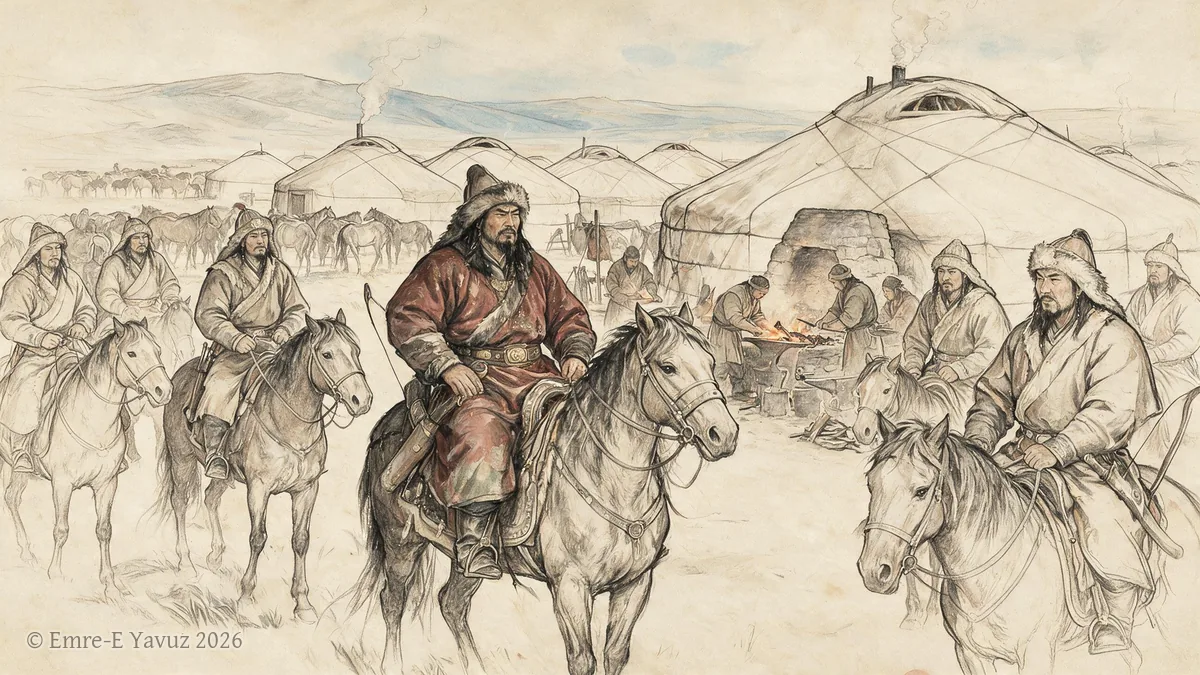
The Wei Shu’s Gaoche chapter says that the Gaoche moved in search of water and grazing, dressed in skins and ate meat. Their cattle, sheep and stock were entirely like the Rouran’s. Only their cart wheels were tall and many-spoked.[1] This is the nearest the sources come to describing Rouran pastoral life. Of the state’s own order, the chapter says what Shelun made. He set armies of a thousand under a general and banners of a hundred under a captain. Spoils went to the first man in, and death to the man who flinched. There was no writing. Commanders counted their men with sheep droppings before they learned to notch wood.[1] There are three notices on writing. The first is that the army counted by dung and tally.[1] The second is the Song Shu of the late fifth century. It says that the Rouran had not known writing and recorded matters on wood, then gradually learned it and had many literate men. It does not say which script, and Chinese is the likeliest.[17] The third is the Mongolian proposal that the Sogdian script reached the Mongols in the Rouran period, together with the attribution of the Khüis Tolgoi inscription to the Rouran.[17] From Yucheng onward every khan proclaimed a reign era of his own: Yongkang, Taiping, Tai’an, Shiping, Jianchang.[1] The Wei Shu records the eras as a presumption. They are the nearest thing to a Rouran chancery that the sources show.[1] The Rouran took wives from the Wei, the Northern Yan, the Hephthalites and the Eastern Wei, and gave daughters to them. Their khatun could be a woman without birth.[1]
Religion
On belief the sources give one story and one embassy. Under Chounu a young woman named Diwan, a physician and sorceress, made the khan’s vanished son reappear in a tent after a seven-day fast and prayer to heaven. She was proclaimed Holy Woman and made khatun. She was strangled in 520.[1] This is the clearest record of shamanism among the Rouran. Some scholars regard their religion as the old steppe religion of the one God, the ancestors and the forces of nature.[17] In 511 Chounu sent the Buddhist monk Hongxuan to the Wei court with a jewelled image, the earliest notice of Buddhism at the Rouran court.[1] Others place the entry of Buddhism after Diwan’s death and have it come from the oasis cities of the Tarim. If the inscription is Rouran, they count the Buddhist elements of the Khüis Tolgoi inscription with it.[17] The articles on Tengrism and Buddhism take up both.
Rouran and the Avars
Some twenty thousand of the nobility rode west after Anagui’s death. From them most likely came the khagans and the ruling nobility of the Avars, and the title khagan went west with them.[19][20] The Göktürk envoys at Constantinople in 568 counted the fugitive Avars at about that number.[21] Three claims stand against one another. The Göktürks called the Avars their runaway slaves.[7] In Theophylact’s letter of the khan, the true Avars flee to Taugast, that is China, and to the Mukri. The barbarians on the Danube had falsely taken the name.[7] Czeglédy argued that both the Rouran and the Hephthalite polities consisted of War and Hun tribes. Therefore it remains unclear which of the two formed the core of the European Avars.[7] Some scholars hold the kinship of Rouran and Avars established and the sceptics refuted by recent genetic studies. The question nevertheless remains undecided.[8] The objection that carries most weight is linguistic rather than genetic. Suppose the Rouran spoke Mongolic and the Avars a Bulghar Turkic variety. Continuity would then require a language shift on the road west. No Mongolic substratum has been shown in the language of the European Avars to mark where it happened.[18] Walter Pohl draws the third conclusion. The European Avars took the Rouran name for the legitimacy it carried, and were otherwise another people speaking another language.[18] One older account takes the Avars for a part of the Rouran, who came to the Black Sea about 560 and stood before Constantinople in 626.[22] A survey of the period calls the opinion that the Avars spoke a Turkic language widespread but unproven and probably unjustified.[13] The Avar article sets out the descent of the ruling nobility and the other positions.
The Rouran and the Göktürks
The Rouran matter to Göktürk history as the power under which it began. In the sources, the Göktürks are what the Rouran made them: ironworkers in the Altai, under a khan who called their leader his blacksmith slave.[6] The Göktürks may have taken over the title khagan from the Rouran, who had been the first in Central Asia to bear it.[23] One account describes the Göktürks as “mixed barbarians” of the Pingliang region, who fled from the Wei to the Rouran. It sees the taunt “smith-slave” as another sign of non-nomad origin, since smiths held honourable standing among nomads.[3] The same account sees the Rouran and the Göktürks as new nomad formations drawn from the margin of China, not as the Xiongnu continued.[24] One survey takes the “caverns” of the Göktürk legend for the underground mines in which the people of Bumin worked iron for the Rouran.[25]
The khaganate, its rulers from Mugulü to Anagui, and its wars have their own articles.
References
- ^ a b c d e f g h i j k l m n Wei Shu, juan 103
- ^ Khazanov 1994, p. 167
- ^ a b Lattimore 1951, p. 528
- ^ a b Ögel 1978, p. 282
- ^ Ögel 1978, p. 273–274, 282
- ^ a b Zhou Shu (Book of Zhou), juan 50
- ^ a b c d e f g Golden 1992
- ^ a b c d e Yavuz 2025
- ^ Kurakichi 1926, p. 16
- ^ Pelliot 1915, p. 689
- ^ Togan 1981, p. 41
- ^ Tekin 2003, p. 13–14
- ^ a b Litvinsky 1996, p. 317
- ^ Litvinsky 1996, p. 322
- ^ Kurakichi 1926, p. 7
- ^ Kurakichi 1926, p. 16–17
- ^ a b c d e f Yıldırım 2024
- ^ a b c d e f g h i Savelyev 2020
- ^ Golden 2013, p. 62–63
- ^ al. 2022, e6
- ^ Menander Protector
- ^ Togan 1981, p. 154–155
- ^ Pelliot 1915, p. 688–689
- ^ Lattimore 1951, p. 526, 528
- ^ Litvinsky 1996, p. 326
Sources
- Wei Shu, juan 103
- Zhou Shu (Book of Zhou), juan 50
- Kül Tegin inscription
- Menander Protector
Literature
- Emre-E. Yavuz, The Gokturk Empire: 2nd Edition (2025)
- Peter B. Golden, An Introduction to the History of the Turkic Peoples (1992)
- Peter B. Golden, Some Notes on the Avars and Rouran (2013)
- Guido Alberto Gnecchi-Ruscone et al., Ancient Genomes Reveal Origin and Rapid Trans-Eurasian Migration of 7th Century Avar Elites (2022)
- Kürşat Yıldırım, On the Culture of Rouran Khanate (2024)
- Alexander Savelyev; Choongwon Jeong, Early Nomads of the Eastern Steppe and Their Tentative Connections in the West (2020)
- Shiratori Kurakichi, A Study on the Titles Kaghan and Katun (1926)
- Paul Pelliot, L'origine de T'ou-kiue, nom chinois des Turcs (1915)
- Zeki Velidi Togan, Umumi Türk Tarihine Giriş I (1981)
- Bahaeddin Ögel, Türk Kültür Tarihine Giriş V: Türklerde giyecek ve süslenme (1978)
- Anatoly M. Khazanov, Nomads and the Outside World (1994)
- Owen Lattimore, Inner Asian Frontiers of China (1951)
- B. A. Litvinsky; Zhang Guang-da; R. Shabani Samghabadi (ed.), History of Civilizations of Central Asia, Vol. III (1996)
- Talât Tekin; Mehmet Ölmez, Türk Dilleri: Giriş (2003)
What links here16
- Persons
- Bagatur (Modu Chanyu)
- States
- Rouran Khaganate
- Institutions and Titles
- Captives and the Unfree · Khan (Khagan) · Skull Cup
- Religions
- Shamanism
- Languages
- The Turkic languages
- Customs & Pastimes
- Seating at the Feast
- Sources
- Liang Shu
Cite this article
Yavuz, Emre-E. “Rouran.” Turkic Atlas, revised 8 November 2026. https://turkicatlas.org/ethnicities/rouran/
Last revised: 8 November 2026

