
- 400
- 500
- 600
- 700
- 800
- 900
- Rouran 400–554
- First Göktürk 552–630
- Tang rule 630–682
- Second Göktürk 682–744
- Uyghur 744–840
- Kirghiz 840–924
- Huns 370–469
- Western Göktürk 552–659
- Türgesh 699–766
- Karluk 766–800
- Khazar 650–969
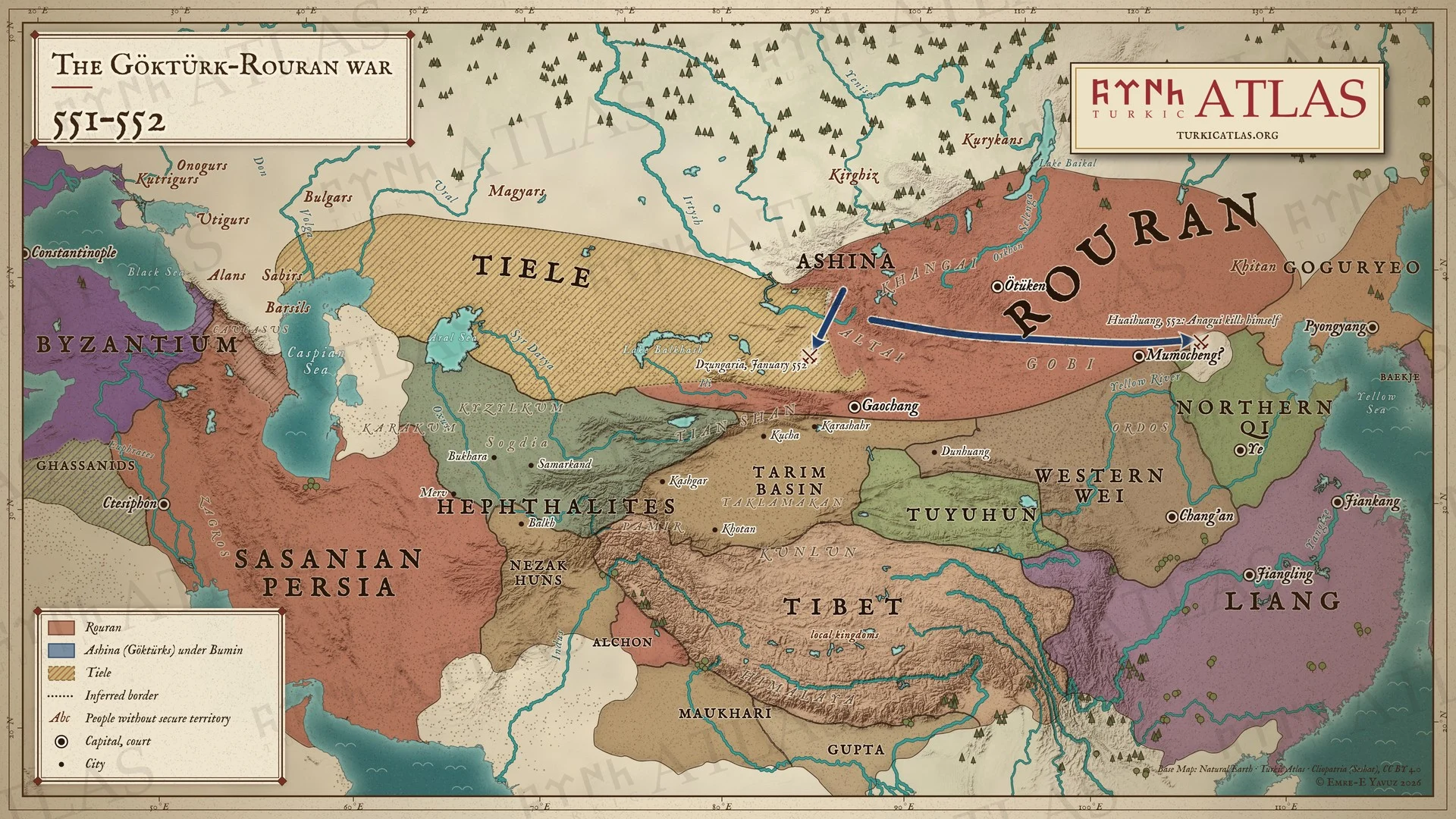
Bumin, leader of the Ashina, asked Anagui, khan of the Rouran, for a princess in marriage.[1] Anagui refused. He called Bumin his blacksmith slave and asked how he dared.[1] Bumin killed the envoy who brought the answer.[1] Early in 552 Anagui was dead, by his own hand according to the Chinese account.[1] Bumin took the title of khan.[1] The centre of his new realm lay in the Ötüken region, where the Rouran had ruled.[1]
The Göktürks left a short account of that victory in the Kül Tegin inscription of 732.[2] Bumin and Istemi, it says, sat on the throne and held the realm and the law of the Göktürk people. The four quarters were enemies, and they made them all submit.[2]
The road to that moment is long. It starts on the steppe of the Bronze Age and runs through the Xiongnu, the Xianbei and the Rouran, the Huns, the Gaoche and the Tiele. After 552 it follows the Göktürk khaganates and the Uyghur Khaganate. It ends with two states that outlived them, the Yenisei Kirghiz and the Khazars. Its country is one of grass, mountain and oasis, and its people lived from herds, from iron and from trade. Their khans said that the sky had set them on the throne.[2]
Türk names a polity and its people. Turkic is a modern label for a language family. The self-name Türk is attested in the Kül Tegin inscription, the earliest Turkic-language source for it.[2] Most claims about where the Turkic peoples came from belong to the historiography of the modern period, not to the sources. Turkic Atlas treats them under the Turkic ethnogenesis debate.
The line that runs from the Xiongnu to the Göktürks is an inference. The Zhou Shu says at three points that the Göktürks were like the Xiongnu of old: in the title of their khan, in the title of his wife, and in their customs.[1] Whether the likeness shows descent is a matter of interpretation. Turkic Atlas sets the likenesses and the competing positions side by side under the Göktürks and the Xiongnu.
The land
Main articles: Eurasian Nomads, The steppe before the Xiongnu
The eastern end of the Eurasian steppe, Mongolia and its surroundings, is the earliest attested centre of Turkic history.[3] South of the northern forest, the steppe reaches from Manchuria to the Hungarian Basin.[4] The natural zones lie in bands from north to south: tundra, taiga, wooded steppe, steppe, desert steppe and desert.[5] Only the steppe could support a powerful state.[6] Tundra, forest and desert cannot feed enough people to raise a large force.[6]
The grass of the steppe is rich, and the land has few natural obstacles to movement.[7] Rain is scarce, between 10 and 20 inches a year, or about 250 to 500 millimetres.[8] Farming is limited by water and by short growing seasons, and it is confined mostly to oases and the moister edges of the steppe.[9]
The Altai and the Tian Shan
Main articles: Altai, Tian Shan
The Altai is a mountain system some two thousand kilometres long, lying where Russia, Kazakhstan, Mongolia and China meet. North and west of it lie the Siberian forest and the Kazakh steppe, and south and east of it lie Dzungaria and the desert. Three of the great Siberian rivers begin here or are fed from here. The mountains catch the water of the westerly airstreams, and so forest grows in the Altai while the country on either side is steppe and desert. The range therefore holds water in a dry belt, which made it habitable for people and animals alike.
Altai pasture rises in belts, so a herd can be moved up as the season warms and down as it cools without leaving the valley. This is a shorter and safer transhumance than the long migrations of the open steppe, and it supports more animals on less ground. The folding of the range also left it one of the richest ore provinces in inner Asia. Geologically the Altai is an old range that was uplifted twice, and its rocks are still being lifted. Glaciers of the last ice age filled its high valleys, and the channels through which ice-dammed lakes drained can still be seen on the plateaus of the southern Altai.
The Tian Shan, the Heavenly Mountains of the Chinese sources, runs east and west between Dzungaria in the north and the Tarim basin in the south. Grass lies on the one side and oasis on the other. The western Göktürk khaganate held both sides, with its seat at Suyab north of the mountains and its tribute coming from the oasis states south of them.[10]
The Orkhon country
Main articles: Ötüken, Orkhon valley
The Orkhon runs north for over a thousand kilometres through central Mongolia, and its upper valley is the region the Göktürks called Ötüken. The Xiongnu, the Rouran, the Göktürks, the Uyghurs and the Mongols each kept their seat there. The valley is not the largest grazing country in Mongolia, and it is not the most defensible. It has reliable water from a large river, and winter and summer pasture lie within a short move of each other. It also sits at the centre of the routes that cross the eastern steppe.
Ötüken was not a city but a wooded mountain country in the heart of central Mongolia, in the region of the Orkhon valley and the Khangai. The word yış means a forested upland. The Göktürk inscriptions say that there is no better place than the Ötüken forest.[2] They tell the Göktürk people that the realm will have no trouble so long as the khan sits there and the caravans go out.[2] A ruler who did not hold Ötüken did not hold the realm, and every ruler of the steppe from the Rouran to the Uyghurs acted as if that were so.
The Tarim Basin
Main article: Tarim Basin
The Tarim Basin is the great desert basin south of the Tian Shan and north of the Kunlun, with the Taklamakan in the centre and the oasis cities on the rim.[10] The rim was a ring of autonomous city-states that had become entrepôts for the goods carried between China and Rome.[10] Whoever formally ruled the basin took, as a rule, a share of all the income from buying and selling, quite apart from the taxes of the inhabitants. The Göktürks took the basin in the 550s and held it for a century as a source of revenue and a road. The Göktürks took their share, protected the road and left the cities their kings. They lost the basin to the Tang in the 640s, and they never governed it.
Climate and its changes
Main article: Climate and the steppe empires
Older theories explained historical change by long-term shifts of climate.[5] They lack support, and the real changes in moisture were short-term.[5] Full nomadism appears at the turn of the second to the first millennium BC, when the climate was at its driest.[11] A sediment core from Lake Telmen, at the western edge of the Khangai, records humid conditions from 1200 BC to about 700 AD and drier ones from 700 to 1300.
The weather of the steppe between the Xiongnu and the Uyghurs can now be measured from tree rings, ice cores and lake sediments. Since about 2015 those records have been dated well enough to be set beside the Chinese annals and the inscriptions. The summer of 536 was the coldest single year of at least the past two thousand in every tree-ring reconstruction of the northern hemisphere. In the Altai the cold lasted longer than in Europe. A reconstruction from the tree rings of the Russian Altai and the Austrian Alps defines a Late Antique Little Ice Age from 536 to about 660. The 540s were the coldest decade of the Altai reconstruction, 3.2 degrees below the mean of 1961 to 1990.
This cold has been seen as a factor in the movements out of the Asian steppe in the sixth century, among them the replacement of the Rouran by the Göktürks in Mongolia. A different explanation, drawn from the lake record, has the Rouran khaganate of about 400 and the first Göktürk khaganate of about 550 both form during favourable grassland conditions in central Mongolia. In this account the run of good years ended around 600, when very harsh and long winters seem to have caused high livestock mortality, warfare and famine. Failing grassland may then have undercut the power base of the first khaganate and contributed to its disintegration in about 603. The two explanations disagree on the date at which the cold began to matter for Mongolia. The palaeoclimatologists themselves ask for caution about the causal link between the cold and the wars of the Göktürks.
A large sulphate signal of 626, a dimmed sky recorded in 626 and 627, and the summer of 627 among the four coldest of fifteen hundred years all precede the collapse of the eastern khaganate in 630. The Chinese account of 630 names hunger, natural disasters and a tax on an exhausted people.[12] Whether the eruption of 626 stands behind the fall is disputed. A khan who lost his herds to a winter did not thereby lose his khaganate. The Chinese histories name the winters, and they also name the Sui agents, the Tang cavalry and the tribes that changed sides.
The tree rings of the Orkhon country record a drought of sixty-eight years in the Uyghur age, from 783 to 850.[13] The Xin Tangshu records that 839 brought famine, pestilence and heavy snow to the Uyghurs and killed many of their sheep and horses.[14] Whether the drought undid the Uyghurs, or the Kirghiz did, is disputed.
Ways of life
Main articles: Eurasian Nomads, Raw Materials and Trade among the Turkic Peoples
The Eurasian nomads lived from herds of sheep, horses and other animals, and they moved the herds between fixed pastures through the year.[15] They could not make everything they needed, and the settled states wanted their horses.[16] Trade, tribute and raiding between the two shaped the history of the steppe empires.[17]
Nomadic pastoralism
Main articles: Eurasian Nomads, Xiongnu Herds, Seasonal Pastures
The herds of the Eurasian steppe are led by sheep and horses, with cattle, goats and camels in smaller numbers.[18] The horse gives transport, meat and milk, and it paws through snow to reach grass.[19] The nomads moved on a yearly cycle, going north to fresh grass in summer and south in winter, where there is less snow.[20] The Chinese sources describe this as wandering after grass and water, but the routes were fixed and the moves planned.[15] Related families grazed together in a camp of about eight to twelve households.[15]
Herding alone does not supply everything, because a pastoral economy cannot match the variety and quantity of food that farming gives and cannot support as large a population.[21] A household needed a minimum herd of about 60 to 100 head.[17] Those who fell below it hired themselves out to relatives as herders, settled, or turned to raiding.[17] Disaster could also strike the herds as a whole: a Chinese report puts the losses of the Xiongnu in 72 BC, after heavy snow and enemy raids, at three of every ten people and five of every ten animals.[22]
Farming and the oases
Main articles: Millet, Grape Wine in Central Asia, Xiongnu Agriculture, Uyghur Farming
Grain stood beside meat and milk from the Xiongnu onward. The Shiji says that the Xiongnu had no walled towns, no fixed dwellings and no work of tilling fields.[23] Under the peace that the first Han emperor made with Bagatur, however, the Han undertook to send the Xiongnu silk floss, silk, wine, grain and food in fixed amounts every year.[23] In 162 BC the emperor Wen wrote to the chanyu that the Xiongnu lived in the cold north, where the killing frost came early, and that for this reason his officials sent the chanyu glutinous millet and malt every year.[23] Excavation shows grain at Xiongnu settlements. At the fortified settlement of Ivolga in Buryatia, the finds included millet, barley and wheat.[24]
The Wei Shu says of the Gaoche, whom the later histories call the Tiele, that they had no grain.[25] After the Wei resettled the eastern Gaoche south of the desert, they gradually came to eat grain.[25] In 698 Kapgan Khan asked the Tang court for the surrendered households of six prefectures, for the land of the Chanyu Protectorate, and for farming tools and seed.[12] The court, afraid of his army, gave him several thousand tents of the surrendered households together with more than forty thousand shi of seed and three thousand farming tools.[12] In the account of the Xin Tang Shu, the seed he asked for was millet.[26] The Kirghiz of the Yenisei grew grain themselves.[14] The Xin Tang Shu lists their crops as grain, millet, wheat, barley and naked barley, and says that they ground these on mills into flour and gruel.[14] They sowed millet in the third month and reaped it in the ninth.[14]
The Chinese histories name the vine and its wine in Kang, Yanqi, Kucha and Gaochang.[27] They name no vine grown in the lands of the Xiongnu or the Göktürks.[28] When the Roman envoys feasted in the camp of Istemi in 569, Menander says, they were served no wine from grapes, because the land grew no vine.[29] Of Gaochang, the Jiu Tang Shu says that its soil was fertile and that grain and wheat ripened twice a year.[30] The Liang Shu says that Gaochang produced fine horses, wine of the vine and rock salt.[31] By contrast, the Han Shu says that the ground of Shanshan was sand and salt with little arable land, so that the kingdom relied on the fields and grain of the countries beside it.[32]
Iron and metalwork
Main articles: Göktürk Ironworking, Altai, Kirghiz Iron and Gold
The Göktürks enter the Chinese histories as smiths. The Zhou Shu says that the Ashina submitted to the Rouran and lived on the southern slope of the Golden Mountain as their ironworkers.[1] The Sui Shu says that they lived there for generations and were skilled at ironwork.[33] The Golden Mountain is the Altai.[34] How the Ashina came by the craft is not recorded. Metallurgy has been called their specific function within the Rouran khaganate, and it is suggested that they had subdued a local Altaian population that already specialised in it.[35]
The Old Turkic word for iron, temir, survives in the inscriptions in the name of the Iron Gate, temir kapıg.[36] In 569 Göktürks offered iron for sale to the Roman envoys of Zemarchos when they reached the land of the Sogdians.[37] Menander thought the aim was to show that they had iron mines, since iron was said to be hard to come by among them.[37] In 698, in the account of the Xin Tang Shu, Kapgan asked the Tang for tens of thousands of jin of iron beside seed and farming tools.[26] At the Uyghur capital on the Orkhon, excavation has found metalworkers and, in the country around it, mines for iron, copper, gold and silver.[38] The sources name the Ashina as smiths and record an offer of iron, but they describe no Göktürk forge.
Salt
Main articles: Salt among the Turkic Peoples, Tuz Köl of the Karluks
The sources of the Göktürk age report no salt-working at all. The Ḥudūd al-ʿĀlam of 982 says that seven tribes of the Khallukh, the Karluks, took their salt from one lake, which it calls Tuz Köl, “Salt Lake”.[39] Which lake the Ḥudūd means is open, and three lakes of the Tian Shan region have been proposed for it.[40] Dus-Dag, “the salt mountain”, stands about 15 kilometres north of Uvs Nuur in Tuva and holds a deposit of rock salt, which is quarried today.[41] The geologist who describes it gives no date for the first quarrying.
Marvazī wrote about 1120 that the Kimak have no salt except what merchants import, and that for a maund of it the merchants obtain “a fox and sable skin”.[42] When the Tang divided the lands of Ashina Helu, the last khan of the western Göktürks, into prefectures, the Hulu Wuque tribe became the governor-generalship of Yanbo, which means “salt lake”.[26] The text does not say whether a lake in the tribe’s country gave it the name. No source names a salt mine of the Ashina, or any other salt-working of theirs, in the sixth century.
Trade, markets and the Silk Road
Main articles: Border Markets, Turkic-Sogdian Synthesis, Göktürk Expansion along the Silk Road, The Göktürk–Sasanian Trade Conflict, Furs and Musk among the Turkic Peoples, Uyghur Horse-Silk Trade, Silk in the Steppe
The steppe had three ways to obtain what it lacked, and the first was trade, in which the horse was the main item the steppe sold.[43] The second was tribute from a settled state.[44] The third was raiding.[45] The Göktürks first appear at the Chinese frontier as traders. The Zhou Shu says that under Bumin his people grew stronger and began to come to the frontier for silk and floss, wishing to open relations with China.[1] The Northern Zhou, allied to the khaganate by marriage, gave the khaganate a hundred thousand pieces of silk every year.[1]
In a letter of 584 Ishbara Khan told the Sui emperor that the sheep and horses of his country were all the emperor’s, and that the silks of the emperor’s country were all his own.[33] Under Tulan Khan the chiefs of the Göktürk tribes sent the Sui ten thousand horses, twenty thousand sheep, five hundred camels and five hundred cattle.[33] Soon afterwards they asked for markets along the frontier, where they could trade with China, and the emperor agreed.[33] In 624 Ilig Khan made peace and then asked leave to open a mutual market at the Beilou pass, and the emperor could not refuse him.[26] The market was a concession that the Chinese court granted at its own pleasure. It could also serve as a trap. Pei Ju lured Shishu Huxi, a favourite of Shibi Khan, to Mayi with word of precious goods, and his soldiers ambushed and killed Huxi there.[46]
The inscription of Bilge Khan lists what the khan won for his people: yellow gold, white silver, figured silks, perfumed silks, thoroughbred horses, stallions, black sables and blue squirrels.[47] In 647 the chiefs of the tribes of the Uyghur country asked the Tang for a road, and the tribes were to pay a yearly tax in sable skins.[48] The Xin Tang Shu says of the Kirghiz that their levy was paid in sable and squirrel skins.[14] These notices name furs as gifts, tribute and tax, and none of them describes a trade in furs between the Göktürks and a buyer.
The first text that mentions the Göktürks also mentions a Sogdian and the silk trade. After the conquest of Sogdiana, the Turkic-Sogdian synthesis became a fusion of the ruling strata of both peoples.[49] Menander says that the Sogdians, now subjects of the Göktürks, asked Istemi to send an embassy to the Persians so that they could sell raw silk to the Medes.[50] Khosrow bought the silk and burned it before the envoys’ eyes.[50] Maniakh then advised Istemi to seek the friendship of the Romans, who used more silk than anyone.[50] The quarrel over the silk trade turned the partners of the Hephthalite war into enemies.[51] The wealthy inhabitants of the Tarim basin count, with the Khitan and the Sogdians, among the peoples whose contributions secured the state and the rule of the Ashina.[10] The other great trade of the Göktürks was horses, which ranked after military service and furs. According to one account, the Göktürks received silk, cotton cloth, grain, gold and silver goods and farming tools from their settled neighbours.[52] A different account puts the horses at the centre, since the courts paid in silk for the horses, sheep and camels that the Göktürks offered as gifts.[53]
Food and drink
Main articles: Steppe Diet, Kumys, Millet Beer
The Shiji says of the Xiongnu that they ate the meat of their herds.[23] The Sui Shu says of the Göktürks that they ate meat and drank soured milk.[33] The Xin Tang Shu says of the Kirghiz that they lived on meat and fermented mare’s milk.[14] At the domestic sites of the Khanui valley in Mongolia, sheep and goats make up 54 per cent of the animal bones that could be identified, horses 25 per cent and cattle 16 per cent.[54]
Kumys is mare’s milk fermented in a skin until it is slightly sour and slightly alcoholic. The Sui Shu says that the Göktürks drank fermented mare’s milk until they were drunk, and that they sang and shouted to one another.[33] Modern accounts identify this drink as kumys.[55] The dictionary of Mahmud al-Kashgari first writes down its Turkic name in the 1070s.[56] The Kirghiz brewed liquor from the millet they grew.[14] The same dictionary gives the Turkic words for the beer of wheat, millet or barley, bägni, and for millet beer, buxsum.[57]
Horses, riding and war
Main articles: Horse harness, Mounted Archery, Composite bow
The horse was the mainstay of the steppe economy.[43] The armies relied on light cavalry with relay horses, and the sources give three to eighteen mounts for each warrior.[58] The bridle is placed in the Altai at about the seventh century BC.[3] With control of the head came the free use of both hands, which is the precondition of shooting from horseback.[3] Graves of the Göktürk period in the Altai and the Tian Shan hold iron stirrups of three types, though they are dated only broadly.[59]
The composite bow is built in layers: a wooden core, horn glued on the belly and sinew on the back. Therefore it stores far more energy for its length than a self bow does, and a short one can be drawn from the saddle. The Sui Shu lists the weapons of the Göktürks as the horn bow, the whistling arrow, armour, the lance, the knife and the sword.[33] It adds that they were good at riding and shooting.[33] The Shiji says that Xiongnu children rode sheep and shot birds and mice with the bow.[23] A Muslim writer of the ninth century has the Turks in the caliph’s army shoot at the gallop in every direction.[60]
Felt and the camp
Main articles: Felt, Ordu, Wagons of the Steppe Peoples
Felt is wool matted by moisture, heat and pressure rather than woven. It can be made anywhere there are sheep, with no loom, and it covers the tent, forms the floor inside it, lines the coat and serves as the saddle blanket. The Sui Shu says of the Göktürks that they followed water and grass and had no fixed dwelling, and that they lived in domed tents of felt.[33][1] Felt also survives in frozen graves, and the Pazyryk burials in the Altai preserved hangings and saddle covers that would have rotted anywhere warmer. In 843 the Tang officer Shi Xiong looked from the wall of Zhenwu at the Uyghur camp and saw dozens of felt carts.[61]
The ordu is the ruler’s camp. In a realm without a capital, it is the capital. The khan, his household, his guard, his treasury and the tents of those who must be near him moved together between pastures. The Zhou Shu says that the khan’s tent opened to the east, out of reverence for the quarter where the sun rises.[1]
Hunting
Main article: Hunting among the Göktürks
The Zhou Shu says of the Göktürks that they wandered after water and grass, lived in felt tents, and made herding and shooting and hunting their business.[1] The Chinese histories show the khans hunting, in peace and on the edge of war.[62] In the first month of 587 Ishbara Khan asked the Sui emperor for leave to hunt between Heng and Dai, and he killed eighteen deer in a day.[33] The same histories show that a people whose bows were taken away could not live by the hunt.[62] In the Tonyukuk inscription the khan’s first followers sat at Kara Kum, north of Čogay, where they ate game and hare, and the throat of the people was full.[63] The Chinese histories make the hunt a livelihood of the Xiongnu. By contrast, of more than a thousand recorded Xiongnu burials, only about eight held the remains of wild animals.[64] The sources of the sixth to the eighth century show the hunt as food in lean years, as the pastime of khans and as an occasion for envoys and ruses.
Belief and the cosmos
Main article: Tengrism
Tengrism is a modern name, not an ancient one, and it does not occur in any source of the steppe empires. It gathers under one word material from four layers that lie centuries apart. The oldest is a Chinese transcription of a Xiongnu royal title. Then come the runiform inscriptions of the Göktürks, the later Turkic and Mongol texts, and the ethnography of the Altaian and Siberian peoples recorded from the eighteenth century onward. The inscriptions and the Chinese accounts of the Göktürks contain no pantheon, no tiered heaven and underworld, no lord of the dead, no priesthood, no doctrine and no scripture.
Tengri
Main article: Tengri
Tengri is the sky, and the power that seats and unseats khans.[2] It is the only divine name the Göktürks ever wrote in their own language and their own script.[2] The Kül Tegin inscription opens by setting the sky above and the earth below: when the blue sky above and the brown earth below were made, between the two the sons of men were made.[2] Ilterish took realms from those who had realms and khans from those who had khans, because Heaven so ordained.[2] He gives strength to the khan’s army.[2] Tengri also takes back what he has given, and the inscriptions describe the fifty years under the Tang as a loss the Göktürks brought on themselves.[2]
The Zhou Shu has the Göktürks gather at a river in the middle of the fifth month to sacrifice to the spirit of heaven.[1] The Sui Shu has them kill many sheep and horses in the middle of the fifth month to sacrifice to heaven.[33] The Göktürks write about their god and almost nothing about their rites, and the Chinese write about the rites and never name the god. The Han Shu says that the Xiongnu called Heaven chengli.[65] The word has long been identified, with little dissent, with tengri.[66]
The three worlds and the world tree
Main articles: The three worlds, Ulukayın (Turkic World Tree)
The three worlds are the upper, middle and lower realms through which many modern accounts explain Turkic cosmology. The model draws heavily on traditions recorded among the Turkic peoples of the Altai and Siberia in the modern period. The Kül Tegin inscription names the sky above and the earth below, with humanity between them.[2] The formula gives no direct account of the three worlds familiar from later ethnography.[67] According to the Zhou Shu, the khan’s tent faced the rising sun as an expression of reverence.[1] In the Kül Tegin inscription, east is the direction in front.[2]
The best-known single image of Turkic cosmology is a tree standing at the centre of the world.[68] The evidence for this image is late. The Göktürk-period sources give one tree, and it decides a succession.[1] When Nadulu died, the sons of his ten wives went beneath a great tree and agreed that whoever leapt highest toward the tree should be set up.[1] Ashina’s son, the youngest of them, leapt highest.[1] The Chinese text says nothing about the roots of the tree, its crown, or any world it holds together.[1] No runiform inscription of the khaganates names a tree, a world axis, or a climb between worlds.[2] The world tree in its familiar form comes from the ethnography of the Turkic-speaking peoples of the Altai and Siberia, recorded from the eighteenth century onward. Their later recording does not establish when each belief arose.
The Earth-and-Water and Umay
Main articles: Yer-Su Spirits, Umay
Iduk Yer-Sub is the sacred Earth-and-Water.[69] It names the land and its waters together, as a single thing, and names it as a power.[69] It stands in the Kül Tegin inscription in the same sentence as the Tengri of the Göktürks, and it speaks in the same breath.[2] Both say that the Göktürk people shall not perish, and Heaven then takes Ilterish and his katun and raises them up.[2] The adjective iduk is not reserved for the Earth-and-Water, since Ötüken carries it too.[2] Twice Bilge Khan justifies a campaign with the formula that the land and water of his forefathers should not be left without a master.[2]
Umay is the third named divine power of the Orkhon monuments, after Tengri and the sacred Earth-and-Water.[2] She is the only one of the three that is female.[2] The Kül Tegin inscription names her once, in a comparison: by the Kut of his mother the katun, who is like Umay, Kül Tegin got a man’s name.[2] The Tonyukuk inscription names her a second time, together with Tengri and the sacred Earth-and-Water.[70] Umay is usually understood as the power of childbirth and of small children. It rests on the later Turkic material and not on the inscription, which says nothing about her function.
Ancestors and the cave
Main articles: Cave of the ancestors, Asena the She-Wolf (Gök Börü)
Once a year the khan of the Göktürks took the nobles of his house to a cave and sacrificed there.[1] The Chinese record it in a single sentence, without a name and without a place.[1] The inscriptions the Göktürks cut for themselves never mention it.[2] The wolf runs through the Göktürk record in three places: as the ancestor of the ruling house, as the golden head carried on the standard, and as the name of the khan’s bodyguard.[1] In the Göktürks’ own writing the wolf appears once, as a simile.[2]
The kam
Main articles: Kam (Turkic Shaman), Shamanism
Kam is the Old Turkic word for the ritual specialist, the man or woman who deals with the powers, treats the sick, presides at a birth and at a burial, and reads what is coming. The Sui Shu says that the Göktürks revered spirits and trusted in spirit-mediums.[33] No runiform inscription of the khaganates names the specialist.[2] In the Göktürk monuments, the sky makes the khan, and no priest crowns him.[2] In 569 the Roman embassy of Zemarchos was purified before it was received.[50] Men of the tribe, whom the Göktürks called drivers-away of misfortune, rang a bell and beat a drum over the baggage and worked themselves into a frenzy to drive off evil.[50] Then they led Zemarchos himself through the flame.[50]
The word shaman is Tungus, and the Turkic peoples of the Altai call the specialist kam.[71] Shamanism has been treated as the old Turkic religion itself.[72] Others hold that the belief of the Göktürk khans arose from that of their shamanist ancestors while becoming more developed, more complex and more hierarchical.[73]
Death and burial
Main article: Burial and the balbal
Of all Göktürk practice, the funeral is the best documented. The Zhou Shu says that the body was laid out in a tent, and that the kin killed sheep and horses and set them before it.[1] They rode seven circuits round the tent, and at each coming to the door they cut their faces with a knife and wept, so that blood and tears ran together.[1] The horse the dead man had ridden and the things he had used were burnt with the body.[1] The burial then waited for the season: those who died in spring or summer were buried when the grass and leaves turned yellow, and those who died in autumn or winter when the flowers and leaves came out.[1] After the burial a stone was set up at the grave, and the number of the stones followed the number of men the dead man had killed in his life.[1]
The Göktürks use the word balbal themselves.[2] The stones stand in a line running east from the grave, in some cases for a great distance.[74] What they represent is argued, and the commonest view is that each stone stands for a man the dead had killed, set there to serve him.[2] The inscription’s own usage, in which a named enemy khan is himself the balbal, supports this view.[2]
Order and writing
The Göktürks had two words for what held them together. Teŋri was the sky and the power in it, and törü, Töre in the modern form, was the law. The law was not written down.
Töre and succession
When Bumin and Istemi mounted the throne, the Kül Tegin inscription says, they took in hand the el and the törü of the Göktürk people, the realm and its right order, which were named together and governed together.[75] The Zhou Shu puts four offences at the level of death: rebellion, murder, intercourse with another man’s wife, and the theft of a hobbled horse.[1] Wounding in a brawl was compensated according to its gravity.[1] On the death of a father, an elder brother or an uncle, the sons, younger brothers and nephews took the widows, and the one limit was that a senior might not take a junior’s wife.[1]
Bumin was followed by Issik, then by Issik’s brother Mukan, then by Mukan’s brother Taspar, each passing over his own sons.[1] Lateral succession was the rule of the Töre: the younger brother, then the elder’s son, then the younger’s. In 581 the choice of Taspar’s successor fell to the assembly of the nobility, the toy, which set the dying khan’s wish aside.[33]
Kut
Main article: Kut
In the Kül Tegin inscription the khan explains his accession in one sentence: he sat on the throne because Tengri commanded it and because his Kut was there.[76] The sources never define Kut, and the definition in the literature is a reconstruction. In that reconstruction Kut is the fortune Tengri gives to the man he chooses, the charge to rule and the luck that goes with it. The Han Shu gives the style of the Xiongnu ruler as Chengli Gutu Chanyu.[65] Gutu may be Kut, so that the title would name the sovereign who holds the fortune the sky grants. The equation is contested.[77] The word survives in the title of the Kutadgu Bilig of 1069 and in modern Turkish, where kutlu means blessed.
The tamga
Main article: Tamga
A tamga is a mark: a few strokes cut into the hide of an animal, into rock, into a coin die or a seal. It says whose the thing is. A branch of a house takes its parent’s mark and alters it, and therefore a set of tamgas can carry a claim about descent. The Siberian ibex, with its heavy backswept horns, is the animal of the tamga cut on the Kül Tegin stele. It is understood as the dynastic mark of the Ashina. Among those who came to the funeral, the Kül Tegin inscription names a tamgaçı, the man who bears the royal seal and uses it.[78]
The twelve-year animal cycle
Main article: The twelve-year animal cycle
The Göktürks dated by a run of twelve years, each named for an animal, and the run repeated without an era and without a count of cycles.[2] It is the only dating system the runiform corpus uses.[2] The Kül Tegin inscription closes with two dates in the cycle.[2] Kül Tegin flew away on the seventeenth day of the Year of the Sheep.[2] The grave building, the carving and the inscribed stone were finished on the twenty-seventh day of the seventh month of the Year of the Monkey.[2] Back-reckoning puts the two in 731 and 732. The Zhou Shu says of the Göktürks of the sixth century that they did not know the calendar and marked only by the greening of the grass.[1] Whether the Turkic peoples took the cycle from China, or whether both drew on something older in Inner Asia, is argued.
The runic script
Main article: The Old Turkic script
The Old Turkic script is an alphabet of some forty signs, written from right to left, in which the steppe wrote its own language on stone, on rock faces, on paper and on objects of daily use.[79] Most consonants have two signs, one used in words with back vowels and one in words with front vowels. The letter itself therefore tells the reader which half of the vowel harmony the word belongs to. The great stone monuments of the Orkhon valley carry the longest texts and the only dated ones: the Kül Tegin and Bilge Khan stones of 732 and 735 and the Tonyukuk inscription before them.[80] Vilhelm Thomsen read the inscriptions in 1893 and published the full decipherment in 1896.[81][82] Everything the Göktürks say in their own voice has therefore been readable for a little over a century. Several theories about the origin of the letters compete, and the question is not closed. One theory derives the alphabet from Aramaic, carried east along the trade roads and passed on by Sogdian scribes.[81] A second derives the letters from the tamgas.
The steppe before the Xiongnu
Main article: The steppe before the Xiongnu
The Turkic peoples did not invent the steppe. They entered a world whose economy, technology and political forms were already old. Others had made them, and the Turkic peoples took them over: the horse, the bow, the bridle, the wagon, the tribal union, the burial with horses. Pastoral nomadism grew up in lands marginal to agriculture in the fourth and third millennia BC. Where it began is argued. The horse was domesticated, certainly by the third and perhaps as early as the fourth millennium, in the Ponto-Caspian steppe. Only about 1500 BC, and the dating is uncertain, was equestrian technology developed enough to produce a true culture of mounted riders.
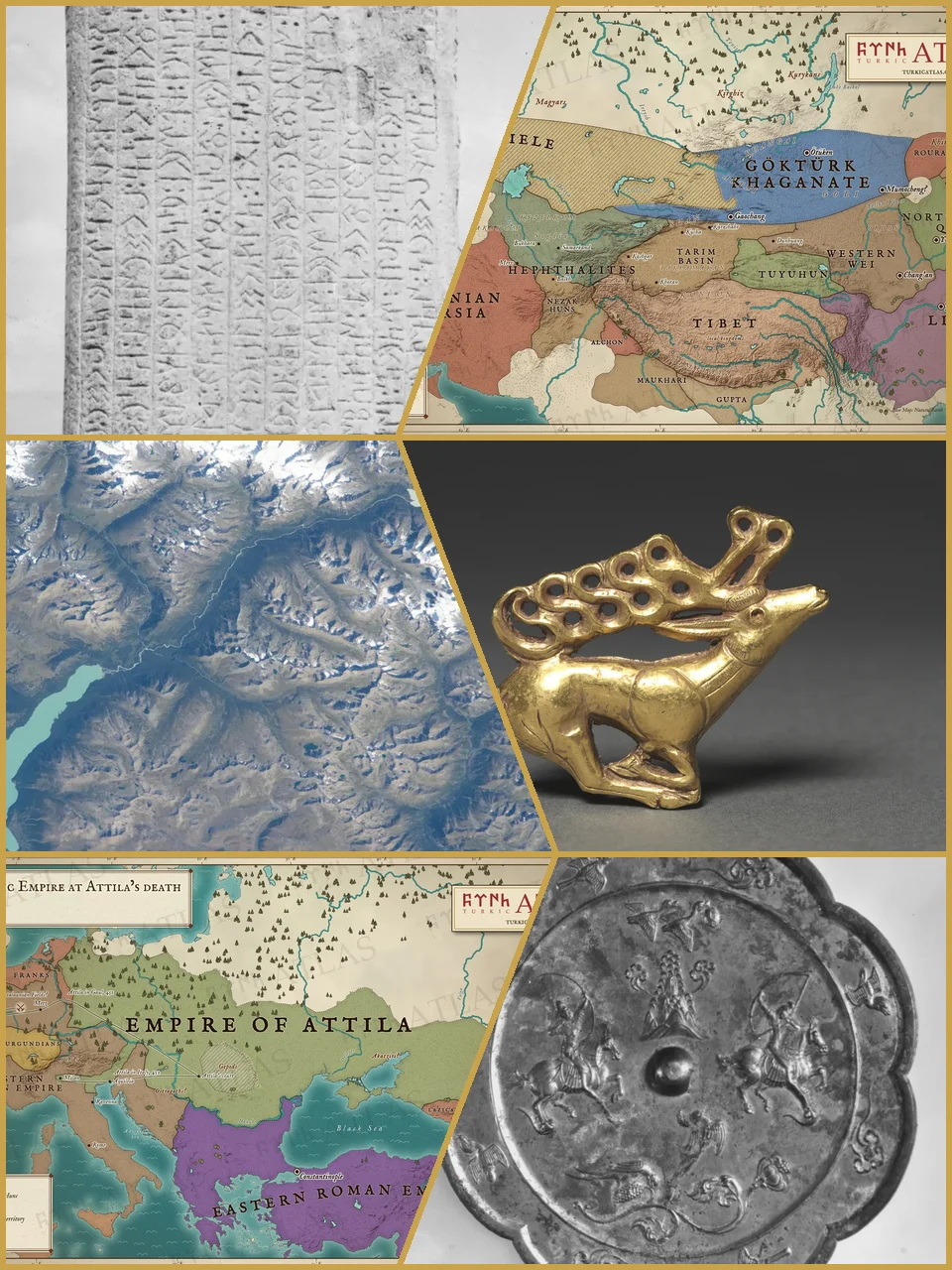
The burials of Pazyryk in the Altai belong to the mounted nomads of the first millennium BC, who were probably of Scytho-Saka origin. The age brought iron to the region, and the finds show sophisticated trade with China in the east and Iran in the west. The ancestors of the early Turkic peoples were not necessarily steppe nomads, and at some point they certainly were not. As late as the tenth century a Chinese traveller could still describe a hunting and fishing Turkic group living in the forests.
The Xiongnu
Main article: Xiongnu
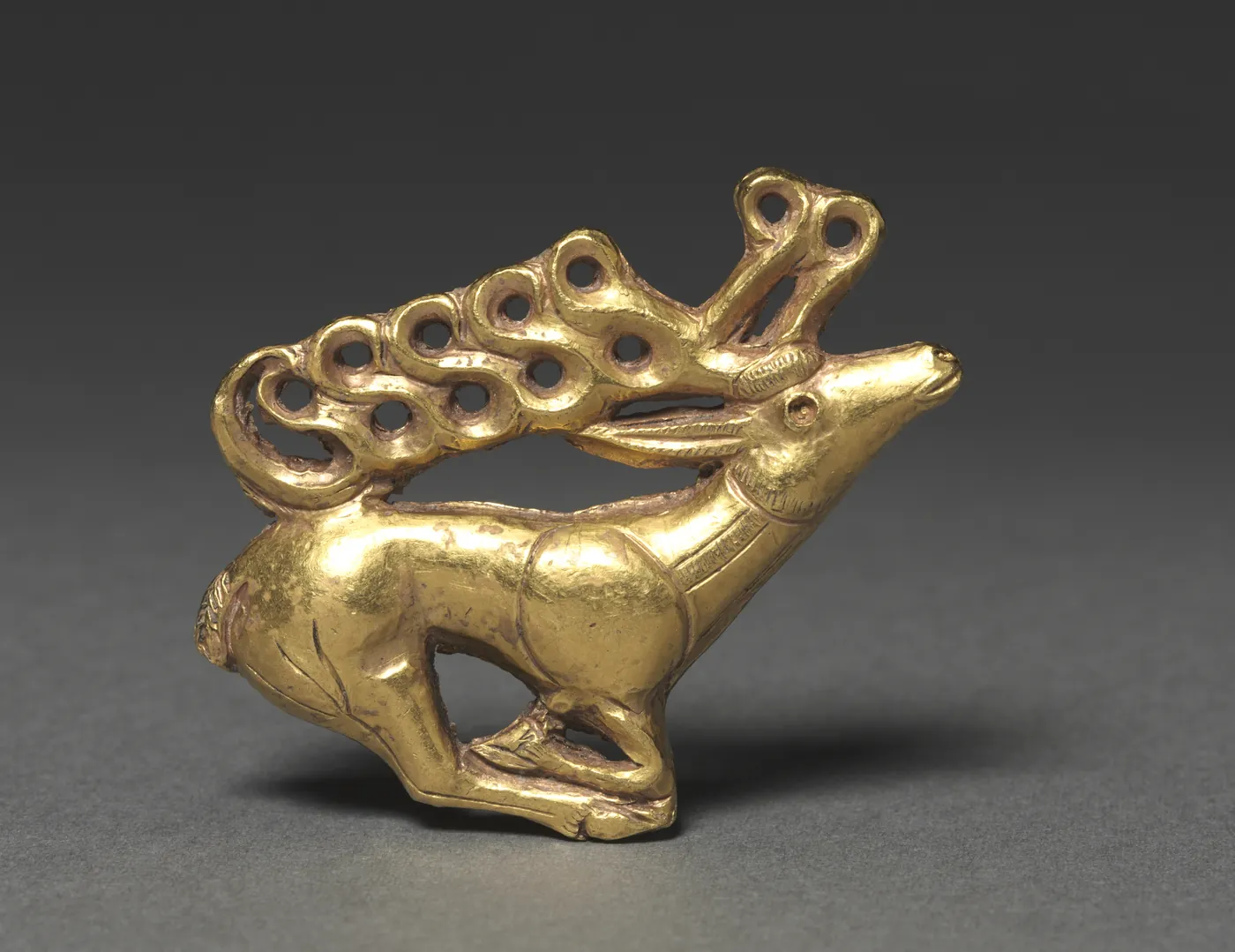
The Xiongnu were the first nomadic empire of the eastern steppe. For two centuries they were the principal adversary of Han China, and they set the pattern of government for the steppe states that came after them.[3] Their leader Duman was killed by his son Bagatur in 209 BC.[23] In 198 BC the Han agreed to a heqin treaty, which gave the Xiongnu a princess, yearly gifts of silk, wine and food, and equal status.[83] In a letter to the Han court of 176 BC Bagatur reported his conquests of the Yuezhi, Loulan, Wusun and Hujie.[23] He declared that all the people who live by drawing the bow had become one family.[23]
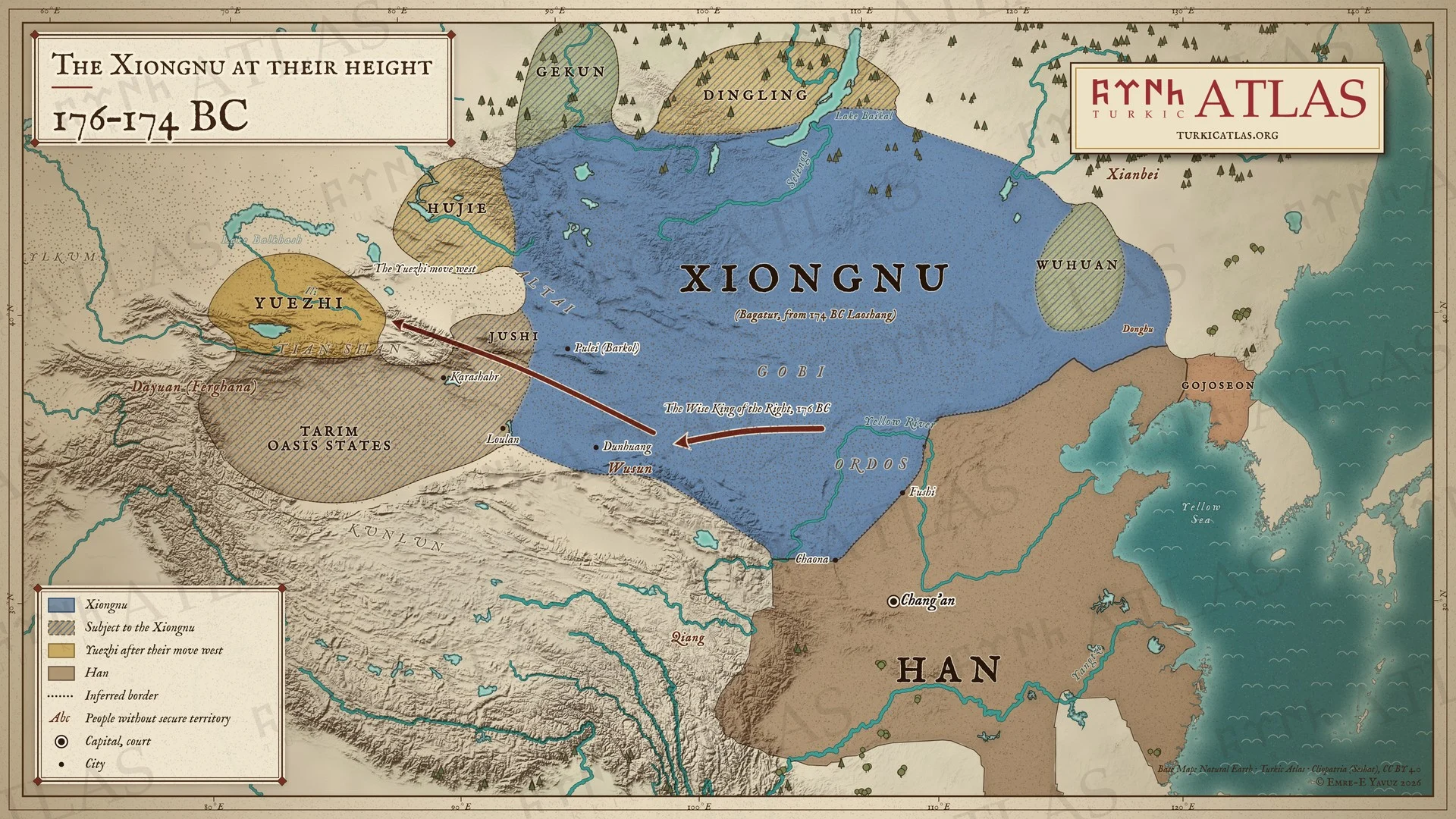
The Han answered with control of markets, diplomacy and force, and in 119 BC their troops reached Lake Baikal. The nomads were weakened rather than destroyed. In the middle of the first century AD a succession struggle divided the Xiongnu again, into a northern and a southern confederation. The northern confederation was most likely beaten in 89, in the Altai, and went west, at least in part. The Xianbei replaced it as masters of northern Mongolia, a region that became the centre of every steppe state after it.
Three grounds support placing the Xiongnu in the Turkic line. The first is the title of the ruler, which the Han Shu gives in full as Chengli Gutu Chanyu and glosses as son of Heaven.[65] Chengli has long been identified, with little dissent, with tengri, the sky-god of the Turkic and Mongolic world.[66] The second is the glossed words, among which Turkic ones already prevail.[84] The third is the continuity of titles. The Zhou Shu says that the title Illig Khan, which Bumin took in 552, was like the chanyu of old.[1] Together, these grounds support a Turkic-speaking Xiongnu elite as an inference, not as a finding.
Other theories exist as well. One classes the language as Yeniseian.[85] Another holds that the Xiongnu were a mainly Mongolic people.[86] A third holds that the language was Eastern Iranian, and a fourth holds that the material permits no classification.[85] Turkic Atlas sets them out under the language of the Xiongnu.
Xianbei and Rouran
Main articles: Xianbei, Rouran Khaganate
The Xianbei held the eastern steppe between the Xiongnu and the Rouran. The Hou Han Shu says that the remnants of the Xiongnu who stayed, more than a hundred thousand tents, all called themselves Xianbei.[87][88] A steppe people here succeeds another by taking its pastures and its name. The men who change the name are not conquered foreigners but the remainder of the defeated confederation.[87] Their chief Tanshihuai took the whole of the old Xiongnu country, fourteen thousand li from east to west and seven thousand from north to south.[87][89] The Tuoba, one of the Xianbei groups that followed, founded the Northern Wei and through it the Western Wei and the Northern Qi.
The Rouran Khaganate is dated from around 400.[25] At that time a fugitive named Shelun gathered a following in the Gobi, defeated the Tiele and took the title khagan.[25] No Rouran text survives, so nothing the Rouran said of themselves is known. The Wei Shu draws their extent from the country of Karashahr in the west to the country of Korea in the east.[25]
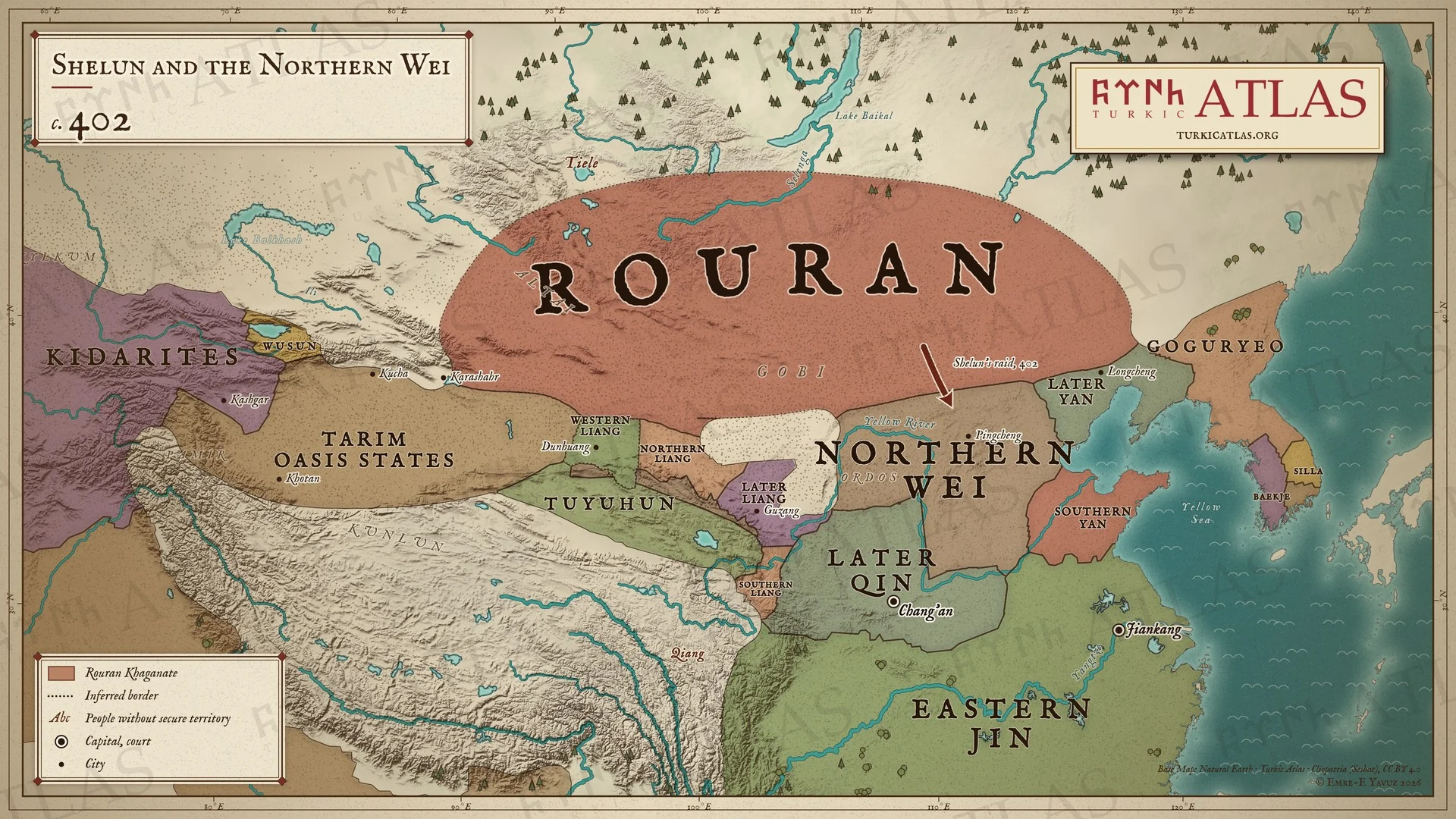
The seat of power was the Orkhon valley, the region that the Göktürk inscriptions call Ötüken. The Xiongnu and the Xianbei had used it before the Rouran, and the Göktürks and the Uyghurs would use it after them. In 429 the Wei emperor Taiwu crossed the desert and scattered the people of the khan Datan.[25] More than three hundred thousand surrendered to him.[25] Even so, the khaganate kept the steppe. The Wei never held it. In 522 the Rouran khan Anagui asked the Wei for millet for sowing, and an edict gave him ten thousand shi.[25] In 523 his people suffered a great famine, and he raided across the frontier.[25]
The Huns in Europe
Main articles: Huns, Hunnic Empire
The Huns were the nomadic people who crossed the Don in the 370s and broke the Alans and the Goths north of the Black Sea. In the following eighty years they built the Hunnic Empire. Under Attila it ruled from the Caucasus to the confines of France and Denmark.[90] The treaty of Margus doubled the tribute that the Romans paid them.[91] In 451 Attila turned west.[92] The invasion of Gaul ended on the Catalaunian Plains. The invasion of Italy in 452 destroyed Aquileia but did not reach Rome.[93] Attila died early in 453, and the empire broke apart within a year.[94]
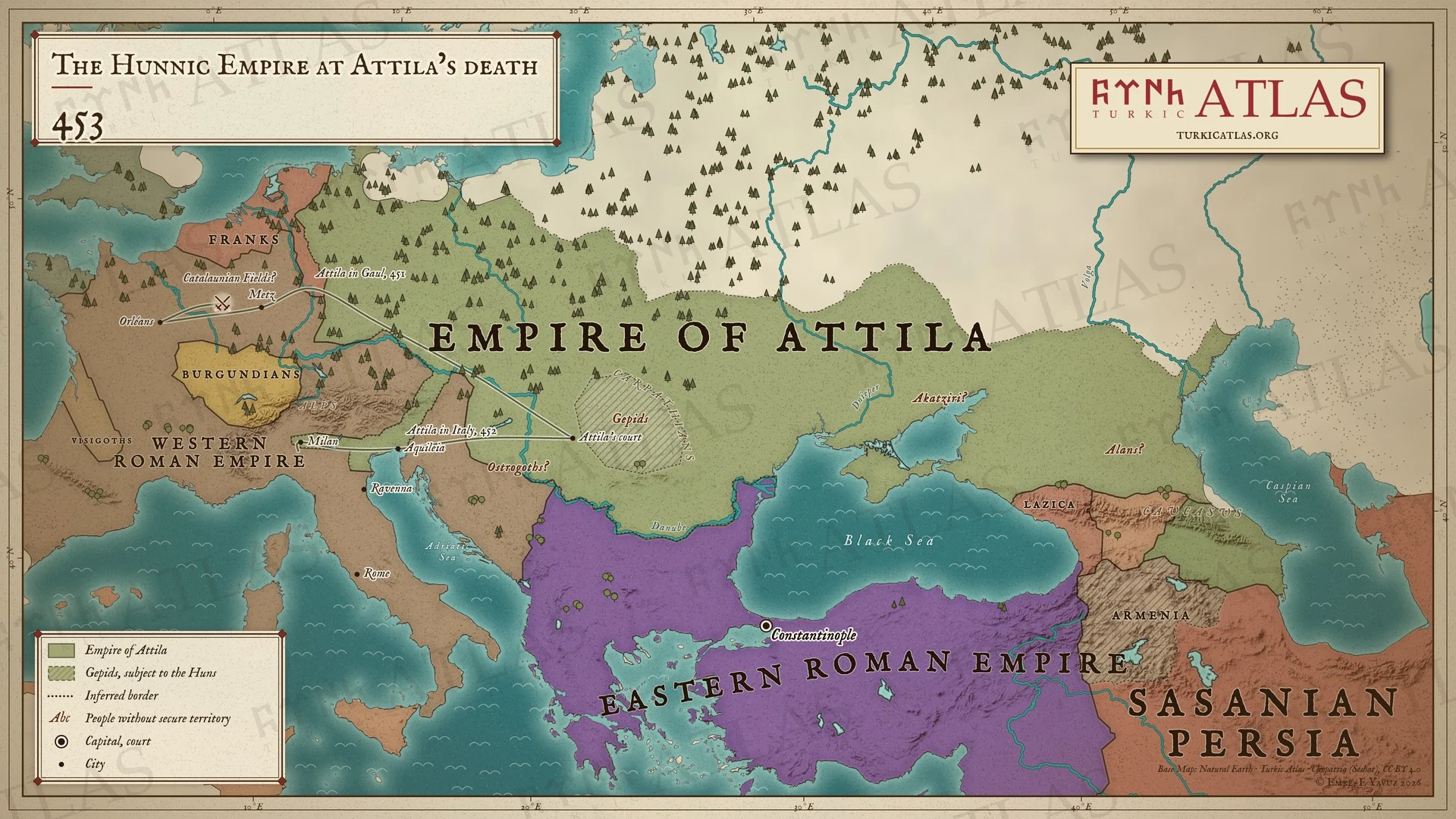
The Huns of Europe have been identified with the Xiongnu of Inner Asia since the eighteenth century.[95] On the best view the identification holds and the elite of both was Turkic-speaking.[96] Other views are more guarded. One finds no unbroken chain of evidence but holds that such a chain seems likely.[97] A second treats the identity as an assumption of earlier scholarship.[98] A third declines to judge.[95] Turkic Atlas sets the evidence out under the Huns and the Xiongnu.
The Kidarites and the Hephthalites
Main articles: Kidarites, Hephthalites
The Kidarites were a Hun dynasty named after their founder Kidara. Their expansion began at the end of the 420s in Bactria, and the Sasanian king Vahram V checked it near Merv.[99] The dynasty waned from the 470s. It was gone when the Hephthalites took Sogdiana in 509.[100]
The Hephthalites were the last power of Hunnic descent to rule Central Asia. At their height in the early sixth century they held Sogdia and the country from Afghanistan to the oasis cities of the Tarim. They took tribute from north-western India. They had killed the Sasanian king Peroz in 484. They had put his successor Kavad on the throne of Iran, and back on it more than once. For decades the Sasanians paid them a colossal tribute. They should not be understood as a distinct ethnic group. They were a confederation of nomadic and semi-nomadic groups.[101]
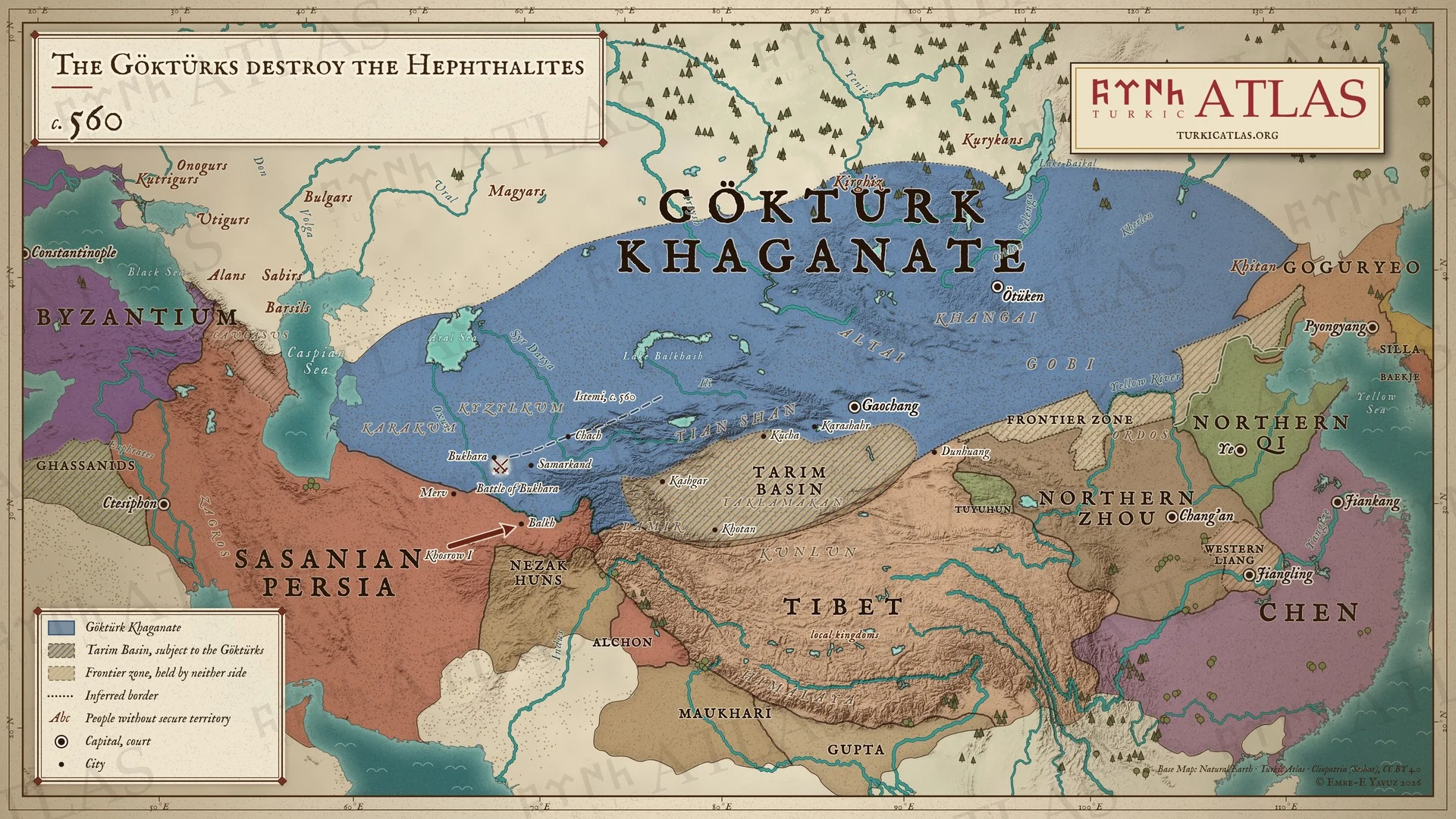
Then the Göktürks came. Istemi, Bumin’s brother, marched west in 553 and reached the Seven Rivers by 555.[102] He destroyed the Hephthalites and took the trade of Sogdiana.[50] The date is argued. One reckoning puts the destruction in 557.[3] A second sets the end between 563 and 567.[101] The collapse opened the western steppe to the Göktürks.
The Tiele and the rise of the Ashina
Main articles: Tiele, Gaoche, Ashina, The Turkic War of Independence
The Tiele were the largest Turkic-speaking population of the sixth-century steppe. They were a federation of nomadic groups, up to forty by one count, who ranged west of the Altai across Dzungaria and beyond.[25] The Wei Shu calls them Gaoche, “high carts”, after the tall many-spoked wagons in which they moved. It says that their language was roughly the same as that of the Xiongnu, with small differences.[25] They rose against the Rouran again and again. In 516 Chounu, the Rouran khan, marched west, crushed the Gaoche, captured their king Mietu and killed him.[25]
The Ashina stood under the Rouran too. Before 546 they were a few hundred households in the Altai, subjects of the Rouran and ironworkers for them.[103] The Sui Shu says that the Ashina fled with five hundred families to the Rouran after the Wei emperor Taiwu crushed the Northern Liang. They lived for generations on the Golden Mountain working iron.[33][104] In the wolf legend, Ashina is the name of one of the she-wolf’s ten sons. He is the ablest and becomes the ruler of the others.[33] The Zhou Shu makes the Göktürks a separate branch of the Xiongnu.[1][105]
In 546 Bumin suppressed a Tiele uprising against Rouran rule and strengthened his own position.[1] Then came the request for a princess, Anagui’s refusal and the open conflict.[1] Early in 552 the Göktürks beat a Rouran army in Dzungaria.[106] They destroyed a second army north of Huaihuang, and Anagui was dead.[1] The Göktürk state was built on Tiele manpower, and the Tiele never fully accepted this role.
The First Göktürk Khaganate
Main article: First Göktürk Khaganate
The First Göktürk Khaganate was the empire of the Ashina dynasty. From its centre at Ötüken it grew to reach Central Asia and the approaches to Iran and Byzantium. Mukan, who reigned from 553 to 572, took the Kirghiz on the Yenisei and the Khitan in the east.[1] In 568, when Persia shut its markets, Istemi sent the Sogdian Maniakh to Constantinople.[50] Taspar, the youngest brother, reigned from 572 to 581 over the khaganate at its greatest extent. After his death the lesser khan Ishbara threatened revolt, and the throne went to Taspar’s son Amrak, who abdicated within the year in Ishbara’s favour. Ishbara then submitted to the Sui emperor in return for protection.[33] 603 is taken as the final division of the realm into two.
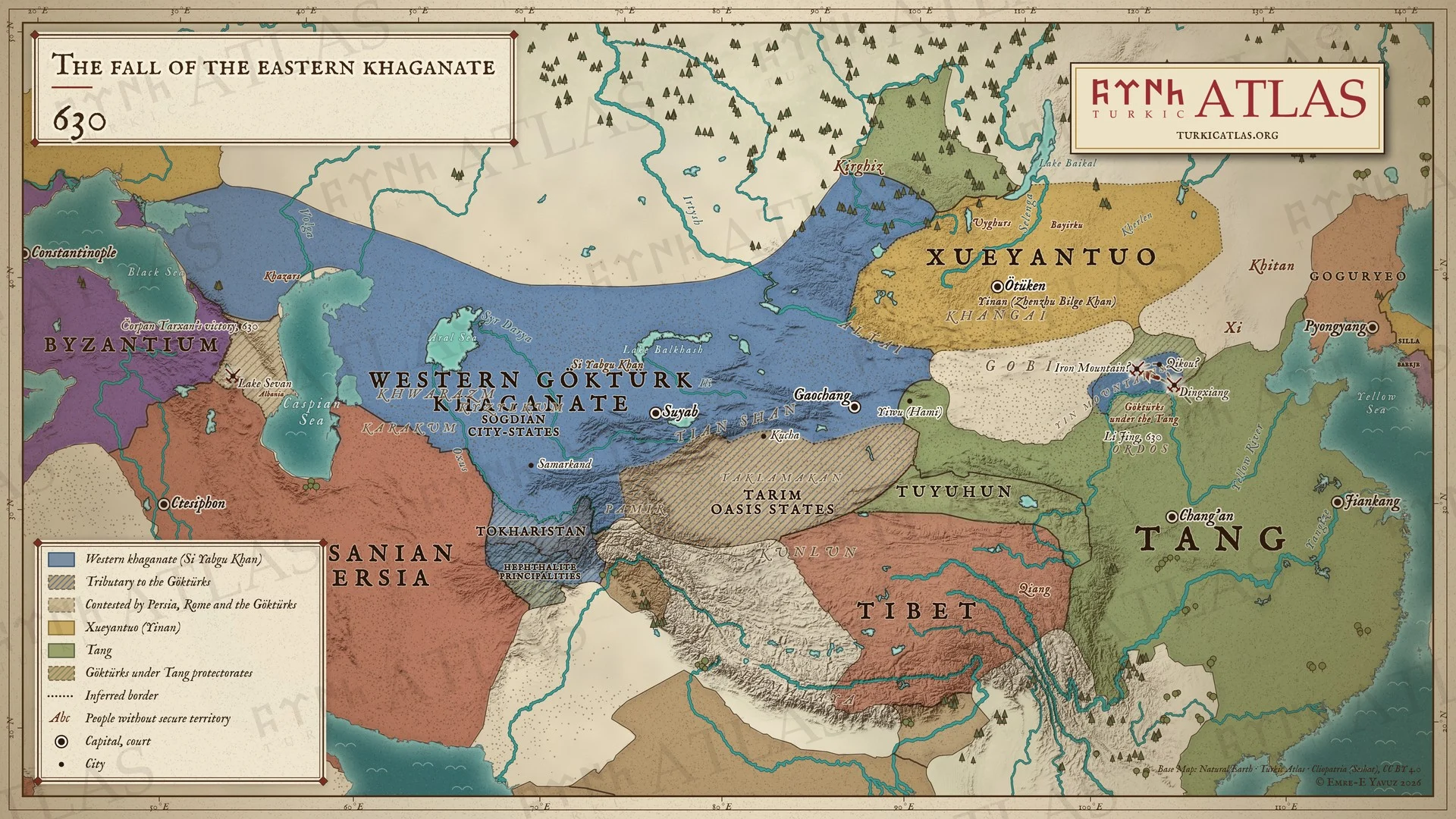
The eastern state spent its last decades in the orbit of China. In 626, eighteen days after Li Shimin had killed his brothers and taken the throne as Taizong, Ilig Khan stood with a great army before Chang’an.[12] Then the state came apart from inside. Ilig fled to the Iron Mountain, offered submission, and rode alone to the camp of his kinsman Shaboluo. There Zhang Baoxiang took him in the third month of 630 and sent him to the capital.[12] The Göktürks gave their own account of the fall. The younger brothers were not like the elder, and the sons were not like the fathers. The begs and the people were not straight with each other. According to the inscription, the Chinese set brother against brother and lord against people. As a result, the Göktürks lost their realm and their khan.[2]
The Western Göktürk Khaganate
Main article: Western Göktürk Khaganate
The Western Göktürk Khaganate was the western half of the state that Bumin founded. For a century it was the larger, richer and better-connected half. Istemi created it in the 550s as a yabgu’s command, the second rank of the Göktürk order, under the khan at Ötüken. In his lifetime it reached the Oxus and the Volga. Beneath its Turkic tribes were Iranian nomads, and there was a substantial urban population of Sogdians, Khwarezmians and Bactrians. In the year of Istemi’s death, 576, the armies of the western wing took Bosporos in the Crimea.[50]
Under Tong Yabgu the west had its brief efflorescence.[107] The Jiu Tang Shu says that the western peoples had never been so powerful.[108] As the ally of the emperor Heraclius he warred with Persia in Transcaucasia. He contributed significantly to the Byzantine victory and the collapse of the Sasanian state.[107] His paternal uncle murdered him and made himself khan.[108]
The murder touched off a civil war. The western Göktürks disintegrated into the On Oq, the Ten Arrows.[107] Tang forces took the last khan, Ashina Helu, in 657, and the west was divided into ten prefectures under Chinese protection. Reckonings of the end of the western khaganate run from the 650s to the 740s. Those who had not gone over to the Tang had founded states of their own. Among these states were the Khazars, the Tokhara yabgus and the Göktürk Shahi.
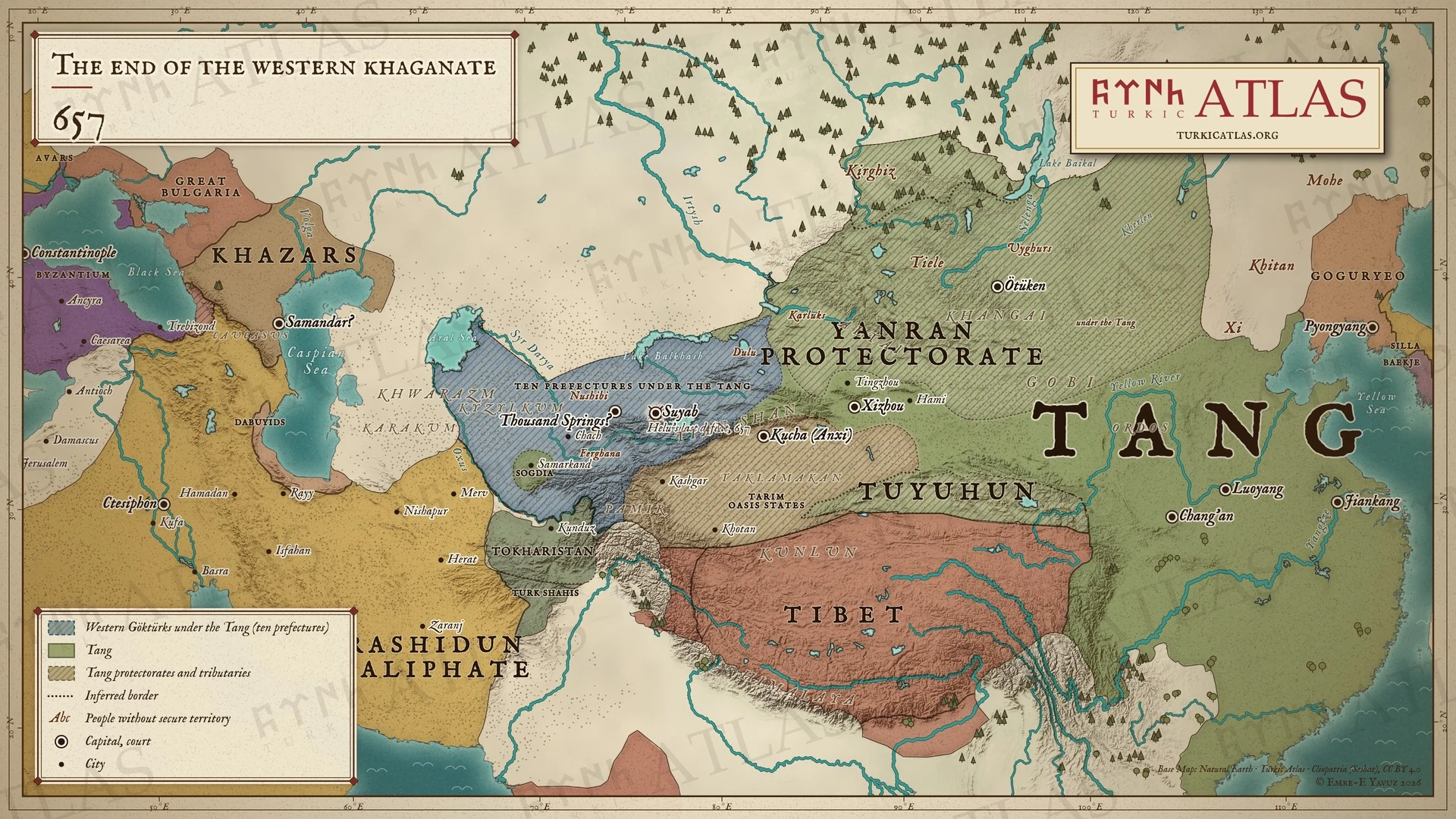
Under Tang rule, 630–682
Main article: The Göktürk interregnum, 630–682
For the next fifty-two years the eastern steppe had no khan of its own. The Kül Tegin inscription, carved a century later, gives the period one line and one number: elig yıl isig küçüg birmis, “for fifty years they gave their toil and their strength.”[2][109] The Tang court debated what to do with the Göktürks who had surrendered.[12] Most officials wanted to break up their tribes and scatter them through the prefectures, to be set to ploughing and weaving. Wen Yanbo argued alone against this plan. The tribes should be kept whole and serve as a shield, and they should not be cut off from their own customs. The emperor took his plan.[12]
The Göktürks rose again and again. In 643 the tribes that had been set under Ashina Simo rebelled as one and crossed back south.[12] In 680 they fetched Ashina Funian.[12] He surrendered to Pei Xingjian and was beheaded in the East Market at Chang’an.[12] Two years later a distant kinsman of Ilig gathered the men who had scattered after Funian’s defeat. He went into the Zongcai mountains with some five thousand of them and raided the Nine Surnames for horses and sheep. Then he declared himself khan.[12] This was Ilterish.
The tribes were never broken up, and the Ashina were never extinguished. The chiefs who served the Tang as prefects kept their followings intact.[12] The system that governed the Göktürks for fifty years also preserved the material for their return.
The Second Göktürk Khaganate
Main article: Second Göktürk Khaganate
The Second Göktürk Khaganate was the state that Ilterish raised in 682.[12] In his own reign it moved to Ötüken. Under his brother Kapgan it became an empire, and the Tang histories thought it the equal of Ilig’s. Under Ilterish’s son Bilge Khan it was a power at peace with China and paid in silk for it.[12] It is the state that carved the Tonyukuk, Kül Tegin and Bilge Khan inscriptions. They are the earliest texts in a Turkic language. This was the only steppe empire before the Mongols that explained itself in its own words.
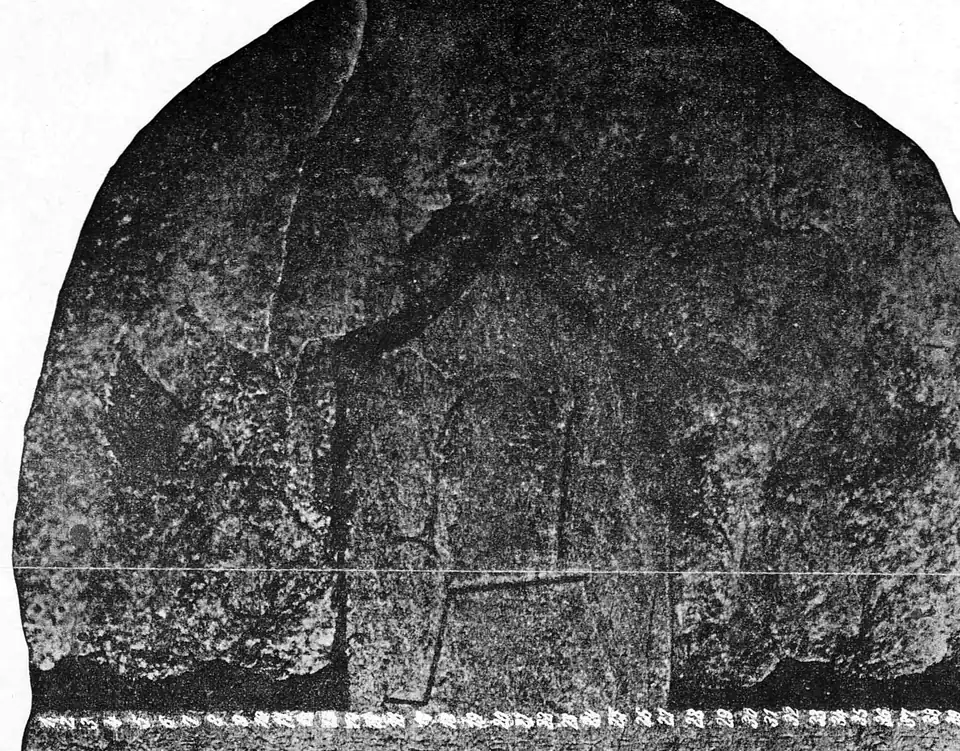
The state rebuilt the first khaganate from memory. The Kül Tegin inscription says that Ilterish set the people in order “according to the law of my forefathers”.[2] In 716 Kapgan, riding home carelessly from a victory over the Bayirku on the Tola, was beheaded in a willow wood by a straggler.[12] Bilge Khan took over, in his own words, “a people who had no food inside them and no clothes on their backs, a wretched and broken people”.[2] The counsellor Tonyukuk set the policy. There was to be no raid on China while the state was weak, no walled towns and no temples. Mobility was the ground of strength.[12][110]
The Tang history gives the plainest account of the fall. Bilge was murdered. A regent and her lover ruled a boy. Two shads, the commanders of the wings, turned with all the troops on the throne and on each other. The subject peoples, the Basmïl, Karluk and Uyghurs, did the rest.[12] A coalition of these three toppled the dynasty in 742.[3] A Basmïl khan held the Orkhon for two years. In 744 an Uyghur-led coalition toppled him in turn.[3]
The Uyghur Khaganate
Main article: Uyghur Khaganate
The Uyghurs were a people of the Tiele, the Nine Oguz of the inscriptions, and for a century they were the power of the eastern steppe. In 744 their leader Kutlug Bilge Kül, with the Basmïl and the Karluk, overthrew the last khan of the Second Göktürk Khaganate. The Uyghurs then turned on their allies and stood alone. In 757 the Uyghur troops helped the Tang to retake Chang’an and Luoyang, and they plundered Luoyang for three days.[111] The elders of the city paid them ten thousand rolls of silk to make them stop.[111]
The khan Bögü reigned from 759 to 779 and brought the empire to the height of its power, and to its turning point. In 762 and 763 he was at Luoyang. There he met followers of Mani and was converted. Shortly afterwards he imposed the faith on his people.[112]
The Arab envoy Tamim ibn Bahr described the Uyghur capital Ordu-Balık on the Orkhon as populous and thickly crowded with markets and trades, with villages and cultivated ground close around it.[38] Excavation has found metalworkers, potters, weavers, stonemasons, irrigation channels and millstones there.[38] Even so, ministers and commoners lived in tents, and the tent remained the commonest dwelling of the Uyghurs.[113] Stock-raising remained the base of the economy, and far from the capital the old ways went on unchanged.[114] The Uyghurs gave the Tang horses and military service and received silk.[115] The trade was largest in the 820s, when the Tang paid 230,000 pieces of silk for horses in the first month of 829.[116][117]
After 821 the empire came apart. A tree-ring record from the Orkhon country shows moderate to wet years when the empire arose. Then a drought set in. It lasted, with few breaks, sixty-eight years, from 783 to 850.[13] The empire did not collapse in those years, and the capital did not move.[118] In 839 a bad season and a hard winter killed much of the livestock on which everything rested. In 840 the Kirghiz came down from the Yenisei with a hundred thousand horse, killed the khan and burnt the court.[116]
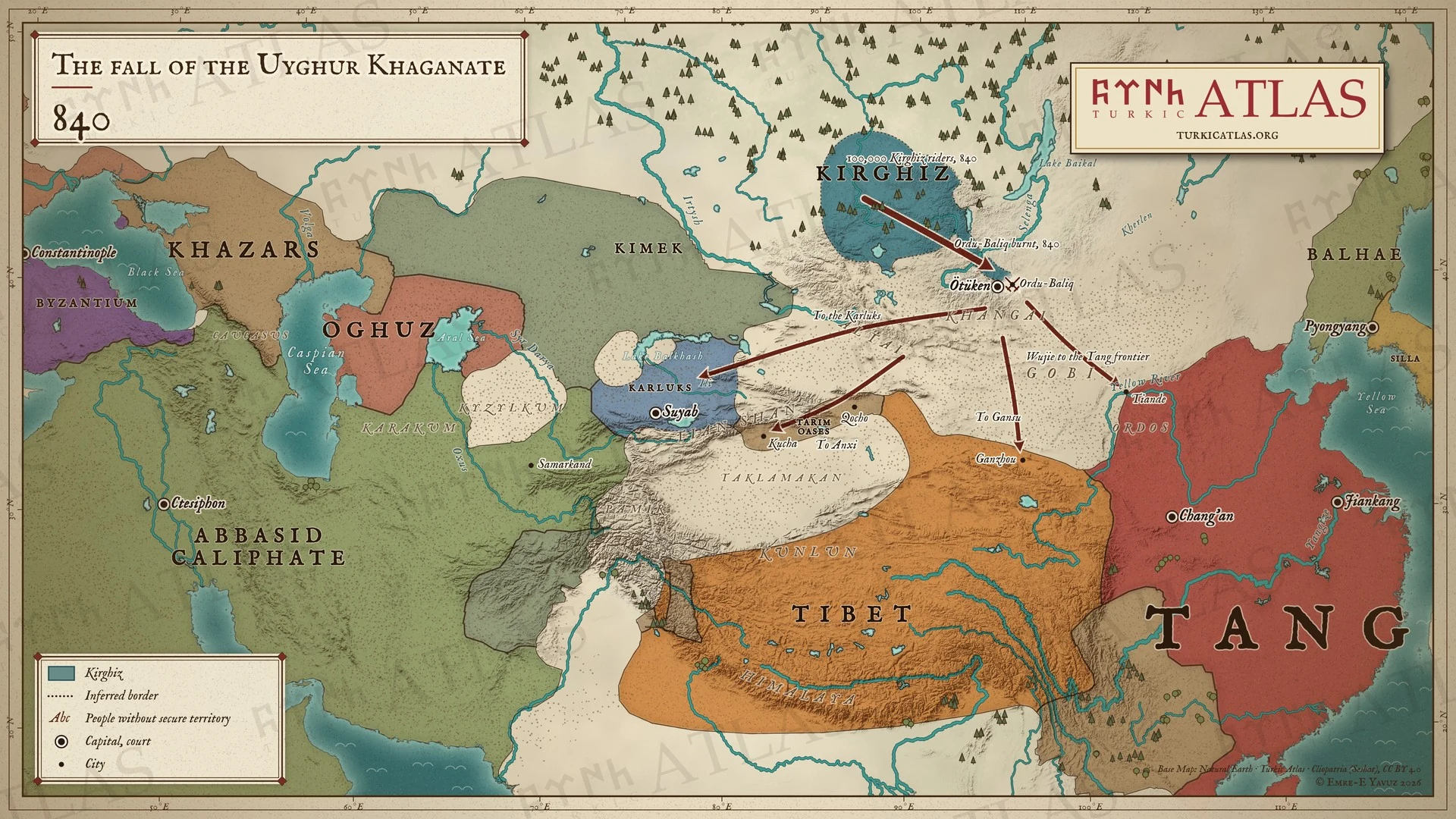
The Yenisei Kirghiz
Main article: Yenisei Kirghiz Khaganate
The Kirghiz lived on the upper Yenisei in southern Siberia, and the realm of their khans is dated from 840 to about 924.[119] They had lived under steppe empires since the sixth century. The Zhou Shu says that Mukan subdued them in the 550s.[1] In 840 their khan, whom the Tang histories call Are, led his army to the Uyghur capital, Ordu-Balık, on the Orkhon.[14] He burned the camp of the Uyghur khans and took the Tang princess Taihe.[14] The Kirghiz did not take the Uyghurs’ place on the Orkhon. They stayed centred on their homeland, and their authority over the plateau was brief.[120]
After every rain, the Xin Tangshu says, iron was found, and the Kirghiz made it into weapons.[14] Their fields grew millet, wheat and barley.[14] Graves of the seventh to the ninth century at Kopen, Uybat and Kapchal show the Kirghiz as farmers and smiths, with ploughshares, sickles and, at Uybat, an irrigation canal.[121] They wrote in the Old Turkic runic script.[122] More than 150 monuments with runic text, the Yenisei inscriptions, are known from the upper Yenisei.[123]
How far Kirghiz power reached is argued. One view gives the Kirghiz a state that held the Khakas-Minusinsk basin, the Altai, the middle Irtysh, Tuva, north-western Mongolia and Lake Baikal. It rests largely on conjecture.[124] A second has the Kirghiz empire last until about 917, when the Khitan united northern China and Mongolia and the khan went back to his old seat on the Yenisei.[125] No known source reports a Khitan victory over the Kirghiz.[126] The year 924 is therefore a convention for the end of the period, not the date of an event.[127] The Kirghiz on the Yenisei did not vanish in 924.[128] The Ḥudūd of 982 still names a Khirkhiz-khāqān.[129]
The Khazars
Main article: Khazar Khaganate
When Göktürk power in the western steppe broke apart in the middle of the seventh century, it left two states behind it: the Bulgar union and the Khazars. By the 670s the Khazars had beaten the Bulgars and controlled the Ponto-Caspian steppe.[130] They controlled it for three hundred years, longer than either Göktürk khaganate and longer than the Uyghurs.
The house that ruled the Khazars is held to have been the Ashina. If that is right, the family that took Ötüken in 552 was still reigning on the Volga when the Rus came in 965. The khaganal rank itself strongly suggests that their ruling house was of Göktürk royal origin, because this was the only source of legitimation the steppe had.[131] The investiture of the Khazar khagan points the same way. It included ritual strangulation and the ceremonies that the Chinese sources describe for the Ashina.[131] One hypothesis has the defeated Nushibi khan Irbis Shegui move to the Khazar lands about 651 and found the ruling house there.[131] It remains a hypothesis, and there are many problems with it.[131]
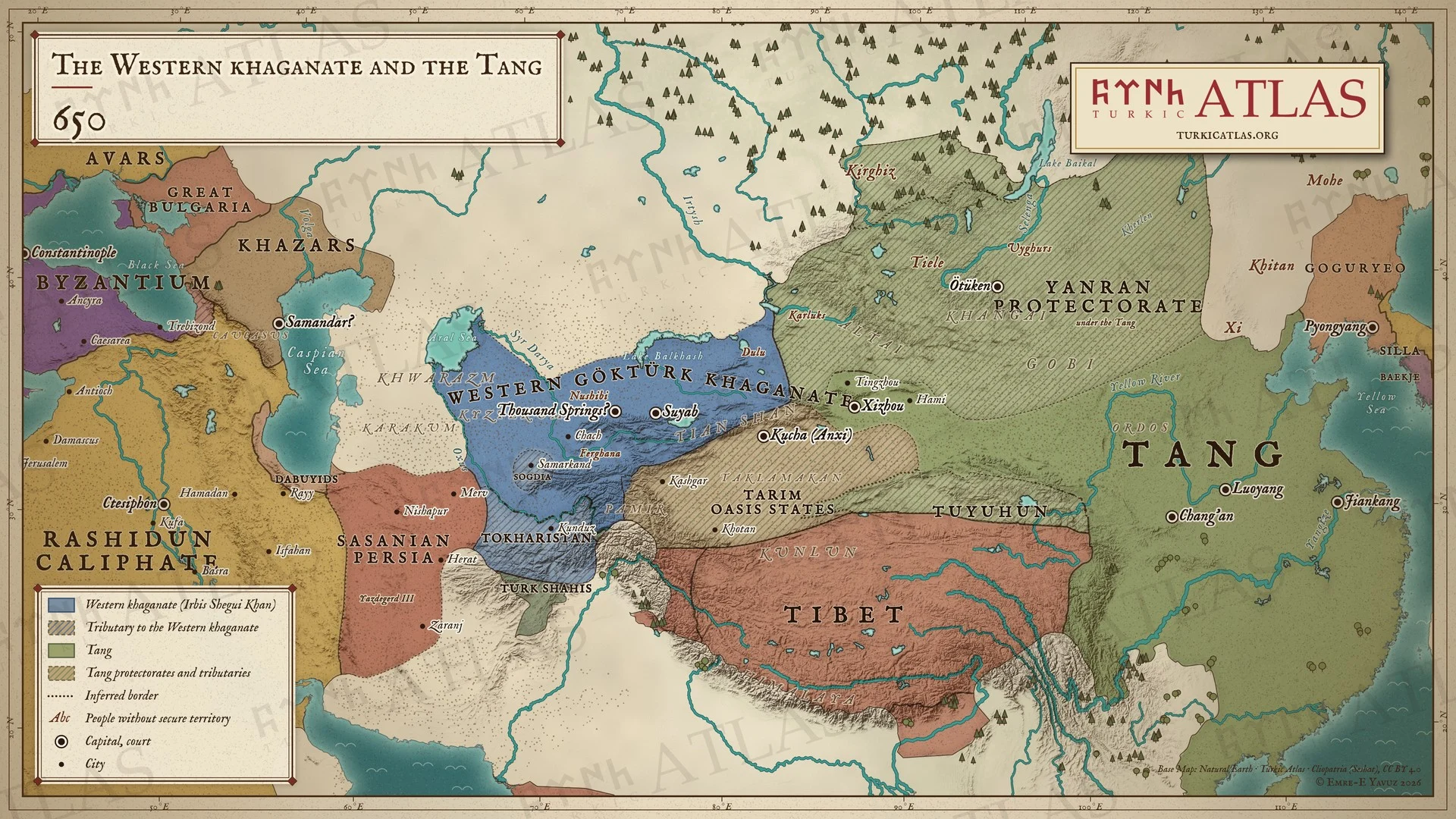
Executive power in Khazaria sat in a double khaganate. The khagan was a sacred ruler chosen from a royal clan. He reigned and did not govern. The Khazar court took up Judaism. The Khazars are the only steppe power of which that is true. In 965 the Rus, allied with Oghuz, overran Atil and probably Sarkel. A khaganate of a kind survived a few years more. Its end is usually set in 969. The Khazars did not vanish. The bulk of the people merged with the surrounding, mostly Turkic peoples, and the nomads were absorbed by other tribes.[132]
References
- ^ a b c d e f g h i j k l m n o p q r s t u v w x y z aa ab ac ad ae af ag ah ai aj ak al am Zhou Shu (Book of Zhou), juan 50
- ^ a b c d e f g h i j k l m n o p q r s t u v w x y z aa ab ac ad ae af ag ah ai aj ak al Kül Tegin inscription
- ^ a b c d e f g Golden 1992
- ^ Sinor 1990, p. 23
- ^ a b c Sinor 1990, p. 30
- ^ a b Sinor 1990, p. 4
- ^ Sinor 1990, p. 20,34
- ^ Sinor 1990, p. 35
- ^ Sinor 1990, p. 26
- ^ a b c d Yavuz 2025
- ^ Khazanov 1994, p. 95
- ^ a b c d e f g h i j k l m n o p q Jiu Tangshu (Old Book of Tang), juan 194
- ^ a b Cosmo 2018, p. 448
- ^ a b c d e f g h i j k Xin Tangshu (New Book of Tang), juan 217
- ^ a b c Golden 1992, p. 3
- ^ Sinor 1990, p. 8-9
- ^ a b c Golden 1992, p. 8
- ^ Khazanov 1994, p. 46-49
- ^ Khazanov 1994, p. 47,49-50
- ^ Khazanov 1994, p. 50-51
- ^ Golden 1992, p. 7-8
- ^ Khazanov 1994, p. 73
- ^ a b c d e f g h Shiji, juan 110
- ^ Houle 2011, p. 138
- ^ a b c d e f g h i j k l Wei Shu, juan 103
- ^ a b c d Xin Tangshu (New Book of Tang), juan 215
- ^ Shiji, juan 123; Sui Shu (Book of Sui), juan 83; Jiu Tangshu (Old Book of Tang), juan 198; Zhou Shu (Book of Zhou), juan 50
- ^ Shiji, juan 110; Han Shu, juan 94; Sui Shu (Book of Sui), juan 84; Jiu Tangshu (Old Book of Tang), juan 194; Xin Tangshu (New Book of Tang), juan 215
- ^ Menander Protector; Blockley 1985, fr. 10.3, p. 121
- ^ Jiu Tangshu (Old Book of Tang), juan 198
- ^ Liang Shu, juan 54
- ^ Han Shu, juan 96
- ^ a b c d e f g h i j k l m n o p Sui Shu (Book of Sui), juan 84
- ^ Golden 1992, p. 120
- ^ Golden 1992, p. 126
- ^ Tonyukuk inscription; Kül Tegin inscription
- ^ a b Menander Protector; Blockley 1985, fr. 10.3, p. 117
- ^ a b c Mackerras 1972, p. 14
- ^ Ḥudūd al-ʿĀlam; Minorsky 1970, p. 54,98
- ^ Minorsky 1970, p. 28,184
- ^ Mongush 2016, p. 67
- ^ al-Marwazī early 12th c., p. 32; Minorsky 1942, p. 32
- ^ a b Sinor 1990, p. 8
- ^ Khazanov 1994, p. 224
- ^ Khazanov 1994, p. 222-223
- ^ Sui Shu (Book of Sui), juan 67
- ^ Bilge Khan inscription
- ^ Xin Tangshu (New Book of Tang), juan 217; Zizhi tongjian (Comprehensive Mirror in Aid of Governance), juan 198
- ^ de la Vaissière 2005a
- ^ a b c d e f g h i Menander Protector
- ^ Menander Protector; Dindorf 1871, p. 47
- ^ Golden 1992, p. 152–153
- ^ Ecsedy 1968, p. 138,141
- ^ Houle 2011, p. 145
- ^ Golden 1992, p. 152
- ^ Dīvān Lughāt al-Turk; al-Kāshgharī 1072–1074, p. 282
- ^ Dīvān Lughāt al-Turk; al-Kāshgharī 1072–1074, p. 327, 360
- ^ Sinor 1990, p. 10
- ^ Ögel 1984, p. 138, 162–163
- ^ al-Jāḥiẓ, Manāqib al-Turk, p. 666; Walker 1915, p. 666
- ^ Jiu Tangshu (Old Book of Tang), juan 161
- ^ a b Jiu Tangshu (Old Book of Tang), juan 194; Xin Tangshu (New Book of Tang), juan 215
- ^ Tonyukuk inscription
- ^ Houle 2011, p. 146
- ^ a b c Han Shu, juan 94
- ^ a b Cosmo 2011
- ^ Dallos 2004, p. 77; 62, 67; Şen 2018, p. 77; 62, 67
- ^ Şenesen 2024, p. 1523–1524; 62; Şen 2018, p. 1523–1524; 62
- ^ a b Kül Tegin inscription; Uçar 2020, p. 28
- ^ Tonyukuk inscription; Tekin 1968, p. 288, 391
- ^ Casanowicz 1924 (Annual Report 1924), p. 419
- ^ İnan 2017; first edition 1954, p. 1,6
- ^ Yavuz 2025, p. 139,150–151
- ^ Kutlu 2021, p. 774, 793; 517; Çikolar 2026, p. 774, 793; 517
- ^ Kül Tegin inscription; Tekin 1968, p. 385
- ^ Kül Tegin inscription; Tekin 1968, p. 348, 392–393
- ^ Kurakichi 1926, p. 38
- ^ Erdal 2004, p. 148
- ^ Tekin 1968, p. 21
- ^ Kül Tegin inscription; Tekin 1968, p. 10–11
- ^ a b Thomsen 1896
- ^ Tekin 1968, p. 13–14
- ^ Sinor 1990, p. 122
- ^ Dybo 2007, p. 115
- ^ a b Savelyev 2020, p. 4
- ^ Kurakichi 1926, p. 9–12, 16, 36–38
- ^ a b c Hou Han Shu, juan 90
- ^ Jagchid 1989, p. 34
- ^ Jagchid 1989, p. 35
- ^ Thompson 1948, p. 177
- ^ Priscus; Müller 1851, fr. 1, p. 72
- ^ Thompson 1948, p. 135–143
- ^ Maenchen-Helfen 1973, p. 132–141
- ^ Maenchen-Helfen 1973, p. 143–147
- ^ a b Thompson 1948, p. 1
- ^ Yavuz 2025, p. 90, 105
- ^ Golden 1992, p. 86–87
- ^ Maenchen-Helfen 1973, p. 367
- ^ de la Vaissière 2005a, p. 108
- ^ de la Vaissière 2005a, p. 110
- ^ a b Kurbanov 2010
- ^ Yavuz 2025, p. 260–263
- ^ Sui Shu (Book of Sui), juan 84; Zhou Shu (Book of Zhou), juan 50
- ^ Lattimore 1951, p. 528
- ^ Kwanten 1979, p. 29–32
- ^ Yavuz 2025, p. 225
- ^ a b c Golden 1992, p. 135
- ^ a b Jiu Tangshu (Old Book of Tang), juan 194; Tongdian, juan 199
- ^ Kayra 1996, p. 151–153
- ^ Ögel 2000, p. 177, 179
- ^ a b Jiu Tangshu (Old Book of Tang), juan 195; Xin Tangshu (New Book of Tang), juan 217
- ^ Kwanten 1979, p. 52
- ^ Sinor 1990, p. 339
- ^ Mackerras 1972
- ^ Cosmo 2018, p. 455,459–460
- ^ a b Jiu Tangshu (Old Book of Tang), juan 195
- ^ İzgi 1989, p. 36
- ^ Cosmo 2018, p. 451
- ^ Drompp 2005, p. 36
- ^ Drompp 2005, p. 38,197,200
- ^ Ögel 1984, p. 210–217, 222
- ^ Barthold 1927, p. 22
- ^ Butanaev 2015, p. 5
- ^ Golden 1992, p. 181
- ^ Minorsky 1970, p. 282,78; Minorsky 1942, p. 282,78
- ^ Barthold 1927, p. 24,183; Golden 1992, p. 24,183
- ^ Drompp 2005, p. 203
- ^ Golden 1992, p. 186
- ^ Ḥudūd al-ʿĀlam; Minorsky 1970, p. 96
- ^ Ögel 1984, p. 229, 234, 239–240
- ^ a b c d Golden 1992, p. 237
- ^ Sinor 1990, p. 269
Sources
- Kül Tegin inscription
- Zhou Shu (Book of Zhou), juan 50
- Shiji, juan 110, 123
- Han Shu, juan 94, 96 (after Shiji)
- Sui Shu (Book of Sui), juan 67, 83, 84
- Hou Han Shu, juan 90
- Wei Shu, juan 103
- Priscus
- Jordanes (after Priscus and Ammianus Marcellinus)
- Menander Protector
- Jiu Tangshu (Old Book of Tang), juan 161, 194, 195, 198
- Tongdian, juan 199 (after Sui Shu and Zhou Shu)
- Xin Tangshu (New Book of Tang), juan 215, 217 (after Jiu Tangshu)
- Ḥudūd al-ʿĀlam
- Tonyukuk inscription
- Liang Shu, juan 54
- Dīvān Lughāt al-Turk
- Bilge Khan inscription
- Zizhi tongjian (Comprehensive Mirror in Aid of Governance), juan 198 (after Wei Shu, Zhou Shu, Sui Shu and Bei Shi)
Literature
- Emre-E. Yavuz, The Gokturk Empire: 2nd Edition (2025)
- İbrahim Kafesoğlu, Türk Millî Kültürü (1997)
- Bahaeddin Ögel, İslâmiyetten Önce Türk Kültür Tarihi. Orta Asya Kaynak ve Buluntularına Göre (1984)
- Peter B. Golden, An Introduction to the History of the Turkic Peoples (1992)
- Nicola Di Cosmo, Ethnogenesis, Coevolution and Political Morphology of the Earliest Steppe Empire: The Xiongnu Question Revisited (2011)
- Anna V. Dybo (А. В. Дыбо), Лингвистические контакты ранних тюрков. Лексический фонд: пратюркский период (2007)
- Alexander Savelyev; Choongwon Jeong, Early Nomads of the Eastern Steppe and Their Tentative Connections in the West (2020)
- Shiratori Kurakichi, A Study on the Titles Kaghan and Katun (1926)
- Sechin Jagchid; Van Jay Symons, Peace, War, and Trade Along the Great Wall. Nomadic-Chinese Interaction through Two Millennia (1989)
- E. A. Thompson, A History of Attila and the Huns (1948)
- Otto J. Maenchen-Helfen, The World of the Huns: Studies in Their History and Culture (1973)
- Karl Müller (ed.), Fragmenta Historicorum Graecorum, Bd. IV (darin: Menandri Protectoris fragmenta, griechisch mit lateinischer Übersetzung) (1851)
- Charles Christopher Mierow, The Gothic History of Jordanes in English Version, with an Introduction and a Commentary (1915)
- László Rásonyi, Tarihte Türklük (1993)
- Denis Sinor (ed.), The Cambridge History of Early Inner Asia (1990)
- Étienne de la Vaissière, Sogdian Traders: A History (2005)
- Aydogdy Kurbanov, The Hephthalites: Archaeological and Historical Analysis (2010)
- Edwin G. Pulleyblank, The 'High Carts': A Turkish-Speaking People Before the Türks (1990)
- Owen Lattimore, Inner Asian Frontiers of China (1951)
- Luc Kwanten, Imperial Nomads. A History of Central Asia, 500–1500 (1979)
- Osman Kemal Kayra, Orhun Anıtlarında Sıfatlar, Sıfat Tamlamaları ve Bunlara İlişkin Bazı Açıklamalar (1996)
- Bahaeddin Ögel, Türk Kültür Tarihine Giriş I: Türklerde köy ve şehir hayatı (2000)
- Nicola Di Cosmo; Amy Hessl; Caroline Leland; Oyunsanaa Byambasuren; Hanqin Tian; Baatarbileg Nachin; Neil Pederson; Laia Andreu-Hayles; Edward R. Cook, Environmental Stress and Steppe Nomads: Rethinking the History of the Uyghur Empire (744–840) with Paleoclimate Data (2018)
- Michael R. Drompp, Tang China and the Collapse of the Uighur Empire: A Documentary History (2005)
- Talât Tekin; Mehmet Ölmez, Türk Dilleri: Giriş (2003)
- V. V. Barthold, Kirgizy: istoričeskij očerk [Киргизы: исторический очерк] (1927)
- V. Ja. Butanaev, Literaturnoe nasledstvo enisejskich kyrgyzov vremën drevnetjurkskich kaganatov [Литературное наследство енисейских кыргызов времён древнетюркских каганатов] (2015)
- Anvarbek Mokeev, Yenisey ve Altay Kırgızlarında siyasi unvan olarak aco ve idi terimlerinin menşesi ve anlamı (2019)
- Mustafa Kalkan, Kırgız Boylarının Yenisey'den Çıkarılmaları ve Coğrafî Dağılımları (2005)
- V. Minorsky, Ḥudūd al-ʿĀlam, "The Regions of the World": A Persian Geography 372 A.H. – 982 A.D., translated and explained, with the preface by V. V. Barthold, 2nd ed. (1970)
- V. Minorsky, Sharaf al-Zamān Ṭāhir Marvazī on China, the Turks and India (1942)
- Anatoly M. Khazanov, Nomads and the Outside World (1994)
- Jean-Luc Houle; Lee G. Broderick, Settlement Patterns and Domestic Economy of the Xiongnu in Khanui Valley, Mongolia (2011)
- Colin Mackerras, The Uighur Empire According to the T'ang Dynastic Histories (1972)
- Ildikó Ecsedy, Trade-and-War Relations between the Turks and China in the Second Half of the Sixth Century (1968)
- R. C. Blockley, The History of Menander the Guardsman: Introductory Essay, Text, Translation, and Historiographical Notes (1985)
- Ludwig Dindorf (ed.), Historici Graeci minores, Bd. II: Menander Protector et Agathias (1871)
- Maḥmūd al-Kāshgharī, Dīwān Lughat al-Turk (1072–1074)
- al-Jāḥiẓ, رسالة في مناقب الترك Risāla fī Manāqib al-Turk (9th c.)
- C. T. Harley Walker, Jāḥiẓ of Basra to al-Fatḥ ibn Khāqān on the 'Exploits of the Turks and the Army of the Khalifate in General' (1915)
- Talât Tekin, A Grammar of Orkhon Turkic (1968)
- Marcel Erdal, A Grammar of Old Turkic (2004)
- Vilhelm Thomsen, Inscriptions de l'Orkhon déchiffrées (1896)
- Edina Dallos, Shamanism or Monotheism? Religious Elements in the Orkhon Inscriptions (2004)
- Ali Ahmetbeyoğlu, Hüseyin Şen, Eski Türk Dininin Kozmolojisi ve Kozmogonisi (2018)
- İsmail Şenesen, Tengri İnancında Üç Dünya İle İlgili Ritüeller (2024)
- Hüseyin Uçar, Bir Kültün Özellikleri: Türklerde Su Kültü (2020)
- I. M. Casanowicz, Shamanism of the Natives of Siberia (1924 (Annual Report 1924))
- Abdülkadir İnan, Tarihte ve Bugün Şamanizm: Materyaller ve Araştırmalar (2017; first edition 1954)
- Mehmet Kutlu, Leila Kutlu, Ölü Gömme Gelenekleri Bağlamında Berel Kurganları (2021)
- Eyüp Çikolar, Türk Ölüm Adetleri ve Balbal Taş Geleneğinin Şahideler Üzerindeki Manevi İzleri (2026)
- Özkan İzgi, Çin Elçisi Wang Yen-te'nin Uygur Seyahatnamesi (1989)
- Andrei A. Mongush (Андрей Александрович Монгуш), О геологическом значении некоторых топонимов Тувы (O geologicheskom znachenii nekotorykh toponimov Tuvy; On the geological roots of some toponyms in Tuva) (2016)
- Sharaf al-Zamān Ṭāhir al-Marwazī, طبائع الحيوان Ṭabāʾiʿ al-Ḥayawān (early 12th c.)
What links here1
Cite this article
Yavuz, Emre-E. “History of the Turkic peoples.” Turkic Atlas, revised 8 November 2026. https://turkicatlas.org/ethnicities/history-of-the-turkic-peoples/
Last revised: 8 November 2026

