
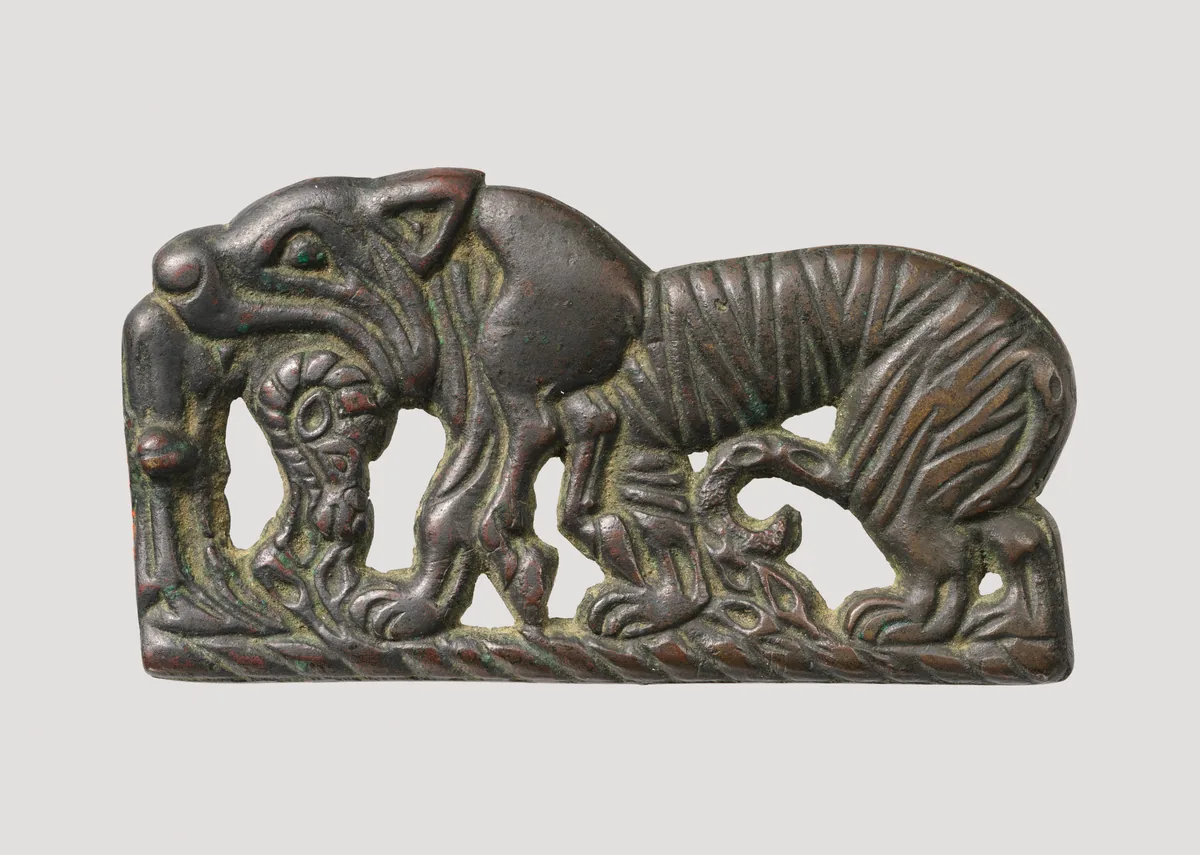
The Xiongnu were the confederation that dominated the eastern steppe from the end of the third century BC. For two centuries they were the principal adversary of Han China. They were the first nomadic empire of the region. They set the pattern of organisation and government for the Turkic and Mongolic steppe states that came after them.[1] Everything known of them comes through Chinese sources, since they left no text of their own. Two questions bear most on the later khaganates, and both are open. The first is what language their rulers spoke. The second is whether the Ashina came out of them, as the Zhou Shu asserts. Turkic Atlas sets out the answer to the first question and the derivation on which it rests under the debate on Turkic origins. The conclusion is that the ruling elite was Turkic-speaking. This conclusion stands as an inference, not as a finding. Turkic Atlas sets the likenesses and the positions on kinship side by side under the Göktürks and the Xiongnu.
Name and language
- 匈奴Chinese
- Hsiung-nuEnglish
- Asian HunsEnglish
The prevailing view is that the Xiongnu, or their ruling stratum, spoke Turkic. Its modern advocates include René Grousset, Annemarie von Gabain, Franz Altheim and Jean-Paul Roux, the last on linguistic and cultural grounds. Ahmet Taşağıl calls the Xiongnu the first Turkic state in history.[2] Alexander Savelyev and Choongwon Jeong find the greater part of the Xiongnu population likely to have spoken Late Proto-Turkic. They add that an Eastern Iranian group was assimilated in time.[3] Talat Tekin holds that the Xiongnu spoke an archaic form of Turkic, Proto-Turkic or even Pre-Turkic. He rests that on the Chinese statement that the Göktürks descended from the Xiongnu, on the few glossed words and on the Jie couplet. He grants that the language material that could prove it is almost nothing.[4]
The first ground for this view is the title of the ruler. The Han Shu gives it in full as Chengli Gutu Chanyu and glosses it as son of Heaven.[5] The Shiji has the same title in the Chanyu whom Heaven has set up, or born of Heaven and Earth and ordained by the sun and moon.[6] Chengli has long been identified, with little dissent, with tengri, the sky-god of the Turkic and Mongolic world. The word is plainly not the Chinese one. Whoever borrowed the idea of a heaven-given sovereignty did not borrow the word for heaven with it.[7] Gutu has been identified with Kut and Chanyu with an original Tanyu. It thus reconstructs Teŋri Kut Tanyu, “the ruler endowed by Heaven with fortune”, three Turkic words in a row.[8] It sets the title beside the Göktürk teŋri teg teŋride bolmış. It notes that Kut and tanyu do not appear among the Mongols. It concludes that the Xiongnu ruling elite spoke Turkic and had a Turkic identity.[9] It adds that the Chinese word chanyu fell out of use with the Xiongnu and returned for the Göktürks. It also notes that a commander of Bagatur’s western wing bore the title Turki.[10] F. W. K. Müller had already explained chengli gutu as Old Turkic täŋri qut, “holy majesty”.[11] Owen Lattimore followed him in identifying gutu with qut.[12] Jean-Paul Roux sees the Turkic idea of kut, the ruling power that Tengri gives, already in this title, although he doubts that the Han Shu is right to gloss gutu as “son”.[13]
The second ground is the glossed words. Anna Dybo went through the fifty-six most transparent etymologies and found two strata. The Turkic words appear in early and late sources alike and run across every field of meaning.[14][15] The Eastern Iranian words appear in the earlier sources, mostly those of the Western Han. They are almost entirely titles and terms for dairy products, with the word for comb beside them.[14][15] In her own summary, Turkic words already prevail among the common nouns of the Han period. The only common nouns of secure Iranian origin are the names of dairy products and the comb.[16] In the later transcriptions she found no word of secure Iranian origin. She offers the result as tentative, to be set beside the other hypotheses on the language.[16] László Rásonyi lists as Turkic the words kız, “girl”, katun, “queen”, bügü, “magic”, tengri, “sky”, kırsa, “steppe fox”, tinglig, “squirrel” and tok, “thick, strong”, all known from the Chinese notices.[17] İbrahim Kafesoğlu adds the words for sky, power, wolf, realm, camp, standard and sabre.[18] The Xiongnu word for the ceremonial sword, Chinese jinglu, has been set beside Turkic kıŋrak, “large knife”, and has been called the oldest Turkic word on record.[4] Edwin Pulleyblank found the match in meaning and sound striking. He pointed out, however, that the Turkic word probably has a connection with Iranian words for “sword” as well.[19]
The third ground is continuity with the Göktürks in titles and offices. The Zhou Shu says that the title Illig Khan, which Bumin took in 552, was like the chanyu of old. It says that the title khatun for his wife was like the yanzhi of old.[20] The claim of a heavenly mandate passes over as well. The Kül Tegin inscription opens Bilge Khan’s address with teŋri teg teŋride bolmış türk bilge kagan, “Bilge Khan of the Göktürks, like Heaven and born in Heaven”. The Bilge Khan stone opens with teŋri teg teŋri yaratmış, “made by Heaven”.[21] Both realms were also divided into two halves. The Shiji places the Left and Right Worthy Kings first among the offices of the Xiongnu.[6] The Sui Shu says that Taspar set Ishbara over the east. It adds that he made Börü Khan, a son of his brother, ruler in the west.[22] Bahaeddin Ögel holds that the Göktürks took their roots, and even their practice of founding a state, from the Xiongnu.[23] He holds that they saw themselves as the continuation of the great Xiongnu state, as the many Xiongnu titles in their state show.[24] Kafesoğlu holds that the Xiongnu state took its form from the steppe and not from China. He names a central command, an army ordered by tens, wings on the left and the right, and an assembly of the ruling men.[25] Together, the title, the rulers’ names and the heartland of the confederation support a Turkic-speaking Xiongnu elite as an inference, not as a finding.
The same material has been explained in other ways. Scholars have explained the glossed words ku-t’u for son and ch’eng-li for heaven as Kettic, as Iranian and as Turkic. Some scholars regard ch’eng-li as a probable borrowing from Turkic. They add that the majority of the Xiongnu words cannot be explained from Turkic at all.[26] They also find the name of the royal clan, Luandi, very un-Altaic.[27] It calls the linguistic data at best ambiguous. At the same time, it grants that the Altaic peoples come to the fore in the Xiongnu era and are by its end the predominant power of Inner Asia.[26] Pulleyblank judged that Müller’s derivation of the title becomes less plausible once the Han-period form of the word is reconstructed.[28] Kurakichi Shiratori rejected it too and took gutu for a Tungusic word, hutta, “son”.[11] Whether the heavenly mandate is a borrowing from China or a common Inner Asian idea is not known. In either case, the idea remained a consistent element of the divine-right language of steppe rulers from the Xiongnu to the Chinggisids.[1] The attempts to connect chanyu with the later titles yabgu and tarkhan have found no general acceptance.[1]
The Yeniseian theory goes back to Lajos Ligeti and Edwin Pulleyblank.[29] Pulleyblank judged it very unlikely that Xiongnu was Altaic.[27] In 1990 he held that the Xiongnu words in Chinese transcription cannot be explained as Turkic or as any other Altaic language.[30] The newest form of the theory, by Svenja Bonmann and Simon Fries, makes the language an early form of Arin and extends it to the Huns of Europe.[31] Genetics tells against it. The Ket, taken as the modern representatives of the Yeniseian speakers of southern Siberia, lack the Iranian-related ancestry that marks the Iron Age steppe and the three published Xiongnu genomes.[14] A third answer, argued by Harold Bailey, makes the language Eastern Iranian. A fourth, with Gerhard Doerfer, holds that the material permits no classification.[29] Andrew Shimunek has recently taken the same position as Doerfer.[14] Pulleyblank, who held that the Xiongnu language was not Turkic, nevertheless wrote that the Göktürks were the heirs to the pattern of political dominance on the steppe that had begun with the Xiongnu. He saw it in the word tängri and in some titles.[30]
The Mongolic theory has its own history. Kurakichi Shiratori held the Turkic view at first, in his work of 1900, and later changed his view.[32][33] By 1926 he took the Xiongnu for a mainly Mongolic people with some Tungusic admixture. He treated shanyu as a Chinese expression, took yanzhi and gutu for Tungusic words, and called the attribution to the Turks a long-established habit of Western scholars.[34] Paul Pelliot found the element gutu again in the title of a Rouran khan. He took the endings in -fa of several Göktürk titles for a Rouran legacy of Mongolic form.[35] Omeljan Pritsak placed the Xiongnu more broadly among Altaic speakers.[14] Luc Kwanten takes the language of the Xiongnu for Altaic and leaves the choice between Proto-Turkic and Proto-Mongol undecided.[36] Denis Sinor holds that the Göktürks are the first great steppe empire whose language is known with certainty. For the Xiongnu and the Rouran, in his words, any attribution of a language remains highly speculative.[37] Turkic Atlas sets the positions out one by one under the language.
The Chinese wrote the name 匈奴. The older forms Hunzhu, Xianyun and Xunyu go back through the Zhou period to the form the third century BC settled on.[1] The Sogdian xwn, the Chionitae of the Latin writers, the Hyōn of Middle Persian, the Hūṇa of India and the Huns of the Greeks have been derived from this name.[1] How far a shared name means a shared people is the central question of the Hun problem. It remains undecided.
One caution applies to all of the above. The Chinese account of Xiongnu origins conflates at least three different things under one name. First come the peoples of the north who had fought the Zhou and the warring states in the remote past: Xunyu, Xianyun, Rong, Di. The account makes them the ancestors of the Xiongnu. Second comes the Xiongnu as an ethnographic type. This is the nomad who lives in tents without fixed abode, follows his animals in search of grass and water and practises no agriculture. Third come the people who actually called themselves Xiongnu. The sources give three or four royal clans for them, the personal names of their rulers and the titles of their high offices.[7] The relation between Xiongnu and Hu has never been worked out. The two words at times seem interchangeable. A term that began as an ethnic name may well have become a political one, covering everyone in the empire, nomad and non-nomad alike.[7] The Turkic literature itself allows for a mixed confederation. Rásonyi holds that a single purely Turkic-speaking Xiongnu people cannot be assumed. In his view the name stands for a union of Mongolic, Tungusic and other tribes under Turkic leadership.[38] Jean-Paul Roux does not commit himself on the language of the rulers. He grants that it is disputed who spoke an Altaic language in these centuries. He adds that it is harder still to separate Proto-Turks, Proto-Mongols and Proto-Tungus without a text.[39]
Rise under Duman and Bagatur
The Xiongnu are noticed in the Chinese sources from the late fourth century BC. However, steady attention begins only with Duman, who died in 209 BC. In the time of the Zhao general Li Mu the Xiongnu did not dare to enter the Zhao frontier.[6] The biography of Li Mu adds that he drew them in with cattle outside the walls and killed more than a hundred thousand of their horsemen.[40][41] By then the panoply of the steppe warrior was fully formed: the compound bow, bronze and bone arrowheads with whistling beads, broadswords, short swords, lances and maces. The Xiongnu union was a response to the Qin. A strong China pushed Duman north from the Ordos and built the fortifications that became the Great Wall.[1] Qin expansion was the catalyst for tribal union among the nomads. They returned better organised when the Qin fell.[1] Where they came from before that is argued. Some argue that they did not come from the Orkhon but from the west, and that Mongolia was only the left wing of their empire. They reject the claim that the empire was a Mongolian state.[42]
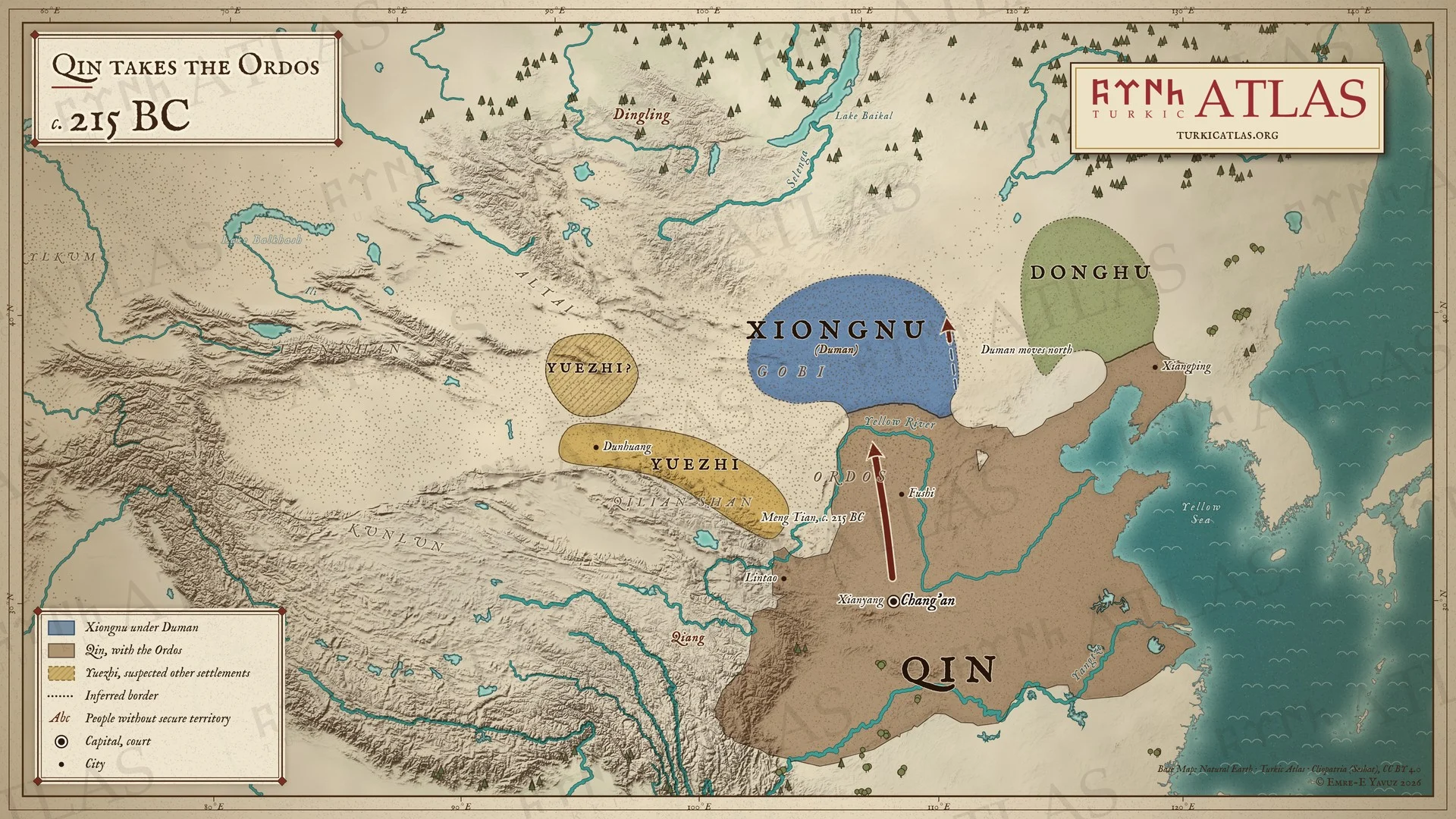
Duman was killed by his son Bagatur in 209 BC.[6] Bagatur defeated the Donghu, the grouping from which the Mongols derived. About 201 BC he brought the Hunyu, Qushe, Dingling, Gekun and Xinli under his control.[6] The Gekun are the Kirghiz and the Xinli the Sir. Both reappear among the subjects of the Göktürks. The campaign may have been for the metal of the north as much as for security.[6] Shortly afterwards he defeated the new Han ruler Gaozu and nearly captured him. That was the siege of Baideng in 200 BC. The Chinese put the Xiongnu army at four hundred thousand, and a modern estimate puts it at forty thousand. The encirclement lasted seven days. It ended in a peace that gave Bagatur a Han princess, the first of the heqin marriages, together with yearly deliveries of silk and wine. In a letter to the Han court of 176 BC Bagatur reported his conquests of the Yuezhi, Loulan, Wusun and Hujie. He declared that all the people who live by drawing the bow had become one family.[6] He died in 174 BC. His son Laoshang crushed the Yuezhi and invaded China in 166 BC. China acquiesced for a time in an arrangement by which the Xiongnu held the nomadic north and the Han the settled south.[6] The polity that resulted encompassed Mongolia, southern Siberia and Dzungaria.
Wars with the Han and the division
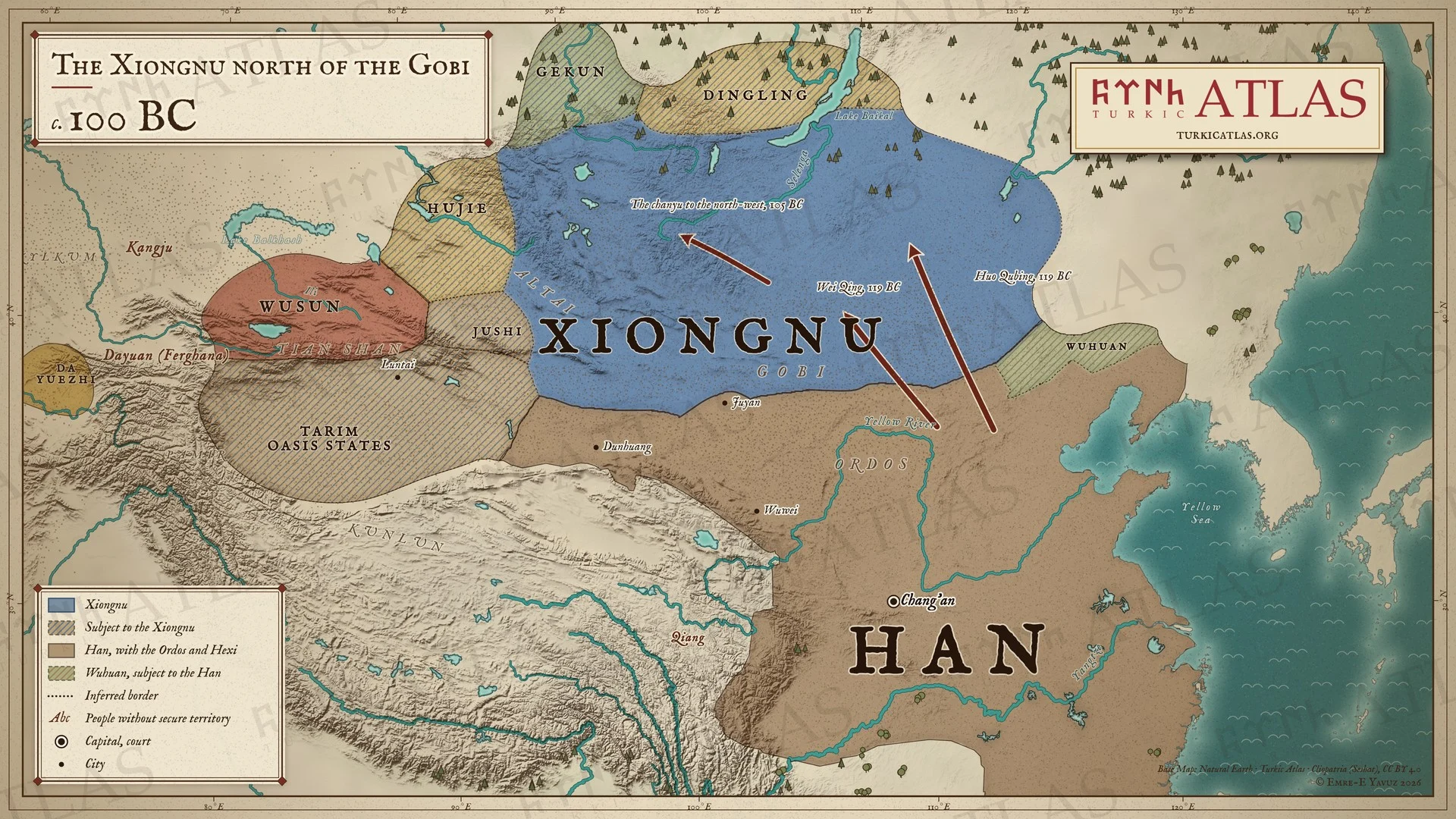
Relations with China turned on raiding. Raiding brought booty and forced trading rights, and it strengthened the union. The Han answered with control of markets, diplomacy and force. Under Wudi (141–87 BC) the Han went over to a military policy aimed at cutting off the Xiongnu’s right arm, the western regions. Major offensives were launched in 127 and 121 BC. In 119 Han troops reached Lake Baikal. The nomads were weakened rather than destroyed. The loss of the western regions and the Han refusal of peace, subsidies and border trade nevertheless produced fissures in the polity. In 71 BC the Wusun, Dingling and Wuhuan, once vassals, attacked from three sides.[5] A Xiongnu retaliation against the Wusun was caught in winter storms, and only one man in ten survived. The Han Shu says that three in ten of the Xiongnu died of hunger, and five in ten of their cattle.[5]
Internal strife from about 60 BC did the rest. In 53 BC (the first year of Ganlu, as the chapter dates it) the southern tribes under Huhanye submitted to China and used the tributary system to rebuild.[5] The Han Shu records how the Xiongnu nobles answered when Zuo Yizizi advised Huhanye to submit. They said that it was the custom of the Xiongnu to prize strength and despise service, and to make a state by fighting on horseback. In this way, they said, the Xiongnu had a name for might among the hundred barbarians. To serve the Han, they said, would shame the former chanyus and make them a laughing-stock among the peoples.[5][43] Huhanye himself appeared before the emperor at the Ganquan palace two years later. He was ranked above the vassal kings and addressed without his personal name.[5] The northern tribes under Zhizhi (56–35 BC) could not rebuild. They moved west under Chinese pressure. They imposed themselves on the Hujie, the Kirghiz and the Dingling, failed against the Wusun, and allied with Kangju. There Zhizhi met his end at Chinese hands. The numbers bear on what that migration was. Three thousand people reached Kangju with Zhizhi. Of these, 1,518 were killed and more than a thousand surrendered when his camp fell in 36 BC. This is not the beginning of a movement west.[44] In 33 BC Huhanye asked leave to dismiss the Han frontier guards. The court official Hou Ying advised against it, for many reasons. One of them was that bondmen on the frontier sighed over their lot. They said that life was easy among the Xiongnu, and asked what could be done when the watch was so strict. Some of them still slipped out through the frontier.[5][45] Some scholars see Huhanye’s submission as a catastrophe for a state founded so that Turkic and Mongol peoples should never fall under Chinese influence. The loss of the Tarim and the Silk Road dates from it.
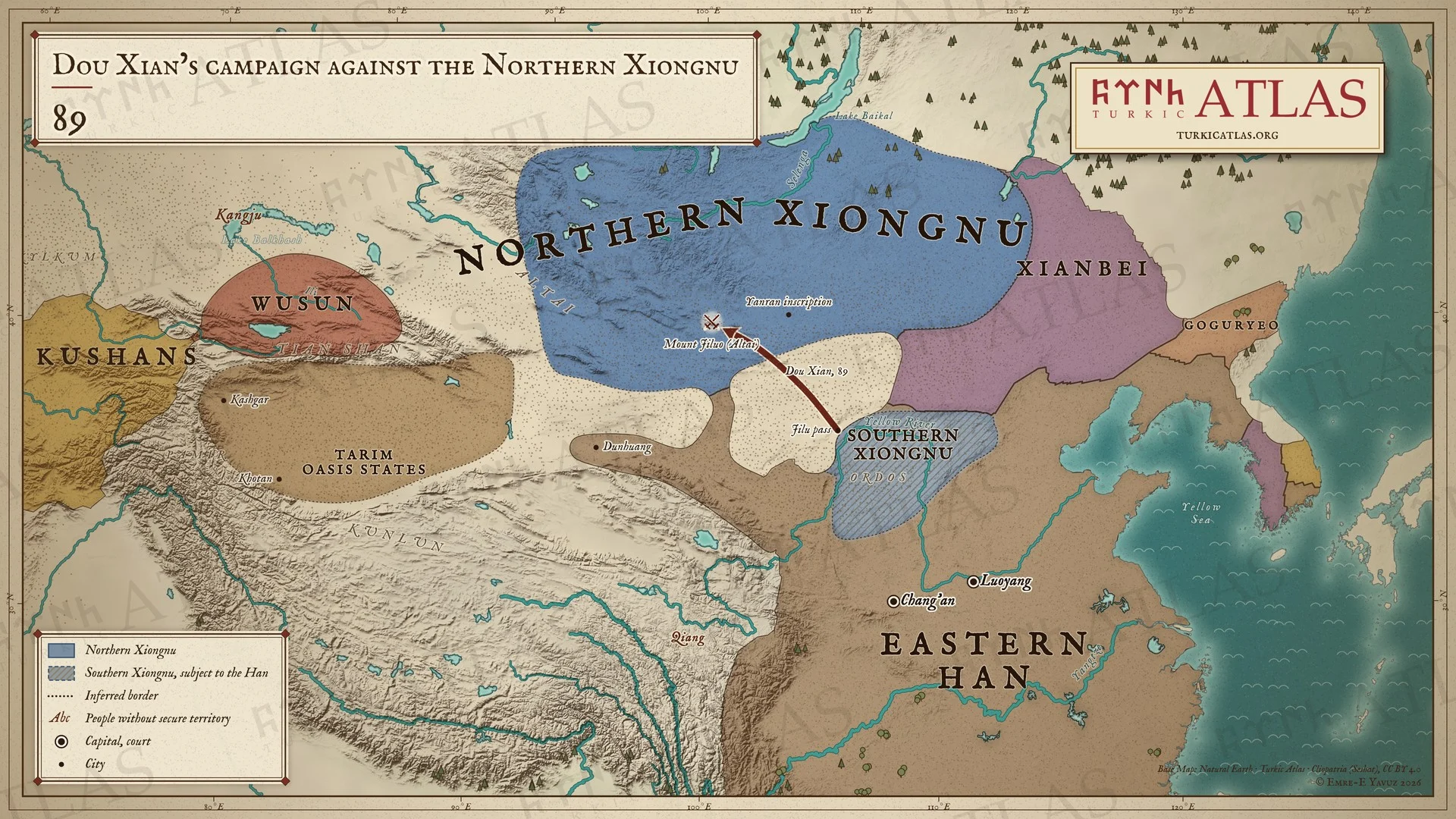
In the middle of the first century AD a second succession struggle divided the Xiongnu again into a northern and a southern confederation. The southern confederation was drawn under Chinese control and used against its kin. Under Ban Chao the Han projected their power into eastern Turkistan from about 73 AD. In 87, 89 and 91 to 93 the Han attacked the Northern Xiongnu, who were already weakened by defections. The Han’s allies, the Xianbei and Wuhuan, joined the attacks. The decisive defeat most likely fell in 89, in the Altai. Tens of thousands were carried off to China, and eighty-one former subject peoples went over to the Han. The Hou Han Shu records the campaign of 89 in one sentence. Dou Xian and Geng Bing went out from Shuofang with eight thousand horsemen, the Duliao troops and thirty thousand riders of the southern Chanyu, and broke the northern Xiongnu. The northern Chanyu fled. More than two hundred thousand of his people were killed or taken.[46] The Northern Xiongnu, or significant elements of them, went west. The Xianbei replaced them as masters of northern Mongolia. This region became the centre of every steppe state after them. The Hou Han Shu says that the remnants of the Xiongnu who stayed, more than a hundred thousand tents, all called themselves Xianbei. The Xianbei grew from that time.[47][48] The Southern Xiongnu revolted in 109 and were put down. On one chronology the Northern Xiongnu tried to recover their old lands in 150. In 155 the Xianbei crushed them. A second chronology records neither event. It is set out year by year from the Hou Han Shu and the Later Han annals of Yuan Hong.[49] Its last northern raid falls on Yiwu in 151. Around 158 the northern Xiongnu left the eastern Western Regions for the steppe north of Kangju.[50] Around 166, on the same chronology, the Xianbei under Tanshihuai held the whole of the old northern Xiongnu land as far as the Wusun. That advance was the chief cause of the Xiongnu withdrawal west.[51] With that they fade from view. The name survived in Chinese usage for former members of the confederation or, in an archaising sense, for any nomads of the north. Byzantium used the name Scythian in the same way.
Organisation of the polity
The Shiji allows the structure to be set out.[1] Under the Chanyu stood the wise kings of the left and right, t’u-ch’i. This title has been compared with the later Göktürk bilge. Also under the Chanyu stood a series of Guli kings, generals, commandants and other officers, divided on a left-and-right principle.[6] The high ministerial offices were hereditary in three clans, the Huyan, the Lan and the Xubu. Each of the twenty-four leaders had a force of ten thousand, subdivided on decimal lines. Beneath them were the local chieftains.[6] The office of Chanyu was hereditary. It combined military, diplomatic, judicial and sacerdotal functions. Succession combined lineal and lateral descent: the former before the civil strife of the first century BC, the latter, from elder to younger brother, after it. Between 114 and 60 BC seven chanyu followed one another, most of them for less than ten years. This contrasts with the long reigns of Bagatur and Junchen. Two of the seven may have been boys at their accession.[52] Of ten successions from Laoshang to Xulüquanqu, six passed from father to son. The reigning chanyu normally had the last word on his heir. After the civil war Huhanye ruled that his eldest son should hand the throne to a younger brother. Brother followed brother until about the middle of the second century AD.[53] The ruling stratum gathered in the first and fifth month to sacrifice to the ancestors, to Heaven and Earth, and to the gods and spirits. It gathered again in the autumn, when a reckoning was made of the number of persons and animals. It may have been a rudimentary census, for taxation and recruitment.[6] The Zhou Shu records a Göktürk custom of a sacrifice in the fifth month. It follows the same calendar.[20] The levirate was known among them. There were sedentary and agricultural elements, and camps that were becoming towns. The Shiji says of them that they make it clear that warfare is their business.[6]
Whether this was a state is argued. There is evidence of regular tribute from subject peoples and of an agency for exploiting the western regions. Against that, it has been held that the polity was a military confederation whose Chanyu was a supreme warlord with some judicial authority. Thomas Barfield calls it an imperial confederacy: autocratic and state-like in foreign affairs, consultative and federally structured within.[1] Put plainly, the Chanyu levied no taxes and had no real control over internal affairs. The office existed to unite the tribes and protect them from outside. Confederation is therefore the better word than empire, and this does not diminish their power. The Xiongnu never attempted to conquer China. Their purpose was to secure and exploit access to its goods.[1]
The Chinese outline leaves out two things. The first is that the great chiefs were not commanders on a payroll. Each of the twenty-four appointed his own subordinate kings, chancellors and officials down to the chiefs of thousands, hundreds and tens. Each, in the Shiji’s phrase, had allotted territory within which his people migrated. What they held were appanages. The ties binding the four high lineages (Luandi, Huyan, Lan and, later, Xubu) ran through an exclusive exchange of consorts and princesses.[6] The Gudu marquises were the lowest of the imperial nobility. They came expressly from other families, had no appanage and no subordinates of their own, and depended on the ruler who had raised them.[6]
The second is a whole stratum below the aristocracy. What the Chinese chroniclers called a king among the Xiongnu was any great man or chiefly commander at any level of the decimal order. The records are scattered with non-royal kings under a variety of labels: name kings, boundary kings, frontier-entrenchment kings, and collectively the various kings and great men.[54] These men mattered. In the first century BC they took over errands that had belonged to the imperial nobility. One inspected the frontier forces, another led a campaign into the western regions, and a third headed the embassy that asked the Han for a renewed treaty.[54] They also made and unmade rulers. Every earlier contest for the office of Chanyu had been fought inside the royal lineage, including the self-elevation of Yichixie in 126 BC.[54] By 50 BC Yujian in the east and the Hujie and Wujie in the west had all claimed the supreme rulership themselves. Sometimes they allied with one another to press the claim.[54] The polity broke at that point, and it broke from below rather than within the royal lineage.
The orderliness of the Chinese description should itself be read with care. The Han chroniclers worked a scheme over what little they knew of their northern neighbours. The simplicity of the Xiongnu political system as they present it is a feature of that scheme, not of the thing described.[54]
Religion
The Xiongnu left no writing. What is known of their beliefs comes from scattered notices in the Chinese histories and from their graves.[55] The notices are short and were written by outsiders. They name few of the powers the Xiongnu honoured.
Heaven is the power about which the notices say most. The Han Shu gives the Xiongnu word for it as chengli, which is generally identified with Tengri. The Shiji does not give the word.[5] In the great sacrifice of the fifth month Heaven is named with Earth after the ancestors and before the gods and spirits.[6] The chanyu styled himself the one whom Heaven had set up. In the longer style he was the one born of Heaven and Earth and ordained by the sun and moon.[6] At Mayi the chanyu Junchen said that Heaven had put a Han frontier officer into his hands. He gave the man the title Heavenly King.[6] Hulugu wrote to the Han in 89 BC that the Hu were the proud sons of Heaven.[5] The oath of about 43 BC with Huhanye called down Heaven’s ill favour on whichever side broke it first.[5] The notices show Heaven as the power that sets up the ruler, helps him in war and punishes the breaking of an oath. The long style makes Earth a second parent of the chanyu. Some scholars set the later Göktürk and Uyghur evidence beside these notices. It holds that Heaven was the sky itself and the chief god, with four functions: it created, it set up rulers, it protected and it punished.[56] The Chinese notices do not say whether Heaven was the sky or a god above the sky.[57] Others regard chengli as the oldest word of Altaic religion that can be followed. It changes little in the Turkic languages from the time of the Xiongnu to today.[58] In his letter of 176 BC Bagatur says that by the favour of Heaven his officers and men were good and his horses strong, and that he had wiped out the Yuezhi.[6][59]
The sun and the moon were honoured as well. In the morning the chanyu came out of his camp and bowed to the rising sun, and in the evening he bowed to the moon. Before a campaign the Xiongnu watched the stars and the moon. They attacked when the moon was full and withdrew as it waned.[6] The days wu and ji were held highest.[6] Discs and crescents of gold and silver, taken to be the sun and the moon, lie in the tombs of the elite in Mongolia.[60] The oath of about 43 BC was sworn on a hill east of the river Nuo. A white horse was killed there, and the chanyu and the Han envoys drank a blood oath from the skull of the Yuezhi king.[5] The choice of a hill has been tied to a cult of mountains.[61] A commentator, Meng Kang, says that the place where the Xiongnu worshipped Heaven was originally at the foot of Mount Ganquan in Yunyang. After the Qin took the place from them, he says, it moved to the former land of the Xiutu king.[6][62] The sacrifice of the Xiutu king may be a lesser copy, in his own land, of the great sacrifice that the chanyu held at Longcheng.[63] Dailin, where the autumn assembly met, is taken for a wood or for a rite of going round one. Either explanation has been held to show a cult of trees and forests.[64] Turkic Atlas gives the passages under the three assemblies.
The Chinese notices mention no goddess.[65] A rock drawing at Khavtsgait in southern Mongolia, dated to the fourth century BC to the first century AD and attributed to the Xiongnu, shows large seated women in tall headdresses before whom smaller men stand.[65] The women may be a goddess, comparable to the Scythian Tabiti. The comparison rests on Scythian art and not on any Xiongnu text.[65]
A knife may belong to a cult of war. At the oath of about 43 BC the chanyu stirred the wine with the jinglu knife and a golden liuli.[5] A commentary on the Han Shu is said to gloss jinglu as a precious knife of the Xiongnu. The Han Shu itself is said to name a shrine of the Jinglu spirit at Yunyang, where a king of Xiutu had sacrificed.[66] The commentator is said to be Ying Shao. The shrine is said to stand in the geographical chapter of the Han Shu, where Yan Shigu notes that it was originally a Xiongnu shrine.[67] A modern commentator, Wang Xianqian, takes jinglu to be the name of the Xiutu king himself and not of a sword.[67] The word has been explained as Old Turkic qıŋraq, “curved”. The knife and its spirit have been set beside the iron sword that the Scythians raised for their god of war.[68] Kurakichi Shiratori took the god of Jinglu in 1930 for a god of the sword. He held that the golden men were lesser gods beside it.[69] Other writers gloss the Turkic word as ‘double-bladed knife’ or ‘large knife’. One of them calls the jinglu the oldest Turkic word on record.[4] Pulleyblank found the match in meaning and sound striking. He pointed out that the Turkic word is probably linked with Iranian words for ‘sword’, and held the Xiongnu form to be closer to the Turkic than to the Iranian forms.[19]
The Shiji and the Han Shu tell of a golden image. In 121 BC Huo Qubing took the golden man with which the king of Xiutu sacrificed to Heaven.[70] Commentators explained what the image was for. In the third century Wei Zhao said that the Xiongnu made the golden man as the lord of their sacrifice to Heaven.[6] Meng Kang and Ru Chun, commentators of the same age, are cited for the same interpretation.[71] The identification as a Buddha image begins in the fifth century with Cui Hao, who took the golden man for the Buddha figures of his own day.[6] The Han Shu is said to record that the son of the Xiutu king received the surname Jin, “gold”, for it.[72] Modern scholars divide three ways. One holds that the Xiongnu had no such image at all. A second holds that it belonged to a Xiongnu cult of its own with no tie to Buddhism. A third holds that it shows a god of heaven worshipped with metal statues.[72] Two further proposals were put forward earlier in the twentieth century. One of 1918 took the statues for an Indian god that reached the Xiongnu through the Yuezhi in Bactria. A later proposal rejected it, because the Yuezhi were enemies of the Xiongnu and Brahmanism never left India.[73] Shiratori took the golden men of the Xiutu king for a Han-period cast made after the twelve bronze figures of the First Emperor of Qin. In his view they were neither a Buddha, nor an Indian god, nor a Xiongnu god.[74]
Ritual specialists, wu, stood close to the court.[75] After Li Guangli had gone over to the Xiongnu in 90 BC, the Han renegade Wei Lü told a Hu wu to say, when the chanyu’s mother fell ill, that the former chanyu was angry. The reason was that before a campaign the Xiongnu used to promise at their sacrifice that they would offer up Li Guangli, and now they did not.[5] The Xiongnu seized Li Guangli. He said that his death would destroy the Xiongnu. They killed him in sacrifice.[5] Then rain and snow fell for months, the herds died, the people sickened and the grain did not ripen. The chanyu, afraid, built a shrine for him.[5] The Han Shu is said to record elsewhere that Xiongnu wu cursed the Han army by burying sheep and cattle along the roads and by the water. It is said to record, too, that the Xiongnu divined before battle and found the Han general ill-omened.[76] The kam article gives what is known of the specialist.
The dead were buried with an inner and an outer coffin, gold, silver, clothing and furs, and without a mound, trees or mourning dress. The Shiji adds that the ruler’s favourite servants and concubines followed him in death. It puts their number at hundreds or thousands. The Han Shu otherwise copies the passage, but it puts the number at tens or a hundred.[70] Excavated Xiongnu graves hold the bones of sacrificed animals.[77] In cemeteries of western Mongolia, small satellite graves lie beside the great square tombs of noblewomen. The dead in them were buried with few goods and were, by their genes, of West Eurasian descent. They are taken to be servants who followed their mistresses in death. Satellite graves are reported as well at a tomb in central Mongolia that is thought to be a chanyu’s.[78] If so, human sacrifice at funerals is confirmed. The numbers of the Chinese text, however, have found no confirmation in the graves.[78] Graves were held sacred. The Wuhuan had opened the tomb of a former chanyu, and the Xiongnu sent twenty thousand horse against them.[5] The first Southern chanyu, Bi, died in AD 56. A Han envoy came with troops to mourn, offered wine and rice and set a guard. Mourning, sacrifice, condolence and gifts became the custom at each later death of a chanyu.[46] Following in death sets this beside the Göktürk record.
A dragon cult has been inferred from the name of Longcheng, where the Han Shu writes “Dragon City” and the Shiji “Long-grass City”, and from the dragon sacrifice of the Hou Han Shu.[79] Others reject it. No find supports a Xiongnu cult of the dragon, and the first character of the Shiji’s spelling may render a Xiongnu word and not a Chinese one.[79]
These beliefs have been taken for the earliest stage of Turkic religion.[80] This view rests on the inference that the ruling elite spoke Turkic, which the debate on the language leaves open. A counterpart among the Göktürks, whether Heaven as giver of rule or the sacrifice of the fifth month, shows a likeness and not a descent. Jean-Paul Roux holds that the religion of the Xiongnu, so far as it can be known, differs little from the later Turkic and Mongolic one. He notes that it resembles the religion of the Scythians as well, and that a likeness of that kind says nothing for language.[81] The making of Tengrism sets out how such interpretations were built.
Standing in the western countries
West of the Pamirs the Xiongnu were the power that counted. The Shiji reports that a Xiongnu envoy bearing a single credential of the Chanyu was passed from state to state and fed, all the way from the Wusun west to Parthia. No one dared detain or trouble him.[82] Han envoys got no food unless they handed out silk and no mounts unless they bought animals in the market. The Shiji gives the reason. The Han were far away and rich, while the Xiongnu were near and had broken the Yuezhi. Therefore the peoples of the west feared the Xiongnu envoys more than the Han.[82]
In the Tarim basin the Xiongnu governed through an office. The Rizhu King set up a Commandant in Charge of Slaves, Tongpu duwei. His seat lay among Yanqi, Weixu and Yuli, and he taxed the states of the Western Regions.[83] The office ended in 60 BC, when the Rizhu King surrendered to the Han, and the Han created the post of Protector General of the Western Regions.[83] The Xiongnu may have lost with it the grain of the oasis states, iron weapons, men for labour and war, and the taxes on the transit trade.[84] Shiratori took the farming towns of Eastern Turkestan for a granary of the Xiongnu empire.[85]
The Xiongnu also passed a name for the Chinese to the west. They called the Chinese of the Han “men of Qin”, after the dynasty that had fought them. The Han Shu has the Han defector Wei Lü advise the Chanyu to dig wells, build walls and towers for grain, and guard them with men of Qin.[5] The Chinese themselves did not use the name, since the Qin had left bitter memories.[86] The Sogdian words for the Chinese, cyn, and for China, cynstn, the land of the Qin, belong to the same name. Some scholars hold that the Xiongnu, with western vassals such as the Wusun, were its likely carriers.[86]
The silk the Han paid to the Xiongnu was colossal in quantity. One thesis has it passing from Xiongnu hands to Sogdian merchants. It rests on no concrete proof. The Chinese texts attest instead a trade conducted directly between Chinese envoys and the merchants of Central Asia.[87]
Later history
The Southern Xiongnu were drawn into the Chinese politics that followed the fall of the Han in 220. With the Xianbei and various Tibetan peoples, they founded a number of short-lived dynasties in northern China. Sixteen kingdoms of the Five Barbarians held the north from 304 to 439. Of these, the Former Zhao, the Later Zhao, the Xia and the Northern Liang were of Xiongnu origin. The Liu house of the Former Zhao came of the Tuge. The Shi of the Later Zhao came of the Jie, a branch of the Qiangqu tribe.[88] The Juqu of the Northern Liang were Xiongnu of Linsong in Zhangye. They took their surname from the Xiongnu office of juqu, which their ancestors had held for generations.[89] Helian Bobo of the Xia was a Tiefu, the name for men of Xiongnu fathers and Xianbei mothers.[90] He called himself Heavenly King and Great Chanyu. He changed the clan name from Tiefu to Helian. He named his state Da Xia after the tradition that the Xiongnu descended from the Xia.[91] The tradition is as old as the Shiji, which makes the first ancestor of the Xiongnu a descendant of the rulers of the Xia.[6] The Northern Liang matter here for a particular reason. In the Sui Shu’s account, their destruction by the Wei in 439 sent the five hundred families of the Ashina to the Rouran and the Altai. The Ashina article gives that story. The wars of the successor states are gathered under the Hegemony Wars. By then the Xiongnu in China were largely indistinguishable from the Chinese.[1] In 350 the Later Zhao ruler Ran Min ordered the massacre of all Xiongnu in his realm. The only marks his officials could go by were a high nose or a heavy beard, and many Chinese died with them.[1]
To the west, some scholars see the greatest of the migrations, producing the Huns of Attila in Europe and the Kidarites, Chionites, Alkhon and Hephthalites in Central Asia. Turkish historiography treats these states as a continuation of the Xiongnu and part of a pan-Turkic history. The thesis is attributed chiefly to non-Turkish historians. It is a position, and Turkic Atlas names it as such. Turkic Atlas sets out the other side of the question under the Huns.
Settlement and economy
The Shiji says the Xiongnu wander in search of water and pasture, have no walled cities and no fixed dwellings, engage in no agriculture of any kind, and live by herding in peace and by hunting.[6] Three bodies of excavation now contradict every clause of that sentence.
The fortified complex at Ivolga, some seven hectares, held about fifty-one dwellings, most of them dug into the ground. Its inventories give sheep, goat, cattle, horses, pigs, camels and yaks, millet, barley and wheat, hunting and fishing, pottery, bone-carving and the working of iron and bronze. Inside the walls stood a workshop with a smelting furnace.[92] A full survey of the lower Egiin Gol valley in northern Mongolia walked 246 square kilometres and recorded 572 sites from the Palaeolithic to the twentieth century.[93] It found the Xiongnu-period material among the commonest of all. Behind it lay a settlement hierarchy, riverside sites occupied through the summer, grain production and a landscape organised around it.[93] The people of that valley were agropastoralists living in settlements.[7]
The domestic sites of the Khanui valley give the proportions of the working economy. The valley lies north of the Khangai, in what is increasingly taken for the heartland of the empire. Of the animal bones that can be identified, sheep and goat make up somewhat over half, horse a quarter and cattle a sixth, with marmot as a seasonal addition.[92] Hunting, which the Shiji makes their living, barely shows. Of more than a thousand recorded burials only about eight held the remains of wild animals. The excavator of Ivolga concluded that hunting served less as a means of getting food than as entertainment.[92] Iron slag turned up at six of the excavated occupation areas in the Khanui valley, most of it along the foothills. Smelting was therefore not confined to the workshops of fortified places but went on at open seasonal camps. The metallurgy of the empire was decentralised.[92]
Nothing in these findings makes the Xiongnu less nomadic. The reason is that settlement and cultivation belong to the pastoral nomadism of inner Asia and do not contradict it. The survey evidence establishes them as part of it.[93] What it does dispose of is any account of the empire that rests on an economy of animals alone.[7] Chinese notices that Eberhard collected give wheat and millet for the Xiongnu as well as for the Göktürks. Some scholars count both crops as native among them from very early times.[94]
The radiocarbon dates from Egiin Gol bring a harder point. The people using Xiongnu-style pottery lived in that valley for generations before the Xiongnu appear in the Han histories. They went on living there after the Xiongnu had stopped being worth recording and other names had risen in the north-east. The oldest and youngest dates in the valley are about 2450 and 1750 years before the present.[93] The name entered and left the Chinese record faster than the population entered or left the valley.
Archaeology
Two cautions frame everything in this section. The first is that the identification of an archaeological culture with the Xiongnu of the written sources cannot be anchored. Apart from very rare cases, no historical event and no historical representation of the Xiongnu can be firmly connected with an actual Xiongnu archaeological culture or population.[7] The second is that there are two Xiongnu archaeologies, and they are not commensurable. One covers the northern zone of today’s China: Shanxi, Inner Mongolia, Liaoning. It identifies sites largely by what the histories say was there.[7] The other covers Mongolia, Transbaikalia, Buriatiia, Tuva and eastern Kazakhstan. It identifies sites by typology of site and artefact.[7] They were built by separate scholarly traditions. They define their Xiongnu cultures differently in method and in type, and their chronologies differ.[7] The monumental burials of Mongolia have no counterpart in Inner Mongolia at all. The link between the Xiongnu of the Ordos and the Khünnü of Mongolia therefore remains an open problem.[7]
A third caution concerns the periodisation itself. The break that is routinely drawn between pre-Xiongnu and Xiongnu cultures in northern China rests on the attribution of ethnic terms (Rong, Di, Hu, Qiang) to sites that show no such break in the ground. It obscures the seven or eight centuries over which mounted nomadism actually developed there.[7] The Mongolian scheme has the opposite defect. It runs a Khünnü period from the second century BC to the second century AD, then a blank stretch with no name at all, and then the period of the Göktürks from the sixth.[7] Four centuries of the eastern steppe have no archaeological identity in that scheme. The Rouran, who ruled for two of them, are among the casualties.
The evidence for the empire’s last two centuries runs against the narrative of decay. From the middle of the first century BC into the second century AD, burial traditions and material assemblages across the steppes of inner Asia became steadily more uniform, forming a single hierarchy of ritual expenditure. Exotic goods from China and from western Eurasia came to dominate the prestige assemblages. Monumental ramped tombs appeared among the Xiongnu for the first time.[54] The turn of the first century BC was therefore not a loosening of cohesion but a coalescence, with heavier investment in the display of authority.[54]
The purpose of that display can be seen in the form of the tombs. The late graves fall into two kinds: a smaller shaft pit with a circle of stones, and a larger ramped, stepped tomb under a square mound. The sizes of the two do not overlap in the way a single graded hierarchy would produce. Certain materials appear in the square tombs and in no circular grave.[54] The explanation is that competition from regional leaders drove the upper elite to raise the stakes. The result was a division: exclusive burial grounds and restricted goods for those inside, while the spread of the same prestige culture bound the disparate regions of the empire together.[54] The historical record of ambitious non-royal kings and the archaeological record of ostentatious tombs describe the same decades from two sides.
Some of the equipment found in these graves points forward to the weapons of the later steppe. Composite bows stiffened with bone plates lie in the princely graves of Noin Ula in northern Mongolia, in graves at Ilmovaja Pad on the Selenga and in the fortified settlement of Ivolga. At Noin Ula a Chinese lacquer bowl of 2 BC dates the grave with its bow and three-edged arrows. The remains of a wooden saddle were found there as well, among the oldest datable saddles of this kind.[95] These sites are commonly assigned to the Xiongnu, with the reservations stated above. The skulls from Noin Ula and Ilmovaja Pad show no artificial deformation.[96] The princely barrows of Noin Ula, 212 mounds opened by the Kozlov expedition in 1924 and 1925, held Chinese silks, goods from the Near East and the Black Sea, and the work of local craftsmen.[97] The finds mix Chinese lacquer, the animal style of the steppe and objects of Pontic Greek make.[98]
Excavation sets limits that bear on the question of continuity. In the Ordos and along the northern bend of the Yellow River, where the southern Xiongnu are supposed to have lived, no secure trace of the Xiongnu cultural complex has been found. This holds for the beginning of our era and for the period of Xiongnu power before it. One conclusion drawn from this is that the split of the mid-first century BC was not a division of the Xiongnu into northern and southern. It was the separation from them of local peoples they had subjected.[44] The northern Xiongnu broke into a number of small hordes. Their chiefs still called themselves chanyu but no longer had the force to impose themselves. Their defeats in the first century AD end, in the chronicles, in flight to nowhere in particular. West of the Sayan-Altai there are no Xiongnu sites datable after the first century AD. The fate of the Xiongnu as a people is therefore bound up with Central Asia. The question of the European Huns is not thereby settled, only shown to be harder. One or several peoples of the confederation may have gone west after it broke.
Archaeogenetics adds a different kind of evidence, though a genome gives no ethnic, linguistic or political attribution. A study of 2023 examined eighteen individuals from two cemeteries on the empire’s western frontier. It found the genetic diversity within those communities as great as that of the empire as a whole. The diversity was greatest among the lowest-ranking burials and least among the highest. The ancestry of the highest burials was drawn disproportionately from the Slab Grave population of the early Iron Age. The highest-status individuals at both sites were women. That describes who was buried where. It does not say what people they thought themselves. Citing a study of 2020, some scholars regard the genetic profile as consistent with a largely Turkic-speaking population.[99] An older judgement, made before either study, called the Xiongnu a Mongoloid population of the Trans-Baikal and Mongolia with some Europoid admixture. It observed that some scholars would reverse the formulation.[1]
Xiongnu and the Göktürks
Two things about the Xiongnu bear on the history of the Göktürks. First, the Chinese histories assert that the Ashina came out of the Xiongnu. The Zhou Shu, describing the Göktürks, says at three points that they were like the Xiongnu of old: in the title of their khan, in the title of his wife, and in their customs.[20] Second, the ruler’s title, as the Han Shu transcribes it, contains the words that Turkic sources use six centuries later for the sky-god and for royal fortune. The Xiongnu ruling elite is taken to have been Turkic, and the Xiongnu are placed in the line of Turkic states. This rests on the title, on the rulers’ names, on where the confederation had its heartland, and on what the Chinese histories say about Ashina descent. The placing is a choice among interpretations and an inference. A more guarded view is that at one point or another the early Turkic peoples fell under the sway of the Xiongnu. Their role in the ethnogenesis of the Turkic peoples, however, cannot be assessed fully.[1] From the eighteenth century on, a long line of scholars has held the Xiongnu to be Turks.[32] One of them identifies the core of the Xiongnu with the Turkic mass whose ancestors are placed in the Altai–Sayan region and who spread from there to the Ordos and Gansu.[100] The argument is set out in Tengrism and in the ethnogenesis debate. It concerns the ruling house. A confederation that at its height counted eighty-one subject peoples was not one thing. The identity in question was far less articulated in the second century BC than it would be in the sixth century AD.
-
c. 215 BC Qin takes the Ordos
Around 215 BC the First Emperor of Qin sent Meng Tian north with a hundred thousand men. He took the land inside the great bend of the Yellow River, the Ordos, made the river the frontier and crossed it to hold the plain below the Yin mountains. According to the Shiji the Donghu north of Yan were strong at this time, and the Yuezhi flourished between Dunhuang and the Qilian mountains. The Xiongnu chanyu Duman could not withstand Qin and moved north. How far north, the source does not say. A second reading places the Qilian of this passage in the Tianshan; the hatched area shows it.
-
209–200 BC Modu unites the steppe
In 209 BC Modu killed his father Duman and became chanyu. Between the Xiongnu and the Donghu lay an empty strip more than a thousand li wide. When the Donghu demanded it, Modu struck east and destroyed their king. The Wuhuan held out at the Wuhuan mountain and paid the Xiongnu a yearly tribute of oxen, horses and sheepskins; the Xianbei withdrew far beyond the Liaodong frontier. Modu drove back the Yuezhi, took back the land Meng Tian had seized as far as Chaona and Fushi, and subjected the Hunyu, Qushe, Dingling, Gekun and Xinli in the north. In 200 BC he surrounded the Han emperor Gaozu for seven days on the hill of Baideng near Pingcheng.
-
176–c. 160 BC The height of the realm
In 176 BC Modu wrote to the Han court that the Wise King of the Right had destroyed the Yuezhi, and that Loulan, the Wusun, the Hujie and twenty-six states around them had all become Xiongnu: all the peoples who draw the bow were now one family. His son Laoshang killed the Yuezhi king and made a drinking cup of his skull. The Yuezhi left the Hexi and moved west into the land of the Saka. The Han Shu names a Xiongnu Commandant of Slaves who resided between Karashahr, Weixu and Weili and taxed the oasis states. In 162 BC the emperor Wendi confirmed the Long Wall as the line between the two realms. No source describes the northern edge of the realm in Tuva and beyond the Baikal.
-
127–121 BC The Han take the Ordos and the Hexi
In 127 BC the Han general Wei Qing drove the kings of the Loufan and the Baiyang out of the Ordos. Han founded Shuofang there and restored Meng Tian's wall along the river; in exchange it gave up the district of Zaoyang beyond Shanggu. In 123 BC the chanyu withdrew north across the Gobi on the advice of the defector Zhao Xin. In the spring and summer of 121 BC Huo Qubing struck into the Hexi corridor, and in the autumn the Hunye king killed the Xiutu king and went over to Han with more than forty thousand people. From then on, says the Shiji, the land from Jincheng and the Hexi west along the Southern Mountains to the Salt Marsh was empty of Xiongnu. By this time the Wusun held the land of the Saka, and the Yuezhi had moved on to the north bank of the Oxus.
-
119–c. 100 BC North of the Gobi
In 119 BC Wei Qing and Huo Qubing crossed the Gobi with separate armies. Huo Qubing marched more than two thousand li beyond Dai, sacrificed on Mount Langjuxu and turned back at the Hanhai. Afterwards, says the Shiji, there was no royal court south of the Gobi. Han settled soldiers and farmers from Shuofang west to Lingju and set up the commanderies of the Hexi, from Wuwei to Dunhuang; the Wuhuan were moved beyond the frontier of five eastern commanderies to watch the Xiongnu for Han. By 105 BC the chanyu had moved further north-west, his left wing facing Yunzhong and his right Jiuquan and Dunhuang. The southern edge of the realm ran somewhere in the Gobi.
-
60–51 BC The Western Regions lost, the realm divided
In 71 BC the Dingling struck the Xiongnu from the north, the Wuhuan from the east and the Wusun from the west, and the peoples bound to them fell away. In 60 BC the Rizhu king went over to Han. The Xiongnu Commandant of Slaves was abolished, and Zheng Ji became the first Protector-General of the Western Regions, with his seat at Wulei. In 57 BC five chanyus contended for the throne. In 54 BC Zhizhi took the royal court, and his younger brother Huhanye moved south to the Han frontier. In 51 BC Huhanye came before the emperor at Ganquan and was allowed to live below the Guanglu wall.
-
49–33 BC Zhizhi in the west, Huhanye in the north
Believing that Huhanye, weak and bound to Han, could not come back north, Zhizhi led his people west. He defeated the Wusun, received the surrender of the Wujie in the north, broke the Jiankun in the west and brought the Dingling under him, and made his seat in the land of the Jiankun. Around 44 BC he killed a Han envoy and went on to Kangju; of his people only three thousand arrived. In 36 BC the Protector-General Gan Yanshou and his deputy Chen Tang marched on Kangju and killed him. Huhanye meanwhile returned to the royal court in the north, and in 33 BC he received the palace lady Wang Zhaojun as his wife. From then on the land north of the Long Wall belonged to the Xiongnu again.
-
AD 48–50 Northern and Southern Xiongnu
Under Wang Mang the states of the Western Regions went over to the Xiongnu. In AD 48 the chiefs of eight southern tribes raised Bi, the Rizhu king, as chanyu under the name Huhanye; he came to the Wuyuan frontier and offered to shield Han against the northern Xiongnu for ever. The next year the northern chanyu fell back a thousand li. In AD 50 the southern court moved inside the frontier, first to Yunzhong and in the winter to Meiji in Xihe, and its chiefs were stationed along the frontier commanderies from Beidi to Dai. Beyond the Liaodong frontier the Xianbei sent their first envoys to Han in AD 49.
-
AD 87–93 The end of the Northern Xiongnu
In AD 87 the Xianbei entered the eastern lands of the Northern Xiongnu and killed the chanyu Youliu; fifty-eight tribes, two hundred thousand people, came to the frontier to surrender. In 89 Dou Xian marched out with the southern chanyu, defeated the northern chanyu at Mount Jiluo and had an inscription cut on Mount Yanran, more than three thousand li beyond the frontier. A rock inscription in the Gobi of central Mongolia is identified with this text; it lies much closer to the frontier than the figure of the source. In 91 Geng Kui defeated the northern chanyu at the Jinwei mountains, and the chanyu fled to the land of the Wusun. The Xianbei moved into the empty land, and more than a hundred thousand Xiongnu tents that stayed behind called themselves Xianbei.
-
c. AD 155–180 The Xianbei in the old Xiongnu land
The Xianbei leader Tanshihuai set his court on the Chuochou river below Mount Tanhan, more than three hundred li north of Gaoliu. According to the Hou Han Shu he raided the Han frontier in the south, held off the Dingling in the north, drove back the Fuyu in the east and struck the Wusun in the west, and held all the old Xiongnu land, fourteen thousand li from east to west. He divided it into an eastern, a central and a western part; the western reached Dunhuang and the Wusun. The Southern Xiongnu remained inside the Han frontier. One reckoning puts the last defeat of the Northern Xiongnu by the Xianbei in 155, a second puts their move west around 158; the hatched area north of Kangju shows where the second places them.
- Place named in a source (position as commonly identified)
- Position disputed or approximate
- Zone drawn after the Han histories
- Second reading or entirely uncertain position (hatched)
- People subject to the Xiongnu, or under Han protection
- Oasis states taxed by the Xiongnu
- Border that no source describes (drawn uncertain)
- Movement named in a source (route drawn)
Relations with other states
Red is war, blue alliance, gold trade. Where several held at once, the line shows what prevailed; alliance and trade can run side by side. Each line rests on an article. Point at a state to see its weightiest relation, select it to see its events. The slider shows what stood in a given year, and Play runs through the years.
Han dynasty200 BC to 93
- War200 BC to 93The Xiongnu–Han Wars
- War200 BCSiege of Baideng
- Treaty198 BC to 33 BCThe Han–Xiongnu heqin treatiesthe heqin treaties
- Trade198 BC to 33 BCHeqinsilk, grain and the frontier markets
- War133 BCMayi ambush
- War119 BCMobei campaign, 119 BC
- War87 to 93Han campaigns against the Northern Xiongnu
Southern Xiongnu48 to 93
- War48 to 93The Xiongnu–Han Wars
- War87 to 93Han campaigns against the Northern Xiongnu
References
- ^ a b c d e f g h i j k l m n Golden 1992
- ^ Yavuz 2025, p. 52, 54
- ^ Savelyev 2020, p. 12
- ^ a b c Tekin 2003, p. 12
- ^ a b c d e f g h i j k l m n o p q r Han Shu, juan 94
- ^ a b c d e f g h i j k l m n o p q r s t u v w x y z aa ab Shiji, juan 110
- ^ a b c d e f g h i j k l Cosmo 2011
- ^ Yavuz 2025, p. 49, 51
- ^ Yavuz 2025, p. 51–52
- ^ Yavuz 2025, p. 52
- ^ a b Kurakichi 1926, p. 38
- ^ Lattimore 1951, p. 450–451
- ^ Roux 1994, p. 91, 133–134
- ^ a b c d e Savelyev 2020
- ^ a b Dybo 2007, p. 114–115
- ^ a b Dybo 2007, p. 115
- ^ Rásonyi 1993, p. 12
- ^ Kafesoğlu 1997, p. 59
- ^ a b Pulleyblank 1962, p. 222
- ^ a b c Zhou Shu (Book of Zhou), juan 50
- ^ Kül Tegin inscription; Bilge Khan inscription
- ^ Sui Shu (Book of Sui), juan 84
- ^ Ögel 2015, p. 216, 380
- ^ Ögel 1993, p. 288
- ^ Kafesoğlu 1997, p. 62–63
- ^ a b Golden 1992, p. 59
- ^ a b Golden 1992, p. 58
- ^ Pulleyblank 1962, p. 244
- ^ a b Savelyev 2020, p. 4
- ^ a b Pulleyblank 1990, p. 21
- ^ Bonmann 2025, p. 29–30
- ^ a b Kafesoğlu 1997, p. 58
- ^ Kurakichi 1926, p. 9–12, 16, 38
- ^ Kurakichi 1926, p. 9–12, 16, 36–38
- ^ Pelliot 1929, p. 228
- ^ Kwanten 1979, p. 12
- ^ Litvinsky 1996, p. 322
- ^ Rásonyi 1993, p. 65
- ^ Roux 1994, p. 12–13, 52
- ^ Shiji
- ^ Ögel 2015, p. 58–61
- ^ Ögel 2000, p. 149–154
- ^ Khazanov 1994, p. 254
- ^ a b Minyaev 2019
- ^ Khazanov 1994, p. 226
- ^ a b Hou Han Shu, juan 89
- ^ Hou Han Shu, juan 90
- ^ Jagchid 1989, p. 34
- ^ 内田吟風 1936b, p. 21,22
- ^ 内田吟風 1936b, p. 21
- ^ 内田吟風 1936b, p. 22,30
- ^ Sinor 1990, p. 136
- ^ Sinor 1990, p. 137–138
- ^ a b c d e f g h i Miller 2014
- ^ Erkoç 2026, p. 225
- ^ Erkoç 2026, p. 229–234
- ^ Erkoç 2026, p. 233
- ^ Roux 1994, p. 12, 90
- ^ Roux 1994, p. 93, 95
- ^ Erkoç 2026, p. 236
- ^ Erkoç 2026, p. 234
- ^ Kurakichi 1930, p. 31
- ^ Kurakichi 1930, p. 29–30
- ^ Erkoç 2026, p. 235–236
- ^ a b c Erkoç 2026, p. 235
- ^ Erkoç 2026, p. 237–238
- ^ a b Kurakichi 1930, p. 38, 52–53
- ^ Erkoç 2026, p. 238–239
- ^ Kurakichi 1930, p. 52–55
- ^ a b Shiji, juan 110; Han Shu, juan 94
- ^ Kurakichi 1930, p. 31–32
- ^ a b Erkoç 2026, p. 252
- ^ Kurakichi 1930, p. 34–36
- ^ Kurakichi 1930, p. 36–52
- ^ Erkoç 2026, p. 246–247
- ^ Han Shu, juan 96; Erkoç 2026, p. 247,249
- ^ Erkoç 2026, p. 241
- ^ a b Erkoç 2026, p. 243
- ^ a b Erkoç 2026, p. 239–240
- ^ Erkoç 2026, p. 255
- ^ Roux 1994, p. 13
- ^ a b Shiji, juan 123
- ^ a b Han Shu, juan 96
- ^ Sinor 1990, p. 134–135
- ^ Ögel 2000, p. 160
- ^ a b de la Vaissière 2005a, p. 23
- ^ de la Vaissière 2005a, p. 32
- ^ 内田吟風 1935, p. 569,571
- ^ 内田吟風 1935, p. 575
- ^ 内田吟風 1935, p. 577
- ^ 内田吟風 1935, p. 578
- ^ a b c d Houle 2011
- ^ a b c d Wright 2009
- ^ Ögel 2000, p. 159
- ^ Werner 1956, p. 47,51
- ^ Werner 1956, p. 10
- ^ Ögel 1984, p. 57–60
- ^ Rásonyi 1993, p. 41–42
- ^ Yavuz 2025
- ^ Kafesoğlu 1997, p. 51
Sources
- Shiji, juan 110, 123
- Han Shu, juan 94, 96 (after Shiji)
- Zhou Shu (Book of Zhou), juan 50
- Hou Han Shu, juan 89, 90
Literature
- Emre-E. Yavuz, The Gokturk Empire: 2nd Edition (2025)
- Peter B. Golden, An Introduction to the History of the Turkic Peoples (1992)
- Sergey Minyaev, Contemporary problems in the study of Huns (Xiongnu) (2019)
- Juhyeon Lee et al., Genetic Population Structure of the Xiongnu Empire at Imperial and Local Scales (2023)
- Nicola Di Cosmo, Ethnogenesis, Coevolution and Political Morphology of the Earliest Steppe Empire: The Xiongnu Question Revisited (2011)
- Bryan K. Miller, Xiongnu “Kings” and the Political Order of the Steppe Empire (2014)
- Jean-Luc Houle; Lee G. Broderick, Settlement Patterns and Domestic Economy of the Xiongnu in Khanui Valley, Mongolia (2011)
- Joshua Wright; William Honeychurch; Chunag Amartuvshin, The Xiongnu Settlements of Egiin Gol, Mongolia (2009)
- Alexander Savelyev; Choongwon Jeong, Early Nomads of the Eastern Steppe and Their Tentative Connections in the West (2020)
- Étienne de la Vaissière, Sogdian Traders: A History (2005)
- Uchida Ginpū 内田吟風, 五胡亂及び北魏に於ける匈奴 (1935)
- Uchida Ginpū 内田吟風, 匈奴西移年表:附・フンネン=匈奴に關する再考察 (1936)
- Denis Sinor (ed.), The Cambridge History of Early Inner Asia (1990)
- Hayrettin İhsan Erkoç, Asya Hunlarında Dinî İnançlar (Religious Beliefs of the Xiongnu) (2026)
- Joachim Werner, Beiträge zur Archäologie des Attila-Reiches (1956)
- Bahaeddin Ögel, Büyük Hun İmparatorluğu Tarihi I (2015)
- Bahaeddin Ögel, Türk Kültür Tarihine Giriş I: Türklerde köy ve şehir hayatı (2000)
- Bahaeddin Ögel, Türk Kültür Tarihine Giriş II: Türklerde ziraat kültürü (2000)
- Bahaeddin Ögel, İslâmiyetten Önce Türk Kültür Tarihi. Orta Asya Kaynak ve Buluntularına Göre (1984)
- László Rásonyi, Tarihte Türklük (1993)
- Jean-Paul Roux, Türklerin ve Moğolların Eski Dini (1994)
- Shiratori Kurakichi, On the Territory of the Hsiung-nu Prince Hsiu-t'u Wang and His Metal Statues for Heaven-worship (1930)
- Edwin G. Pulleyblank, The Consonantal System of Old Chinese, Part II (1962)
- Talât Tekin; Mehmet Ölmez, Türk Dilleri: Giriş (2003)
- Anatoly M. Khazanov, Nomads and the Outside World (1994)
- İbrahim Kafesoğlu, Türk Millî Kültürü (1997)
- Sechin Jagchid; Van Jay Symons, Peace, War, and Trade Along the Great Wall. Nomadic-Chinese Interaction through Two Millennia (1989)
What links here119
- Persons
- Abangbu · Axian Shad · Ban Chao · Dou Xian · Emperor Gaozu of Han · Emperor Wu of Han · Er Chanyu · Hulugu Chanyu · Hunye King · Huo Qubing · Huyandi Chanyu · Jin Midi · Li Guangli · Li Ling · Meng Tian · Qiedihou Chanyu · Su Wu · Tanshihuai · Wang Zhaojun · Wei Lü · Wei Qing · Wuwei Chanyu · Xulihu Chanyu · Xulüquanqu Chanyu · Yizhi Nishidu · Yizhixie Chanyu · Zhang Qian · Zhonghang Yue
- States
- Shanshan · Suo · Xueyantuo Khaganate (Syr Tardush)
- Battles & Events
- Han Reply to the Northern Xiongnu (AD 52) · Mobei campaign, 119 BC · Northern Xiongnu Market at Wuwei (AD 84) · The Court Debate of 630 · The Han–Xiongnu heqin treaties
- Places
- Altai · Berel · Cave of the ancestors · Gol Mod · Gouzhu Pass · Jiuquan · Loulan · Mayi · Noin Ula · Ordos · Ötüken · Tarim Basin · Yunzhong
- Peoples
- Dingling · Donghu · Eurasian Nomads · Hephthalites · History of the Turkic peoples · Huns · Jie · Sarmatians · Scythians · Tashtyk Culture · The Great Empires of the Steppe · Wuhuan · Wusun · Yueban
- Lineages
- Ashina
- Institutions and Titles
- Chanyu · Composite bow · Diplomacy of the Steppe Empires · Gold of the Xiongnu Court · Han Military Farms in the Western Regions · Honour of Death in Battle · Khan (Khagan) · Kut · Ordos bronzes · Skull Cup · The Economy of the Steppe Empires · Tongpu Duwei · Toy · Tuğ · Women among the Turkic Peoples · Xiongnu Agriculture · Xiongnu Herds · Xiongnu Ironworking · Xiongnu Pottery
- Religions
- Asena the She-Wolf (Gök Börü) · Ay Ata · Kam (Turkic Shaman) · Kün Tengri · Raiding at the Full Moon · Shamanism · Tengri · Tengrism
- Languages
- The Turkic languages
- Foods
- Ayran · Grape Wine in Central Asia · Kumys · Millet · Millet Beer · Qurut · Steppe Diet
- Customs & Pastimes
- Horse and Camel Races at the Xiongnu Sacrifices · Knucklebones · Mounted Archery · Seating at the Feast · The New Year on the Steppe · The Three Xiongnu Assemblies
- Sources
- Han Shu · Hou Han Shu · Shiji · Sogdian Ancient Letters
Cite this article
Yavuz, Emre-E. “Xiongnu.” Turkic Atlas, revised 8 November 2026. https://turkicatlas.org/polities/xiongnu/
Last revised: 8 November 2026

