
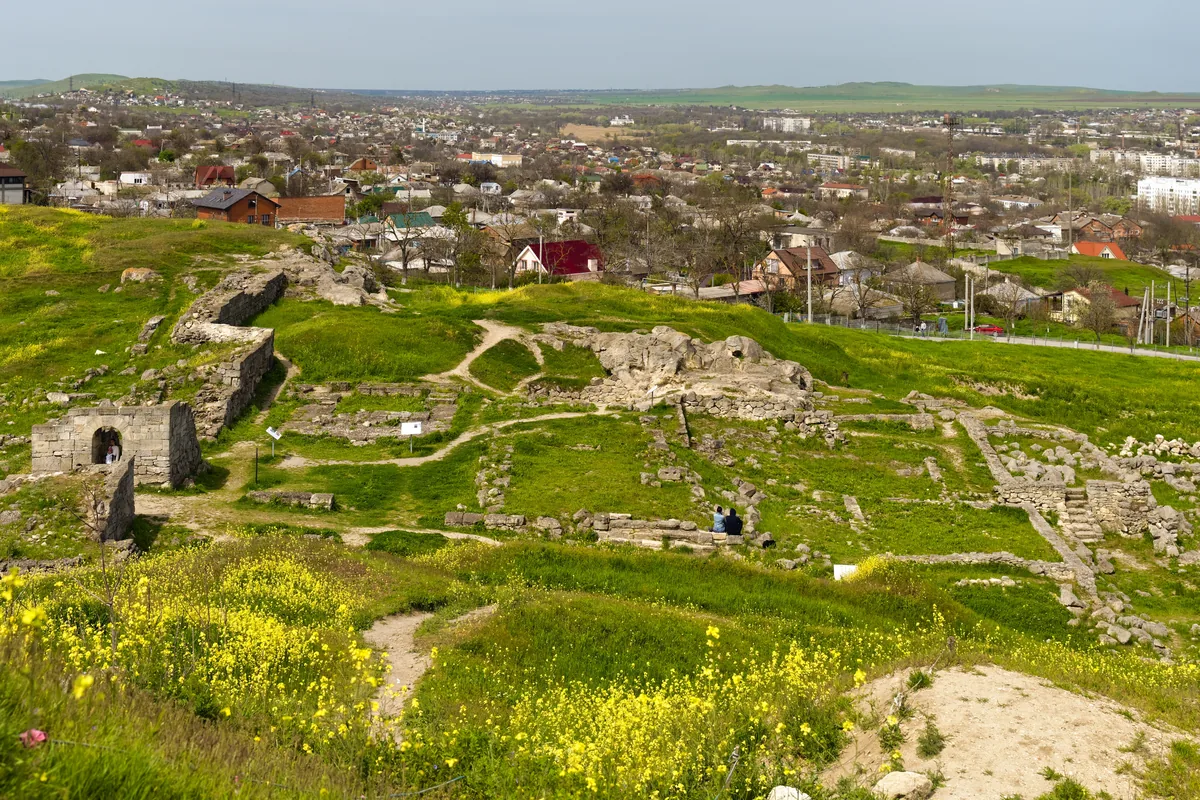
Bosporos was a Roman city at the eastern end of the Crimea, the ancient Panticapaeum.[1][2][3] It stood on the western side of the strait that joins the Sea of Azov to the Black Sea, close to the modern town of Kerch.[2][3][4] A Göktürk army and the Utigurs took the city while the Roman envoy Valentinos was among the Göktürks.[5]
The strait
The city shared its name with the strait.[3] In the description of Scythia by Jordanes, the land reaches beyond Lake Maeotis, across the straits of Bosphorus, to the Caucasus.[6] Lake Maeotis is the Sea of Azov. The strait is the Cimmerian Bosporus, its outlet into the Black Sea.[4]
Under the Huns
Burials with deformed skulls at Panticapaeum, Phanagoria and Chersonesos are not older than the late fourth century. These cities may have come under Hunnic rule at that time.[7] In the first half of the fifth century Panticapaeum was probably a centre of Hunnic rule. The rich catacomb graves found in 1904 make this likely, as does a grave of 1905 on the hill of Mithridates, which held the gold plates of a saddle. The excavations of the cemeteries are unpublished.[8] A burial find from Kerch in the Historical Museum in Moscow consists of a gold buckle, an amber bead with a gold knob and a gold sword-strap loop set with garnets. It matches pieces of the Hunnic age found in Hungary and on the Rhine.[9]
The Göktürk attack
In 576 Türk-shad, whom Menander calls Turxanthos, sent Bochan with a very large force against Bosporos. Anagai, chief of the Utigurs, already lay encamped there with another force.[10][11] The city fell while the Roman envoys were still with the Göktürks. Menander concludes that the Göktürks had been provoked to war with the Romans.[5] The siege of Bosporos is the one capture of a Roman city by the Göktürks on record.
How the Göktürk force reached the city is not recorded.[12] It has been noted that the force apparently crossed the strait without difficulty. Perhaps the strait was frozen over, as can happen in winter.[2] It is thought less likely that the force went round the Sea of Azov and entered the Crimea by land from the west.[2] Once the Göktürks had crossed the strait, the whole Crimea lay open to them.[13]
Date
Menander tells the fall of the city in his account of the embassy of Valentinos. He dates the embassy to the second year of Tiberius as Caesar.[14] That year began in December 575.[11] One dating sets both the siege and the capture of the city in 576.[15] A second dates the attack to 576 and the fall of the city to about 579.[16] A third puts the siege in 576. In that case the Göktürks go on soon after to besiege Cherson.[17] In 579 the emperor Tiberius told the Avars that the Göktürks were encamped at Cherson, on the south-western coast of the peninsula.[18][19]
References
- ^ Golden 1992, p. 130
- ^ a b c d Blockley 1985, p. 277
- ^ a b c Chavannes 1903, p. 241
- ^ a b Mierow 1915, p. 148
- ^ a b Menander Protector; Blockley 1985, fr. 19.2, p. 179
- ^ Jordanes; Mierow 1915, § 30, p. 58
- ^ Werner 1956, p. 13
- ^ Werner 1956, p. 86
- ^ Werner 1956, p. 129
- ^ Menander Protector; Blockley 1985, fr. 19.1, pp. 173, 179
- ^ a b Chavannes 1903, p. 240
- ^ Menander Protector
- ^ Blockley 1985, p. 278
- ^ Menander Protector; Blockley 1985, fr. 19.1–19.2, pp. 171, 179
- ^ Marquart 1903, p. 504
- ^ Golden 1992, p. 100, 131
- ^ Yavuz 2025, p. 321
- ^ Menander Protector; Blockley 1985, fr. 25.2, pp. 223–225
- ^ Blockley 1985, p. 275, 283
Sources
- Menander Protector
- Jordanes (after Priscus and Ammianus Marcellinus)
Literature
- R. C. Blockley, The History of Menander the Guardsman: Introductory Essay, Text, Translation, and Historiographical Notes (1985)
- Ludwig Dindorf (ed.), Historici Graeci minores, Bd. II: Menander Protector et Agathias (1871)
- Édouard Chavannes, Documents sur les Tou-Kiue (Turcs) occidentaux (1903)
- Peter B. Golden, An Introduction to the History of the Turkic Peoples (1992)
- Josef Marquart, Osteuropäische und ostasiatische Streifzüge (1903)
- Emre-E. Yavuz, The Gokturk Empire: 2nd Edition (2025)
- Charles Christopher Mierow, The Gothic History of Jordanes in English Version, with an Introduction and a Commentary (1915)
- Joachim Werner, Beiträge zur Archäologie des Attila-Reiches (1956)
What links here14
- Persons
- Anagai · Bochan · Busir Glavan · Türk-shad · Valentinos
- States
- Byzantium
- Battles & Events
- Embassy of Valentinos (576) · Siege of Bosporos, 576 · Subjugation of the Alans and Onogurs (before 576) · The Göktürks before Cherson (579)
- Places
- Cherson
- Sources
- Menander Protector
Cite this article
Yavuz, Emre-E. “Bosporos.” Turkic Atlas, revised 8 November 2026. https://turkicatlas.org/places/bosporos/
Last revised: 8 November 2026

