
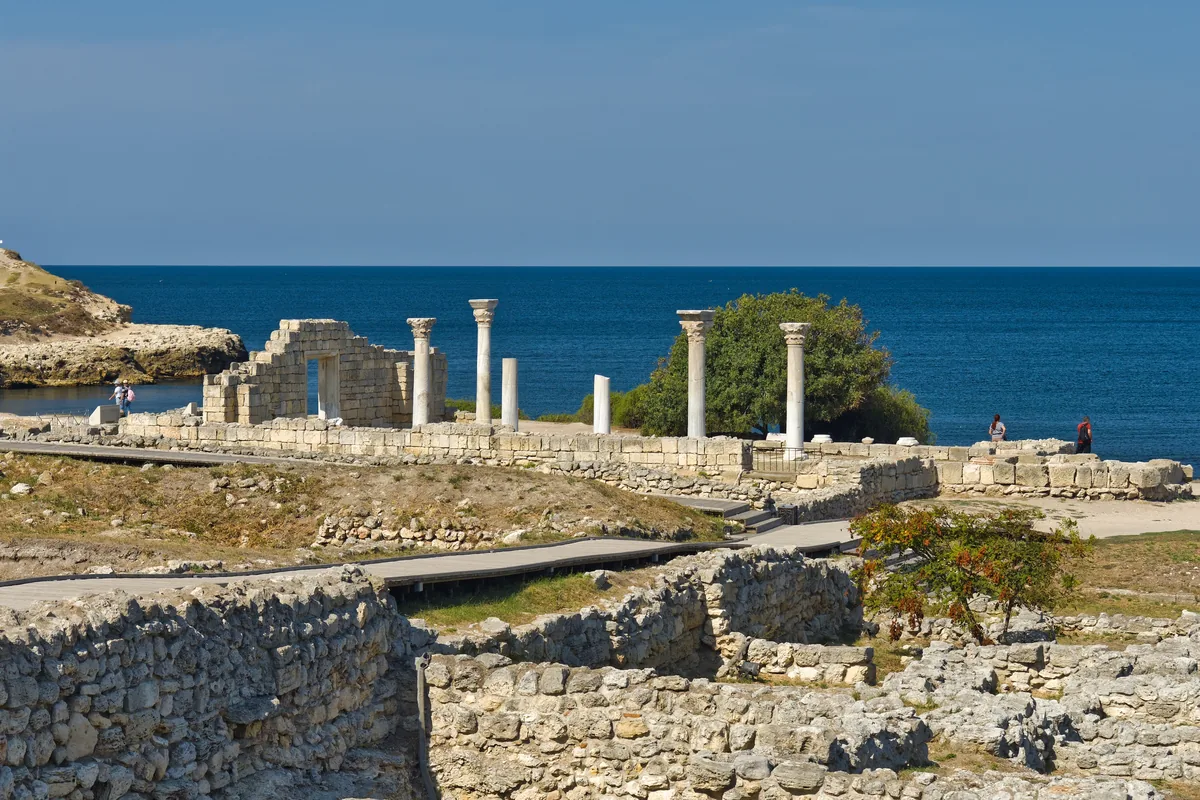
Cherson was a city on the Black Sea coast of the Crimea, probably the ancient Chersonesus on the south-western shore of the peninsula.[1] Jordanes counts it among the towns on the Pontic coast that the Scythian peoples had allowed the Greeks to build for the sake of trade.[2] The Roman envoy Valentinos sailed by way of Cherson to the Göktürks in 576.[3][4] Three years later the emperor Tiberius told an Avar embassy that the Göktürks were encamped there.[5]
Before the Göktürks
In 419 Asclepiades, bishop of Chersonese, asked the emperor to pardon the men who had taught the barbarians to build ships. The emperor granted it.[6] The town was then the only place on the west coast of the Crimea still under Roman rule. Its barbarian neighbours were Goths and Huns.[6]
In his description of Scythia, Jordanes says that the Huns of the land above the Black Sea sprouted into two peoples, the Altziagiri and the Sabiri.[7] The Altziagiri lived near Cherson, “where the avaricious traders bring in the goods of Asia”.[7] In summer they ranged over the plains wherever their cattle found pasture. In winter they withdrew beyond the Pontic sea.[7] The Altziagiri have been identified with the Kutrigurs.[8]
The Göktürks
In 576 Valentinos took fast merchant ships from Constantinople by way of Sinope and Cherson on his embassy to the Göktürks.[3][4] From the Crimea he rode on through marshes and reed beds to the war camp of Türk-shad, whom Menander calls Turxanthos.[9] While the envoys were among the Göktürks, a Göktürk army under Bochan and the Utigurs of Anagai took Bosporos at the eastern end of the Crimea.[10][11]
In 579 an Avar embassy asked Tiberius for ships to carry the Avar army across the Danube.[12][13] Tiberius had no troops to spare. He answered that the moment was not good, “since the Turks were encamped at Cherson and they would quickly hear if the Avars crossed the Danube”.[5] The Avar envoy understood that the emperor had put the story together on purpose.[14]
Menander does not say whether the Göktürks were in fact at Cherson.[15] The emperor’s words are taken as evidence that by the middle of 579 the Göktürks had reached Cherson and overrun the whole Crimea.[16] A different account has them besiege the old Greek fortress city soon after the fall of Bosporos. The Göktürk realm would then have reached its western limit there.[17] In that account the siege and occupation of the Crimea lasted until 598.[18] The same account calls Cherson the farthest point of the Göktürk khaganate in the Crimea.[19]
After the Göktürks
Theophanes, in his account of the year 710 or 711, says that an official whom he calls Toudounos governed Cherson as the representative of the khagan.[20] Toudounos is not a name but the title tudun.[21][22] The khagan was the ruler of the Khazars, to whom the men of Cherson later sent Toudounos.[23][22]
Name and location
- ΧερσώνGreekMenander Protector
- ChersonaLatinJordanes
- ChersonesusEnglish
Menander’s Greek has the forms Χερσῶνος and Χερσῶνα, from Χερσών, and Jordanes writes Chersona.[24][25] In a passage whose Greek is corrupt, Menander places Cherson on the western coast.[9][1] His Cherson is taken to be the town of Chersonesus on the south-western coast of the peninsula.[1] The Cherson of Jordanes has been put perhaps at Eupatoria.[26] The city is not the modern Kherson, which lies farther north in Ukraine.[19]
References
- ^ a b c Blockley 1985, p. 275
- ^ Jordanes; Mierow 1915, § 32, p. 59
- ^ a b Menander Protector; Blockley 1985, fr. 19.1, pp. 171–173
- ^ a b Chavannes 1903, p. 240
- ^ a b Menander Protector; Blockley 1985, fr. 25.2, pp. 223–225
- ^ a b Maenchen-Helfen 1973, p. 75
- ^ a b c Jordanes; Mierow 1915, § 37, p. 60
- ^ Marquart 1903, xxvi
- ^ a b Menander Protector; Blockley 1985, fr. 19.1, p. 173
- ^ Menander Protector; Blockley 1985, fr. 19.1–19.2, pp. 173, 179
- ^ Chavannes 1903, p. 241
- ^ Menander Protector; Blockley 1985, fr. 25.2, p. 223
- ^ Blockley 1985, p. 283
- ^ Menander Protector; Blockley 1985, fr. 25.2, p. 225
- ^ Menander Protector
- ^ Blockley 1985, p. 277–278
- ^ Yavuz 2025, p. 321
- ^ Yavuz 2025, p. 388
- ^ a b Yavuz 2025, p. 455
- ^ Theophanes the Confessor; Scott 1997, p. 527
- ^ Scott 1997, p. 530
- ^ a b Chavannes 1903, p. 264
- ^ Theophanes the Confessor; Scott 1997, p. 528
- ^ Menander Protector; Dindorf 1871, p. 85, 125
- ^ Jordanes; Mierow 1915, § 32, 37, pp. 59–60
- ^ Mierow 1915, p. 148
Sources
- Menander Protector
- Jordanes (after Priscus and Ammianus Marcellinus)
- Theophanes the Confessor (after Theophylact Simocatta)
Literature
- R. C. Blockley, The History of Menander the Guardsman: Introductory Essay, Text, Translation, and Historiographical Notes (1985)
- Ludwig Dindorf (ed.), Historici Graeci minores, Bd. II: Menander Protector et Agathias (1871)
- Édouard Chavannes, Documents sur les Tou-Kiue (Turcs) occidentaux (1903)
- Charles Christopher Mierow, The Gothic History of Jordanes in English Version, with an Introduction and a Commentary (1915)
- Otto J. Maenchen-Helfen, The World of the Huns: Studies in Their History and Culture (1973)
- Josef Marquart, Osteuropäische und ostasiatische Streifzüge (1903)
- Emre-E. Yavuz, The Gokturk Empire: 2nd Edition (2025)
- Cyril Mango, Roger Scott (trans.), The Chronicle of Theophanes Confessor: Byzantine and Near Eastern History AD 284–813 (1997)
What links here14
- Persons
- Busir Glavan · Theodora of Khazaria · Valentinos
- Conflicts
- The Göktürk–Rouran Wars
- Battles & Events
- Embassy of Valentinos (576) · Mission of Constantine to the Khazars (860–861) · Siege of Bosporos, 576 · The Göktürks before Cherson (579)
- Places
- Bosporos · Tamatarkha
- Peoples
- Kutrigurs
- Sources
- Jordanes · Menander Protector · The Schechter letter
Cite this article
Yavuz, Emre-E. “Cherson.” Turkic Atlas, revised 8 November 2026. https://turkicatlas.org/places/cherson/
Last revised: 8 November 2026

