
- 400
- 500
- 600
- 700
- 800
- 900
- Rouran 400–554
- First Göktürk 552–630
- Tang rule 630–682
- Second Göktürk 682–744
- Uyghur 744–840
- Kirghiz 840–924
- Huns 370–469
- Western Göktürk 552–659
- Türgesh 699–766
- Karluk 766–800
- Khazar 650–969
The Sabirs were a steppe people who held the country north of the Caucasus and on the lower Volga from the early sixth century.[1] Jordanes counts them as one of the two branches of the Huns in that country.[2] They fought for both Rome and Persia. After the Göktürk conquest of the western steppe their union passed into Göktürk hands.[3]
Origin
About 463, Priscus says, the Abares expelled the Sabirs. The Sabirs in turn drove the Saragurs, the Ogurs and the Onogurs from their seats.[4] Where the Sabirs came from is argued.[5] Their origin has been sought in western Siberia, where their name has been found in that of Siberia.[5] Other proposals place them in the Turfan region, in the Ili valley and Jungaria between 350 and 463, or on both sides of the Urals.[5] Some call their language Common Turkic, others Oguric, and a third group Ugric.[5] The personal names of their leaders point broadly to Turkic. The linguistic evidence does not allow a firm conclusion.[6]
Between Rome and Persia
By 515 the Sabirs were established north of the Caucasus.[1] Malalas credits them with an army of a hundred thousand. This is an exaggeration, but it still shows a considerable military power. Procopius praises their skill at building siege engines.[1] They raided Transcaucasia and Asia Minor. Sabir mercenaries served both the Roman and the Sasanian armies.[3] About 528 their queen Boarex, widow of Balakh, sided with Justinian.[3] Grod, the Hunnic king of Bosporos who was baptised in 528, may have been a Sabir.[7] Others make him a prince of the Utigurs.[8] The Turkic Sabirs are counted among the peoples who fought in the war over Lazica in the 540s and 550s.[9]
After the Avar conquest
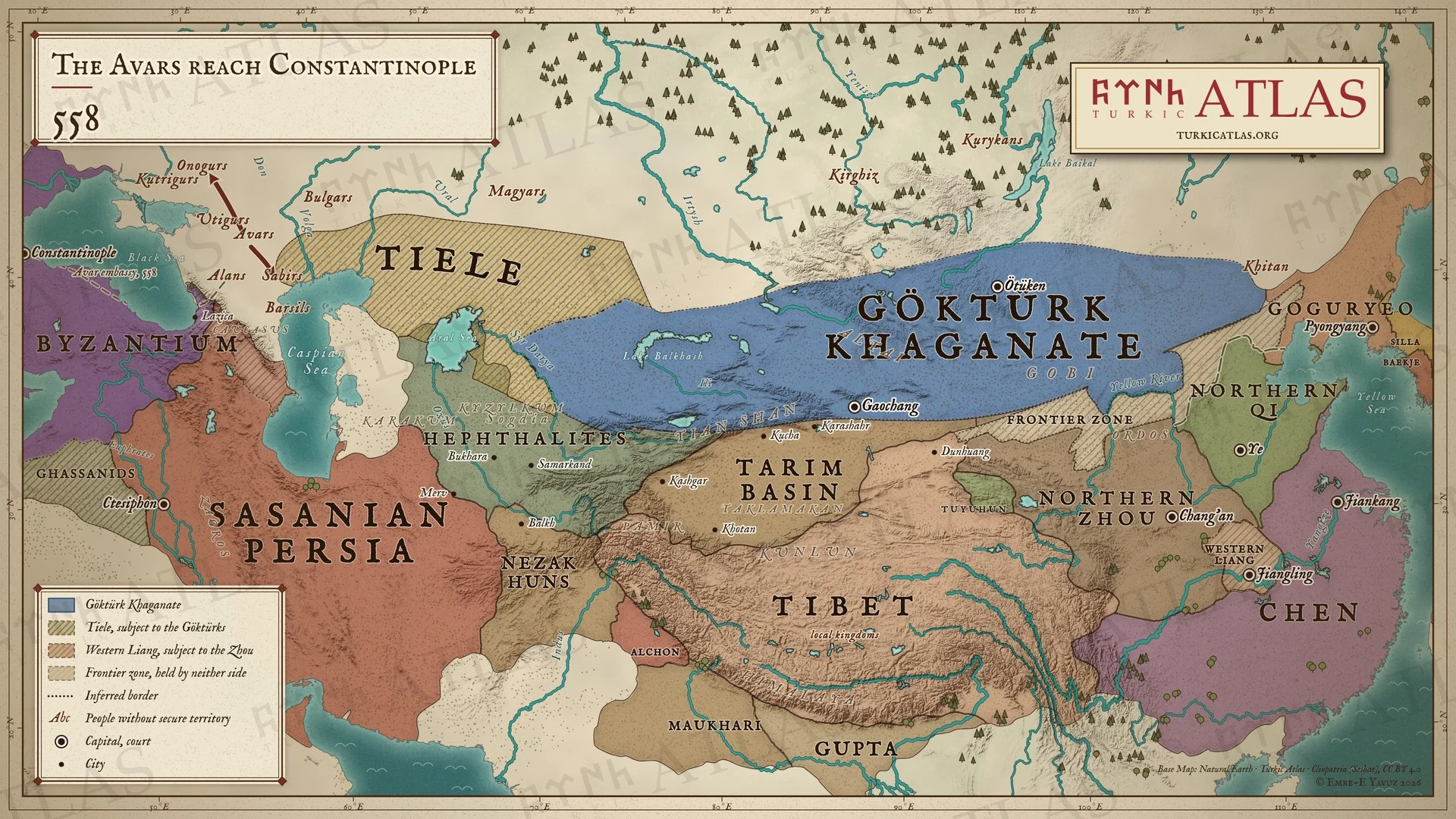
In 558 a Roman envoy named Valentinos came to the Avars with Justinian’s gifts. Then the Avars made war first on a people the manuscript calls Ouigouroi and next on the Zaloi, a Hunnic people. They destroyed the Sabirs.[10] The Sabirs may have disappeared north of the Caucasus from that year.[11]
Menander still knows them twenty years later, south of the mountains.[10] Under Tiberius Caesar the Roman generals invaded Albania and took hostages from the Sabirs. They brought Sabirs and Albanians with their households across the river Kyros to live in Roman territory.[10] One date proposed for the resettlement is 575.[12] In 576 envoys of the Alans and the Sabirs came to Constantinople.[10] Tiberius promised their chiefs double what the Persian king had paid them. The envoys reported that “the Sabir” had soon gone over to the Persians, heedless of the hostages.[10] In 578 Khosrow I sent a cavalry force of about twenty thousand against Roman Mesopotamia. Sabirs rode with it.[10]
Under the Göktürks
By the 560s the Göktürks had established their hegemony over the Sabirs, the Utigurs, the Ogurs and the Onogurs.[13] The Göktürks absorbed the Sabirs, who play a part in the rise of the Khazars. Elements of them were also found among the Volga Bulgars.[3] The dominant Sabir union may have been reorganised after the Göktürk conquest, with the Khazars at its head. The argument cites al-Masʿudi’s remark that the Khazars are called Sabir in Turkic.[14] A different explanation has the Khazar realm arise under Göktürk overlordship after the fall of the Sabirs in 558.[15]
The Arabic geographers still knew a people called Suwar beyond Derbent. The Sabir name outlived the Sabir union inside the realm that followed it.[16]
References
- ^ a b c Golden 1992, p. 105
- ^ Jordanes; Mierow 1915, § 37, p. 60
- ^ a b c d Golden 1992, p. 106
- ^ Priscus; Müller 1851, fr. 30, p. 104
- ^ a b c d Golden 1992, p. 104
- ^ Golden 1992, p. 104-105
- ^ Golden 1992, p. 99
- ^ Marquart 1903, p. 301
- ^ Yavuz 2025, p. 273
- ^ a b c d e f Menander Protector
- ^ Marquart 1903, p. 58
- ^ Marquart 1903, p. 49
- ^ Golden 1992, p. 128
- ^ Golden 1992, p. 236
- ^ Marquart 1903, p. 46
- ^ Golden 1992, p. 105,236
Sources
- Menander Protector
- Procopius
- Jordanes (after Priscus and Ammianus Marcellinus)
- Priscus
Literature
- Peter B. Golden, An Introduction to the History of the Turkic Peoples (1992)
- Josef Marquart, Osteuropäische und ostasiatische Streifzüge (1903)
- Emre-E. Yavuz, The Gokturk Empire: 2nd Edition (2025)
- Karl Müller (ed.), Fragmenta Historicorum Graecorum, Bd. IV (darin: Menandri Protectoris fragmenta, griechisch mit lateinischer Übersetzung) (1851)
- Ludwig Dindorf (ed.), Historici Graeci minores, Bd. II: Menander Protector et Agathias (1871)
- Charles Christopher Mierow, The Gothic History of Jordanes in English Version, with an Introduction and a Commentary (1915)
- anonymous, Chronicle of Pseudo-Zachariah Rhetor (ca. 568/569)
What links here11
- Persons
- Valentinos
- Conflicts
- Göktürk Expansion into Europe
- Battles & Events
- Flight of the Avars (557) · Subjugation of the Alans and Onogurs (before 576)
- Peoples
- Ogurs · Onogurs · Saragurs · Turkic Tribes in Europe · Utigurs
Cite this article
Yavuz, Emre-E. “Sabirs.” Turkic Atlas, revised 8 November 2026. https://turkicatlas.org/ethnicities/sabirs/
Last revised: 8 November 2026

