
Buxara döyüşü eftalit dövlətini məhv edən və göytürkləri Soqdianaya sahib çıxaran qarşıdurmanın müasir adıdır. Hadisə şübhəsizdir. İl, yer və məğlub kralın adı şübhəsiz deyil. Üç ənənə onu təsvir edir, heç biri döyüş meydanından deyil: ərəbcə Təbəri, Çin sülalə tarixləri və yunanca Menander, o, nəticələrini Konstantinopola gələn elçilərdə görmüşdü.
Mənbələr
Təbəri qalibi və məğlubu adlandırır və başqa heç nə.[1] Xaqan Sinjibu, yəni İstəmi, “bütün Türklərin ən cəsuru və ən qüdrətlisi idi və ən çox qoşunu var idi; Hayāṭilanın kralı Warzı öldürən o idi; onların sayından və gücündən qorxmadan kralı ordusunun böyük hissəsi ilə birlikdə öldürmüş, sərvətlərini qənimət almış və Xosrovun əlinə keçən hissələr istisna olmaqla, ölkələrini fəth etmişdi”.[2] Məsudi kralı Axšunwāz adlandırır, bu, Perozu iki nəsil əvvəl məğlub edən eftalit hökmdarının Axšunwārını xatırladır.[3] Zhou Shu eftalitlərin məğlubiyyətini Mukan xanın fəthləri arasında verir. İstəmini heç adlandırmır. Sui Shu bunu təkrar edir və heç bir mətn bir İran müttəfiqindən və ya kralın ölümündən xəbər vermir.[4] Menander, o biri ucdan, soqdların İstəmiyə özlərini bir vaxt eftalitlərin, indi isə göytürklərin təbəəsi kimi təsvir etdiyini bildirir. O, həmçinin İstəminin II Yustinə məktubunda eftalitlərin tabe edilib şəhərlərdə yaşadığını bildirir.[5] Zemarxosdan bütün eftalitlərin tabe edilib-edilmədiyi soruşulanda cavab bir söz idi: “hamısı”.[5] Menander tərəf dəyişən adamı da adlandırır: Xosrovun şurasında olan, öz xalqına göytürklərə xəyanət etdirmiş eftalit Katulph.[5]
Bərpa
Yürüş belə gedir.[6] Bu bərpaya görə, soqd şəhərlərinin yeddi kralı Buxarada toplaşdı. Onlar Sırdəryadakı yeni göytürk qonşularına eftalitlərə qarşı kömək üçün xəbər göndərdi, eftalitlər ən böyük qarnizonlarını Buxarada saxlayırdı. Göytürklər kiçik eftalit məntəqələrini tez başa vurdu və Buxaranın qapıları qarşısında göründü. Bu arada qərbi Tarimdə ikinci cəbhə, cənub-şərqdə isə üçüncü, İran cəbhəsi açıq idi. Eftalit hökmdarı Ğadfar Balxdan və başqa yerlərdən kömək çağırmışdı. O, qarnizonu müdafiə etdi. Döyüşün yeddi gün və yeddi gecə davam etdiyi deyilir. Səkkizincidə göytürklər yarıb keçdi və atlılar və piyadalar şəhərə girdi. Onlar qalanı, Arkı, ələ keçirdi və eftalit komandanlarının getdiyini gördü. Faganiş Əfqanıstana, Ğadfar isə ona cənub-şərqdən hücum etmiş farslara qaçmışdı. Yarımköçəri göytürklər hasarlı şəhəri aldı və talan etmədi.[6] Aşina əyanları sonra Buxarada yerləşdi. İstəmi Arkdan planlaşdırma mərkəzi kimi istifadə etmiş ola bilər, ordunun böyük hissəsi isə bozqıra qayıtdı.[6] Buxaranın sağ qalan yeganə yerli tarixi, Narşaxinin tarixi, nə müharibəni, nə də eftalitləri bilir. O, yeddi kralı da ehtiva etmir.[7] Firdovsiyə, Təbəriyə, Dinavəriyə və yunanlara əsaslanan ikinci bir bərpa eyni müharibənin başqa cür bitdiyini göstərir.[8] Göytürklər Çaçı aldı və Çirçiqi keçdi. Orada Qatfar adlanan kral Balxdan, Şuğnandan və Termezdən Buxara yaxınlığında qoşun topladı və düzənlikdə döyüşdən boyun qaçırdı. O, Nasafdakı təpələrdə vuruşdu, orada səkkiz gündən sonra göytürklər qalib gəldi.[8] Sağ qalanlar farslara təslim olan Çağaniyanlı Faganişi seçdi.[8] Turkic Atlas bu bərpanı eftalitlər məqaləsində tam verir.[8]
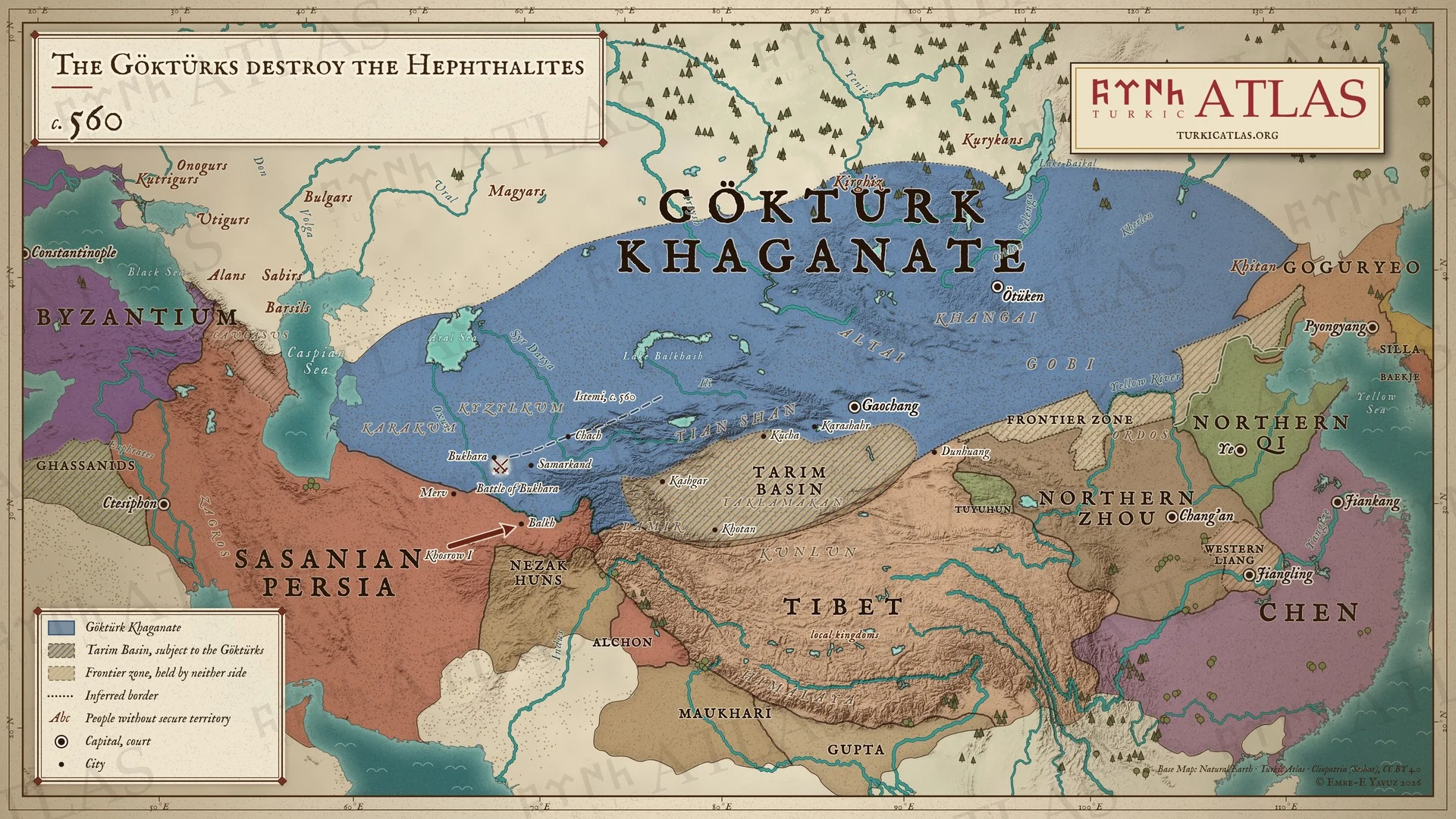
Dinavəri hər qalibin nə aldığını əlavə edir. Xosrov eftalitlərin Toxaristan, Zabulistan, Kabulistan və Çağaniyan torpaqlarını aldı. Sinjibu Çaç, Fərqanə, Səmərqənd, Keş və Nasaf şəhərlərini Buxaraya qədər, Mavərənnəhrin əsas hissəsini aldı.[1] Silzibul eftalitlərə şimaldan hücum edəndə Xosrov təxminən Balxa qədər irəliləmişdi. İki fatih onda o qədər yaxın idi ki, çəkişməli oldu.[1] Arxeologiya göstərir ki, göytürk fəthi Panjikenti zədəsiz qoydu və eftalit gümüşü dövriyyədə qaldı.[9]
Tarix
Döyüş təxminən 560-a, iki kralın Gürganda görüşü də eyni ilə aiddir.[6] Bir hesablama məhvi 557-yə qoyur.[3] İkinci hesablama 557-dən 565-ə qədər təklifləri nəzərdən keçirir. O, sonu 563 ilə 567 arasına qoyur, bunun əsası Menanderin 568-ci il elçilərinin “hamısı” cavabını verə bilməsidir.[8] Təbəri il vermir və Çin fəsilləri də vermir. Menander yalnız son həddi verir. On illik fərq Çin, fars, ərəb və yunan hesablamalarının görüşündən gəlir.
Nəticələr
Oksus sərhəd oldu, soqdlar onun göytürk tərəfində idi. Bir neçə il ərzində soqd tacirləri İstəmidən İrana elçilik istəyirdi, Xosrov onların ipəklərini yandırırdı və Maniax Konstantinopola yolda idi.[5] Turkic Atlas bu davamı Sasani imperiyası və Xosrov məqalələrində danışır.[5] Buxara döyüşdən siyasi çəki qazandı. O, Soqdiananın paytaxtı olmadı. O, qərbdə Aşina əyanlarının iqamətgahı və bölünmədən sonra iki imperiya arasında qalan şəhər oldu.[6] Turkic Atlas şəhərin sonrakı tarixini Buxara məqaləsində verir. Müharibəni bütövlükdə İstəmi məqaləsində danışır.
-
c. 402 Shelun takes the title khagan
Shelun, a fugitive who gathered a following in the Gobi, defeats the Tiele and takes the title khagan. The Wei Shu draws his realm in four directions: in the west the country of Karashahr, in the east the country of Korea, in the north across the desert to the Hanhai, in the south to the great desert. The line between these points is drawn, not recorded.
-
429 Taiwu crosses the Gobi
The Northern Wei emperor Taiwu leaves Pingcheng, crosses the Gobi and scatters the Rouran of Datan at the Li river; his armies sweep five thousand li from east to west. The route is drawn after the Wei Shu; the rivers it names are not located with certainty.
-
460 The Tölös subjected
In the west the Rouran subject the Tölös, that is the Tiele. That their reach then extended to Lake Balkhash and the Seven Rivers is the extent the modern literature gives; the sources do not state it. The Ashina, five hundred families, settle on the southern slope of the Altai as the smiths of the Rouran.
-
487 The Gaoche break away
More than a hundred thousand Gaoche tents under Afuzhiluo leave the khaganate and found a kingdom of their own north-west of Gaochang. The Rouran khan Tulun pursues them, is beaten again and again, and leads his people east.
-
525 Anagui fights for the Wei
In 520 Anagui has brought the Tiele under Rouran rule again; after the Chinese histories their lands reach as far as the Caspian and the Alans. In 523, in a year of hunger, Anagui raids the Six Garrisons on the Wei frontier. In 525, after the garrisons have risen themselves, he leads a hundred thousand men from Wuchuan west towards Woye against the rebels, on the Wei's behalf.
-
545 The Rouran at their height
The Rouran rule the eastern and central steppe; the Ashina in the Altai and the Tiele of Dzungaria are their subjects, and the Tiele range, after the Chinese histories, as far as the Caspian. The frontier drawn here, from the Khingan to the Seven Rivers and from Lake Baikal to the frontier of the Wei, is the extent the modern literature gives.
-
546 Bumin defeats the Tiele
In 546 the Tiele of Dzungaria move against the Rouran. Bumin, chief of the Ashina, intercepts them on the march and defeats them, and more than fifty thousand Tiele tents submit to him. The Ashina are still subjects of the Rouran, but now a power of their own.
-
552 Bumin destroys the Rouran
Early in 552 a Rouran army is beaten in Dzungaria and a second destroyed north of Huaihuang; Anagui dies. The Göktürks take the steppe, and a Rouran remnant holds out in the contested borderland between the Göktürks and China. The extent of the new khaganate follows the modern estimate.
-
553–555 The last Rouran; Istemi marches west
Issik breaks the Rouran of Dengshuzi at Mount Mulai north of Woye, and the remnant in the Northern Qi is destroyed by its hosts in 554. In the west Istemi marches from 553 and, by one reckoning, reaches the Seven Rivers by 555.
-
c. 560 The Hephthalites destroyed
Istemi destroys the Hephthalites and takes the trade of Sogdiana. One reading has him act with the Persian king Khosrow I and divide their lands along the Oxus, in 557 or 560. The route drawn follows one modern reconstruction: the Göktürks take Chach, cross the Chirchik and win after eight days in the hills at Nasaf; a second reading has the decisive fight at Bukhara itself. Khosrow comes up from the south as far as Balkh. In the east Mukan takes the Kirghiz on the Yenisei and the Khitan.
-
568–569 Embassies to Constantinople
Persia shuts its markets to the Sogdian silk. Istemi sends the Sogdian Maniakh to Constantinople, and the Roman envoy Zemarchos reaches him in 569 at a mountain called Ektag. Where Ektag lay is disputed: the Altai and the Tian Shan are both proposed.
-
576 Bosporos
In the year of Istemi's death a Göktürk army takes Bosporos in the Crimea, the western limit of the expansion into Europe. That the western wing then reached the Volga and the northern Caucasus is inferred.
-
581–584 The realm divides
Taspar dies in 581 with the khaganate at what is inferred to be its greatest extent. The succession divides the house, and Ishbara, Apa and Tardush go to war while the Sui take sides. The line between the eastern and the western wing is reconstructed as running from the Altai through Dzungaria to the Dzungarian Gate.
- Place named in a source (position as commonly identified)
- Position disputed or approximate
- Area or line drawn from a description in the sources
- Area as the modern literature gives it
- Subject people or its range (dashed outline)
- Frontier zone between the steppe and China, held by neither side (hatched)
- Movement named in a source (route drawn)
- Route after a modern reconstruction
Qeydlər
Mənbələr
- Təbəri
- Menandr Protektor
- Sui Shu (Suy kitabı), juan 84
- Zhou Shu (Çjou kitabı), juan 50
- Nərşəxi, Buxara Tarixi
Ədəbiyyat
- Emre-E. Yavuz, The Gokturk Empire: 2nd Edition (2025)
- Peter B. Golden, An Introduction to the History of the Turkic Peoples (1992)
- Aydogdy Kurbanov, The Hephthalites: Archaeological and Historical Analysis (2010)
- Étienne de la Vaissière, Sogdian Traders: A History (2005)
- Theodor Nöldeke, Geschichte der Perser und Araber zur Zeit der Sasaniden. Aus der arabischen Chronik des Tabari übersetzt und mit ausführlichen Erläuterungen und Ergänzungen versehn (1879)
- Richard N. Frye (trans.), The History of Bukhara. Translated from a Persian Abridgment of the Arabic Original by Narshakhi (1954)
Bura keçid verənlər9
- States
- Sasani Farsı
- Places
- Buxara · Soqdiana · Tarim hövzəsi
- Peoples
- Eftalitlər
Məqaləyə istinad
Yavuz, Emre-E. “Buxara döyüşü.” Turkic Atlas, revised 20 November 2026. https://turkicatlas.org/events/battle-of-bukhara/
Last revised: 20 November 2026

