
Buhara söweşi eftalit ýurdyny ýok edip, Göktürkleri Sogdiananyň eýeleri eden söweşiň zamanabap adydyr. Waka anykdyr. Ýyl, ýer we ýeňilen şanyň ady anyk däl. Üç däp ony beýan edýär, olaryň hiç biri meýdandan däl: arapça Taberi, hytaý hanedan taryhlary we grekçe Menander, ol onuň netijelerini Konstantinopola gelen ilçilerde gördi.
Çeşmeler
Taberi ýeňiji bilen pidany atlandyrýar we başga zat aýtmaýar.[1] Kagan Sinjibu, ýagny Istemi, “ähli Türkleriň iň batyry we iň güýçlisidi we iň köp goşuny bardy; ol Hayāṭilanyň şasy Warzy öldürendi; olaryň sanyndan we güýjünden gorkman, şany goşunynyň uly bölegi bilen öldürdi, olaryň baýlygyny olja aldy we Hosrowyň eline düşen bölekleri bolmasa, olaryň ýurduny basyp aldy”.[2] Mesudi şa Akşunwaz diýip atlandyrýar, bu iki nesil öň Perozy ýeňen eftalit hökümdarynyň Akşunwaryny ýada salýar.[3] Zhou Shu eftalitleriň ýeňlişini Mukan Hanyň basyp alyşlarynyň arasynda berýär. Ol Istemini umuman atlandyrmaýar. Sui Shu muny gaýtalaýar we iki tekst hem pars ýaranyny ýa-da şanyň ölümini bilmeýär.[4] Menander beýleki tarapdan sogdlaryň Istemi bilen gürleşende özlerini ozal eftalitleriň, indi bolsa Göktürkleriň tabyndakylary hökmünde tanadýandygyny aýdýar. Ol şeýle hem Istemiň Justin II ýazan hatynda eftalitleriň boýun egdirilip, şäherlerde ýaşaýandygyny habar berýär.[5] Zemarchosdan ähli eftalitleriň boýun egdirilendigi soralanda, jogap bir söz boldy, “hemmesi”.[5] Menander şeýle hem tarapyny çalşan adamy atlandyrýar: Hosrowyň maslahatynda öz halkyna Göktürkler üçin satgynlyk eden eftalit Katulph.[5]
Gaýtadan gurma
Ýöriş şeýle geçýär.[6] Bu gaýtadan gurma görä, sogd şäherleriniň ýedi şasy Buharada ýygnandy. Olar eftalitlere garşy kömek üçin Syr Derýadaky täze Göktürk goňşularyna adam iberdi, eftalitleriň iň uly garnizony Buharadady. Göktürkler kiçi eftalit postlary bilen çalt ýüz tutdy we Buharanyň derwezeleriniň öňünde göründi. Şol aralykda günbatar Tarimde ikinji, günorta-gündogarda bolsa üçünji, pars frontuna açyldy. Eftalit hökümdary Gadfar Balhdan we başga ýerlerden goşmaça güýç çagyrypdy. Ol garnizony goraýardy. Söweşiň ýedi gije-gündiz dowam eden diýilýär. Sekizinji günde Göktürkler ýarylyp girdi we atlylar bilen pyýadalar şähere girdi. Olar Ark galasyny aldy we eftalit serkerdeleriniň gidendigini gördi. Faganiş Owganystana, Gadfar bolsa günorta-gündogardan oňa çozan parslara gaçypdy. Ýarym göçmen Göktürkler diwarly şäheri aldy we ony talamady.[6] Aşina begleri soň Buharada ýerleşdi. Istemi goşunyň uly bölegi düzlüge gaýdyp barýarka, Arky meýilnamalaşdyryş merkezi hökmünde ulanan bolmagy mümkin.[6] Buharanyň saklanyp galan ýeke-täk ýerli taryhy, Narşahynyňky, ne uruşy, ne-de eftalitleri öz içine alýar. Onda ýedi şa hem ýok.[7] Firdowsiden, Taberiden, Dinawariden we grekleriden gelen ikinji gaýtadan gurma şol bir uruşy başgaça gutarýar.[8] Göktürkler Çaçy alyp, Çirçikden geçdi. Şol ýerde Gatfar diýlip atlandyrylýan şa Balhdan, Şugnandan we Termezden Buharanyň ýanyna goşun ýygnady we düzlükde söweşmekden ýüz öwürdi. Ol Nesefdäki depelerde söweşdi, şol ýerde sekiz günden soň Göktürkler ýeňdi.[8] Diri galanlar Çaganiýanly Faganişi saýlady, ol parslara boýun egdi.[8] Turkic Atlas şol gaýtadan gurmany eftalitler makalasynda doly berýär.[8]
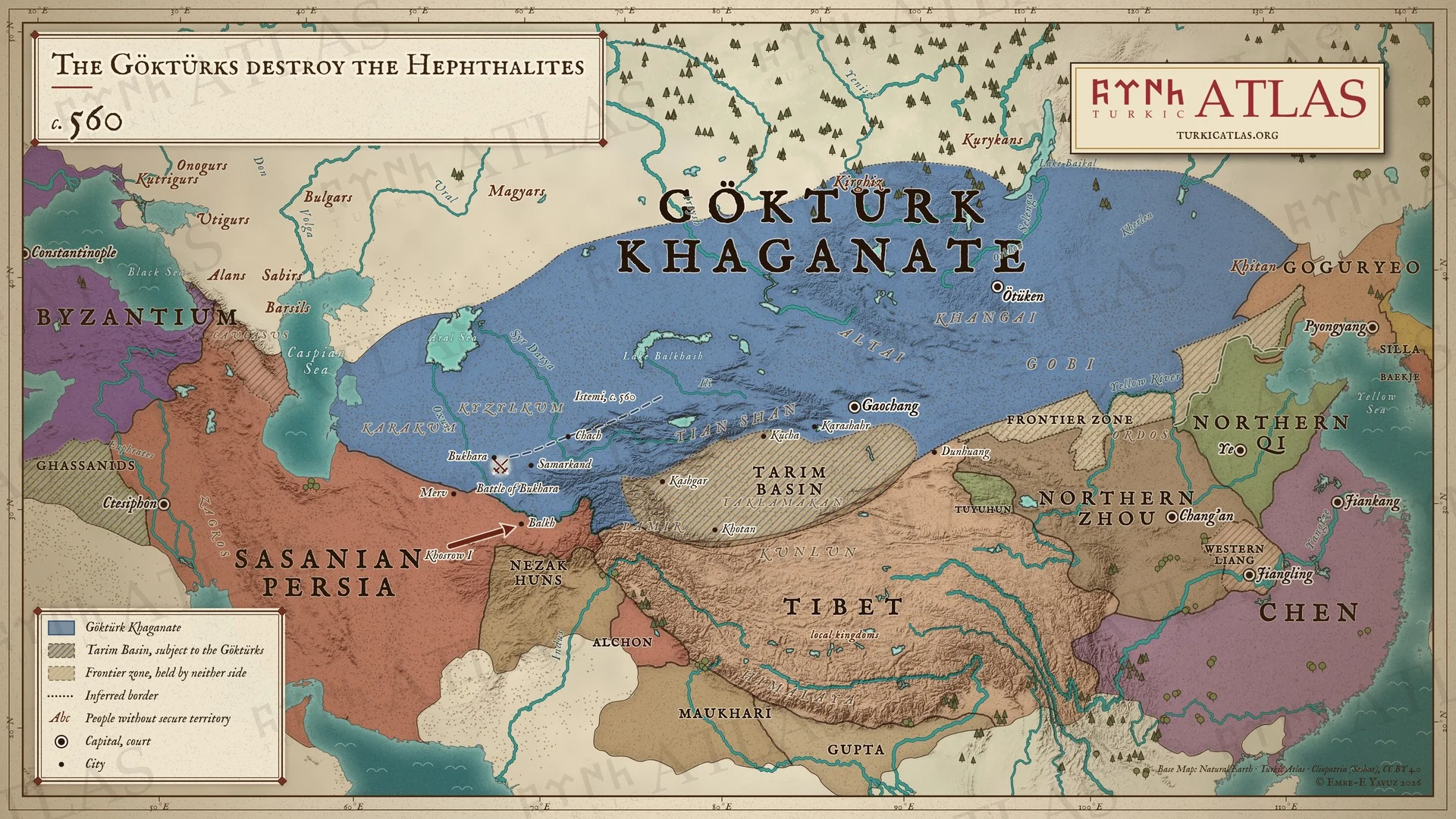
Dinawari her ýeňijiniň näme alandygyny goşýar. Hosrow eftalitleriň Toharystan, Zabulystan, Kabulystan we Çaganiýan ýerlerini aldy. Sinjibu Çaç, Fergana, Samarkand, Kesh we Buhara çenli Nesef şäherlerini, Transoksiananyň esasy bölegini aldy.[1] Hosrow takmynan Balha çenli öňe giden mahaly Silzibul eftalitlere demirgazykdan çozdy. Iki basyp alyjy şonda şeýle golaýdady welin, olar dawalaşmaga mejbur boldy.[1] Arheologiýa Göktürk basyp alşynyň Pendžikenti zeper ýetirmän goýandygyny we eftalit kümüşiniň aýlawda galandygyny görkezýär.[9]
Sene
Söweş takmynan 560-njy ýyla, iki şanyň Gurganda duşuşygy bolsa şol bir ýyla degişlidir.[6] Bir hasaplama ýok edilmegi 557-nji ýyla goýýar.[3] Ikinji hasaplama 557-nji ýyldan 565-nji ýyla çenli teklipleri gözden geçirýär. Ol soňuny 563-nji bilen 567-nji ýyllaryň arasyna goýýar, sebäbi Menanderiň 568-nji ýyldaky ilçileri “hemmesi” diýip jogap bermäge ukyplydy.[8] Taberi ýyl bermeýär, hytaý baplary hem bermeýär. Menander diňe bir çäk berýär. On ýyllyk tapawut hytaý, pars, arap we grek hasaplamalarynyň duşuşmagyndan gelýär.
Netijeler
Oksus serhet boldy, sogdlar onuň Göktürk tarapyndady. Birnäçe ýyl içinde sogd söwdagärleri Istemiden Parsa ilçilik sorap başlady, Hosrow olaryň ýüpegini ýakýardy we Maniah Konstantinopola barýan ýoldady.[5] Turkic Atlas şol dowamy Sasanid imperiýasy we Hosrow makalalarynda gürrüň berýär.[5] Buhara söweşden syýasy agram gazandy. Ol Sogdiananyň paýtagty bolmady. Ol günbatarda Aşina begleriniň mekany boldy we bölünişden soň iki imperiýanyň arasynda ýatan şäher boldy.[6] Turkic Atlas şäheriň soňky taryhyny Buhara makalasynda berýär. Ol uruşy bütinleý Istemi makalasynda gürrüň berýär.
-
c. 402 Shelun takes the title khagan
Shelun, a fugitive who gathered a following in the Gobi, defeats the Tiele and takes the title khagan. The Wei Shu draws his realm in four directions: in the west the country of Karashahr, in the east the country of Korea, in the north across the desert to the Hanhai, in the south to the great desert. The line between these points is drawn, not recorded.
-
429 Taiwu crosses the Gobi
The Northern Wei emperor Taiwu leaves Pingcheng, crosses the Gobi and scatters the Rouran of Datan at the Li river; his armies sweep five thousand li from east to west. The route is drawn after the Wei Shu; the rivers it names are not located with certainty.
-
460 The Tölös subjected
In the west the Rouran subject the Tölös, that is the Tiele. That their reach then extended to Lake Balkhash and the Seven Rivers is the extent the modern literature gives; the sources do not state it. The Ashina, five hundred families, settle on the southern slope of the Altai as the smiths of the Rouran.
-
487 The Gaoche break away
More than a hundred thousand Gaoche tents under Afuzhiluo leave the khaganate and found a kingdom of their own north-west of Gaochang. The Rouran khan Tulun pursues them, is beaten again and again, and leads his people east.
-
525 Anagui fights for the Wei
In 520 Anagui has brought the Tiele under Rouran rule again; after the Chinese histories their lands reach as far as the Caspian and the Alans. In 523, in a year of hunger, Anagui raids the Six Garrisons on the Wei frontier. In 525, after the garrisons have risen themselves, he leads a hundred thousand men from Wuchuan west towards Woye against the rebels, on the Wei's behalf.
-
545 The Rouran at their height
The Rouran rule the eastern and central steppe; the Ashina in the Altai and the Tiele of Dzungaria are their subjects, and the Tiele range, after the Chinese histories, as far as the Caspian. The frontier drawn here, from the Khingan to the Seven Rivers and from Lake Baikal to the frontier of the Wei, is the extent the modern literature gives.
-
546 Bumin defeats the Tiele
In 546 the Tiele of Dzungaria move against the Rouran. Bumin, chief of the Ashina, intercepts them on the march and defeats them, and more than fifty thousand Tiele tents submit to him. The Ashina are still subjects of the Rouran, but now a power of their own.
-
552 Bumin destroys the Rouran
Early in 552 a Rouran army is beaten in Dzungaria and a second destroyed north of Huaihuang; Anagui dies. The Göktürks take the steppe, and a Rouran remnant holds out in the contested borderland between the Göktürks and China. The extent of the new khaganate follows the modern estimate.
-
553–555 The last Rouran; Istemi marches west
Issik breaks the Rouran of Dengshuzi at Mount Mulai north of Woye, and the remnant in the Northern Qi is destroyed by its hosts in 554. In the west Istemi marches from 553 and, by one reckoning, reaches the Seven Rivers by 555.
-
c. 560 The Hephthalites destroyed
Istemi destroys the Hephthalites and takes the trade of Sogdiana. One reading has him act with the Persian king Khosrow I and divide their lands along the Oxus, in 557 or 560. The route drawn follows one modern reconstruction: the Göktürks take Chach, cross the Chirchik and win after eight days in the hills at Nasaf; a second reading has the decisive fight at Bukhara itself. Khosrow comes up from the south as far as Balkh. In the east Mukan takes the Kirghiz on the Yenisei and the Khitan.
-
568–569 Embassies to Constantinople
Persia shuts its markets to the Sogdian silk. Istemi sends the Sogdian Maniakh to Constantinople, and the Roman envoy Zemarchos reaches him in 569 at a mountain called Ektag. Where Ektag lay is disputed: the Altai and the Tian Shan are both proposed.
-
576 Bosporos
In the year of Istemi's death a Göktürk army takes Bosporos in the Crimea, the western limit of the expansion into Europe. That the western wing then reached the Volga and the northern Caucasus is inferred.
-
581–584 The realm divides
Taspar dies in 581 with the khaganate at what is inferred to be its greatest extent. The succession divides the house, and Ishbara, Apa and Tardush go to war while the Sui take sides. The line between the eastern and the western wing is reconstructed as running from the Altai through Dzungaria to the Dzungarian Gate.
- Place named in a source (position as commonly identified)
- Position disputed or approximate
- Area or line drawn from a description in the sources
- Area as the modern literature gives it
- Subject people or its range (dashed outline)
- Frontier zone between the steppe and China, held by neither side (hatched)
- Movement named in a source (route drawn)
- Route after a modern reconstruction
Bellikler
Çeşmeler
- Tabari
- Menander Protector
- Sui Shu (Sui kitaby), juan 84
- Zhou Shu (Žou kitaby), juan 50
- Narshakhī, Buhara taryhy
Edebiýat
- Emre-E. Yavuz, The Gokturk Empire: 2nd Edition (2025)
- Peter B. Golden, An Introduction to the History of the Turkic Peoples (1992)
- Aydogdy Kurbanov, The Hephthalites: Archaeological and Historical Analysis (2010)
- Étienne de la Vaissière, Sogdian Traders: A History (2005)
- Theodor Nöldeke, Geschichte der Perser und Araber zur Zeit der Sasaniden. Aus der arabischen Chronik des Tabari übersetzt und mit ausführlichen Erläuterungen und Ergänzungen versehn (1879)
- Richard N. Frye (trans.), The History of Bukhara. Translated from a Persian Abridgment of the Arabic Original by Narshakhi (1954)
Şu sahypa salgylananlar9
- States
- Sasanid Persiýasy
- Places
- Buhara · Sogdiana · Tarim basseýni
- Peoples
- Eftalitler
Makalany sitata almak
Yavuz, Emre-E. “Buhara söweşi.” Turkic Atlas, revised 20 November 2026. https://turkicatlas.org/events/battle-of-bukhara/
Last revised: 20 November 2026

