
Бұхара шайқасы эфталит патшалығын жойып, көктүріктерді Соғдиананың иесі еткен қақтығыстың қазіргі заманғы атауы. Оқиға сенімді. Жыл, орын және жеңілген патшаның есімі сенімді емес. Оны үш дәстүр сипаттайды, олардың ешқайсысы шайқас алаңынан емес: араб тіліндегі Табари, қытай әулеттік тарихтары және грек тіліндегі Менандр, ол оның салдарларын Константинопольге келген елшілерден көрді.
Дереккөздер
Табари жеңімпаз бен құрбанды атайды және басқа ештеңе атамайды.[1] Қаған Синджибу, яғни Істемі, «барлық түріктердің ішіндегі ең батыл және ең құдіретті болды және ең көп әскері болды; Хайатила патшасы Варзды өлтірген сол болды; олардың санынан және күшінен қорықпай ол патшаны әскерінің көп бөлігімен бірге өлтіріп, олардың байлығын олжа етіп алды және Хосровтың қолына түскен бөліктерден басқа олардың жерін жаулап алды».[2] Масуди патшаны Ахшунваз деп атайды, бұл екі ұрпақ бұрын Перозды жеңген эфталит билеушісінің Ахшунварын еске салады.[3] Чжоу шу эфталиттердің жеңілісін Мұқан ханның жаулап алуларының ішінде береді. Ол Істемін мүлде атамайды. Суй шу оны қайталайды, және екі мәтін де парсы одақтасын немесе патшаның өлімін білмейді.[4] Менандр екінші жағынан соғдылардың Істемінің алдында өздерін бір кезде эфталиттердің, ал қазір көктүріктердің қарамағындағылар ретінде сипаттағанын береді. Ол сондай-ақ Істемінің II Юстинге жазған хатында эфталиттердің бағындырылып, қалаларда тұратынын хабарлағанын береді.[5] Земархтан барлық эфталиттер бағындырылды ма деп сұрағанда, жауап бір сөз болды: «бәрі».[5] Менандр сондай-ақ жағын ауыстырған адамды атайды: Хосровтың кеңесіндегі эфталит Катульфты, ол өз халқын көктүріктерге сатқан.[5]
Қайта құру
Жорық былай өтеді.[6] Осы қайта құру бойынша Соғды қалаларының жеті патшасы Бұхарада жиналды. Олар Сырдариядағы жаңа көктүрік көршілеріне эфталиттерге қарсы көмек сұрап хабар жіберді, эфталиттердің ең үлкен гарнизоны Бұхарада тұрған. Көктүріктер кішірек эфталит бекеттерін тез басып, Бұхара қақпасының алдында пайда болды. Осы арада Таримнің батысында екінші майдан ашылды, оңтүстік-шығыста үшінші, парсы майданы. Эфталит билеушісі Гадфар Балхтан және басқа жерлерден күшейтуді шақырған еді. Ол гарнизонды қорғады. Шайқас жеті күн мен жеті түн созылған делінеді. Сегізінші күні көктүріктер жарып өтіп, салт аттылар мен жаяулар қалаға кірді. Олар Арк деп аталатын цитадельді алып, эфталит қолбасшыларының кетіп қалғанын тапты. Фағаниш Ауғанстанға, ал Гадфар оған оңтүстік-шығыстан шабуыл жасаған парсыларға қашқан. Жартылай көшпелі көктүріктер қабырғалы қаланы алып, оны тонамады.[6] Содан кейін Ашина асыл тектілері Бұхарада орналасты. Істемі Аркты жоспарлау орталығы ретінде пайдаланған болуы мүмкін, ал әскердің көп бөлігі далаға қайтты.[6] Бұхараның сақталған жалғыз жергілікті тарихы, Наршахидікі, соғысты да, эфталиттерді де білмейді. Онда жеті патша да жоқ.[7] Екінші қайта құру, Фирдаусиден, Табаридан, Динавари мен гректерден жасалған, сол соғыстың басқаша аяқталғанын береді.[8] Көктүріктер Чачты алып, Чирчиктен өтті. Онда Гатфар деп аталатын патша Балхтан, Шуғнаннан және Термезден Бұхараның жанына әскер жинап, жазықта шайқастан бас тартты. Ол Насафтағы төбелерде соғысты, онда сегіз күннен кейін көктүріктер жеңді.[8] Аман қалғандар Чағаниянның Фағанишін таңдады, ол парсыларға бағынды.[8] Turkic Atlas бұл қайта құруды эфталиттер туралы мақалада толық береді.[8]
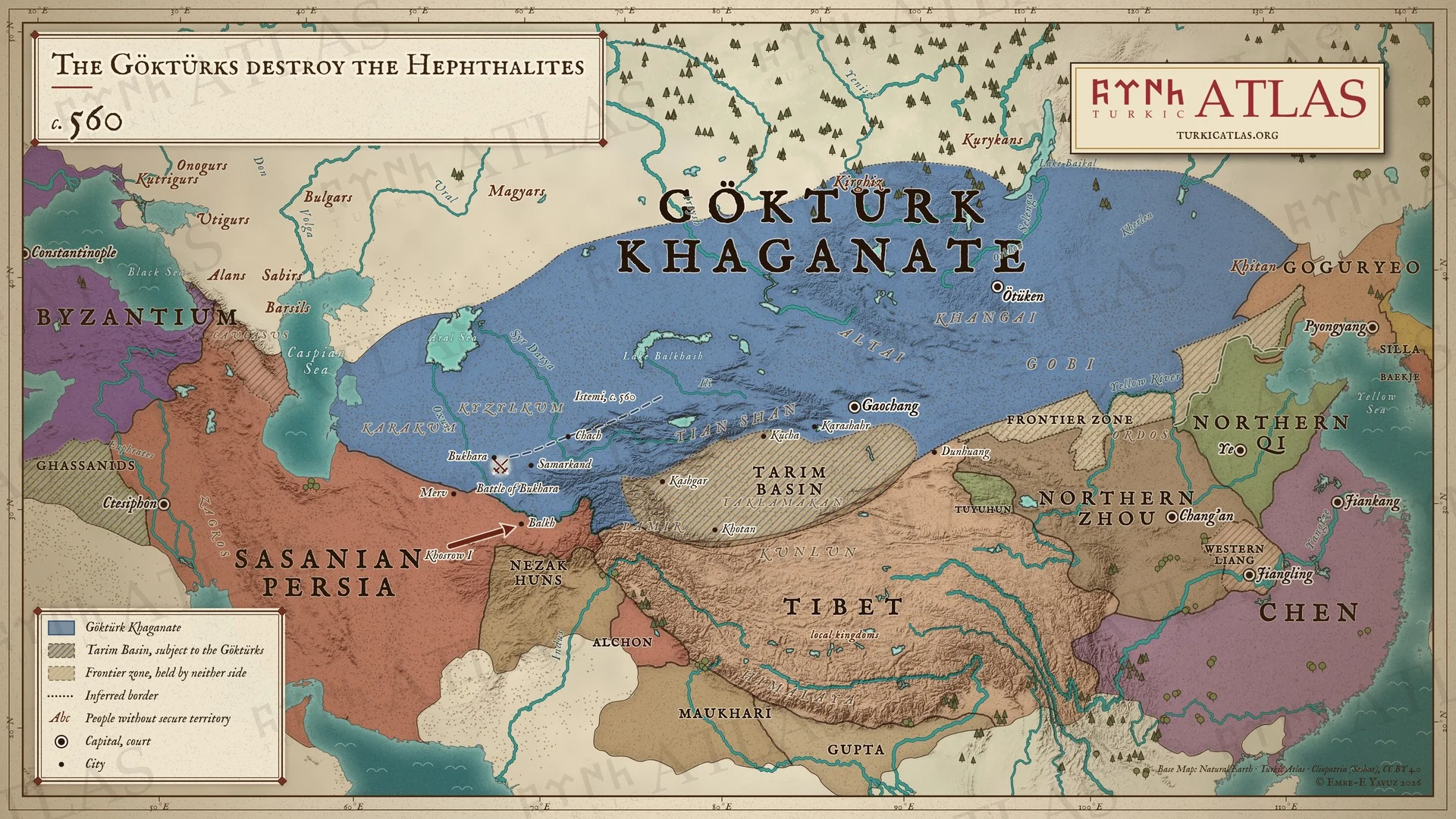
Динавари әрбір жеңімпаз нені алғанын қосады. Хосров эфталиттердің Тохаристан, Забулистан, Кабулистан және Чағаниян жерлерін алды. Синджибу Чач, Ферғана, Самарқанд, Кеш және Бұхараға дейінгі Насаф қалаларын алды, бұл Трансоксиананың маңызды бөлігі.[1] Силзибул эфталиттерге солтүстіктен шабуыл жасағанда, Хосров шамамен Балхқа дейін ілгерілеген еді. Екі жаулап алушы сонда соншалықты жақын болды, сондықтан олар таласуға мәжбүр болды.[1] Археология көктүріктердің жаулап алуы Пенджикентті зақымдамай қалдырғанын және эфталит күмісі айналымда қалғанын көрсетеді.[9]
Мерзімі
Шайқас шамамен 560 жылға жатады, ал екі патшаның Гурганда кездесуі сол жылға.[6] Бір есеп жойылуды 557 жылға қояды.[3] Екінші есеп 557-ден 565 жылға дейінгі ұсыныстарды қарастырады. Ол соңын 563 пен 567 жылдар аралығына қояды, себебі Менандрдың 568 жылғы елшілері «бәрі» деп жауап бере алған.[8] Табари жыл бермейді, қытай тараулары да бермейді. Менандр тек терминус береді. Он жылдық айырма қытай, парсы, араб және грек есептерінің кездесуінен шығады.
Салдары
Оксус шекараға айналды, соғдылар оның көктүрік жағында болды. Бірнеше жыл ішінде соғды көпестері Істемінен Персияға елшілік сұрады, Хосров олардың жібегін өртеді, ал Маниах Константинопольге баратын жолда болды.[5] Turkic Atlas бұл жалғасты Сасани империясы және Хосров туралы мақалаларда баяндайды.[5] Бұхара шайқастан саяси салмақ алды. Ол Соғдиананың астанасы болған жоқ. Ол Ашина асыл тектілерінің батыстағы резиденциясы болды және бөлінуден кейін екі империяның арасында жатқан қала болды.[6] Turkic Atlas қаланың кейінгі тарихын Бұхара мақаласында береді. Ол соғысты тұтастай Істемі мақаласында баяндайды.
-
c. 402 Shelun takes the title khagan
Shelun, a fugitive who gathered a following in the Gobi, defeats the Tiele and takes the title khagan. The Wei Shu draws his realm in four directions: in the west the country of Karashahr, in the east the country of Korea, in the north across the desert to the Hanhai, in the south to the great desert. The line between these points is drawn, not recorded.
-
429 Taiwu crosses the Gobi
The Northern Wei emperor Taiwu leaves Pingcheng, crosses the Gobi and scatters the Rouran of Datan at the Li river; his armies sweep five thousand li from east to west. The route is drawn after the Wei Shu; the rivers it names are not located with certainty.
-
460 The Tölös subjected
In the west the Rouran subject the Tölös, that is the Tiele. That their reach then extended to Lake Balkhash and the Seven Rivers is the extent the modern literature gives; the sources do not state it. The Ashina, five hundred families, settle on the southern slope of the Altai as the smiths of the Rouran.
-
487 The Gaoche break away
More than a hundred thousand Gaoche tents under Afuzhiluo leave the khaganate and found a kingdom of their own north-west of Gaochang. The Rouran khan Tulun pursues them, is beaten again and again, and leads his people east.
-
525 Anagui fights for the Wei
In 520 Anagui has brought the Tiele under Rouran rule again; after the Chinese histories their lands reach as far as the Caspian and the Alans. In 523, in a year of hunger, Anagui raids the Six Garrisons on the Wei frontier. In 525, after the garrisons have risen themselves, he leads a hundred thousand men from Wuchuan west towards Woye against the rebels, on the Wei's behalf.
-
545 The Rouran at their height
The Rouran rule the eastern and central steppe; the Ashina in the Altai and the Tiele of Dzungaria are their subjects, and the Tiele range, after the Chinese histories, as far as the Caspian. The frontier drawn here, from the Khingan to the Seven Rivers and from Lake Baikal to the frontier of the Wei, is the extent the modern literature gives.
-
546 Bumin defeats the Tiele
In 546 the Tiele of Dzungaria move against the Rouran. Bumin, chief of the Ashina, intercepts them on the march and defeats them, and more than fifty thousand Tiele tents submit to him. The Ashina are still subjects of the Rouran, but now a power of their own.
-
552 Bumin destroys the Rouran
Early in 552 a Rouran army is beaten in Dzungaria and a second destroyed north of Huaihuang; Anagui dies. The Göktürks take the steppe, and a Rouran remnant holds out in the contested borderland between the Göktürks and China. The extent of the new khaganate follows the modern estimate.
-
553–555 The last Rouran; Istemi marches west
Issik breaks the Rouran of Dengshuzi at Mount Mulai north of Woye, and the remnant in the Northern Qi is destroyed by its hosts in 554. In the west Istemi marches from 553 and, by one reckoning, reaches the Seven Rivers by 555.
-
c. 560 The Hephthalites destroyed
Istemi destroys the Hephthalites and takes the trade of Sogdiana. One reading has him act with the Persian king Khosrow I and divide their lands along the Oxus, in 557 or 560. The route drawn follows one modern reconstruction: the Göktürks take Chach, cross the Chirchik and win after eight days in the hills at Nasaf; a second reading has the decisive fight at Bukhara itself. Khosrow comes up from the south as far as Balkh. In the east Mukan takes the Kirghiz on the Yenisei and the Khitan.
-
568–569 Embassies to Constantinople
Persia shuts its markets to the Sogdian silk. Istemi sends the Sogdian Maniakh to Constantinople, and the Roman envoy Zemarchos reaches him in 569 at a mountain called Ektag. Where Ektag lay is disputed: the Altai and the Tian Shan are both proposed.
-
576 Bosporos
In the year of Istemi's death a Göktürk army takes Bosporos in the Crimea, the western limit of the expansion into Europe. That the western wing then reached the Volga and the northern Caucasus is inferred.
-
581–584 The realm divides
Taspar dies in 581 with the khaganate at what is inferred to be its greatest extent. The succession divides the house, and Ishbara, Apa and Tardush go to war while the Sui take sides. The line between the eastern and the western wing is reconstructed as running from the Altai through Dzungaria to the Dzungarian Gate.
- Place named in a source (position as commonly identified)
- Position disputed or approximate
- Area or line drawn from a description in the sources
- Area as the modern literature gives it
- Subject people or its range (dashed outline)
- Frontier zone between the steppe and China, held by neither side (hatched)
- Movement named in a source (route drawn)
- Route after a modern reconstruction
Ескертпелер
Дерек көздері
- Табари
- Менандр Протектор
- Суй шу (Суй кітабы), juan 84
- Чжоу шу (Чжоу кітабы), juan 50
- Наршахи, Бұхара тарихы
Әдебиет
- Emre-E. Yavuz, The Gokturk Empire: 2nd Edition (2025)
- Peter B. Golden, An Introduction to the History of the Turkic Peoples (1992)
- Aydogdy Kurbanov, The Hephthalites: Archaeological and Historical Analysis (2010)
- Étienne de la Vaissière, Sogdian Traders: A History (2005)
- Theodor Nöldeke, Geschichte der Perser und Araber zur Zeit der Sasaniden. Aus der arabischen Chronik des Tabari übersetzt und mit ausführlichen Erläuterungen und Ergänzungen versehn (1879)
- Richard N. Frye (trans.), The History of Bukhara. Translated from a Persian Abridgment of the Arabic Original by Narshakhi (1954)
Осы бетке сілтемелер9
- States
- Сасани Персиясы
- Places
- Бұхара · Соғдиана · Тарим ойпаты
- Peoples
- Эфталиттер
Мақаладан дәйексөз алу
Yavuz, Emre-E. “Бұхара шайқасы.” Turkic Atlas, revised 20 November 2026. https://turkicatlas.org/events/battle-of-bukhara/
Last revised: 20 November 2026

