
Buxoro jangi eftaliy davlatini yoʻq qilgan va Koʻk turklarni Sugʻdiyona xoʻjayiniga aylantirgan toʻqnashuvning zamonaviy nomidir. Voqea shubhasiz. Yil, joy va magʻlub boʻlgan shohning ismi shubhali. Uch anʼana uni bayon qiladi, birortasi ham jang maydonidan emas: arabcha Tabari, Xitoy sulola tarixlari va yunoncha Menander, u oqibatlarini Konstantinopolga kelgan elchilarda koʻrdi.
Manbalar
Tabari gʻolibni va magʻlubni nomlaydi va boshqa hech narsa aytmaydi.[1] Xoqon Sinjibu, yaʼni Istami, «barcha turklarning eng jasuri va eng qudratlisi edi va eng koʻp qoʻshinga ega edi; Hayāṭila shohi Warzni oʻldirgan u edi; ularning soni va kuchidan qoʻrqmay, u shohni qoʻshinining katta qismi bilan oʻldirdi, boyliklarini oljaga oldi va Xusrav qoʻliga tushgan qismlardan tashqari yurtini zabt etdi».[2] Masʿudiy shohni Axšunwāz deb ataydi, bu ikki avlod oldin Perozni magʻlub etgan eftaliy hukmdorining Axšunwāriga oʻxshaydi.[3] «Zhou Shu» eftaliylarning magʻlubiyatini Mukan xonning fathlari qatorida beradi. U Istamini umuman nomlamaydi. «Sui Shu» buni takrorlaydi va ikkala matn ham fors ittifoqchisini ham shohning oʻlimini ham bilmaydi.[4] Menander, boshqa chetdan, sugʻdlarning oʻzini Istamiga bir paytlar eftaliylarning va endi Koʻk turklarning fuqarosi deb taʼriflashini beradi. U ham Istamining Yustin II-ga yozgan maktubida eftaliylar boʻysundirilgan va shaharlarda yashaydi deb xabar qilinganini beradi.[5] Zemarxosdan barcha eftaliylar boʻysundirilganmi, deb soʻralganda, javob bitta soʻz edi, «hammasi».[5] Menander tomonini oʻzgartirgan kishini ham nomlaydi: Xusravning kengashidagi eftaliy Katulph, oʻz xalqiga Koʻk turklar foydasiga xiyonat qilgan edi.[5]
Qayta tuzish
Yurish quyidagicha kechadi.[6] Shu qayta tuzishga koʻra, sugʻd shaharlarining yetti shohi Buxoroda yigʻildi. Ular Sirdaryo boʻyidagi yangi Koʻk turk qoʻshnilariga eftaliylarga qarshi yordam soʻrab xabar yubordi, eftaliylar ularning eng katta garnizonini Buxoroda ushlab turardi. Koʻk turklar kichikroq eftaliy postlarini tezda yoʻq qilib, Buxoro darvozalari oldida paydo boʻldi. Shu orada Tarimning gʻarbida ikkinchi front ochiq edi va janubi-sharqda uchinchi, fors fronti. Eftaliy hukmdori Ghadfar Balxdan va boshqa joylardan qoʻshimcha kuchlarni chaqirgan edi. U garnizonni himoya qildi. Janglar yetti kecha-kunduz davom etgan deyiladi. Sakkizinchisida Koʻk turklar yorib kirdi va otliq va piyoda shaharga kirdi. Ular qalʼa Arkni oldi va eftaliy qoʻmondonlari ketib qolganini topdi. Faganish Afgʻonistonga, Ghadfar esa unga janubi-sharqdan hujum qilgan forslar oldiga qochgan edi. Yarim koʻchmanchi Koʻk turklar devor bilan oʻralgan shaharni oldi va talon-taroj qilmadi.[6] Ashina zodagonlari keyin Buxoroda joylashdi. Istami Arkdan rejalashtirish markazi sifatida foydalangan boʻlishi mumkin, qoʻshinning katta qismi esa dashtga qaytdi.[6] Buxoroning saqlanib qolgan yagona mahalliy tarixi, Narshaxiyniki, na urushni, na eftaliylarni oʻz ichiga oladi. U yetti shohni ham oʻz ichiga olmaydi.[7] Firdavsiy, Tabari, Dinavariy va yunonlardan tuzilgan ikkinchi qayta tuzish xuddi shu urushni boshqacha tugatadi.[8] Koʻk turklar Chochni oldi va Chirchiqdan oʻtdi. U yerda Gatfar deb ataladigan shoh Balx, Shugʻnon va Termizdan qoʻshin yigʻib, Buxoro yaqinida tekislikda jangdan bosh tortdi. U Nasafdagi tepaliklarda jang qildi, u yerda sakkiz kundan keyin Koʻk turklar gʻalaba qozondi.[8] Tirik qolganlar Chaghaniyanlik Faganishni tanladi, u forslarga boʻysundi.[8] Turkic Atlas bu qayta tuzishni toʻliq eftaliylar ostida beradi.[8]
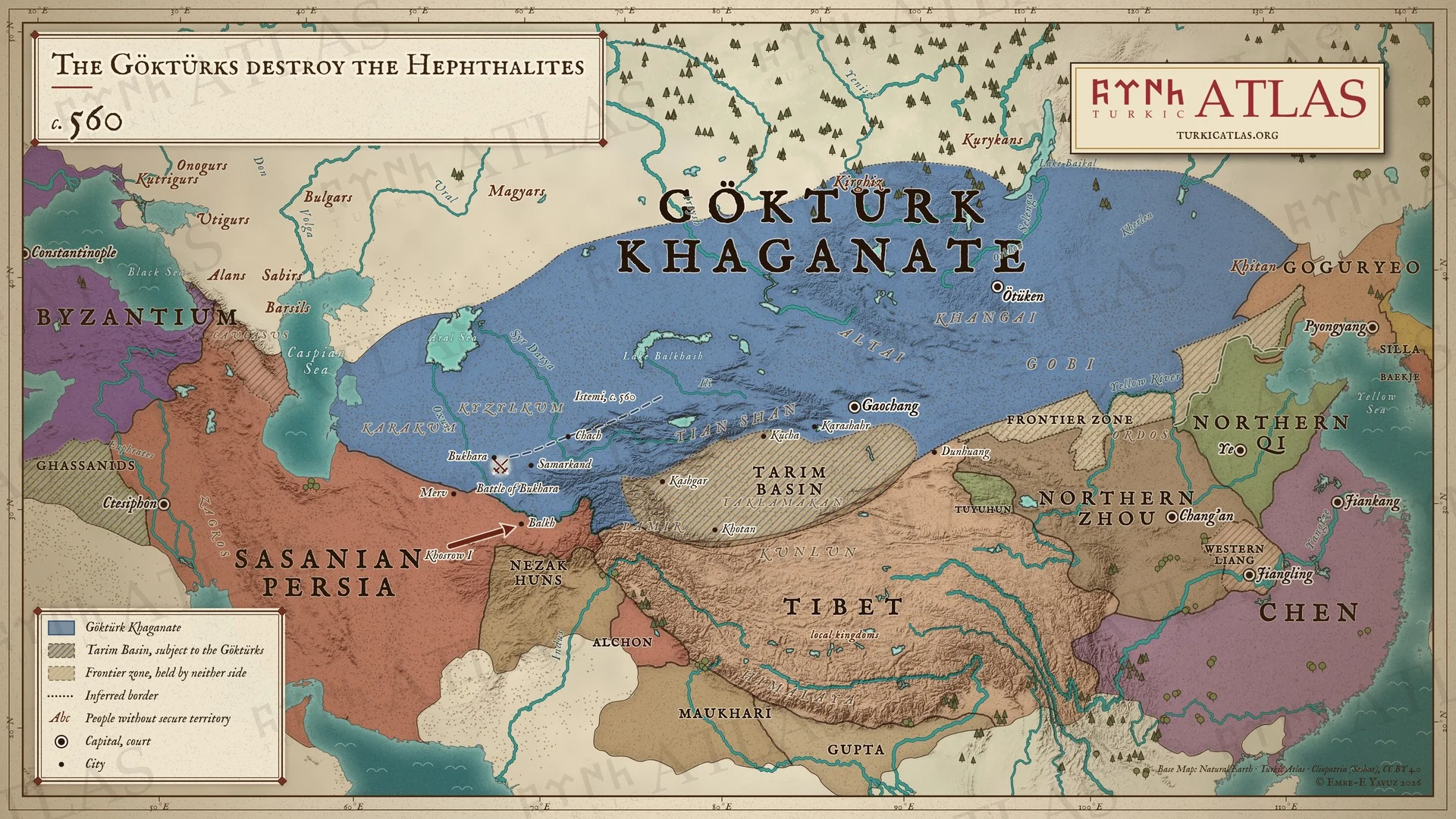
Dinavariy har bir gʻolib nimani olganini qoʻshib aytadi. Xusrav eftaliylarning Toxariston, Zabulistan, Kabulistan va Chaghaniyan yerlarini oldi. Sinjibu Choch, Fargʻona, Samarqand, Kesh va Nasafdan Buxorogacha boʻlgan shaharlarni, Movarounnahrning asosiy qismini oldi.[1] Xusrav Balxgacha qariyb yetib kelgan edi, shu paytda Silzibul eftaliylarga shimoldan hujum qildi. Ikki fotih shunda shu qadar yaqin edi, ular janjallashmay iloji yoʻq edi.[1] Arxeologiya Koʻk turklar fathi Panjikentni shikastlamay qoldirganini va eftaliy kumushi muomalada qolganini koʻrsatadi.[9]
Sana
Jang taxminan 560-yilga tegishli va ikki shohning Gurgonda uchrashuvi ham xuddi shu yilga.[6] Bir hisob yoʻq qilinishni 557-yilga qoʻyadi.[3] Ikkinchi hisob 557 dan 565 gacha boʻlgan takliflarni koʻrib chiqadi. U oxirini 563 va 567 orasiga qoʻyadi, chunki Menanderning 568-yildagi elchilari «hammasi» deb javob bera olgan edi.[8] Tabari yil bermaydi va Xitoy boblari ham bermaydi. Menander faqat terminusni beradi. Oʻn yillik farq Xitoy, fors, arab va yunon hisoblarining uchrashuvidan kelib chiqadi.
Oqibatlar
Amudaryo chegaraga aylandi, sugʻdlar uning Koʻk turk tomonida qoldi. Bir necha yil ichida sugʻd savdogarlari Istamidan Forsga elchilik soʻrar edi, Xusrav ularning ipagini yoqar edi va Maniax Konstantinopolga yoʻlda edi.[5] Turkic Atlas bu davomni Sosoniylar imperiyasi va Xusrav ostida bayon qiladi.[5] Buxoro jangdan siyosiy ogʻirlik oldi. U Sugʻdiyonaning poytaxtiga aylanmadi. U gʻarbda Ashina zodagonlarining qarorgohiga va boʻlinishdan keyin ikki imperiya oʻrtasida joylashgan shaharga aylandi.[6] Turkic Atlas shaharning keyingi tarixini Buxoro ostida beradi. U urushni butunligicha Istami ostida bayon qiladi.
-
c. 402 Shelun takes the title khagan
Shelun, a fugitive who gathered a following in the Gobi, defeats the Tiele and takes the title khagan. The Wei Shu draws his realm in four directions: in the west the country of Karashahr, in the east the country of Korea, in the north across the desert to the Hanhai, in the south to the great desert. The line between these points is drawn, not recorded.
-
429 Taiwu crosses the Gobi
The Northern Wei emperor Taiwu leaves Pingcheng, crosses the Gobi and scatters the Rouran of Datan at the Li river; his armies sweep five thousand li from east to west. The route is drawn after the Wei Shu; the rivers it names are not located with certainty.
-
460 The Tölös subjected
In the west the Rouran subject the Tölös, that is the Tiele. That their reach then extended to Lake Balkhash and the Seven Rivers is the extent the modern literature gives; the sources do not state it. The Ashina, five hundred families, settle on the southern slope of the Altai as the smiths of the Rouran.
-
487 The Gaoche break away
More than a hundred thousand Gaoche tents under Afuzhiluo leave the khaganate and found a kingdom of their own north-west of Gaochang. The Rouran khan Tulun pursues them, is beaten again and again, and leads his people east.
-
525 Anagui fights for the Wei
In 520 Anagui has brought the Tiele under Rouran rule again; after the Chinese histories their lands reach as far as the Caspian and the Alans. In 523, in a year of hunger, Anagui raids the Six Garrisons on the Wei frontier. In 525, after the garrisons have risen themselves, he leads a hundred thousand men from Wuchuan west towards Woye against the rebels, on the Wei's behalf.
-
545 The Rouran at their height
The Rouran rule the eastern and central steppe; the Ashina in the Altai and the Tiele of Dzungaria are their subjects, and the Tiele range, after the Chinese histories, as far as the Caspian. The frontier drawn here, from the Khingan to the Seven Rivers and from Lake Baikal to the frontier of the Wei, is the extent the modern literature gives.
-
546 Bumin defeats the Tiele
In 546 the Tiele of Dzungaria move against the Rouran. Bumin, chief of the Ashina, intercepts them on the march and defeats them, and more than fifty thousand Tiele tents submit to him. The Ashina are still subjects of the Rouran, but now a power of their own.
-
552 Bumin destroys the Rouran
Early in 552 a Rouran army is beaten in Dzungaria and a second destroyed north of Huaihuang; Anagui dies. The Göktürks take the steppe, and a Rouran remnant holds out in the contested borderland between the Göktürks and China. The extent of the new khaganate follows the modern estimate.
-
553–555 The last Rouran; Istemi marches west
Issik breaks the Rouran of Dengshuzi at Mount Mulai north of Woye, and the remnant in the Northern Qi is destroyed by its hosts in 554. In the west Istemi marches from 553 and, by one reckoning, reaches the Seven Rivers by 555.
-
c. 560 The Hephthalites destroyed
Istemi destroys the Hephthalites and takes the trade of Sogdiana. One reading has him act with the Persian king Khosrow I and divide their lands along the Oxus, in 557 or 560. The route drawn follows one modern reconstruction: the Göktürks take Chach, cross the Chirchik and win after eight days in the hills at Nasaf; a second reading has the decisive fight at Bukhara itself. Khosrow comes up from the south as far as Balkh. In the east Mukan takes the Kirghiz on the Yenisei and the Khitan.
-
568–569 Embassies to Constantinople
Persia shuts its markets to the Sogdian silk. Istemi sends the Sogdian Maniakh to Constantinople, and the Roman envoy Zemarchos reaches him in 569 at a mountain called Ektag. Where Ektag lay is disputed: the Altai and the Tian Shan are both proposed.
-
576 Bosporos
In the year of Istemi's death a Göktürk army takes Bosporos in the Crimea, the western limit of the expansion into Europe. That the western wing then reached the Volga and the northern Caucasus is inferred.
-
581–584 The realm divides
Taspar dies in 581 with the khaganate at what is inferred to be its greatest extent. The succession divides the house, and Ishbara, Apa and Tardush go to war while the Sui take sides. The line between the eastern and the western wing is reconstructed as running from the Altai through Dzungaria to the Dzungarian Gate.
- Place named in a source (position as commonly identified)
- Position disputed or approximate
- Area or line drawn from a description in the sources
- Area as the modern literature gives it
- Subject people or its range (dashed outline)
- Frontier zone between the steppe and China, held by neither side (hatched)
- Movement named in a source (route drawn)
- Route after a modern reconstruction
Izohlar
Manbalar
- Tabari
- Menander Protektor
- Sui Shu (Suy kitobi), juan 84
- Zhou Shu (Zhou kitobi), juan 50
- Narshakhī, Buxoro tarixi
Adabiyot
- Emre-E. Yavuz, The Gokturk Empire: 2nd Edition (2025)
- Peter B. Golden, An Introduction to the History of the Turkic Peoples (1992)
- Aydogdy Kurbanov, The Hephthalites: Archaeological and Historical Analysis (2010)
- Étienne de la Vaissière, Sogdian Traders: A History (2005)
- Theodor Nöldeke, Geschichte der Perser und Araber zur Zeit der Sasaniden. Aus der arabischen Chronik des Tabari übersetzt und mit ausführlichen Erläuterungen und Ergänzungen versehn (1879)
- Richard N. Frye (trans.), The History of Bukhara. Translated from a Persian Abridgment of the Arabic Original by Narshakhi (1954)
Bu yerga havolalar9
- States
- Sosoniy Fors
- Places
- Buxoro · Soʻgʻdiyona · Tarim havzasi
- Peoples
- Eftalitlar
Maqoladan iqtibos olish
Yavuz, Emre-E. “Buxoro jangi.” Turkic Atlas, revised 20 November 2026. https://turkicatlas.org/events/battle-of-bukhara/
Last revised: 20 November 2026

