
The battle of Bukhara is a modern name for the engagement that destroyed the Hephthalite realm and made the Göktürks masters of Sogdiana. The event is certain. The year, the place and the name of the defeated king are not. Three traditions describe it, none of them from the field: Tabari in Arabic, the Chinese dynastic histories, and Menander in Greek, who saw its consequences in the envoys who came to Constantinople.
The sources
Tabari names the victor and the victim and nothing else.[1] The khagan Sinjibu, that is Istemi, “was the boldest and mightiest of all the Türk and had the most numerous troops; it was he who had killed Warz, the king of the Hayāṭila; without fearing their number and strength he had killed the king with the greater part of his army, taken their wealth as booty and conquered their land, except the parts that had fallen into Khosrow’s hand”.[2] Masʿudi calls the king Axšunwāz, which recalls the Axšunwār of the Hephthalite ruler who had beaten Peroz two generations before.[3] The Zhou Shu gives the defeat of the Hephthalites among the conquests of Mukan Khan. It does not name Istemi at all. The Sui Shu repeats it, and neither text knows of a Persian ally or of a king’s death.[4] Menander, from the other end, has the Sogdians describe themselves to Istemi as once the subjects of the Hephthalites and now of the Göktürks. He also has Istemi’s letter to Justin II report the Hephthalites subdued and dwelling in cities.[5] When Zemarchos was asked whether all the Hephthalites had been subjected, the answer was one word, “all”.[5] Menander also names the man who changed sides: the Hephthalite Katulph, in Khosrow’s council, who had betrayed his own people to the Göktürks.[5]
The reconstruction
The campaign runs as follows.[6] On this reconstruction, seven kings of the Sogdian cities assembled at Bukhara. They sent to their new Göktürk neighbours on the Syr Darya for help against the Hephthalites, who held the largest of their garrisons in Bukhara. The Göktürks made short work of the smaller Hephthalite posts and appeared before the gates of Bukhara. Meanwhile a second front was open in the western Tarim and a third, Persian, front in the south-east. The Hephthalite ruler Ghadfar had called up reinforcements from Balkh and elsewhere. He defended the garrison. The fighting is said to have lasted seven days and seven nights. On the eighth the Göktürks broke through, and horse and foot entered the city. They took the citadel, the Ark, and found the Hephthalite commanders gone. Faganish had fled to Afghanistan and Ghadfar to the Persians who had attacked him from the south-east. The half-nomadic Göktürks took a walled city and did not sack it.[6] The Ashina nobility then quartered themselves in Bukhara. Istemi may have used the Ark as a planning centre while the greater part of the army went back to the steppe.[6] The one local history of Bukhara that survives, Narshakhi’s, has neither the war nor the Hephthalites. It does not contain the seven kings either.[7] A second reconstruction, from Firdausi, Tabari, Dinawari and the Greeks, has the same war end differently.[8] The Göktürks took Chach and crossed the Chirchik. The king, there called Gatfar, gathered troops from Balkh, Shughnan and Termez near Bukhara and declined battle on the plain. He fought in the hills at Nasaf, where after eight days the Göktürks won.[8] The survivors chose Faganish of Chaghaniyan, who submitted to the Persians.[8] Turkic Atlas gives that reconstruction in full under the Hephthalites.[8]
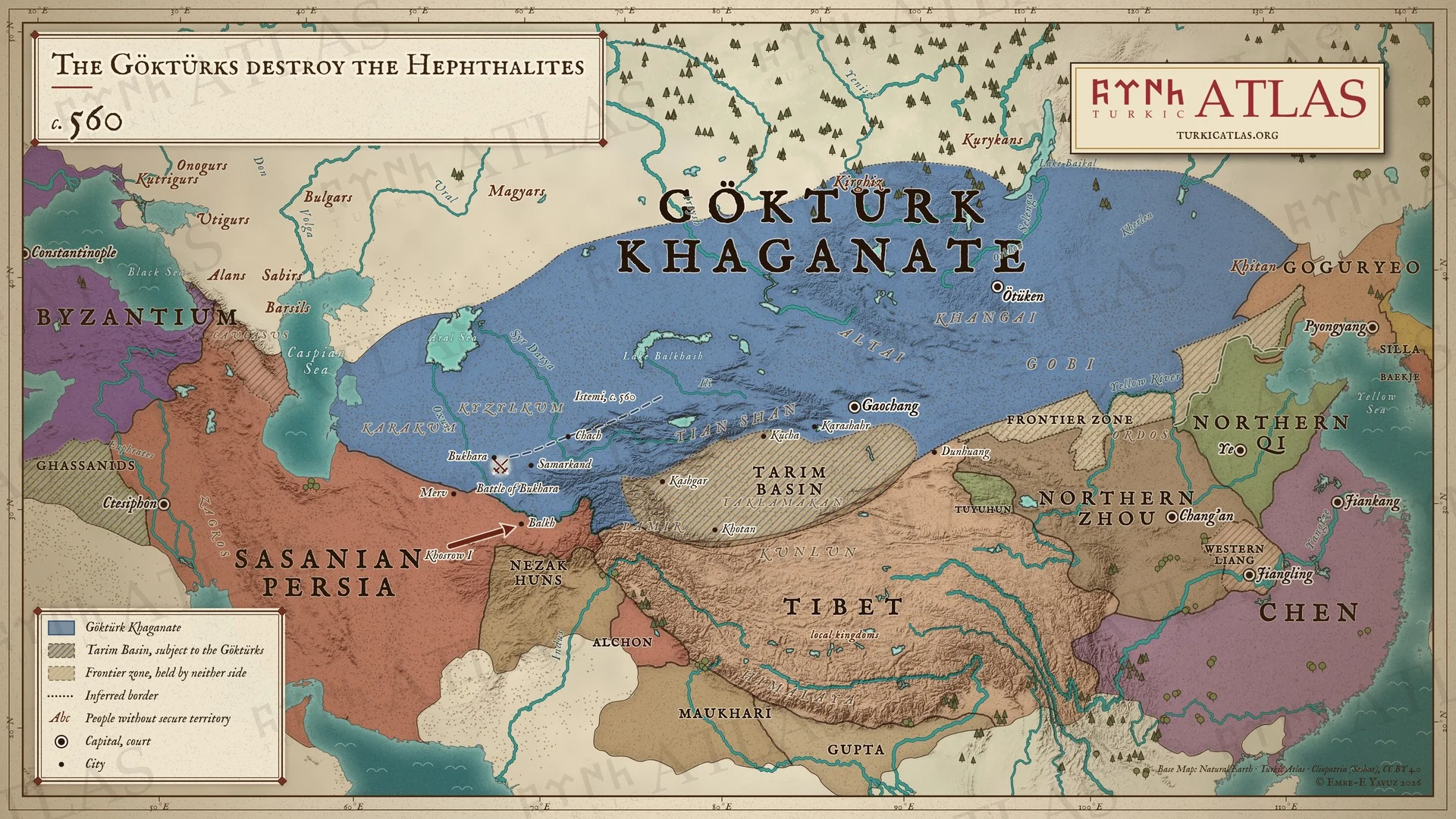
Dinawari adds what each victor took. Khosrow took the Hephthalite lands of Tokharistan, Zabulistan, Kabulistan and Chaghaniyan. Sinjibu took the cities of Chach, Ferghana, Samarkand, Kesh and Nasaf as far as Bukhara, the essential part of Transoxiana.[1] Khosrow had advanced about as far as Balkh when Silzibul attacked the Hephthalites from the north. The two conquerors were then so close that they had to quarrel.[1] The archaeology shows that the Göktürk conquest left Panjikent undamaged and that the Hephthalite silver stayed in circulation.[9]
Date
The battle belongs to about 560, and the meeting of the two kings at Gurgan to the same year.[6] One reckoning puts the destruction in 557.[3] A second reckoning reviews the proposals from 557 to 565. It sets the end between 563 and 567, on the ground that Menander’s envoys of 568 could answer “all”.[8] Tabari gives no year, and neither do the Chinese chapters. Menander gives only a terminus. The difference of a decade comes from the meeting of the Chinese, Persian, Arabic and Greek reckonings.
Consequences
The Oxus became the border, with the Sogdians on the Göktürk side of it. Within a few years the Sogdian merchants were asking Istemi for an embassy to Persia, Khosrow was burning their silk, and Maniakh was on the road to Constantinople.[5] Turkic Atlas tells that sequel under the Sasanian empire and under Khosrow.[5] Bukhara gained political weight from the battle. It did not become the capital of Sogdiana. It became the seat of the Ashina nobility in the west and, after the division, the city that lay between the two empires.[6] Turkic Atlas gives the city’s later history under Bukhara. It tells the war as a whole under Istemi.
-
c. 402 Shelun takes the title khagan
Shelun, a fugitive who gathered a following in the Gobi, defeats the Tiele and takes the title khagan. The Wei Shu draws his realm in four directions: in the west the country of Karashahr, in the east the country of Korea, in the north across the desert to the Hanhai, in the south to the great desert. The line between these points is drawn, not recorded.
-
429 Taiwu crosses the Gobi
The Northern Wei emperor Taiwu leaves Pingcheng, crosses the Gobi and scatters the Rouran of Datan at the Li river; his armies sweep five thousand li from east to west. The route is drawn after the Wei Shu; the rivers it names are not located with certainty.
-
460 The Tölös subjected
In the west the Rouran subject the Tölös, that is the Tiele. That their reach then extended to Lake Balkhash and the Seven Rivers is the extent the modern literature gives; the sources do not state it. The Ashina, five hundred families, settle on the southern slope of the Altai as the smiths of the Rouran.
-
487 The Gaoche break away
More than a hundred thousand Gaoche tents under Afuzhiluo leave the khaganate and found a kingdom of their own north-west of Gaochang. The Rouran khan Tulun pursues them, is beaten again and again, and leads his people east.
-
525 Anagui fights for the Wei
In 520 Anagui has brought the Tiele under Rouran rule again; after the Chinese histories their lands reach as far as the Caspian and the Alans. In 523, in a year of hunger, Anagui raids the Six Garrisons on the Wei frontier. In 525, after the garrisons have risen themselves, he leads a hundred thousand men from Wuchuan west towards Woye against the rebels, on the Wei's behalf.
-
545 The Rouran at their height
The Rouran rule the eastern and central steppe; the Ashina in the Altai and the Tiele of Dzungaria are their subjects, and the Tiele range, after the Chinese histories, as far as the Caspian. The frontier drawn here, from the Khingan to the Seven Rivers and from Lake Baikal to the frontier of the Wei, is the extent the modern literature gives.
-
546 Bumin defeats the Tiele
In 546 the Tiele of Dzungaria move against the Rouran. Bumin, chief of the Ashina, intercepts them on the march and defeats them, and more than fifty thousand Tiele tents submit to him. The Ashina are still subjects of the Rouran, but now a power of their own.
-
552 Bumin destroys the Rouran
Early in 552 a Rouran army is beaten in Dzungaria and a second destroyed north of Huaihuang; Anagui dies. The Göktürks take the steppe, and a Rouran remnant holds out in the east. The extent of the new khaganate follows the modern estimate.
-
553–555 The last Rouran; Istemi marches west
Issik breaks the Rouran of Dengshuzi at Mount Mulai north of Woye, and the remnant in the Northern Qi is destroyed by its hosts in 554. In the west Istemi marches from 553 and, by one reckoning, reaches the Seven Rivers by 555.
-
c. 560 The Hephthalites destroyed
Istemi destroys the Hephthalites and takes the trade of Sogdiana. One reading has him act with the Persian king Khosrow I and divide their lands along the Oxus, in 557 or 560. The route drawn follows one modern reconstruction: the Göktürks take Chach, cross the Chirchik and win after eight days in the hills at Nasaf; a second reading has the decisive fight at Bukhara itself. Khosrow comes up from the south as far as Balkh. In the east Mukan takes the Kirghiz on the Yenisei and the Khitan.
-
568–569 Embassies to Constantinople
Persia shuts its markets to the Sogdian silk. Istemi sends the Sogdian Maniakh to Constantinople, and the Roman envoy Zemarchos reaches him in 569 at a mountain called Ektag. Where Ektag lay is disputed: the Altai and the Tian Shan are both proposed.
-
576 Bosporos
In the year of Istemi's death a Göktürk army takes Bosporos in the Crimea, the western limit of the expansion into Europe. That the western wing then reached the Volga and the northern Caucasus is inferred.
-
581–584 The realm divides
Taspar dies in 581 with the khaganate at what is inferred to be its greatest extent. The succession divides the house, and Ishbara, Apa and Tardush go to war while the Sui take sides. The line between the eastern and the western wing is reconstructed as running from the Altai through Dzungaria to the Dzungarian Gate.
- Place named in a source (position as commonly identified)
- Position disputed or approximate
- Area or line drawn from a description in the sources
- Area as the modern literature gives it
- Subject people or its range (dashed outline)
- Frontier zone between the steppe and China, held by neither side (hatched)
- Movement named in a source (route drawn)
- Route after a modern reconstruction
References
Sources
- Tabari
- Menander Protector
- Sui Shu (Book of Sui), juan 84
- Zhou Shu (Book of Zhou), juan 50
- Narshakhī, History of Bukhara
Literature
- Emre-E. Yavuz, The Gokturk Empire: 2nd Edition (2025)
- Peter B. Golden, An Introduction to the History of the Turkic Peoples (1992)
- Aydogdy Kurbanov, The Hephthalites: Archaeological and Historical Analysis (2010)
- Étienne de la Vaissière, Sogdian Traders: A History (2005)
- Theodor Nöldeke, Geschichte der Perser und Araber zur Zeit der Sasaniden. Aus der arabischen Chronik des Tabari übersetzt und mit ausführlichen Erläuterungen und Ergänzungen versehn (1879)
- Richard N. Frye (trans.), The History of Bukhara. Translated from a Persian Abridgment of the Arabic Original by Narshakhi (1954)
What links here9
- States
- Sasanian Persia
- Places
- Bukhara · Sogdiana · Tarim Basin
- Peoples
- Hephthalites
Cite this article
Yavuz, Emre-E. “Battle of Bukhara.” Turkic Atlas, revised 8 November 2026. https://turkicatlas.org/events/battle-of-bukhara/
Last revised: 8 November 2026

