
Ay Ata, the Moon Father, is the moon as a male deity in the beliefs of the Turkic peoples, paired with the sun as a mother.[1] The name joins ay, moon, with ata, father.[2] The oldest records do not name him. They show what was done before the moon. The Xiongnu ruler bowed to it each evening. The Göktürks waited for it to grow full before they rode out. The Uyghur khagans of the late eighth century took it into their titles.[3]
Name
- ay tängridäOld Turkic
- 愛登里邏ChineseTang Huiyao 98
- Ay AtamTurkish
- Ay AtaTurkish
In the material gathered among the Turkic peoples from the eighteenth to the twentieth century, most of them thought of the sun as a woman and the moon as a man. They spoke of Mother Sun, and of Father Moon or the old man of the moon.[1][4] Their tales also speak of a Sun Khan and a Moon Khan.[5][4] Among the Altaians the sun is the mother and the moon the father. The Altaian shamanists swore their oaths by kün ana, Mother Sun.[6] The collector of the Altaian cosmology held that the names Mother Sun, kün ana, and Father Moon, ai ada, arose only from a likeness of sound and had no mythological meaning. He placed the moon in the sixth heaven and the sun in the seventh.[7] Among the Yakuts sun and moon are two siblings, both of them gods. Some heroes are said to descend from them.[6]
The form Ay Atam, my Moon Father, is the name of the first man in a legend of Turkic origins.[2] Al-Dawādārī, an Egyptian historian of Turkic descent, copied it from a book he called Ulu Han Ata Bitikçi. He said that the physician Jibrīl ibn Bakhtīshūʿ had put the book into Persian in the year 211 of the Hijra.[2] In the legend, floods carried clay into a cave on a mountain. The sun baked it, and after nine months a man stepped out. He was called Ay Atam.[2] A second baking brought forth a woman, called Ay-va, the moon-faced.[2] The two married. They had forty children.[2] The legend mixes Oghuz tales and traditions of the Mongol period with Iranian and Greek material.[2]
In the Oghuz epic written in Uyghur script, the father of Oghuz Khan is named Ay-Han. A second son of Oghuz Khan bears the same name. One Turkish study understands the name as a title and not as “Khan of the Moon”. It adds that Gün-Han is no “Khan of the Sun”, and that the sons of Oghuz Khan are not beings who live in the sky.[8] The same study holds that descent from the moon first appears, as an official belief, in the legends of the ancestors of Genghis Khan, and that it is not found among the Turks.[9]
The moon in the Chinese records
The Shiji describes the Xiongnu ruler at his camp.[10] Each morning the chanyu went out to bow to the rising sun. Each evening he bowed to the moon.[10] The Xiongnu timed their undertakings by the stars and the moon. They attacked when the moon waxed full and withdrew when it waned.[10] The Han Shu repeats both statements from the Shiji.[11]
The Sui Shu says the same of the Göktürks in one sentence. They waited for the moon to be nearly full, and then they raided.[12] The Bei Shi repeats it.[13] The Zhou Shu, the older account of the Göktürks, does not contain the sentence.[14] Both the Zhou Shu and the Sui Shu place the great sacrifice to heaven in the middle of the fifth month.[15] Among the Black Forest Tatars of the Altai the phases of the moon had names of their own in the nineteenth century. The names were its newness, its oldness, its fullness, the red fullness of the day before and the black fullness of the day after. The Black Forest Tatars and the Altaians divided the year into thirteen moons.[16]
The moon god in the Uyghur titles
From the khagans who followed Tun Bagha Tarkan, the titles of the Uyghur rulers carried one of two phrases. These were ay tängridä, by the god of the moon, and kün tängridä, by the god of the sun.[17] The Chinese wrote them as ai denglilo and jun denglilo.[18] Tängri in these phrases is the word that also names Tengri. Here it is used for one god among several.[19] The phrases belong to Manichaeism, the religion that Bögü Khan had made the faith of the Uyghur state.[18]
The phrases are found in titles only after the conversion. Therefore it is not settled whether the sun and the moon came to be named as givers of Kut through Manichaeism or from an older local belief.[20] Some scholars hold that the moon is not seen as a god among the Turks and the Huns, because a great Heaven made the moon too. On this account the phrase Ay Tengri arose among the Uyghurs only after Manichaeism and Buddhism came.[9]
The Tang Huiyao records one of these titles.[21] In 805 Huaixin Khan died. In the eleventh month the Tang court invested his successor under a title that opens with 愛登里邏, the moon god.[21]
Eclipses
The shamanists held that evil spirits fight the sun and the moon. At times the spirits seize them and drag them into the world of darkness. That is an eclipse.[6] In every Turkic language an eclipse is expressed with tutul-, to be seized. The verb keeps the trace of that belief.[6] During an eclipse the shamanists shouted and beat their drums to frighten the spirit away.[6] The Black Forest Tatars of the Altai said that a seven-headed demon, Jälbägän, devours the moon and that Ülgen forces him to give it back. The Altaians said “Jälbägän has eaten the moon” or, under Buddhist influence, “the moon has become Burkhan”.[22] Beyond such rites, the evidence for a cult of the moon among the peoples of Siberia consists of the greeting of the new moon, with the wish that it bring luck.[5][4]
The coin
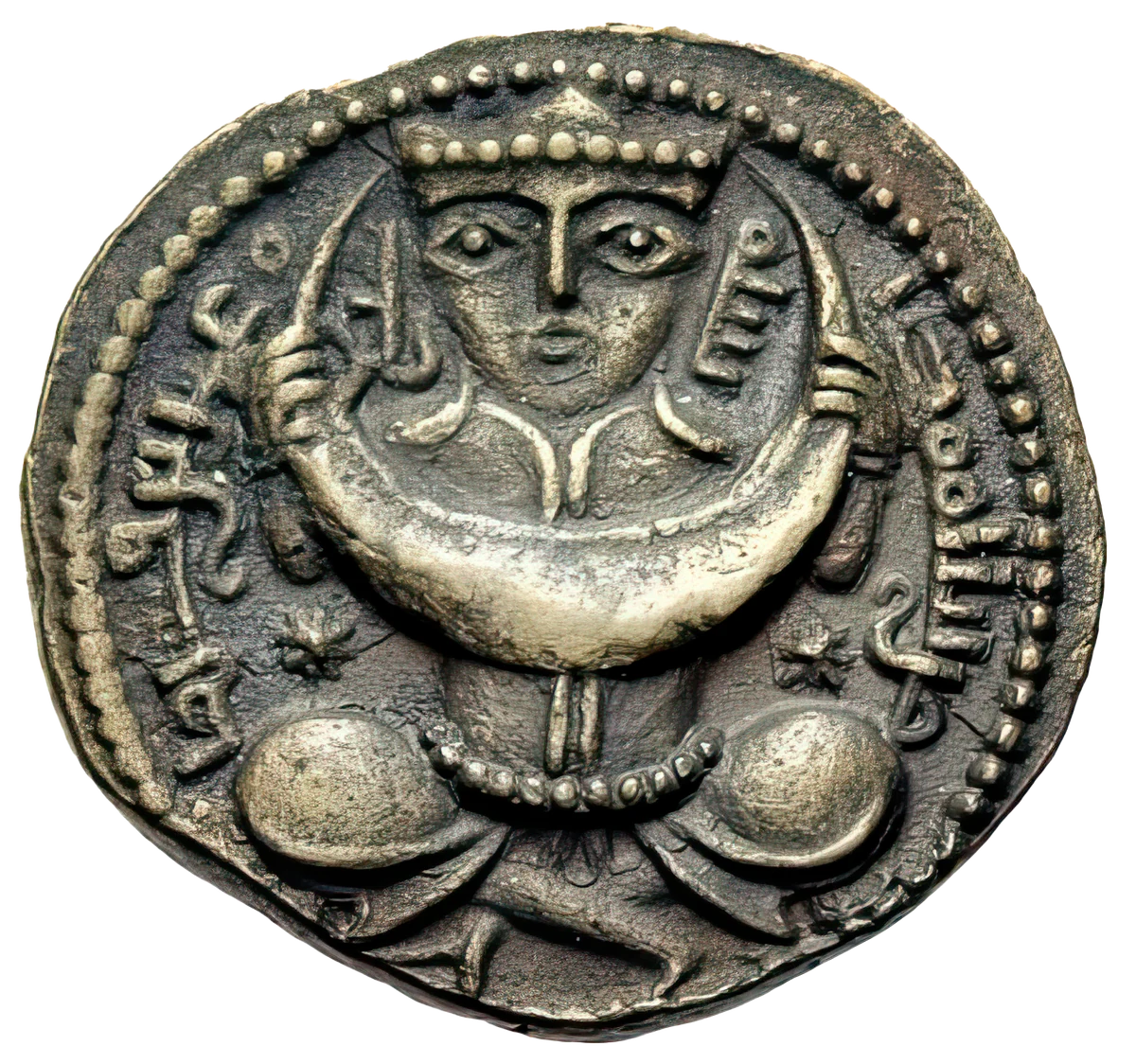
A coin of the eighth century shows a crowned figure who faces the viewer and holds a crescent moon before the chest with both hands. A star stands on either side of the figure. A legend runs round it inside a beaded border.
Across these records the moon appears less as a figure with a story than as a power. Rulers bowed to it, armies watched it before war, and khagans named it in their titles.
References
- ^ a b Harva 1938, p. 182–183
- ^ a b c d e f g İnan 2017; first edition 1954, p. 21
- ^ Shiji, juan 110; Sui Shu (Book of Sui), juan 84; Tang Huiyao (Institutional History of the Tang), juan 98
- ^ a b c Holmberg 1927, p. 422
- ^ a b Harva 1938, p. 183
- ^ a b c d e İnan 2017; first edition 1954, p. 29
- ^ Radloff 1893 (zweite Ausgabe), p. 6
- ^ Ögel 1995, p. 200
- ^ a b Ögel 1995, p. 202
- ^ a b c Shiji, juan 110
- ^ Han Shu, juan 94
- ^ Sui Shu (Book of Sui), juan 84
- ^ Bei Shi (History of the Northern Dynasties), juan 99
- ^ Zhou Shu (Book of Zhou), juan 50
- ^ Zhou Shu (Book of Zhou), juan 50; Sui Shu (Book of Sui), juan 84
- ^ Radloff 1884, p. 373
- ^ Mackerras 1972, p. 152; 64; Şen 2018, p. 152; 64
- ^ a b Mackerras 1972, p. 152
- ^ Wilkens 2024, p. 84–85
- ^ Wilkens 2024, p. 85; 65; Şen 2018, p. 85; 65
- ^ a b Tang Huiyao (Institutional History of the Tang), juan 98
- ^ Radloff 1884, p. 372–373
Sources
- Shiji, juan 110
- Han Shu, juan 94 (after Shiji)
- Sui Shu (Book of Sui), juan 84
- Bei Shi (History of the Northern Dynasties), juan 99 (after Wei Shu, Zhou Shu and Sui Shu)
- Zhou Shu (Book of Zhou), juan 50
- Tang Huiyao (Institutional History of the Tang), juan 98
Literature
- Uno Harva, Die religiösen Vorstellungen der altaischen Völker (1938)
- Abdülkadir İnan, Tarihte ve Bugün Şamanizm: Materyaller ve Araştırmalar (2017; first edition 1954)
- Colin Mackerras, The Uighur Empire According to the T'ang Dynastic Histories (1972)
- Jens Wilkens (trans. Celalettin Bulut Bostan), Uygur Budizmi ve Manihaizm ile Yerel Dinlerin Etkisi: Dinî Terminoloji Örneği (2024)
- Ali Ahmetbeyoğlu, Hüseyin Şen, Eski Türk Dininin Kozmolojisi ve Kozmogonisi (2018)
- Wilhelm Radloff, Aus Sibirien. Lose Blätter aus meinem Tagebuche. Zweiter Band (1893 (zweite Ausgabe))
- Wilhelm Radloff, Aus Sibirien. Lose Blätter aus meinem Tagebuche. Erster Band (1884)
- Uno Holmberg (Harva), The Mythology of All Races, Volume IV: Finno-Ugric, Siberian (1927)
- Bahaeddin Ögel, Türk Mitolojisi (Kaynakları ve açıklamaları ile destanlar) II (1995)
What links here3
- Religions
- Kün Tengri · Raiding at the Full Moon · Turkic Mythology
Cite this article
Yavuz, Emre-E. “Ay Ata.” Turkic Atlas, revised 8 November 2026. https://turkicatlas.org/religions/ay-ata/
Last revised: 8 November 2026

