
Tengri is the sky, and the power that seats and unseats khans. It is the only divine name the Göktürks ever wrote in their own language and their own script. It stands in the first line of their longest monument.[1] Turkic Atlas concerns the god himself. It covers how his name is spelled and sounded, what the stones say he did, how the Chinese saw the rites addressed to him, and how far back the word can be traced. The belief system that modern scholarship has built around the name is treated under Tengrism, and the fortune he grants under Kut.
Spelling and sound
In English the name is written Tengri, the form in which it is read. The Old Turkic spelling is Teŋri. The letter in the middle is the reason the two forms differ. ŋ is the velar nasal, the sound at the end of English sing, and the runiform script writes it with a character of its own. It is one consonant and not two. Therefore the name has two syllables, teŋ-ri, and the g of the English spelling stands for a sound that is not there.
The runiform is 𐱅𐰭𐰼𐰃, read t²ŋr²i. The script writes the consonants and leaves most vowels to be supplied. It does distinguish front consonants from back ones, and that is how a reader knows which vowels belong in the gaps.[1] In quoted Old Turkic the name keeps its philological spelling, as in türk teŋrisi and teŋri teg teŋride bolmıs. In English it is Tengri.
The word in the inscriptions
The Kül Tegin inscription opens by setting the sky above and the earth below: when the blue sky above and the brown earth below were made, between the two the sons of men were made.[1] Two details of that line matter for everything that follows. First, the sky is kök, blue, and the earth yagız, brown. The pair is therefore described by colour before it is described by function. Second, the verb is passive. The sky was made. By whom, the text does not say, and no line of the corpus names a maker.
A few lines further on the same word is an agent. The Tengri of the Göktürks and the sacred Earth-and-Water of the Göktürks speak. What they say is that the Göktürk people shall not perish. Heaven then takes İltiriš Khan and his katun by the crown of the head and lifts them up.[1] The image is physical: a hand on the top of the head. It reads as the description of a gesture actually performed at an enthronement.
Between those two senses, the sky and the god, the text moves without marking the shift. No passage anywhere in the corpus separates the one from the other. The stones cannot settle whether this is because the distinction did not exist for the Göktürks, or because commemorative inscriptions had no occasion to draw it. National-historical scholarship holds that the Tengri of the inscriptions was one creator without an image. It ranks the sun, the moon and the Earth-and-Water below him as lesser sacred beings.[2]
The acts of Tengri
Tengri acts, and the verbs are consistent from one monument to the next. He ordains: İltiriš took realms from those who had realms and khans from those who had khans because Heaven so ordained.[1] He gives strength. The seventeen men who went out with İltiriš became seventy and then seven hundred. His army was like wolves and his enemies like sheep, because Heaven gave them strength.[1] He commands a man to the throne. Bilge Khan says so twice, adding his own Kut and his allotted portion beside the command.[1][3] He apportions time. Öd teŋri yasar, Heaven arranges the span, and the sons of men were all born to die.[1]
That last line is less secure than its usual translation suggests. The middle word is written with three consonants and no vowels. It supports at least three readings: yasar, arranges; yaşar, lives; aysar, if he commands. The fatalism of the usual translation is therefore a choice among them, not a fact of the text.[1][4]
Tengri also takes back what he has given. The inscriptions describe the fifty years under the Tang not as a defeat from outside but as a loss the Göktürks brought on themselves. Their khans were foolish and cowardly, and their lords took Chinese names. A fortune granted can be lost.[1] The one sentence in the corpus that sets a limit to Göktürk power sets it in the sky: unless the sky presses down from above and the earth splits open below, who could destroy the realm and the law of the Göktürks?[1]
A god of one people
The possessive in türk teŋrisi is in the stone.[1] So is the possessive in türk ıduk yeri subı, the sacred Earth-and-Water of the Göktürks, which stands in the same sentence and speaks in the same breath.[1] These are not universal powers to which a people happens to pray. They are that people’s own, acting in that people’s interest. The text says so by its grammar rather than by any argument. From these lines it has been concluded that Tengri is above all the god of an empire. He is named less often outside the periods of empire, and without an empire he breaks up into many tengri.[5]
The consequence runs through the whole political theology of the monuments. A khan is teŋri teg, teŋride bolmıs, like Heaven, come into being in Heaven. He rules a people whose god carries their name.[1] Some scholars think that the Göktürk khan was no son of Heaven. Heaven sent him, as a messenger is sent, while the Chinese emperor was the son of Heaven.[6] When Heaven and Earth fall into disorder, teŋri yer bulgakın üçün, the Nine Oguz who were the khan’s own people turn into his enemies.[1] The phrase gives political disorder and cosmic disorder together, as one thing. Some scholars take this as the picture of a state whose order was bound to the order of the world. When Heaven and Earth are stirred, the order of the state and of men is lost.[7]
The Chinese witnesses
The Chinese accounts describe the practice and never the name. The Zhou Shu has the Göktürks gather at a river in the middle of the fifth month to sacrifice to the spirit of heaven, 天神. It also names a bare high mountain four or five hundred li from the khan’s seat, which the Göktürks called 勃登凝黎 and the Chinese glossed as the spirit of the earth, 地神.[8] The Sui Shu has them kill many sheep and horses in the middle of the fifth month to sacrifice to heaven. It adds that they revered spirits and trusted in spirit-mediums.[9] The khan’s tent opened to the east out of reverence for the place where the sun rises. Once a year he led the nobles to sacrifice at the cave of the ancestors.[8]
Set side by side, the two bodies of evidence complement each other. The Göktürks write about their god and almost nothing about their rites. By contrast, the Chinese write about the rites and never name the god. The term 天神 is what a Chinese writer would put down for a sky-power whose name he had not asked for. It is not evidence that the Göktürks used no name. One Chinese notice does gloss a name. The Jiu Tang Shu says of Dengli, the Chinese form of the name of the boy khan Tengri Khan, that it is like the Chinese word for retribution, 果報.[10][11] The rendering fits the sense of Heaven only loosely, since the word means both sky and god.[11]
Before the Göktürks
The earliest thing that may be the word is a Chinese transcription of a Xiongnu royal title of the first century. The Han Shu gives the ruler’s full style as Chengli Gutu Chanyu and glosses it as son of heaven.[12] Chengli is generally taken to render Tengri. This would place the word in the eastern steppe six centuries before the Orkhon monuments. According to some scholars, this connection is the main support for the view that the Xiongnu spoke a Turkic language.[13] An older account saw no doubt about the reading tengri and took the Xiongnu for speakers of a Turkic language.[14] Another observation points the other way. The word varies so much in Turkic and in Mongolian that in the end it was quite probably a loanword in both languages.[13] The second element and the gloss are argued over, and Turkic Atlas carries that argument under Xiongnu and Kut. Some scholars regard the second word of the title as kut and not as “son”, so that the title would speak of Heaven’s kut.[15]
The Han Shu records the word and says that the Xiongnu called Heaven chengli. The Shiji gives the same title in Chinese but does not give the word.[12] The Chinese notices show Heaven among the Xiongnu as the power that sets up the chanyu, helps him in war and punishes the breaking of an oath. The Xiongnu article sets them out.[16] They do not say whether the Xiongnu meant the sky or a god above it.[17] In the Göktürk inscriptions the same question stays open, as the section on the word in the inscriptions shows.
The conception of a sky that grants rule was in the eastern steppe long before Bumin. The vocabulary the eighth-century khans used was therefore inherited rather than invented.
Later occurrences
Outside the khaganates the name appears in an Armenian history that tells of a mission, in the winter of 681 to 682, to the people it calls Huns, north of Derbent. They burned horses as offerings, it says, to a gigantic wild monster. They invoked him as the god T’angri Xan, and the Persians called him Aspandiat.[18] Tall oaks stood dedicated to him. The blood of the horses sacrificed there was poured over the trees, and their heads and skins hung in the branches.[19] When the bishop Israyēl ordered the chief of these trees cut down, the sorcerers, wizards and chief priests cried out that Aspandiat had made the sick whole, had raised up the poor and had brought rain in drought.[19] The writer is hostile to the cult he describes. The Armenian form can be read as Tengri Khan. The History does not say what the Huns themselves meant by it. The rites of the same people at their dead are set out in Funeral Games of the Caucasian Huns.
The Irk Bitig, a manuscript book of omens of the ninth century, names Tengri. It is the fullest Turkic-language text of the pre-Islamic period in which the name occurs.[20] In one omen a man falls to the ground while hunting and says that in heaven is a mighty god, and the omen is bad. In another, Heaven above heard and men below knew.[20] The god of the inscriptions, who installs khans and apportions the span of a life, is here a power that hears what is said on the ground. It is the same Tengri, in a book that has nothing to do with legitimacy.[20] The book belongs to the Uyghur period and to a world in which Manichaean and Buddhist vocabulary was already present.
In the Old Uyghur texts the word also serves as a form of address. Täŋrim, literally “my god”, means “Your Majesty” when a king or a queen is spoken to, and sometimes marks respect in speaking of someone absent. Teŋrikän, “our majesty”, names a king in an Uyghur text. In the eleventh-century dictionary of Mahmud al-Kashgari the form is tärim, the address for princes and princesses of the Khaqani house.[21]
The Mongol chancery of the thirteenth century opened its letters to foreign rulers with an invocation of Eternal Heaven; the formula is Mongol, and it lies five centuries after the Göktürk khaganates. Whether the Mongol word meant a personal god or the sky as such is itself argued over. That is precisely the difficulty in reading Mongol evidence back into Turkic religion.
The word survives in modern Turkish as tanrı, the ordinary word for god. The derivation is not in doubt.
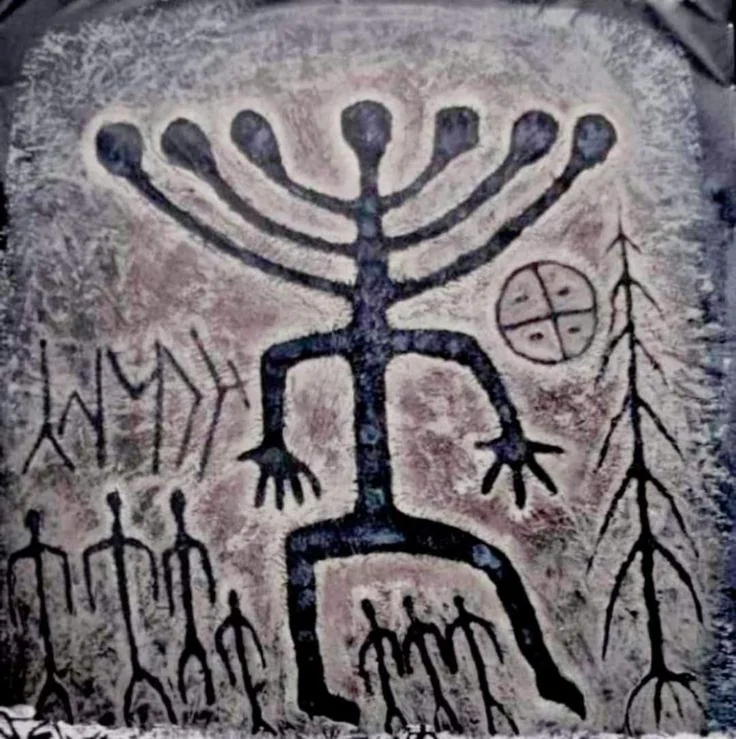
By the eleventh century teŋri was also the Muslim word for God. In the Kutadgu Bilig, written at the Karakhanid court in 1069–1070, Tengri creates tens of thousands of creatures and gives each thing its cause. The poet calls God bayat, the Lord, in his first line.[22] The Tengri of that book is the God of the Qur’an.
The comparisons
Two comparisons recur in popular accounts: Tengri with the Sumerian dingir, and with the Indo-European sky-god Dyeus. Neither is accepted as an etymological connection. Both are typological resemblances at most, and the first has been carried far past anything that has been argued philologically.
No derivation of the word is generally accepted. It has been derived from an isolated language, from Sumerian, from Yeniseian or Iranian by borrowing, and from Turkic.[23] The Turkic derivation most often preferred takes it from teŋir-, an older form of the verb tegir-, “to turn, to surround”, with the suffix -i.[24]
References
- ^ a b c d e f g h i j k l m n o Kül Tegin inscription
- ^ Kafesoğlu 1997, p. 309–311
- ^ Roux 1994, p. 91–92, 95–96
- ^ Tekin 1968, p. 398
- ^ Roux 1994, p. 90, 92
- ^ Ögel 2015, p. 289
- ^ Ögel 2000, p. 121–123
- ^ a b Zhou Shu (Book of Zhou), juan 50
- ^ Sui Shu (Book of Sui), juan 84
- ^ Jiu Tangshu (Old Book of Tang), juan 194
- ^ a b Pelliot 1929, p. 242–243
- ^ a b Han Shu, juan 94
- ^ a b Pulleyblank 1962, p. 239–240
- ^ Lattimore 1951, p. 450–451
- ^ Kafesoğlu 1997, p. 62, 250–251
- ^ Shiji, juan 110; Han Shu, juan 94
- ^ Erkoç 2026, p. 233
- ^ Movsēs Dasxurancʿi, book II; Dowsett 1961, p. 156
- ^ a b Movsēs Dasxurancʿi, book II; Dowsett 1961, p. 161
- ^ a b c Tekin 1993
- ^ Erdal 2004, p. 354,528–529
- ^ Kutadgu Bilig; Dankoff 1983, couplets 1, 1022, 1485
- ^ Erkoç 2026, p. 228
- ^ Erkoç 2026, p. 228–229
Sources
- Kül Tegin inscription
- Bilge Khan inscription
- Tonyukuk inscription
- Zhou Shu (Book of Zhou), juan 50
- Sui Shu (Book of Sui), juan 84
- Han Shu, juan 94 (after Shiji)
- Shiji, juan 110
- Movsēs Dasxurancʿi, book II
- Irk Bitig
- Kutadgu Bilig
- Jiu Tangshu (Old Book of Tang), juan 194
Literature
- Emre-E. Yavuz, The Gokturk Empire: 2nd Edition (2025)
- Talat Tekin, Irk Bitig: The Book of Omens (1993)
- Uno Harva, Die religiösen Vorstellungen der altaischen Völker (1938)
- Abdülkadir İnan, Tarihte ve Bugün Şamanizm: Materyaller ve Araştırmalar (2017; first edition 1954)
- Marcel Erdal, A Grammar of Old Turkic (2004)
- Charles J. F. Dowsett (trans.), The History of the Caucasian Albanians by Movsēs Dasxuranci (1961)
- Hayrettin İhsan Erkoç, Asya Hunlarında Dinî İnançlar (Religious Beliefs of the Xiongnu) (2026)
- Talât Tekin, A Grammar of Orkhon Turkic (1968)
- Jean-Paul Roux, Türklerin ve Moğolların Eski Dini (1994)
- Bahaeddin Ögel, Türk Kültür Tarihine Giriş II: Türklerde ziraat kültürü (2000)
- Bahaeddin Ögel, Büyük Hun İmparatorluğu Tarihi I (2015)
- Paul Pelliot, Neuf notes sur des questions d'Asie Centrale (1929)
- Edwin G. Pulleyblank, The Consonantal System of Old Chinese, Part II (1962)
- Owen Lattimore, Inner Asian Frontiers of China (1951)
- İbrahim Kafesoğlu, Türk Millî Kültürü (1997)
What links here35
- Persons
- Bumin Khan
- States
- Xiongnu
- Battles & Events
- The Great Sacrifice of the Gaoche · The khan's letter to Maurice
- Places
- Bodeng Ningli
- Religions
- Animism · Asena the She-Wolf (Gök Börü) · Ay Ata · Burial and the balbal · Erklig · Fire Worship · Gaoche Thunder Rite · Horse Sacrifice · Iye · Kam (Turkic Shaman) · Kün Tengri · Raising on the Felt · Shamanism · Stone Figures · Turkic Mythology · Ülgen and Kayra Khan · Umay · Water Cult · Yer-Su Spirits · Yol Tengri
- Customs & Pastimes
- Funeral Games of the Caucasian Huns
- Controversies
- The Huns and the Xiongnu
Cite this article
Yavuz, Emre-E. “Tengri.” Turkic Atlas, revised 8 November 2026. https://turkicatlas.org/religions/tengri/
Last revised: 8 November 2026

