
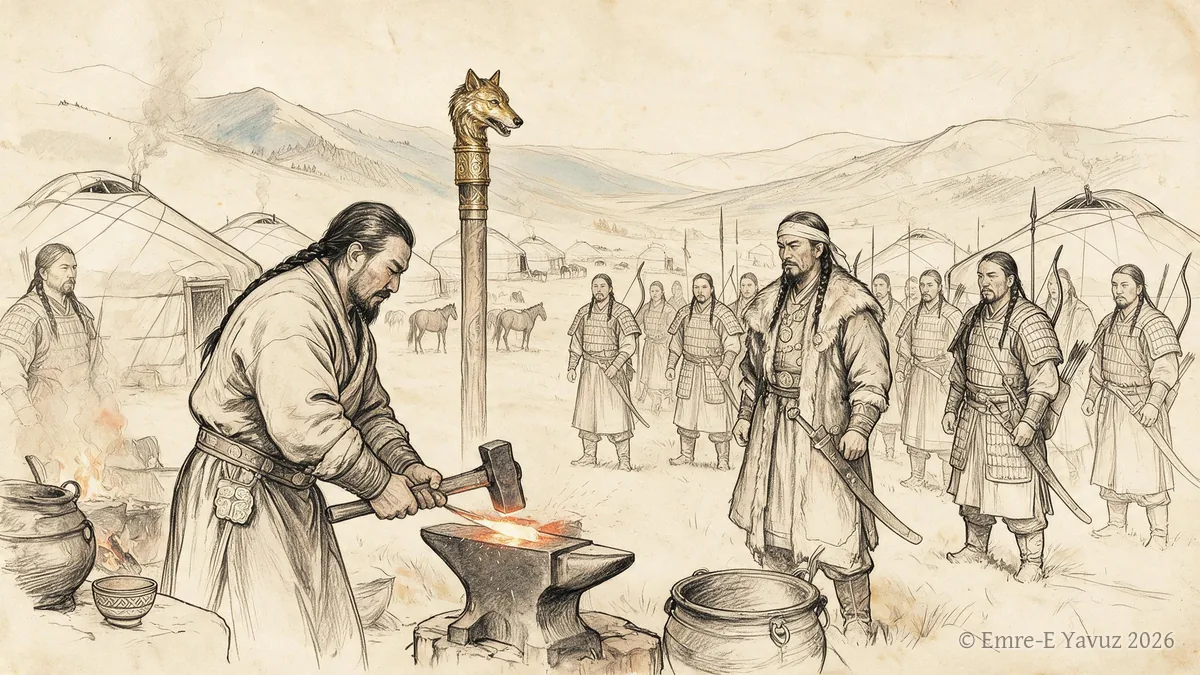
The Chinese histories call the people ruled by the Ashina 突厥.[1] The self-designation Türk is attested in the Kül Tegin inscription of 732. This is the earliest Turkic-language source for it.[2]
Türk names a polity and its people. It is not the same as Turkic, which is a modern label for a language family. The two are not interchangeable. The modern coinage Göktürk is used for the people. It has its own history. Turkic Atlas treats where and why it arose under that debate.
Reading of the name
In the runes of the Kül Tegin inscription, the name is spelled 𐱅𐰇𐰼𐰜. It ends in the sign for -ük.[2] It is read Türük.[3] A minority view does not read it so on the strength of the spelling alone. The same ligature stands in words that are not read with a vowel after the r, as körklüg is not read körüklüg. In addition, the name Türk is attested early and in places far apart.[4]
Meanings of the name
One scholar distinguishes two senses of the word in the inscriptions of the Göktürk and Uyghur khaganates. The first is gentile. Türk bodun, the most frequent compound of the runic texts, names a community that regarded itself as bound by common descent. The two origin legends the Chinese preserve both give an eponymous ancestor born of a she-wolf. The community was bound by common customary law, the türk törüsü, which held for begs and commoners alike. It was also bound by a common cult, the türk täŋrisi and the sacred land and water of the Göktürks. A common language came as the outcome of a stable political frame rather than as its precondition. The second sense is political. Türk was also the name for whoever was subject to the Göktürk khan, whatever his own people. The Kül Tegin inscription says of the Türgesh khan that he and his people had been our Göktürks and our people. It says of the Nine Oguz that they had been my own people.[2] A Khitan under the khan spoke a Mongolic language. He was a Göktürk in the second sense and not the first.
By this distinction, both meanings faded with the fall of the khaganate in 744. The political meaning faded at once, the gentile one after a time. The steppe offered no political frame stable enough to carry an ethnic community across the centuries. What survived were fragments: a language community, the Islamic genealogy that made Türk a son of Japheth, and in the Muslim and Greek sources a word for the nomad of the steppe as such. From this he draws a sound terminological rule: there were no Turkic peoples, only peoples speaking Turkic languages. A language community is a statistical set, not a community in any sociological sense. The formation of the Türk bodun as a tribal confederacy is placed in the fourth and fifth centuries. Its rise to the ruling confederation of an empire is placed in the middle of the sixth.
The Arabic sources use the word more widely still. Masʿudi calls three peoples of the upper Oxus Turks: the Wakhi, the Tibetans and the Aigan. The Wakhi, however, speak an Iranian language. Biruni calls the Tibetans and the kings of Kabul Turks.[5] Some scholars hold that for the Arab writers the nomadic way of life counted more than descent. The word therefore says little about the speech of a people.[6]
In 1069–1070, türk is the plain name of the poet’s own people. The Kutadgu Bilig calls the türk begleri, the begs of the Turks, the best among the lords of the world. It quotes a khan and a buyruk of the Turks, and it cites proverbs as türkçe.[7] These begs and khans are titles of authority rather than persons. The passages therefore show how the name was used, not who bore it.[8]
References
- ^ Zhou Shu (Book of Zhou), juan 50
- ^ a b c Kül Tegin inscription
- ^ Tekin 1968, p. 8, 317
- ^ Erdal 2004, p. 38–39
- ^ Markwart 1938, p. 102–103
- ^ Markwart 1938, p. 103
- ^ Kutadgu Bilig; Dankoff 1983, couplets 273, 276, 880, 1163, 3817
- ^ Dankoff 1983, p. 8–11
Sources
Literature
- István Zimonyi, Changing Perceptions of Türk Identity Among the Medieval Nomads of Central Eurasia (2018)
- Marcel Erdal, A Grammar of Old Turkic (2004)
- Talât Tekin, A Grammar of Orkhon Turkic (1968)
- Josef Markwart, Wehrot und Arang. Untersuchungen zur mythischen und geschichtlichen Landeskunde von Ostiran (1938)
- Robert Dankoff (trans.), Wisdom of Royal Glory (Kutadgu Bilig): A Turko-Islamic Mirror for Princes (1983)
What links here5
- Lineages
- Ashina
- Institutions and Titles
- Töre
- Religions
- Tengrism
- Sources
- Bugut inscription
- Controversies
- Xiongnu: Making the First Steppe Empire
Cite this article
Yavuz, Emre-E. “Göktürks.” Turkic Atlas, revised 8 November 2026. https://turkicatlas.org/ethnicities/turk/
Last revised: 8 November 2026

