
- 400
- 500
- 600
- 700
- 800
- 900
- Rouran 400–554
- First Göktürk 552–630
- Tang rule 630–682
- Second Göktürk 682–744
- Uyghur 744–840
- Kirghiz 840–924
- Huns 370–469
- Western Göktürk 552–659
- Türgesh 699–766
- Karluk 766–800
- Khazar 650–969
The Kutadgu Bilig is a long poem of advice to rulers, written in Turkic at the court of the Karakhanids and finished in 1069 or 1070. It is the oldest work of Islamic Turkic literature. It belongs to the tradition of the mirror for princes, and it is set as dialogues within a frame story.[1] Its title means “the wisdom that brings Kut”. Bilig is wisdom, and kut is the fortune that makes a man fit to rule.[1] The poet names the book himself: “I gave the book the name Kutadgu Bilig.”[2]
The author
The poet names himself only once in the poem, as Yusuf, in a line addressed to himself.[3] Everything else that is told of his life comes from two prologues added to the book later. They say that he came from Balasaghun, which they call Quz Ordu. They say that he left his homeland and finished the book in Kashgar. They also say that the ruler rewarded him with the title of chamberlain, from which he is known as Yusuf Khass Hajib.[4] The poem itself names neither Balasaghun nor Kashgar.[5]
In one couplet the poet says that his fiftieth year has laid its hand on him and turned his raven-black head white as a swan. In the next couplet the sixtieth is already calling.[6] If he wrote those lines in 1069, he was born about 1019.[7] The year of his death is not known.
Date and dedication
The poem dates itself twice. In the epilogue the poet says that he finished writing the book in the year 462 of the Hijra, which ran from October 1069 to October 1070.[8] The closing ode gives the same year and adds that the work took eighteen months.[9]
The fourth chapter, an ode to spring, praises the ruler: “The mighty Tavgach Bughra Khan has conquered the world.”[10] A few couplets later the poet offers the book as his gift. Thousands of hands, he says, have brought the khan precious things. Let this one be his, the Kutadgu Bilig, for the gifts of others come and go, but his remains forever.[11] The ruler was the reigning prince of Kashgar.[12] One reckoning identifies him with Hasan, son of Süleyman Arslan Khan, and has the book finished in the fourteenth year of his reign. The length of that reign is known only from a court document of Yarkend. The book itself gives no such name.[13]
Structure and the four figures
The poem runs to 6,645 couplets in the standard count. The first 6,520 are the work proper, and the rest are three odes.[14] It opens with praise of God, the Prophet and his companions, the ode to spring, and chapters on the planets and the zodiac, on wisdom and on the tongue.[15] Then the frame story begins.
Four figures carry the story, and the poet says what each stands for.[16] Kün-Toğdı, “Rising Sun”, is the king. He stands for törü, law and justice. Ay-Toldı, “Full Moon”, enters his service as vizier. He stands for Kut, fortune. Ögdülmiş, “Highly Praised”, the vizier’s son, stands for ukuş, intellect. Odgurmış, “Wide Awake”, a kinsman of the vizier who lives as an ascetic, stands for the end, the thought of the last things.[17] The names are allegorical and point to no historical persons.[18]
Full Moon serves the king and dies. His testament to his son fills a chapter.[19] Highly Praised becomes the king’s counsellor. The middle of the book sets out the duties of the prince, the vizier, the commander of the army, the chamberlain, the doorkeeper, the envoy, the secretary, the treasurer, the cook and the cupbearer.[20] The king then seeks out the ascetic Wide Awake. Letters pass between them and they debate. The book closes with the ascetic’s death and the king’s consolation of Highly Praised.[21] The poet sums the book up as “the path of religion and the path of the world”.[22]
Through the book the poet quotes sayings of authorities: the khan of the Turks, the beg of Ötüken, the yabgu of Böke, the irkin of the Ili, the hero Tonga Alp Er.[23] Apart from Tonga Alp Er they are titles rather than persons. The sayings and quatrains are the poet’s own composition.[24]
Language and form
The language is Karakhanid, substantially the same as that of the Orkhon inscriptions, of the Uyghur translation literature and of later Chagatay.[1] Some scholars count Karakhanid as Old Turkic, others assign it to Middle Turkic.[25] The poet calls the language türkçe. In his closing ode he says that he caught the Turkic word like a wild deer.[26] It has few Persian loanwords but many calques, Turkic words carrying Persian meanings.[27] God is bayat, the Lord, in the first line and Tengri elsewhere in the book.[28]
The metre is the Arabic and Persian mutaqārib. The poem rhymes in couplets, with quatrains set among them. The closing odes are monorhymed.[29]
The later prologues
Two prologues stand before the poem in the manuscripts, one in verse and one in prose. They were written later. The verse prologue perhaps dates from a century after the book, and the prose prologue summarises it.[30] The verse prologue says that the kings of the East and the princes of Machin took up the book and kept it in their treasuries. It says that the Turks and the Chinese together had no book like it.[31] It also says that every realm gave the book its own name. The people of Chin called it “Etiquette of Kings”, those of Machin “Companion of Kingdoms”, the nobles of the East “Adornment of Princes”, the people of Iran “Book of Kings”, and those of Turan Kutadgu Bilig.[32]
The manuscripts
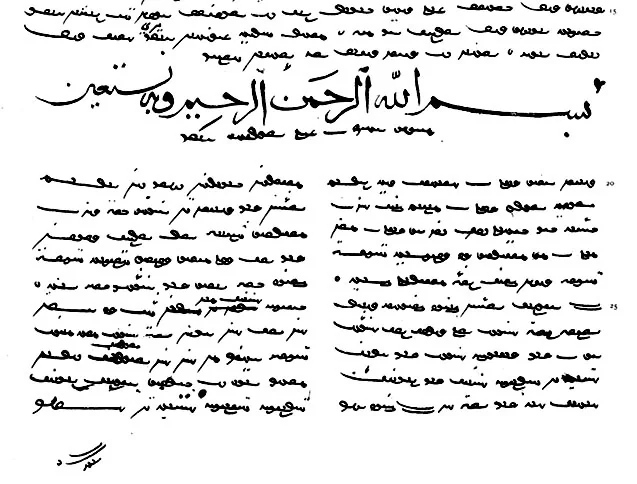
Three manuscripts survive, none of them from the poet’s lifetime. The one in Uyghur script was copied at Herat in 1439 from an exemplar in Arabic script, and it was the first to be known.[33] It is known as the Vienna manuscript and is the latest of the three.[34] A manuscript in Arabic script was found in 1896 in the Khedival Library in Cairo. It alone keeps the first two odes, and in the fourteenth century it belonged to a Mamluk emir.[35] The third, also in Arabic script and the most careful of the three, was seen in a private library at Namangan in the Fergana valley in 1913. Its beginning is lost, and it breaks off at couplet 6232.[36] All three go back to a single later redaction.[37] The copy presented to the khan may have been in Uyghur script.[38] The Vienna manuscript dates from the Timurid period, and its text counts as evidence only when read beside the other two. The first edition, of 1891, was made from it alone. The critical edition of 1947 uses all three.[39] The opposite view is that the Uyghur-script manuscript is a secondary transcription.[40]
Reliability
The Kutadgu Bilig names no event, no place of its own day and no living person besides its patron. It is a didactic poem, not a history.[41] What it offers is the vocabulary of a Turkic court four centuries after the Göktürks. Kut, törü, el, beg, tamga, tuğ and ordu are all in use there, and so are the titles ilig, khan, yavğu, buyruk and erkin.[5] The book shows how these words were used at a Muslim court in 1069. It cannot show what they meant to the khans of the inscriptions. It is a witness for the eleventh century. Its nearest companion is the dictionary of Mahmud al-Kashgari, the Dīvān Lughāt al-Turk, written in the same decade in the same realm.[42]
References
- ^ a b c Dankoff 1983, p. 1
- ^ Kutadgu Bilig; Dankoff 1983, couplet 350
- ^ Kutadgu Bilig
- ^ Dankoff 1983, p. 258–261
- ^ a b Kutadgu Bilig
- ^ Kutadgu Bilig; Dankoff 1983, couplets 365–366
- ^ Hacib 2006 (Birinci Basım Nisan 2006, İkinci Basım Eylül 2008), p. 27
- ^ Kutadgu Bilig; Dankoff 1983, couplet 6495
- ^ Kutadgu Bilig; Dankoff 1983, couplets 6623–6624
- ^ Kutadgu Bilig; Dankoff 1983, couplet 88
- ^ Kutadgu Bilig; Dankoff 1983, couplets 112–115
- ^ Dankoff 1983, p. 2–3
- ^ Hacib 2006 (Birinci Basım Nisan 2006, İkinci Basım Eylül 2008), p. 14–15, 22–23
- ^ Hacib 2006 (Birinci Basım Nisan 2006, İkinci Basım Eylül 2008), p. 66
- ^ Kutadgu Bilig; Dankoff 1983, couplets 1–397
- ^ Kutadgu Bilig; Dankoff 1983, couplets 353–358
- ^ Kutadgu Bilig; Dankoff 1983, couplets 353–357
- ^ Dankoff 1983, p. 14–15
- ^ Kutadgu Bilig; Dankoff 1983, couplets 1342–1547
- ^ Kutadgu Bilig; Dankoff 1983, couplets 1921–2956
- ^ Dankoff 1983, p. 28–29
- ^ Kutadgu Bilig; Dankoff 1983, couplet 6498
- ^ Kutadgu Bilig; Dankoff 1983, couplets 277, 1962, 3817, 4752, 5523
- ^ Dankoff 1983, p. 8–11
- ^ Erdal 2004, p. 8,21
- ^ Kutadgu Bilig
- ^ Dankoff 1983, p. 10–11
- ^ Kutadgu Bilig; Dankoff 1983, couplets 1, 1022, 1485
- ^ Dankoff 1983, p. 32–35
- ^ Dankoff 1983, p. 34
- ^ Dankoff 1983, p. 258
- ^ Dankoff 1983, p. 258–259
- ^ Hacib 2006 (Birinci Basım Nisan 2006, İkinci Basım Eylül 2008), p. 37–39
- ^ Dankoff 1983, p. 12–13
- ^ Hacib 2006 (Birinci Basım Nisan 2006, İkinci Basım Eylül 2008), p. 42–43
- ^ Hacib 2006 (Birinci Basım Nisan 2006, İkinci Basım Eylül 2008), p. 41
- ^ Hacib 2006 (Birinci Basım Nisan 2006, İkinci Basım Eylül 2008), p. 36
- ^ Hacib 2006 (Birinci Basım Nisan 2006, İkinci Basım Eylül 2008), p. 37
- ^ Erdal 2004, p. 9, 22
- ^ Erdal 2004, p. 37
- ^ Hacib 2006 (Birinci Basım Nisan 2006, İkinci Basım Eylül 2008), p. 31
- ^ Dīvān Lughāt al-Turk
Literature
- Yusuf Has Hacib; çeviren Reşid Rahmeti Arat, Kutadgu Bilig (2006 (Birinci Basım Nisan 2006, İkinci Basım Eylül 2008))
- Yusuf Has Hacib; Text after Reşid Rahmeti Arat, Kutadgu Bilig Metni (Webseite „Kutadgu Bilig Dizini“, Ausdruck vom 2015-04-30) (2015-04-30 (Ausdruck))
- Robert Dankoff (trans.), Wisdom of Royal Glory (Kutadgu Bilig): A Turko-Islamic Mirror for Princes (1983)
- Marcel Erdal, A Grammar of Old Turkic (2004)
Articles resting on this source 51
Afrasiab · Asena the She-Wolf (Gök Börü) · Ayran · Balasaghun · Beg · Bread · Buddhism among the Göktürks · Burial and the balbal · Buyruk · Captives and the Unfree · Composite bow · Drums and Banners for the Khans · Envoys and Embassies · Er At · Feasts in Kashgari's Dictionary · Felt · Göktürk Weapons · Göktürks · Honour of Death in Battle · Horse harness · Illig · Irkin · Islam · Kam (Turkic Shaman) · Kara-Khanid Khanate · Khan (Khagan) · Kumys · Kün Tengri · Kut · Millet · Ordu · Ötüken · Peri · Post and Communication · Qurut · Sacred Mountains · Salt among the Turkic Peoples · Seating at the Feast · Steppe Diet · Tamga · Tengri · Tengrism · Terken · The Turkic languages · The twelve-year animal cycle · Töre · Toy · Tuğ · Tuoba · Turkic Mythology · Yabgu
What links here45
- Persons
- Afrasiab
- States
- Kara-Khanid Khanate
- Places
- Balasaghun · Ötüken
- Institutions and Titles
- Beg · Buyruk · Composite bow · Drums and Banners for the Khans · Felt · Göktürk Weapons · Honour of Death in Battle · Horse harness · Illig · Irkin · Khan (Khagan) · Kut · Ordu · Salt among the Turkic Peoples · Tamga · The twelve-year animal cycle · Töre · Toy · Tuğ · Yabgu
- Religions
- Asena the She-Wolf (Gök Börü) · Buddhism among the Göktürks · Burial and the balbal · Islam · Kam (Turkic Shaman) · Tengri · Tengrism · Turkic Mythology
- Languages
- Old Turkic · The Turkic languages
- Customs & Pastimes
- Er At · Feasts in Kashgari's Dictionary · Seating at the Feast
Cite this article
Yavuz, Emre-E. “Kutadgu Bilig.” Turkic Atlas, revised 8 November 2026. https://turkicatlas.org/sources/kutadgu-bilig/
Last revised: 8 November 2026


