
Twenty years after Bumin, the khaganate was the largest state the steppe had produced and could not decide who should rule it. This path follows the quarrel from the assembly of 581 to the exile of Tardush in 603: the khan who submitted to China, the cousin who would not yield, the son of Istemi who reached for everything, the brother who marched into Persia, and then the western realm that came out of it, from Suyab to the walls of Tiflis, told where the readings agree and marked where they do not.
1/10
Göktürk Succession Crisis (581)
581–582
The assembly that overrode a dying khan's wish, and the two candidates it made enemies.
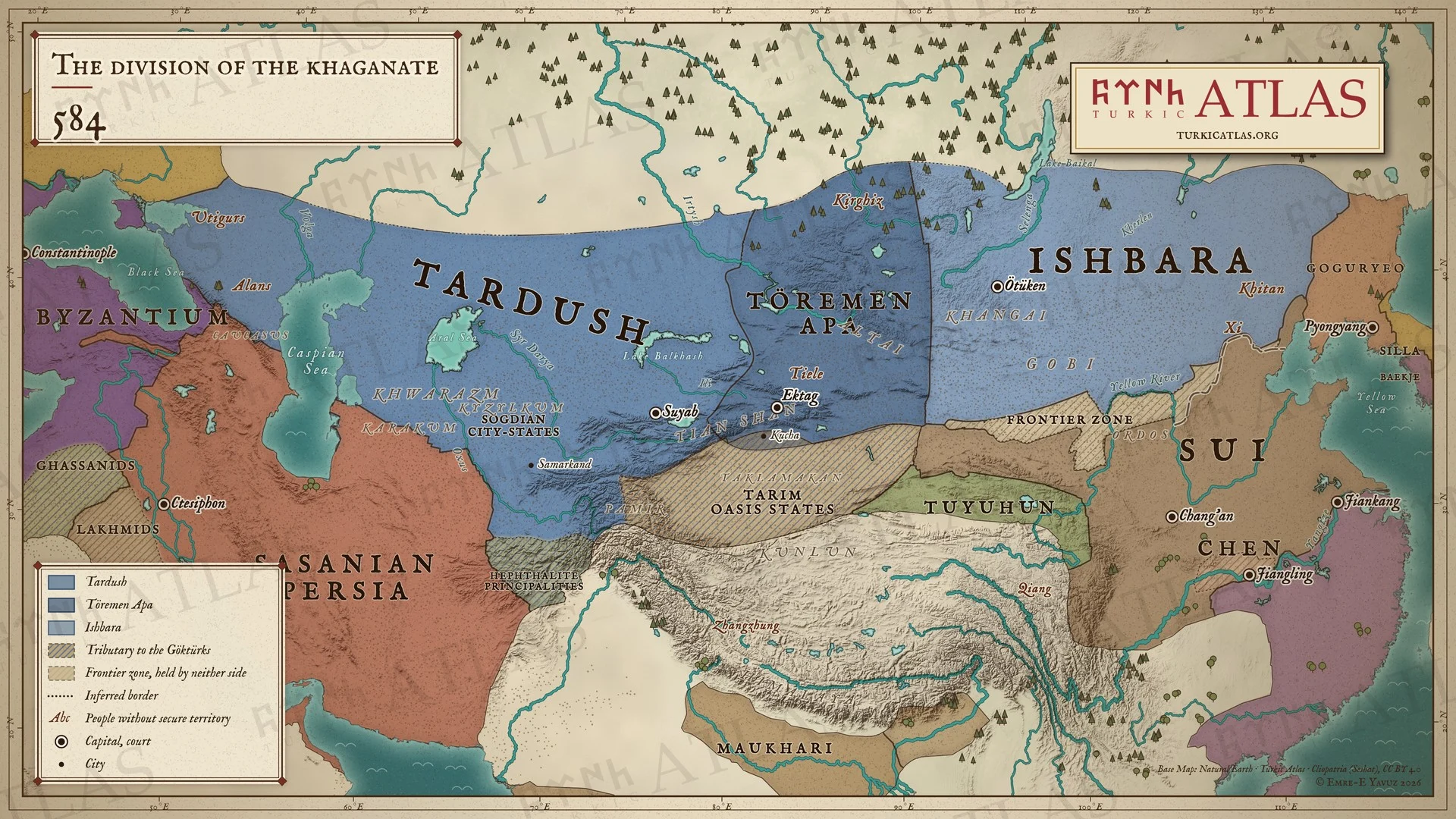
When Taspar Khan died in 581, his wish was that the throne should pass to Töremen, the son of his brother Mukan, and not to his own son Amrak. The nobility assembled at Ötüken refused it. Ishbara, the son of Bumin's eldest son Issik, objected that a khan had no right to name his successor and that Töremen's mother had not been a Göktürk. He threatened revolt, and the assembly elected Amrak. Within a year Töremen raised his following, and Amrak abdicated in favour of Ishbara. Töremen, known from then on as Apa Khan, went to war, and Tardush, the yabgu of the west, took his side. Over the next three years the quarrel turned into the civil war that divided the khaganate for good.
2/10
Ishbara Khan
582–587
The khan who won the throne, lost the war and wrote to the Sui that two suns do not shine in the heavens.
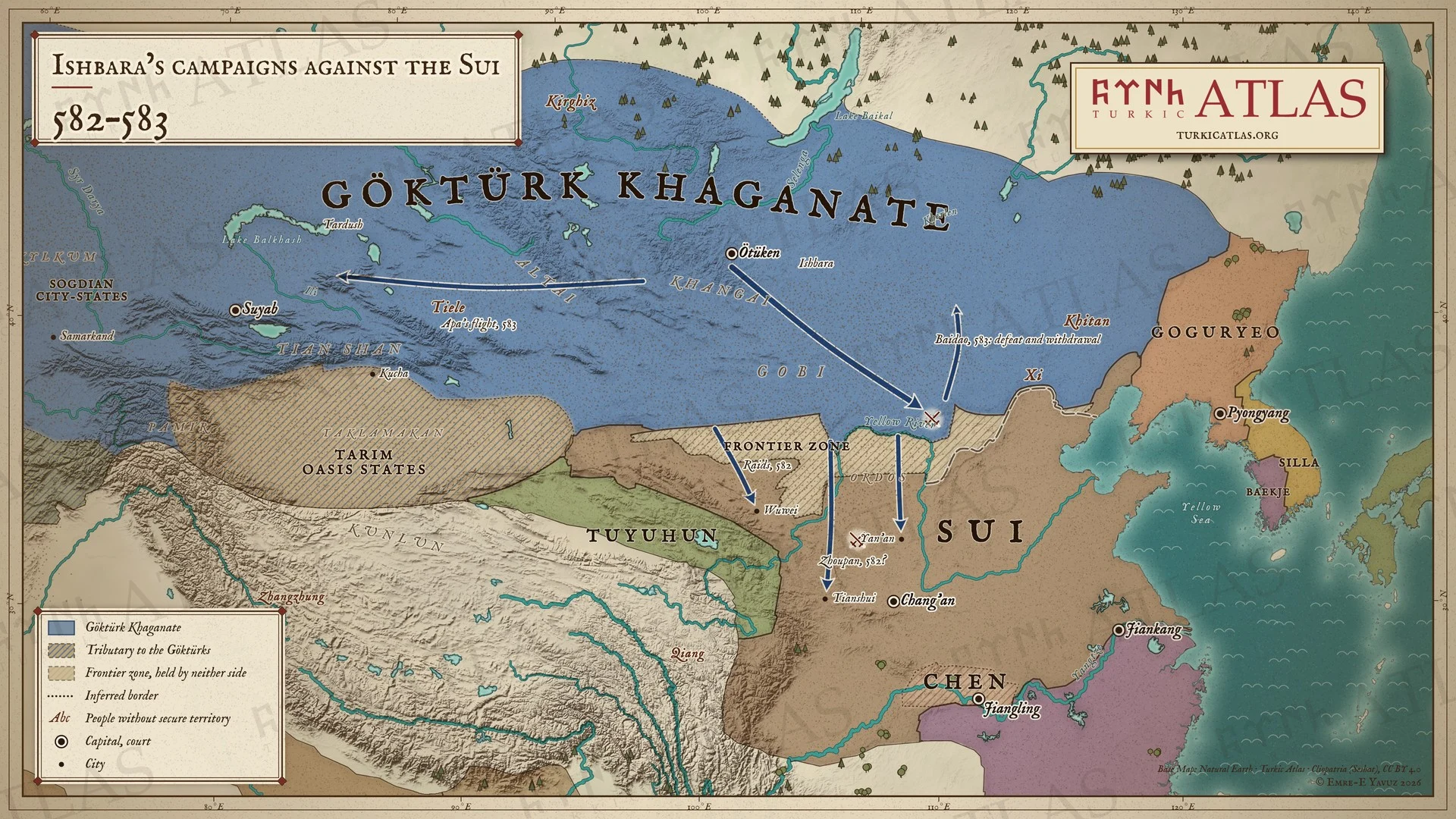
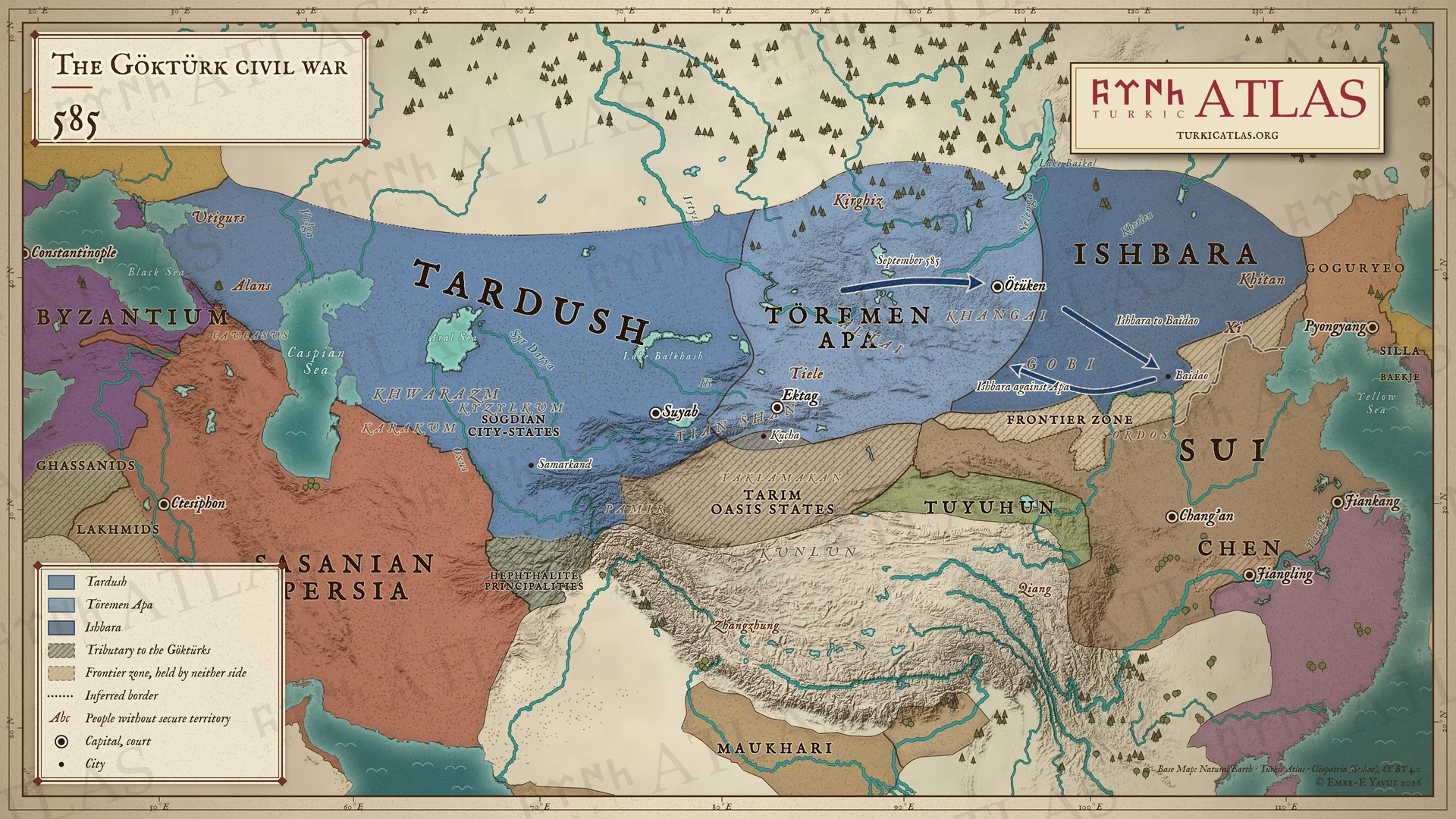
Ishbara had held the east as lesser khan since 572, and after Amrak stood down he was acclaimed at Ötüken. His wife Qianjin, a princess of the Northern Zhou, hated the Sui founder, who had destroyed the Zhou and slaughtered its court. At her urging Ishbara invaded China in 583 with Apa, Tardush and his brother Bagha, and for the first time the Göktürks held a broad strip of the north. Then a Tiele rising drew Tardush back to the west, and in June the Sui broke the remaining army near Baidao. In 585, pressed by Tardush, Ishbara declared himself a vassal of the Sui. Since two suns do not shine in the heavens, he wrote to the emperor, only one ruler can reign on earth. He died in 587, and the emperor declared three days of mourning.
 First Göktürk Khaganate
 Ashina
3/10
Töremen Apa
† 587
The cousin passed over twice, whose mother Ishbara killed, and whose line may have ruled the west.
Töremen, the son of Mukan, was passed over in 581 for Amrak and then for Ishbara, and received the title Apa Khan. After the defeat at Baidao in 583, Ishbara grew fearful of him, raided his camp and killed his mother, Ishbara's own aunt. Apa fled west to Tardush and fought on from Suyab. In 587 Bagha marched against him under banners the Sui emperor had sent. Apa's men took them for a sign of Sui troops and came over, and Bagha took Apa alive. The emperor spared him, and the Sui Shu says no more of him. One reading derives the later khans of the west from Apa rather than from Istemi.
- First Göktürk Khaganate
- Ashina
4/10
Tardush
576–603
Istemi's son: the yabgu who moved the seat to Suyab, backed Apa, and for three years held the whole khaganate.
Tardush succeeded his father Istemi as yabgu of the west in 576. He moved the seat from the Altai to Suyab on the Chu, which the Göktürks called Ordukent, the city of the army. When Apa rose against Ishbara, Tardush took his side and received Apa and the others whom Ishbara had forced out of the east. In 585 his attack pressed Ishbara into vassalage to the Sui, and in September the western army marched on Ötüken. One reading has Tardush hold supreme power over east and west from about 600 to 603; a second has his march east fail without a single battle. About 603 a rising of the Tiele, encouraged by the Sui, drove him to the Tuyuhun, and he disappeared.
- Ashina
5/10
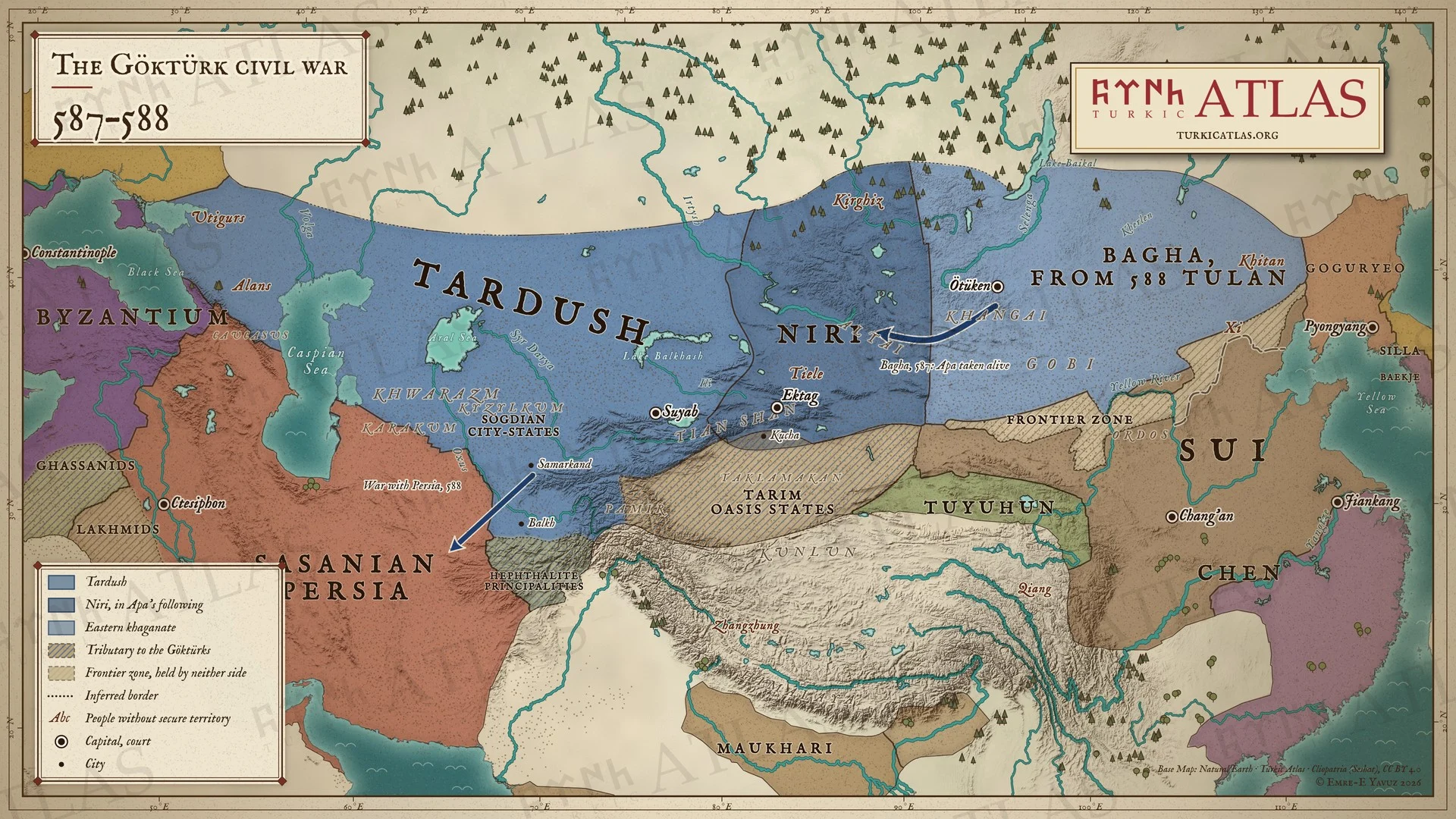
The Göktürk Civil War
584–603
The twenty years as one event, with what each source says and where the readings part.
One reckoning dates the civil war from 584 to about 603; a second begins it with Tardush's revolt about 582. Its main witness is the Göktürk chapter of the Sui Shu, compiled for the dynasty that profited from the war, and Theophylact Simocatta reports a civil war among the Göktürks from the Byzantine side. The division of the realm is dated to 583 by one reading, to 587 by a second and to 603 by a third. One reading blames the lateral succession, which left the princes governing parts of the realm while they waited for the throne. A second weighs the Sui and their agents more heavily. The Kül Tegin inscription names both causes: ignorant khans, and Chinese who set brother against brother. What the war left was two states where there had been one.
- First Göktürk Khaganate
6/10
Bagha Khan
587–588
The lesser khan who crossed the Oxus, or did not: Bagha by one reading, Šāba by a second.
Bagha, the Chuluohou of the Chinese histories, was Ishbara's brother. When Ishbara died in 587, he passed over his own son Yongyulü as weak of character and left the throne to Bagha. The Sui emperor sent the new khan drums, pipes and banners, and under those banners Bagha marched west and took Apa alive. Later he campaigned in the west a second time and was killed by a stray arrow; the Sui Shu gives no year. One reading makes that campaign the invasion of Persia in 588 and has Bagha fall at the Hyrcanian rock. A second gives the invasion to Tardush's son, the Šāba of the Persian tradition, and the defeat to Herat in 589. The equation of Bagha with Šāba remains a hypothesis.
- First Göktürk Khaganate
- Ashina
7/10
Göktürk–Persian war, 588–589
588–589
Balkh, Herat, the Hyrcanian rock, and Bahram Chobin, who won this war and then lost his own.
In 588 a Göktürk army crossed the Oxus and took Balkh, Herat, Talakan and Badghis. Tabari calls its king Šāba and gives him three hundred thousand men; a more realistic figure lies between twenty and thirty thousand. The Sasanian king Hormizd IV sent his general Bahram Chobin against him with twelve thousand, and Bahram killed Šāba with an arrow. One reading sets the decisive battle in April 588 at the Hyrcanian rock; a second puts the defeat at Herat in 589. The victory made Bahram strong enough to turn against his own king. He proclaimed himself king of kings, lost to the young Khosrow II and fled to the Göktürks, where he rose to be a respected general at Suyab until Khosrow had him killed. The general who had beaten the Göktürks spent his last years in their service.
 Sasanian Persia
8/10
Tulan Khan
588–599
The eastern khan of the divided realm, killed by his own men in 603.
Tulan, the Yongyulü of the Sui Shu, had served Bagha as yabgu, and when Bagha fell in 588 his people raised Tulan as khan in the east. He inherited a state whose khan had become a vassal of the Sui, and he tried to undo it. In 597 Ishbara's son Yami sent secretly to the Sui for a princess and, at the price the chancellor Pei Ju named, had Qianjin, now Tulan's wife, murdered. Tulan attacked the Sui, and each time the Chinese armies stood ready, because Yami was writing to Pei Ju. In 599 Tulan and Tardush drove Yami to the Sui court. Before the Sui army sent against Tulan had left the frontier, his own followers killed him. Tardush proclaimed himself Bujia Khan, and the eastern realm fell into chaos.
- First Göktürk Khaganate
- Ashina
9/10
Tong Yabgu
618–630
The high point of the west: Suyab, Xuanzang, Derbent, Tiflis, and the emperor's diadem.
Tong Yabgu ruled the western Göktürks from 618 to 630, and in those years the west was a great power for the last time. He reunited the quarrelling west, brought the Tiele to full submission and extended his rule over Afghanistan as far as Gandhara. In 627 he allied with the emperor Heraclius against Persia, and his nephew Börü Shad led an army through Derbent into the Caucasus. Before Tiflis the yabgu and the emperor met, and Heraclius called him his son and crowned him with his own diadem. After a long siege the Göktürks took and sacked the city. In 629 the Chinese pilgrim Xuanzang found him at Suyab in a robe of green satin, among two hundred ministers in embroidered robes. In 630 his uncle murdered him, and the west dissolved into the Ten Arrows.
- Ashina
10/10
Western Göktürk Khaganate
552–657
The realm entire, from Istemi to the Ten Arrows and the Türgesh.
The western khaganate began in the 550s as Istemi's command under the khan at Ötüken, and in his lifetime it reached the Oxus and the Volga. It broke away in the civil war, when Tardush reached for the whole khaganate and lost even his own half. Under Tong Yabgu it rose once more. After his murder in 630 it dissolved into the Ten Arrows, two unions of five tribes whose chieftains had each received an arrow as a sign of authority. The Tang took the confederation over in 657, and its last Ashina khan, Ashina Helu, fell into their hands. The Türgesh leaders held the west from 699 to 738, and by 766 the Karluks held Suyab. It was the half of the state in which the Göktürks were fewest, and the half that soonest ceased to be a state.
© Emre-E Yavuz 2026© Emre-E Yavuz 2026© Emre-E Yavuz 2026© Emre-E Yavuz 2026
