
- 400
- 500
- 600
- 700
- 800
- 900
- Rouran 400–554
- First Göktürk 552–630
- Tang rule 630–682
- Second Göktürk 682–744
- Uyghur 744–840
- Kirghiz 840–924
- Huns 370–469
- Western Göktürk 552–659
- Türgesh 699–766
- Karluk 766–800
- Khazar 650–969
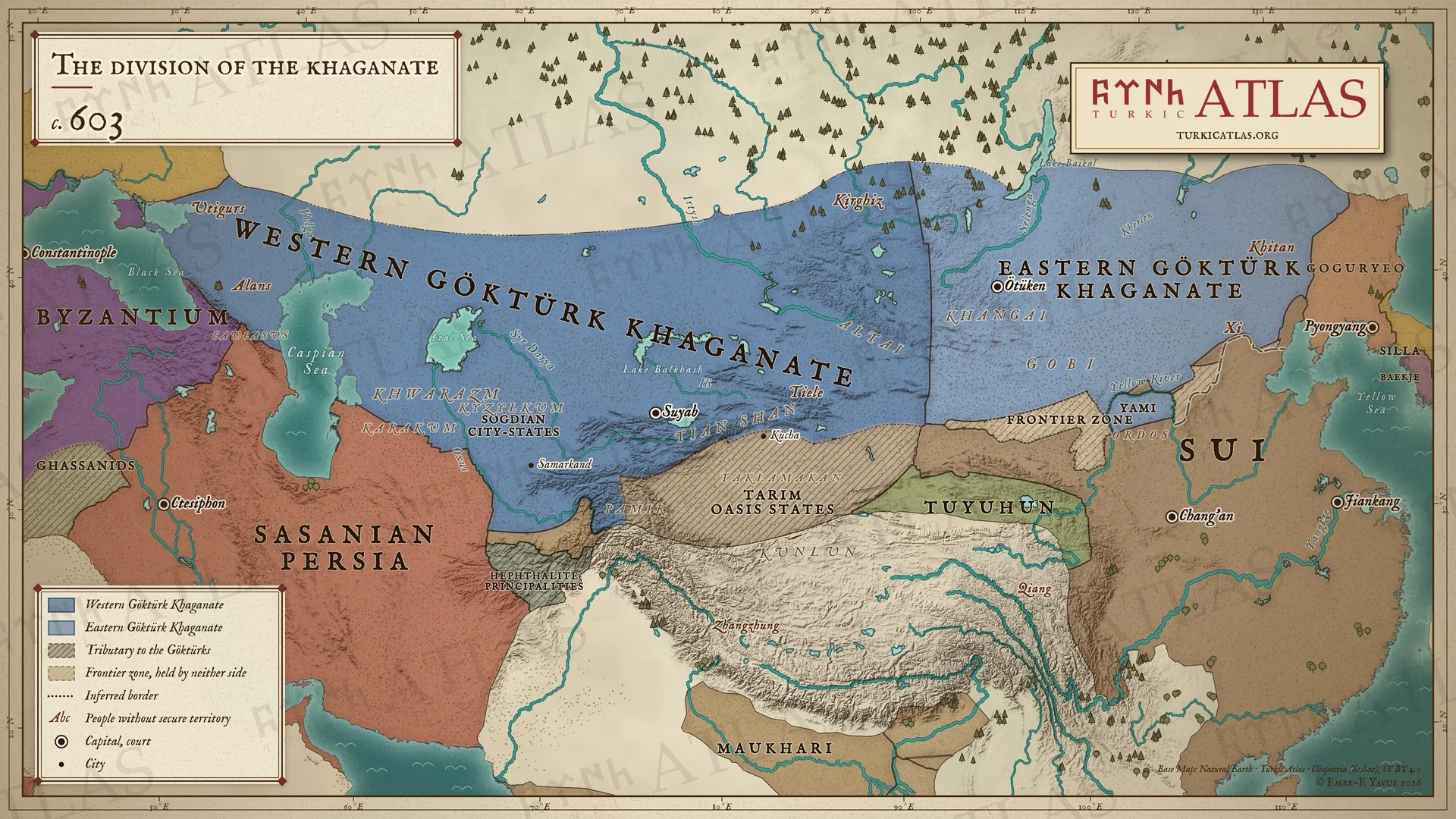
The civil war was the twenty years in which the First Göktürk Khaganate destroyed itself. It began in the quarrel over Taspar’s succession. Four princes of the Ashina, Ishbara, Töremen Apa, Amrak and Tardush, found that the throne could not hold all of them. The Sui fed the conflict. This new China fought the Göktürks with agents rather than soldiers. The war ended about 603. The eastern khan was a Chinese client, the western yabgu was in exile, and the realm had divided into two states that never reunited. One reckoning dates the war from 584 and its end to 603.[1] Another reckoning dates Tardush’s revolt, the war’s most serious threat, from about 582. It has Tardush hold supreme power in the united khaganates from about 600 to 603, before his fall.[1]
The war is known from the Chinese histories, above all the Göktürk chapter of the Sui Shu. The text was compiled for the dynasty that profited from the war. Theophylact Simocatta reports a civil war among the Göktürks from the Byzantine side. Not all the names he gives have been identified. Two centuries later, the Kül Tegin inscription gives the Göktürks’ own account of why it happened.
Causes
The cause was structural. In theory, succession to the supreme khaganate was lateral, from brother to brother and then to their sons. The sequence was frequently broken.[1] The notion of the royal clan’s collective sovereignty made the system unstable. This instability proved a fatal flaw in the structure of the first and second khaganates.[1] While awaiting their turn, the Ashina princes governed the parts of the realm. This created, in effect, an appanage system.[1] A second summary is personal. Princes had been raised all their lives to rule and were then not allowed to. Their greed for power was too great for the war to be averted. Both are positions. The Töre article sets out what is known of the rule the princes broke.
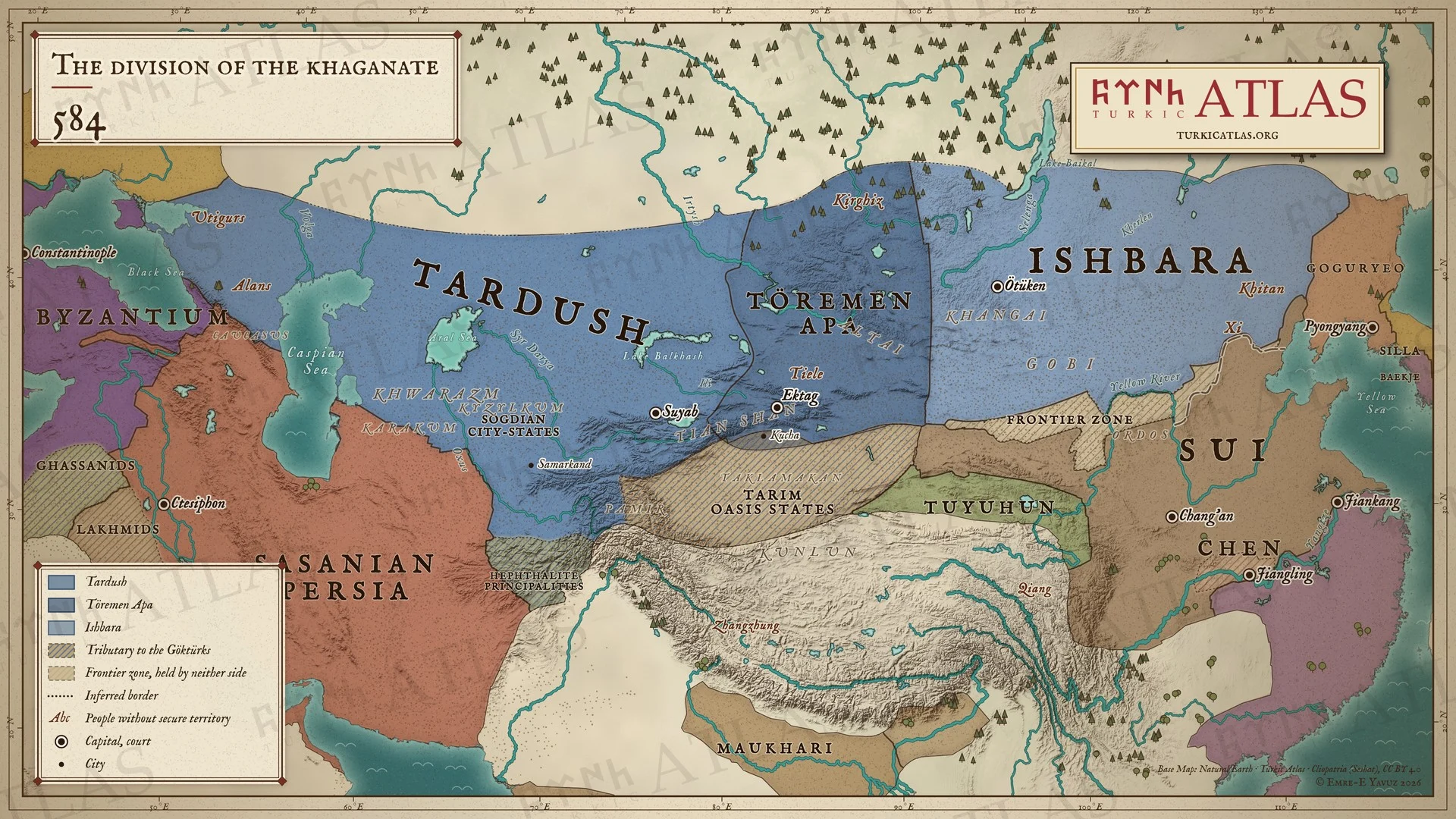
Four men made the war. Ishbara, the son of Issik, had been made a lesser khan in the east by Taspar in 572. The assembly of 581 raised him to khan after Amrak stood down.[2] Töremen, Mukan’s son, had been Taspar’s own choice to succeed him. The assembly refused him. He took the title Apa Khan and rose.[2] Amrak, Taspar’s son, was elected. Within the year he was gone.[2] Tardush, Istemi’s son, had been yabgu of the west since 576. He took Apa’s side and reached for the whole.[2] A fifth man, Bagha, was Ishbara’s brother. He fought in the east and died in the west.[2]
Ishbara at Ötüken (581–583)
Ishbara was acclaimed supreme ruler under a string of titles that the Chinese preserve: Ilig Külüg Šad Baga Ishbara Khan. He established himself at Ötüken, the sacred territory of the Ashina.[2] Amrak, on the Tola, was proclaimed second khan. Töremen was given the title Apa Khan.[2] The Sui Shu comments that Ishbara was brave and won the hearts of his subjects. According to the text, all the northern barbarians submitted to him.[2] His wife was a Northern Zhou princess, Qianjin. She hated the Sui, who had slaughtered her house in 581. At her urging, Ishbara invaded China in 582 with Apa, Tardush and Bagha beside him. For the first time, the Göktürks held a broad strip of the north. A rising of the Tiele in the west drew Tardush off. In June, a Sui surprise attack near Baidao broke the Göktürk army. Disease followed the retreat. Chinese agents in the army set the commanders against each other. In the same year, Ishbara wrote to the Sui court in the language of the inscriptions, calling himself “born by Heaven, wise and holy son of Heaven of the empire of the great Türk”.[2]
Weather may have played a part. A tree-ring study finds extreme conditions in the years 581 to 583. The first years of the civil war are set against them, as the six years of Bumin’s war are set against the extreme years of 536 to 545. A lake record from the western Khangai traces the same decades through the grass. The first khaganate rose in favourable conditions. Around 600, however, the Late Antique Little Ice Age reached Mongolia with long hard winters, livestock deaths and famine. Its authors suggest that failing grassland may have undercut the khaganate’s power base and contributed to its disintegration in about 603.
Break (583–585)
Ishbara grew fearful of Apa, who appears to have been dealing with the Sui. He turned on him, raided his camp and killed his mother, who was Ishbara’s own aunt. Apa fled to Tardush in the west.[2] Ishbara also purged the east of rivals. He took the people of Tanhan Khan, a long-standing friend of Apa, and deposed him. Tanhan fled to Tardush.[2] Ishbara’s younger cousin Diqincha led tribes of his own and had quarrelled with him. He went over to Apa with his people. The Zizhi tongjian dates both events to 583.[3] According to a further report, Ishbara pursued Apa west and beat him twice. In the same report, he took the obedience of the local rulers and merged their armies with his own. Begs went over to Apa in horror. Within two years the relations of the khaganate had turned upside down. The begs, not the khan, decided its course. Modern accounts date the split of the eastern and western halves of the realm to this struggle within the royal clan.
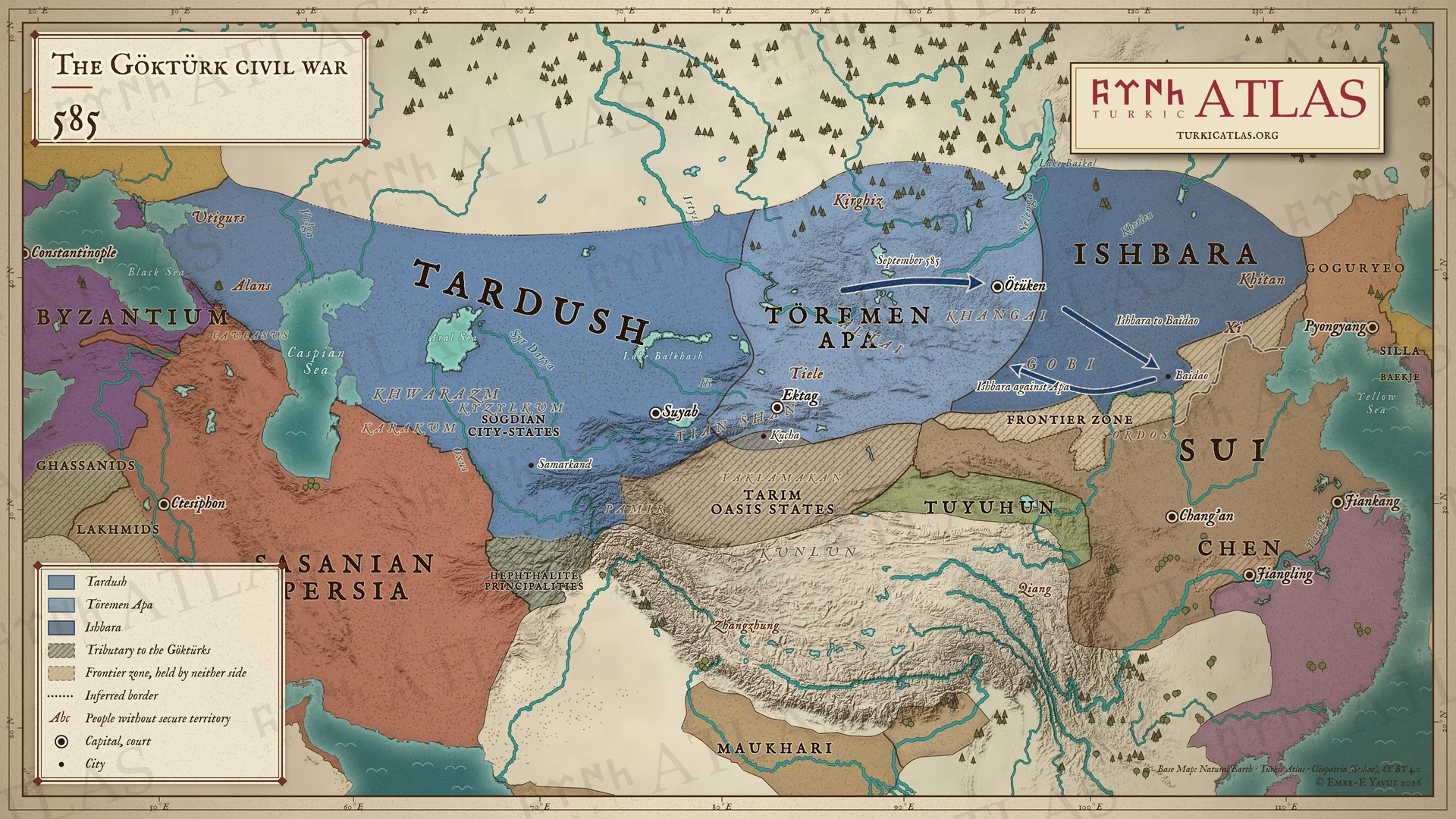
By the likeliest estimate, Tardush had a hundred thousand men, with the forcibly recruited Tiele among them. Ishbara had thirty or forty thousand. In 585, pressed by an attack from Tardush, Ishbara turned to China. He declared himself a vassal of the Sui.[2] In his letter to the emperor, Ishbara wrote that since two suns do not shine in the heavens, only one ruler can reign on earth, and that the emperor of the great Sui is the true emperor.[2] This subservience was a preview of things to come. It was not so much the success of Chinese arms as the result of the centrifugal forces pulling at the Göktürk state.[1] The mechanism was Qianjin. Sui envoys courted her and gave her the Sui title of princess Dayi. She urged her husband to seek Chinese protection. A Sui agent named Zhangsun Sheng had spent years at Ötüken as a diplomat. He recorded every institution and event and reported to the emperor. He also sent further agents to the western court. The Sui played Ishbara against the stronger western Göktürks. In case the east should fall, they planted the seed of the next civil war in the west. In September 585, the western army marched on Ötüken. Ishbara had already fled to China.
Death of Ishbara and capture of Apa (587)
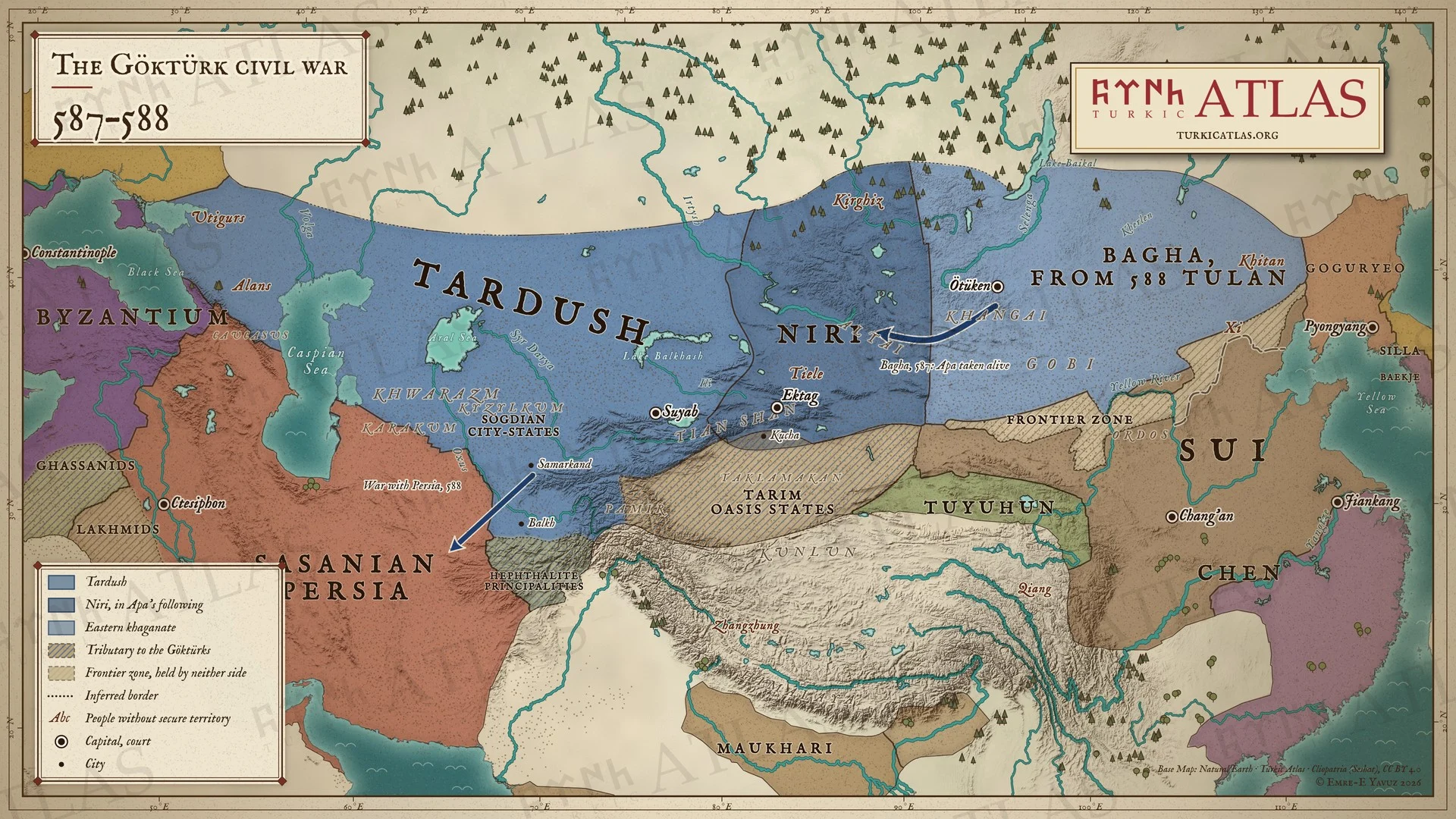
Ishbara died in 587, a little more than a month after his royal tent had burned at the Zihe garrison. The Sui emperor declared three days of mourning and sent five thousand bolts of silk to the Göktürks.[2] An illness of a month is also reported.[4] By his will, the throne passed not to his son Yongyulü but to his brother Bagha. Bagha took it as Yehu Khan, with Yongyulü as his yabgu.[2] Bagha marched west against Apa under the drums and banners the Sui emperor had sent him. Apa’s men took them for a sign that Sui troops were near and came over in great numbers. Bagha took Apa alive.[2] On the chancellor Gao Jiong’s advice, the emperor spared the captive.[2] In the west, Apa’s people raised Niri, the son of Yangsu Tegin, as their khan.[2] Bagha fell to a stray arrow on a second campaign in the west. In 588, Yongyulü succeeded him as Tulan Khan. By then the division of the khaganate was complete.[2] Theophylact reports a civil war among the Göktürks and names three great khans of it who remain unidentified. Károly Czeglédy dates that war to 581–582. Mikhail Artamonov and Lev Gumilev date it to 598. Both datings stand.[1]
Tardush’s war (588–603)
The war’s western chapter was fought against Persia. In 588, a Göktürk army crossed the Oxus and took Balkh, Herat and the cities of Bactria. Bahram Chobin destroyed it.[1] The war has its own article. Who led the army is disputed: reports name Bagha or Tardush’s son.[1] By 598, Tardush had recovered from the defeat and from domestic disturbances. He then moved to establish his dominion over the whole steppe empire. From about 600 to 603 he held supreme power in the united khaganates. Other sources tell it differently. Tardush’s plan to win support by a victory over China failed. His army suffered massive losses on the long march east and from poisoned wells, without fighting the Sui once. The Tiele and other tribes then revolted and drove him out. The two accounts agree on the end. About 603, Tardush faced a massive revolt of the Tiele and other tribes, which the Sui Shu names. The Sui had instigated or encouraged it. Tardush fled to the Tuyuhun and disappeared. He is also said to have died in northern Tibet in the same year.[2]
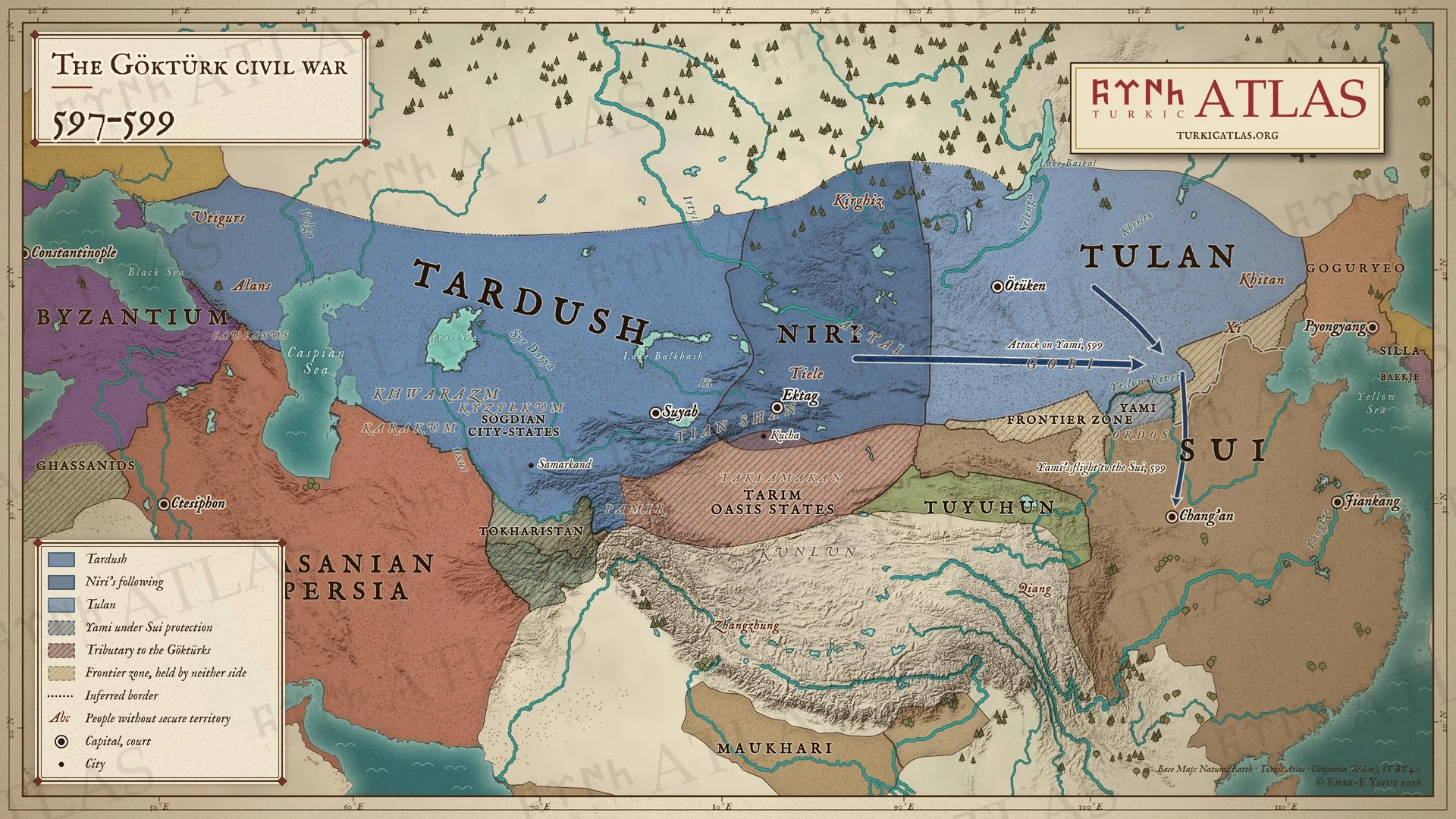
In the east the war had already produced its last turn. Ishbara’s son Yami sent secretly to the Sui in 597. He had Qianjin, now Tulan’s wife, murdered at the Sui chancellor’s price. He received a Sui princess and the title of khan as a rival to Tulan.[2] Tulan was killed by his own followers in 599. After Tardush’s fall, Yami marched into Ötüken with Göktürk and Chinese troops.[2] Tulan’s death is put in 603 in one report.[5] Modern accounts see the march as the breaking of a taboo, on the ground that Ötüken was sacred land free of armies. The sources do not state the taboo. Yami was now a Sui client at Ötüken, and Tardush was gone. The final division of the realm is therefore best dated to 603.
Consequences
The details of the throne struggles are not worth tracing. What counts is that the Sui tried to keep all the parties off balance. The fall of the first khaganate is attributed to the disorder of the Göktürk succession system.[1] Others weigh the Sui more heavily. They fought with spies and agents, courted the khan’s wife, planted diplomats at both courts and set brother against brother. They succeeded because four princes gave them the means. The Kül Tegin inscription gives the Göktürks’ own theory of the loss. It gives both halves of the cause and puts them in order.[6] The younger brothers were not like the elders, and the sons were not like the fathers. Ignorant and bad khans took the throne. The begs and the people were not straight with one another.[6] The Chinese, cunning and deceitful, set brother against brother and lord against people. As a result, the Göktürks lost their realm and their khan.[6] Four causes are internal and one is external. The external one works by exploiting the rest.
The war left two states where there had been one. The eastern khaganate spent its last three decades in the orbit of China. The western khaganate rose once more under Tong Yabgu and then dissolved into the Ten Arrows. Turkic Atlas treats both under the western khaganate and the khaganate.
-
581 Taspar's succession
Taspar dies with the khaganate undivided, from the Black Sea to the Khingan. The assembly at Ötüken passes over his choice, Töremen, and after Amrak stands down it raises Ishbara, the son of Issik. Töremen takes the title Apa Khan, and Tardush, the son of Istemi, holds the west as yabgu.
-
583 The campaign against the Sui
Ishbara invades China with Apa, Tardush and Bagha beside him. A rising of the Tiele draws Tardush off, and a Sui surprise attack near Baidao breaks the Göktürk army. Ishbara then raids Apa's camp and kills his mother, and Apa flees west to Tardush.
-
584 Three powers
Apa, with Tardush behind him, holds a coalition from the Kyrgyz to Kucha and Hami. Ishbara keeps the east around Ötüken, with Amrak on the Tola as second khan. Tardush's western dominions reach from the Black Sea to Suyab.
-
585 Ishbara turns to the Sui
Pressed by Tardush, Ishbara declares himself a vassal of the Sui. In September the western army marches on Ötüken, and Apa's power reaches it; Ishbara has withdrawn south to Baidao under Sui protection. Later in the year he strikes back at Apa.
-
587 Apa taken alive
Ishbara dies, and by his will his brother Bagha succeeds him. Bagha marches west under drums and banners sent by the Sui emperor; Apa's men take them for a Sui army and come over, and Apa is taken alive. In the west Apa's people raise Niri as their khan.
-
588 Tulan, and the war with Persia
Bagha falls to a stray arrow on a second campaign in the west, and Ishbara's son Yongyulü succeeds him as Tulan Khan. In the same year a Göktürk army crosses the Oxus, takes Balkh and Herat, and is destroyed by Bahram Chobin. The division of the khaganate is complete.
-
c. 603 Two khaganates
Tulan is killed by his own followers in 599. About 603, facing a revolt of the Tiele and other tribes, Tardush flees to the Tuyuhun and disappears. Yami, a Sui client since 597, marches into Ötüken with Göktürk and Chinese troops, and the realm stays divided into an eastern and a western khaganate.
- Place named in a source (position as commonly identified)
- Position disputed or approximate
- Zone drawn after the editor's maps of the civil war and the Sui Shu
- Area as the modern literature gives it
- Frontier zone between the steppe and China, held by neither side (hatched)
- Movement named in a source (route drawn)
References
Sources
- Sui Shu (Book of Sui), juan 84
- Zhou Shu (Book of Zhou), juan 50
- Theophylact Simocatta
- Kül Tegin inscription
- Zizhi tongjian (Comprehensive Mirror in Aid of Governance), juan 175 (after Wei Shu, Zhou Shu, Sui Shu and Bei Shi)
Literature
- Emre-E. Yavuz, The Gokturk Empire: 2nd Edition (2025)
- Peter B. Golden, An Introduction to the History of the Turkic Peoples (1992)
- Rustam Ganiev; Vladimir Kukarskih, Climate Extremes and the Eastern Turkic Empire in Central Asia (2018)
- Julian Struck; Marcel Bliedtner; Paul Strobel; William Taylor et al., Central Mongolian lake sediments reveal new insights on climate change and equestrian empires in the Eastern Steppes (2022)
What links here35
- Persons
- Amrak · Bagha Khan · Diqincha · Dusuliu · Ishbara Khan · Qinyu Shad · Silifa · Tanhan Khan · Tardush · Töremen Apa · Tulan Khan · Yami Khan · Yintou Tegin
- States
- Sui · Western Göktürk Khaganate
- Conflicts
- Göktürk–Persian war, 588–589 · Hegemony Wars in Northern China · The Göktürk–Sui wars, 582–603
- Battles & Events
- Battle of Baidao (583) · Capture of Apa (587) · Death of Princess Dayi · Death of Tulan Khan · Embassy of Yu Qingze (584) · Fall of Tardush (603) · Revolt of Turum · The Archery Match at the Wu'an Hall (599) · The Attack on Yami Khan (599) · The Succession of 587 · The Sui Campaign of 599
- Places
- Baidao Plain · Dali City · Dujin Garrison
- Institutions and Titles
- Yabgu
- Customs & Pastimes
- Göktürk Games
- Controversies
- Climate and the steppe empires
Cite this article
Yavuz, Emre-E. “The Göktürk Civil War.” Turkic Atlas, revised 8 November 2026. https://turkicatlas.org/conflicts/turk-civil-war-584-603/
Last revised: 8 November 2026

