
Ishbara Khan was a grandson of Bumin. He took the throne in the crisis of 581 and lost the khaganate in the six years that followed.[1] He was the son of Issik, the eldest line of the house. Taspar had made him a lesser khan in the east in 572.[1] Taspar died wishing the throne on Töremen. Ishbara objected and threatened the assembly with revolt. He had Amrak chosen instead.[1] When Amrak stood down within the year, the assembly acclaimed Ishbara as supreme ruler at Ötüken.[1] The Sui Shu says of him that he was brave and won the hearts of his subjects. It adds that all the northern barbarians submitted to him.[1] Five years later he wrote to the emperor of China. Only one ruler can reign on earth, he said, and the emperor of the great Sui was that ruler.[1]
Names
- Nivarilig külüg šad baga ïšbara qaġanOld TurkicBugut inscription
- 沙鉢略可汗ChineseSui Shu 84
- 攝圖ChineseSui Shu 84
- Sha-po-lüeEnglish
The Chinese give him the title Shabolüe, conventionally read Ishbara, and the personal name Shetu.[1] The Chinese transcriptions make it possible to reconstruct the whole string he was acclaimed under: ilig külüg šad baga ïšbara qaġan. The word ïšbara, “lord”, is Sanskrit. It reached the Göktürks through Tokharian, like many other borrowed titles.[2] His own name was Nivar. The Bugut inscription was set up in Sogdian about 584. It names the khan after Taspar as Nivar and lists him as the khan of 581 to 587. Kljaštornyj and Livšic read the name so.[3] Pritsak reads the Chinese personal name Shetu as Nabar.[4] Whether the stone was raised in his reign depends on which account of the stone one follows. One account dates it to 582 or 584 and says it was set up for Taspar. On that dating it falls after Taspar’s death in 581, and so in Ishbara’s reign, though not for him.[5][6] The first published reading, by contrast, says it was set up for Mahan Tegin and tells of events of the years 572 to 580.[3] Under the title, Turkic Atlas sets out the forms.
Lesser khan under Taspar
In the first year of his reign, Taspar appointed his nephews Ishbara and Börü as lesser khans, one in the east and one in the west of his own domain.[7][8] In the Sui Shu’s words, Taspar named Shetu as the Nivar khan to rule over the east. He made the son of his younger brother the Börü khan, to reside in the west.[7] For nine years Ishbara governed the east as the khan’s deputy. The appointment began an appanage system. In it, princes awaiting their turn governed parts of the realm. The need to keep them occupied created the rivals who undid the system.[2] The man Taspar had raised was the man who refused his last wish.
Accession (581)
The assembly at Ötüken, the toy, met to choose Taspar’s successor. Taspar had wished the throne on Töremen, Mukan’s son. Ishbara objected on two grounds. A khan had no right to name his successor, and Töremen’s mother had been neither Göktürk nor of rank. Ishbara threatened revolt if Töremen were chosen.[1] He proposed Amrak, Taspar’s own son and the eldest prince. The delegates accepted.[1] Amrak reigned for less than a year. Töremen rose against the election. Amrak chose diplomacy. He abdicated and named Ishbara in his place.[1] Turkic Atlas sets out the rule of succession Taspar had offended against and the objection Ishbara raised in its account of the crisis. Another account of the same events has Amrak refuse the throne to Töremen and Ishbara step in. The difference is one of emphasis.[2]
Ishbara was acclaimed and established himself at Ötüken, the sacred territory of the Ashina. Amrak was proclaimed second khan on the Tola. Töremen was given the title Apa Khan.[1] The arrangement was an attempt to satisfy all three. What followed was its failure.[2]
Invasion of China (583)
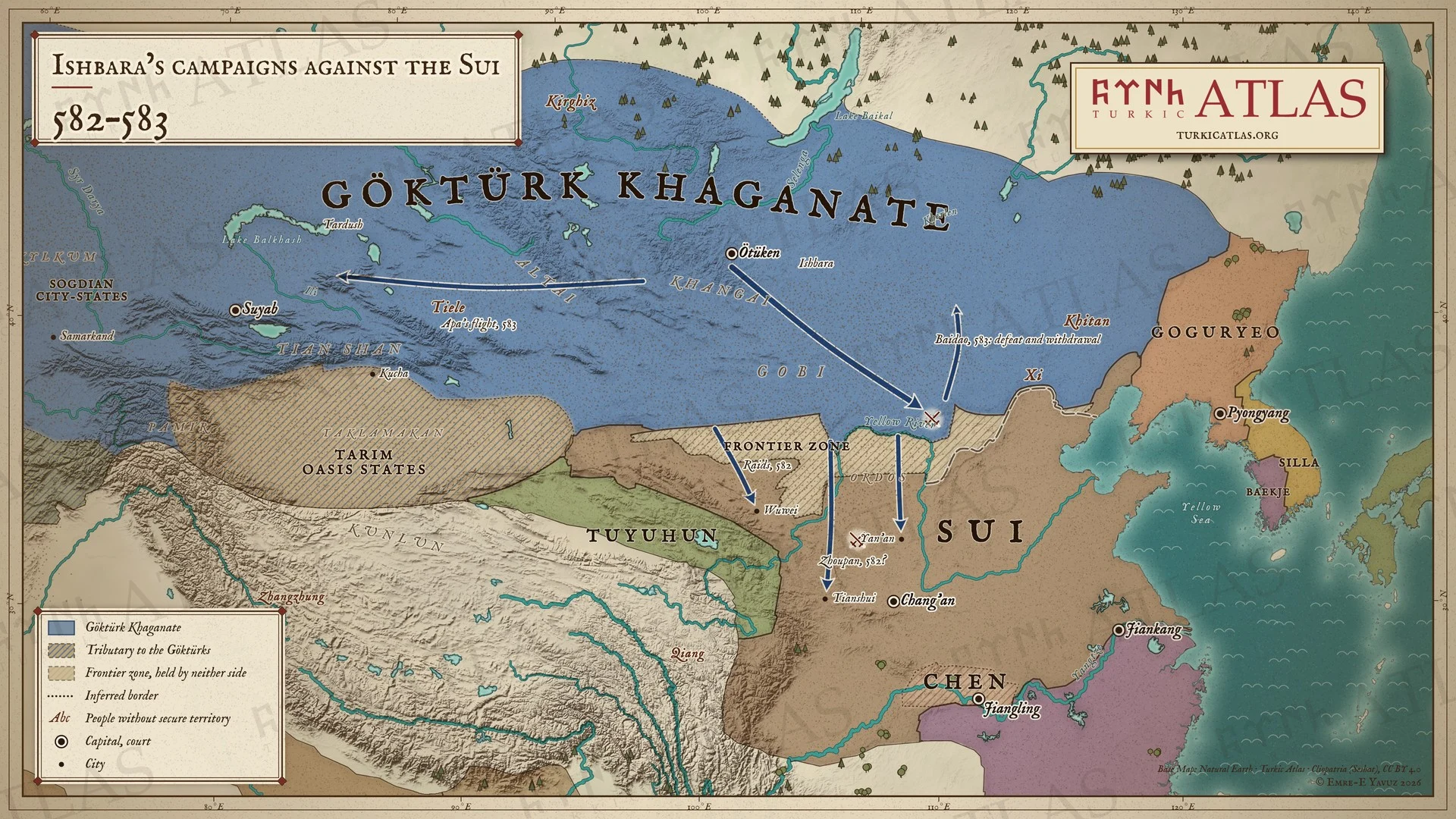
Ishbara’s wife was Qianjin, a princess of the Northern Zhou. She had been given to Taspar in 580 and passed to his successor. The Sui founder Yang Jian had destroyed the Zhou and slaughtered its court in 581, and she hated him.[1][9] At her urging, and with a rebel Qi general as ally, Ishbara took several frontier garrisons.[1] Then he called in Apa, Tardush and his brother Bagha. With the united forces of the house he invaded China and held a broad strip of the north for the first time.[1] The Göktürks meant to advance on Chang’an. At that moment word came of a Tiele rising in the west, and Tardush withdrew. In June 583 the Sui struck the remaining army by surprise near Baidao. Disease broke out on the retreat. Chinese agents in the army set the commanders against each other. In 584 Ishbara wrote to the Sui court. In words the Sui Shu preserves, he styled himself born by Heaven, wise and holy son of Heaven of the empire of the great Göktürks.[7] The inscriptions use the same formula of the khans a century and a half later.[7]
Purge and civil war (583–585)
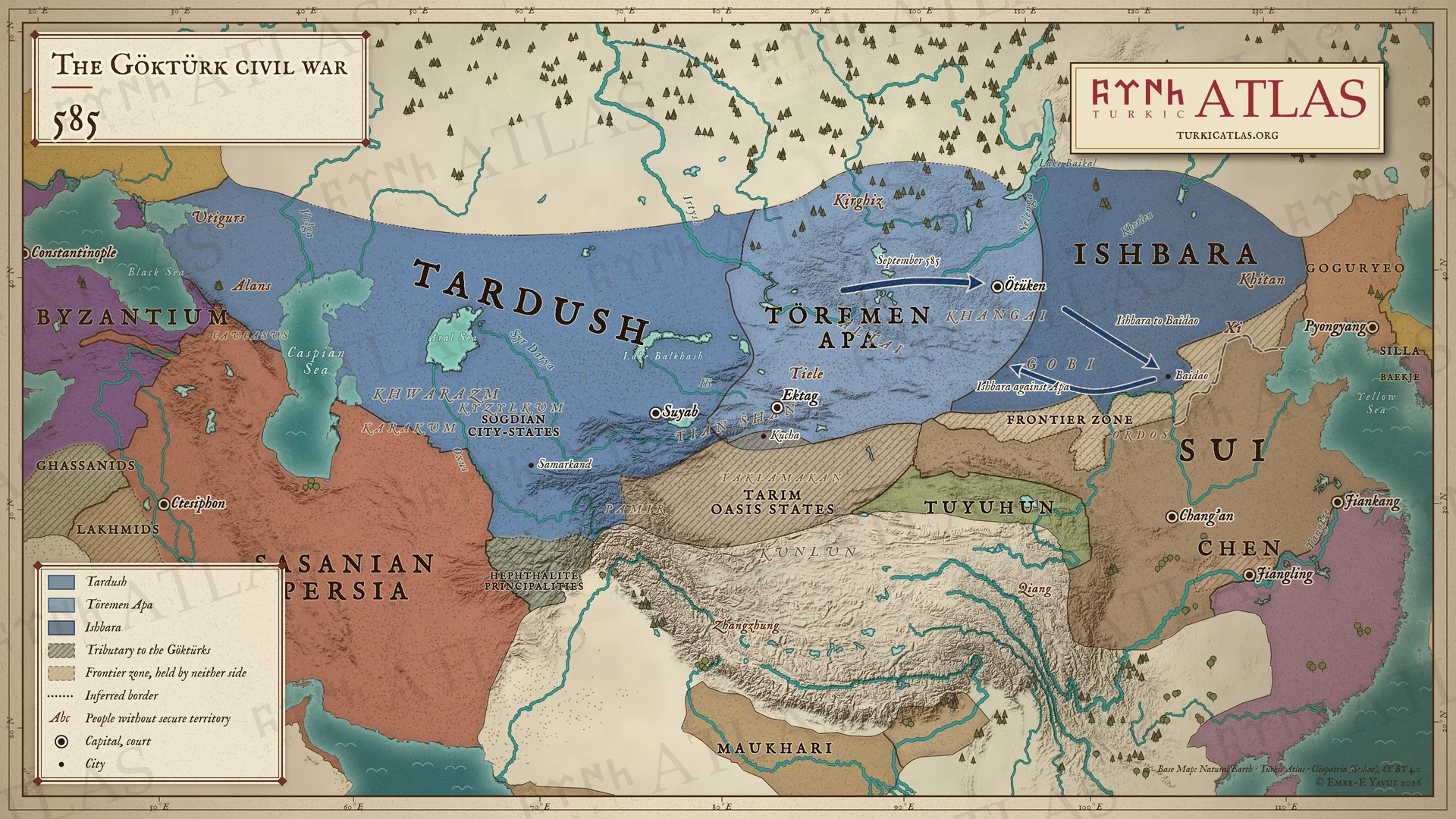
Ishbara grew fearful of Apa, who appears to have been dealing with the Sui. He suddenly turned on him, raided his camp and killed his mother, who was Ishbara’s own aunt. Apa fled to Tardush.[1] Ishbara followed Apa west and beat him twice. He received the submission of the local rulers and merged their armies with his own. He gave up the chase in the Kazakh steppe and returned to Ötüken. Another account has the mother killed only there, after his return. Ishbara purged the east of rivals. He took the people of Tanhan Khan, a long-standing friend of Apa, and deposed him. Tanhan fled to Tardush.[1] Ishbara’s younger cousin Diqincha led tribes of his own and had quarrelled with him. He went over to Apa with his people. The Zizhi Tongjian dates both events to 583.[10] More and more begs of lower rank turned away from him and went west.
The civil war proper dates from these months. Ishbara was on the losing side of it from the start. One estimate puts his army at thirty or forty thousand, against Tardush’s hundred thousand. Forcibly recruited Tiele were among the western host.
Submission to the Sui (585)
Ishbara found his allies among his wife’s enemies. The Sui emperor ordered a rapprochement with Qianjin. Sui envoys came to Ötüken. The princess received the Sui title of princess Dayi and urged her husband to seek Chinese protection. The intermediary was Zhangsun Sheng, a Sui agent. He had spent years at Ötüken disguised as a diplomat and had befriended Ishbara. He had recorded every institution, custom and event of the Göktürks for the emperor. On the basis of his knowledge, the Sui sent further agents to the western court. In 585 Tardush pressed Ishbara with an attack. Ishbara declared himself a vassal of the Sui and received military protection in return.[1] His letter to the emperor survives in the Sui Shu. Two suns do not shine in the heavens, he wrote, and so he believed that only one ruler can reign on earth. The emperor of the great Sui is the true emperor.[1]
The submission was less a success of Chinese arms than a result of the centrifugal forces pulling at the Göktürk state. It was also a preview of things to come.[2] On the best view, the Sui emperor played divide and rule. His calculation worked. Ishbara could be set against the stronger western Göktürks. The agents at Tardush’s court had already planted the seed of the next war, in case the west should win. In September 585 the western army marched on Ötüken. Ishbara had already fled to China.
Death
Ishbara died in 587, a little more than a month after his royal tent had burned at the Zihe garrison. The Sui emperor declared three days of mourning and sent five thousand bolts of silk to the Göktürks.[1] One account speaks of an illness of a month.[11] He had judged Yongyulü, the later Tulan, to be weak of character. He willed the throne to his brother Bagha. Bagha took Apa alive in the same year.[1] After Bagha’s death in 588, Tulan succeeded in the east. Ishbara’s son Yami would take the throne in 603 as a Sui client and march into Ötüken with Chinese troops. The division of the khaganate was already complete.
Assessment
The Sui Shu praised his bravery and the love of his subjects. It was compiled for the court that had made him its vassal. He is counted among the four princes who put the khaganate at risk when no foreign power had. He is reckoned the strongest of them. He overrode Taspar’s will, took the throne himself and enjoyed it briefly. The sources give him the acclamation, the invasion, the purge and the letter.[2] The Kül Tegin inscription names none of the princes. It describes the khans of these years as ignorant and bad, and their ministers likewise. It says that the Göktürks lost their realm because the Chinese set brother against brother.[12] The inscription does not say whether Ishbara is meant. The description fits.[12]
References
- ^ a b c d e f g h i j k l m n o p q r s t Sui Shu (Book of Sui), juan 84
- ^ a b c d e f Golden 1992
- ^ a b Çağatay 1976, p. 247
- ^ Bugut inscription
- ^ Litvinsky 1996, p. 337
- ^ Yavuz 2025
- ^ a b c d Sui Shu (Book of Sui), juan 84; Golden 1992
- ^ Yavuz 2025, p. 305
- ^ Yavuz 2025, p. 318
- ^ Sui Shu (Book of Sui), juan 84; Zizhi tongjian (Comprehensive Mirror in Aid of Governance), juan 175
- ^ Yavuz 2025, p. 323
- ^ a b Kül Tegin inscription
Sources
- Sui Shu (Book of Sui), juan 84
- Zhou Shu (Book of Zhou), juan 50
- Bugut inscription
- Kül Tegin inscription
- Zizhi tongjian (Comprehensive Mirror in Aid of Governance), juan 175 (after Wei Shu, Zhou Shu, Sui Shu and Bei Shi)
Literature
- Emre-E. Yavuz, The Gokturk Empire: 2nd Edition (2025)
- Peter B. Golden, An Introduction to the History of the Turkic Peoples (1992)
What links here73
- Persons
- Amrak · Bagha Khan · Börü Khan · Diqincha · Empress Ashina · Ishbara Tolis Khan · Issik Khan · Kuhanzhen · Lijicha · Pan Die · Princess Qianjin · Rudan Khan · Tanhan Khan · Tardush · Taspar Khan · Töremen Apa · Tulan Khan · Yami Khan
- States
- First Göktürk Khaganate · Northern Zhou · Sui · Western Göktürk Khaganate · Xiongnu
- Conflicts
- Göktürk–Persian war, 588–589 · Hegemony Wars in Northern China · The Göktürk Civil War · The Göktürk–Sui wars, 582–603
- Battles & Events
- Battle of Baidao (583) · Battle of Mount Mulai (553) · Battle of Zhoupan (582) · Capture of Apa (587) · Death of Princess Dayi · Edict of Emperor Wen against the Göktürks (583) · Embassy of Yu Qingze (584) · Göktürk Succession Crisis (581) · Ishbara's Hunt (587) · Proclamation of Bumin Khan (552) · Submission of Ishbara (585) · Taspar's Appointment of the Lesser Khans (572) · The Archery Match at the Wu'an Hall (599) · The Marriage of Princess Qianjin (580) · The Succession of 587
- Places
- Baidao Plain · Ötüken · Shuozhou · Tanhan Mountain · Youzhou · Zhoupan · Zihe Garrison
- Institutions and Titles
- Army of the Steppe Empires · Baga · Border Markets · Daluobian · Diplomacy of the Steppe Empires · Drums and Banners for the Khans · Göktürk Dress and Hair · Great Khan · Illig · Ishbara (Title) · Levirate · Taisan · The Western and Southern Khans · Töre · Toy
- Foods
- Steppe Diet
- Customs & Pastimes
- Hunting among the Göktürks · Seating at the Feast
- Sources
- Cefu yuangui · Tongdian
- Controversies
- The Göktürks and the Xiongnu
Cite this article
Yavuz, Emre-E. “Ishbara Khan.” Turkic Atlas, revised 8 November 2026. https://turkicatlas.org/persons/ishbara-khan/
Last revised: 8 November 2026

