
The five ideas that the Göktürk inscriptions treat as the foundations of rule, each in its own article, and the one text in which the Göktürks set them down themselves. Read in this order the ideas build on one another: the god, the fortune he gives, the law the ruler keeps, the assembly that can unmake him, and the place from which alone the realm can be held.
1/6
Tengrism
Tengri in both senses, the sacred Earth-and-Water, Umay, and what the inscriptions do not contain.
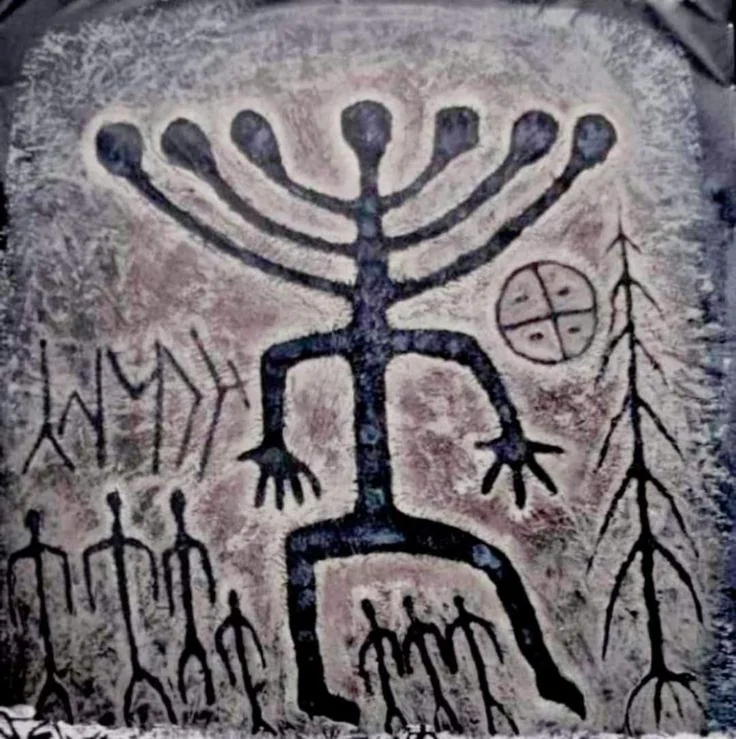
Tengrism is a modern name, not an ancient one. The earliest trace of the god's name is Chinese: the Han Shu writes the Xiongnu ruler's style as Chengli Gutu Chanyu, and Chengli is taken to render Tengri. Some six centuries later the Göktürk inscriptions use the word in two senses. In the opening formula it is the blue sky; a few lines on, the Tengri of the Göktürks, who raises a man and his wife so that the people should not perish. Beside him stand the sacred Earth-and-Water and Umay, invoked where the khan speaks of his mother. The Chinese histories add sacrifices to the spirit of heaven and a trust in shamans. Neither body of evidence knows a pantheon, a tiered heaven or a lord of the dead; those come from Altaian and Siberian ethnography, a thousand years younger.
2/6
Kut
The ruler's fortune: said of the khan, not of the place.
Kut was the fortune Tengri gave the man he chose to rule. On the best reading it already stands in the Han Shu, as the Gutu in the Xiongnu ruler's title, which the Han court glossed as "son". The Göktürk inscriptions use it twice, both times in the khan's own mouth. He sat on the throne, he says, because Tengri commanded it and because his Kut was there; on the south face he pairs it with his allotted portion. Where the same text speaks of the Ötüken forest it uses another word, ıduq, sacred. Kut could also be lost, and the inscriptions tell the fifty years under the Tang as a fortune the Göktürks forfeited through their own khans and lords. The founder of the Second Khaganate, who ended those years, is remembered as Kutluk, the one who has Kut.
3/6
Töre
The customary law that the founders held together with the realm.
Töre, törü in the inscriptions, was the customary law of the Göktürks, and it was never written down. When Bumin and Istemi took the throne, the Kül Tegin inscription says, they took the realm and its law in hand together. The Zhou Shu records what the law contained: death for rebellion, murder, adultery with another man's wife and the theft of a hobbled horse, and payment in livestock for nearly everything else. The throne passed laterally. After Bumin came Issik, then his brother Mukan, then Mukan's brother Taspar, each passing over his own sons. In 581 the dying Taspar broke the rule and wished the throne to pass to his nephew Töremen. An unwritten law had no court to appeal to, and when the rule and the ruler's wish diverged, only force could decide between them.
4/6
Toy
The assembly that chose a khan in 581 and could depose one.
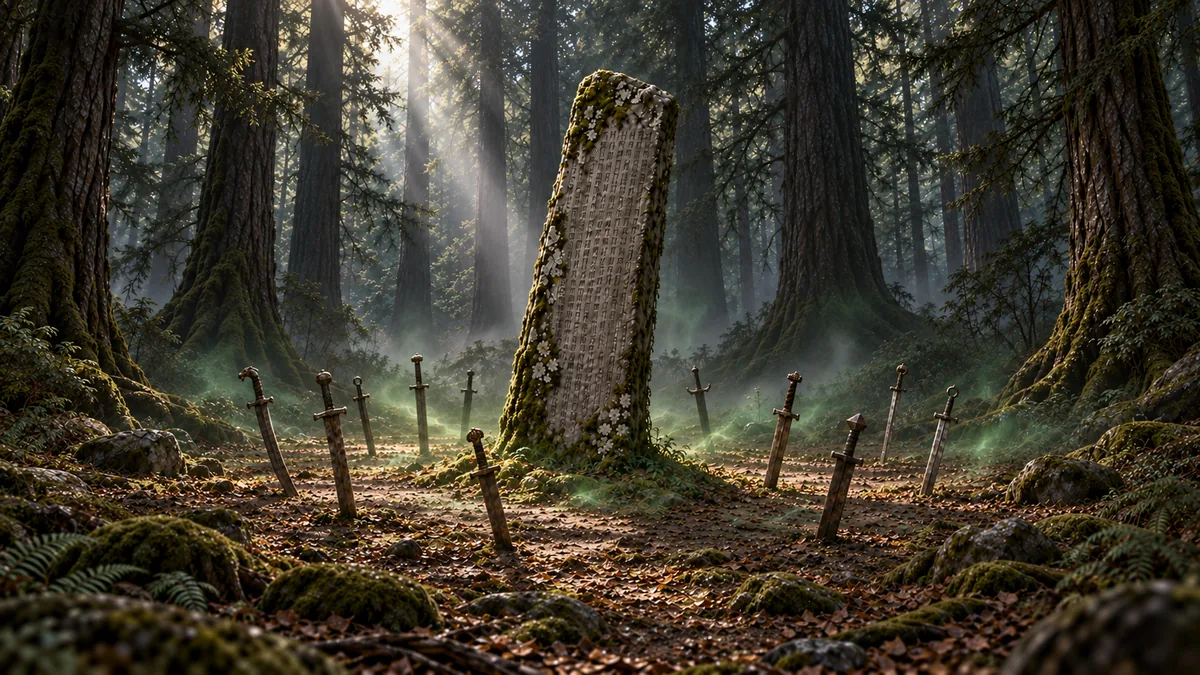
The toy was the assembly of the Ashina nobility, the body that raised a man to rule. When Tuwu died in 542, the inner circle of the family gathered in the Altai and made his elder son Bumin yabgu, the title Tuwu had held under the Rouran. Every year, the Zhou Shu reports, the khan led the nobles to sacrifice at the cave of the ancestors. In 581 the toy set aside the dying Taspar's wish for his nephew Töremen: Töremen's mother was of low birth, Amrak's was noble. Ishbara arrived last and declared he would meet Töremen at the frontier with sharp blade and long spear. Amrak, Taspar's own son, was installed. The toy could refuse a khan but could not enforce the refusal, and when the nobility divided, the assembly divided with it.
5/6
Ötüken
400–840
The forested upland from which the realm is held, and the question of whether it was sacred or blessed.
Ötüken was not a city but a forested upland near the Orkhon, the seat of the Xiongnu, the Rouran, the Göktürks and the Uyghurs in turn. The Zhou Shu calls it Mount Dujin and says the khan always dwelt there, his tent opening to the east. Bumin entered it in April 552 and took the title of khan. Nearly two centuries later the Kül Tegin inscription made it the condition of rule: if the khan sits in the Ötüken forest, there is no trouble in the realm. The same text calls the forest ıduq, sacred, the word it also gives the Earth-and-Water. A modern gloss reads kutlu, blessed with Kut, but the inscriptions say Kut of the ruler, not of the place. The Uyghurs took the seat in 744, and the Mongols later built Karakorum in the same valley.
6/6
Kül Tegin inscription
732
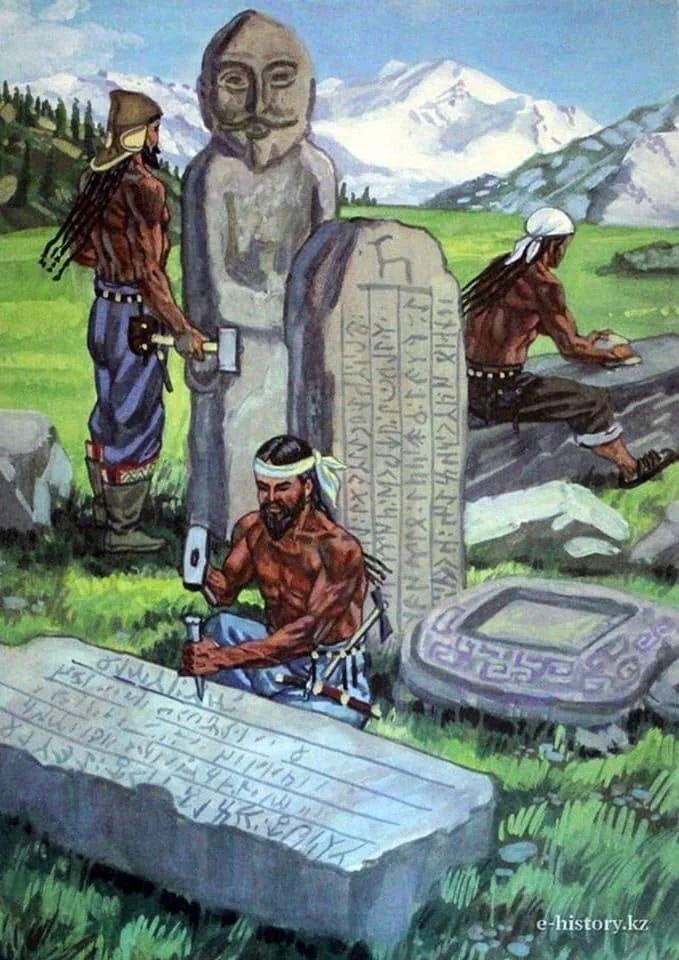
The text itself, all three faces, with the readings the articles above depend on.
In 732 Bilge Khan raised a stone in the Orkhon valley for his younger brother Kül Tegin, who had died the year before. Three faces carry Turkic in runiform script, the fourth a Chinese condolence from the Tang court. The east face runs from the making of sky and earth through Bumin and Istemi, the lost state and the fifty years of service to China, to the restoration and Kül Tegin's first battles. The north face carries his last battles and his brother's lament. The south face is a speech: Chinese words are sweet and their silks soft, and the Göktürks who stay in the Ötüken forest will hold the realm for ever. Kül Tegin's nephew Yollug Tegin wrote the text in twenty days. What it says of the sixth century it says at two hundred years' distance.

