
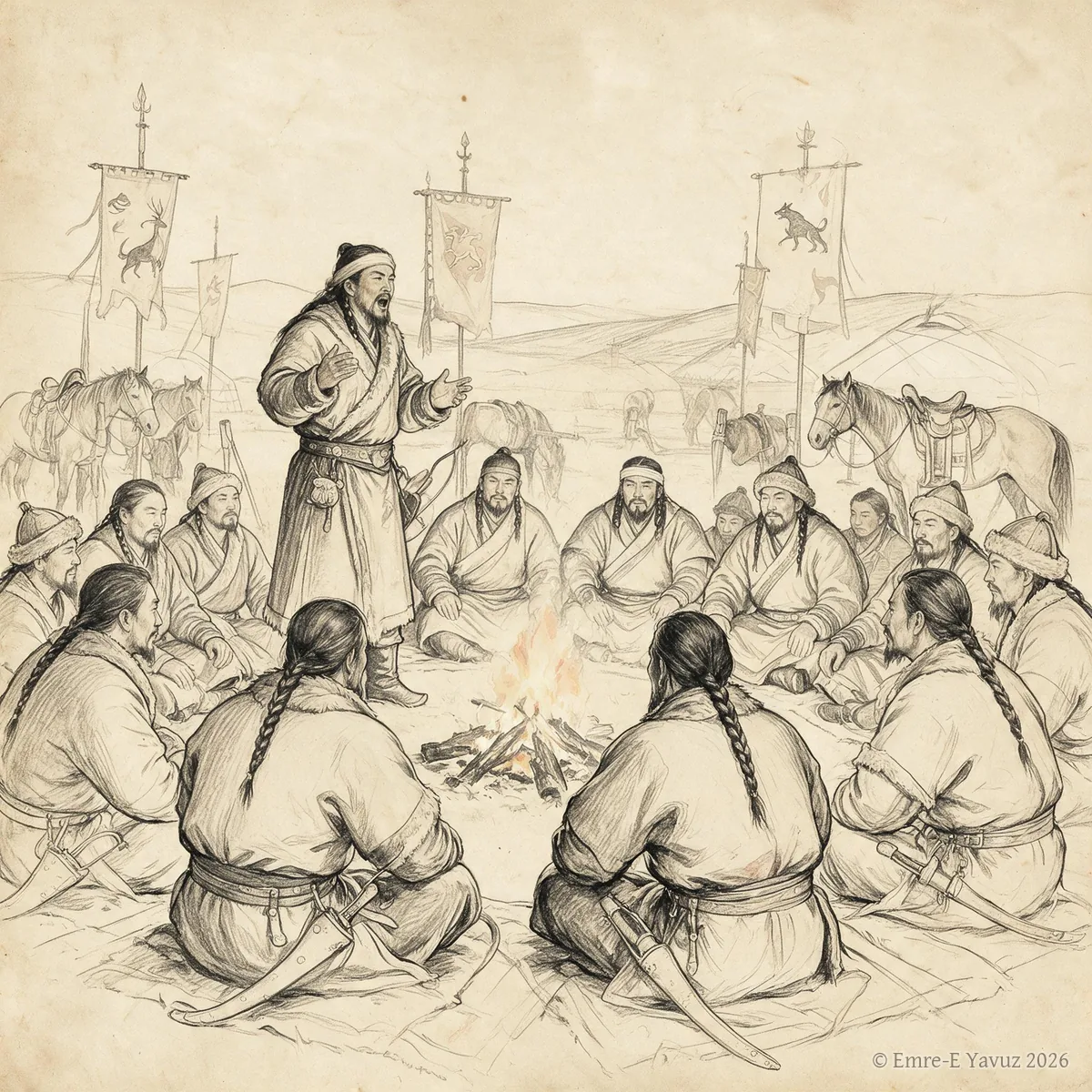
A khan of the Göktürks was not born to the office and could not bequeath it. He was raised to it by the toy, the assembly of the Ashina nobility. The toy stands between the Töre and the men who actually ruled. The Töre laid down who might rule and in what order. The sources show the toy at work on two occasions: at the beginning of the khaganate, and at the beginning of its end.
Elevation of Bumin (542)
Tuwu died in 542 and left two sons, Bumin and Istemi. The leadership of the Göktürks of the Altai passed to the elder.[1] It did not pass by itself. Bumin was made yabgu, the title his father had held under the Rouran, at a toy. Everyone of the Ashina who belonged to the inner circle of the family came together in the Altai for it.[2]
What the gathering ratified was descent. By the sixth century the name Ashina covered a core clan and the peoples that had attached themselves to it over a hundred years. The yabgus came only from the core, from those who could trace their line to the founder, dated to 460. A man from an attached clan, however strong, was not eligible. The assembly did not choose between candidates so much as confirm which of the eligible was to lead. In 542 there was, it seems, no serious contest. Bumin was the elder, there were no other sons, and the Göktürks needed a leader who would act.
Annual assembly and ancestral cave
The toy was not only convened for successions. The Chinese report that every year the khan led the nobles to sacrifice at the cave of the ancestors. They also report that in the middle of the fifth month the nobles gathered at a river to sacrifice to the spirit of heaven.[3] The Zhou Shu does not say where the cave lay. The five hundred li it gives, roughly the distance usually quoted, belong to another place, the bare mountain of the earth-spirit.[4]
What was done there is not recorded. The reasonable inference is that the dynasty honoured its ancestors and Tengri. It is also reasonable to infer that a good deal of dynastic business was transacted at a distance from the capital and from foreign eyes. The cave is not mentioned in the Orkhon inscriptions. Neither is the wolf-ancestress, and no one doubts that the Göktürks told that story. The silence of the monuments is what one would expect of monuments. The Chinese were interested in what the Göktürks did every May, and the rite is known from the Chinese.
Assembly of 581
The assembly’s real power was the power to choose a khan. In 581 it used that power and set the dying khan’s wish aside.[5] The case yields a rule: no khan could name his successor, in his lifetime or after it. For thirty years the rule was never tested, because the succession ran as the Töre said it should. Bumin passed the office to his sons in turn, brother followed brother, and then came the next generation. In 581 the rule was tested and the succession failed.[5]
Taspar, dying, wanted his nephew Töremen Apa to follow him. The toy assembled and would not have it. Töremen’s mother was of low birth. Amrak’s mother was noble, and the Göktürks had always honoured her.[5] Ishbara arrived last. He declared that he would serve Amrak with his brothers, but would meet Töremen at the frontier with sharp blade and long spear.[5] Ishbara was the elder and the stronger, and no one dared oppose him. Amrak, Taspar’s own son, was installed.[5]
The assembly had acted exactly as it was meant to, and it broke the khaganate anyway. Töremen refused the election. Amrak resigned within the year to avoid a war and proposed Ishbara, which produced the war. The west under Istemi’s son took its chance, and the Sui court fed both sides. Twenty years later the khaganate was permanently in two halves.
The episode shows the toy’s strength and its limit in the same act. It could refuse a khan. It could not enforce the refusal, because it had no instrument but the nobility that composed it. Once that nobility divided, the assembly divided with it. An electoral body without a standing force behind it is only as strong as its consensus, and in 581 there was none.
Representation and diplomacy
The later usage, and the glossaries built on it, describe the assembly as a body in which representatives of all the regions of the realm were present. They brought their wishes and proposals before the khan. The same accounts note that Chinese, Persian and Byzantine envoys made use of the assembly to conduct their missions. That fits the Byzantine evidence. Zemarchos was received by Istemi with the western nobility gathered about him. Maniakh negotiated on the Göktürk side as a man speaking for a court, not for a person. The sources do not say whether those receptions were toys in the formal sense, or simply the court in session.
The word toygun stands in the Kül Tegin inscription, in the passage on the building of the monument.[6] Its meaning is disputed, and there are four views. The first takes it as “member of the assembly”, from toy.[7] The Chinese sources are said to give the word as ta-guan, and the second identifies that Chinese title with tarkan.[7] The third sees a name, Tuygun, followed by the title Elteber.[8] The fourth sees two groups in the plural, toygun and eltebirler, and takes toygun to be a rank.[9]
The Xiongnu already held yearly meetings of their leading men, in the first month, in the fifth and in the autumn.[10] They have also been related to the later toy.[11] On the same account the Xiongnu state took its form from the steppe and not from China: a central command, an army ordered by tens, wings to the left and right, and an assembly of the ruling men.[12] For the Göktürks and Uyghurs, three institutions are distinguished: the head of state, the council, which is the toy, and the government.[13]
Later history
The institution outlived the khaganate in two directions. Among the Turkic peoples the word survived. The Göktürks may not have been the first to use it, and it is unknown whether they coined the term or inherited it. Among the Mongols it became the quriltai. This assembly elected Genghis Khan’s successors and stopped his armies in their tracks when it was convened. It is the most famous descendant of the toy and the form under which most readers first meet it. In the later Oghuz tradition, the toy is also a feast. A great state meal is described at which the guests plunder the table service.[14] The Oghuz epic regulates which parts of a slaughtered sheep each tribe eats. Some scholars see in this a picture of the system of the share, ülüş or pay, and of an idea of state and law.[15] In modern Turkish kurultay is the word for a party congress. That is a long continuity for a political term.
In the Kutadgu Bilig of 1069–1070 the word toy means a great gathering or camp. The dead who went before lie waiting like a great toy, and a house beside the graves stands beside “the toy of the dead”.[16]
References
- ^ Xin Tangshu (New Book of Tang), juan 215
- ^ Sui Shu (Book of Sui), juan 84; Xin Tangshu (New Book of Tang), juan 215
- ^ Zhou Shu (Book of Zhou), juan 50
- ^ Zhou Shu (Book of Zhou), juan 50; Yavuz 2025
- ^ a b c d e Sui Shu (Book of Sui), juan 84
- ^ Kül Tegin inscription
- ^ a b Kafesoğlu 1997, p. 262
- ^ Tekin o. J., p. 52–53
- ^ Orkun 1994, p. 53–54
- ^ Shiji, juan 110; Han Shu, juan 94
- ^ Kafesoğlu 1997, p. 258–260
- ^ Kafesoğlu 1997, p. 62–63
- ^ Kafesoğlu 1997, p. 264–266
- ^ Kafesoğlu 1997, p. 257
- ^ Ögel 1978, p. 335
- ^ Kutadgu Bilig; Dankoff 1983, couplets 4512, 5340
Sources
- Zhou Shu (Book of Zhou), juan 50
- Kül Tegin inscription
- Sui Shu (Book of Sui), juan 84
- Xin Tangshu (New Book of Tang), juan 215 (after Jiu Tangshu)
- Kutadgu Bilig
- Shiji, juan 110
- Han Shu, juan 94 (after Shiji)
Literature
- Emre-E. Yavuz, The Gokturk Empire: 2nd Edition (2025)
- İbrahim Kafesoğlu, Türk Millî Kültürü (1997)
- Talât Tekin, Orhon Yazıtları. Kül Tigin, Bilge Kağan, Tunyukuk (o. J.)
- Hüseyin Namık Orkun, Eski Türk Yazıtları (1994)
- Bahaeddin Ögel, Türk Kültür Tarihine Giriş IV: Türklerde yemek kültürü (1978)
- Robert Dankoff (trans.), Wisdom of Royal Glory (Kutadgu Bilig): A Turko-Islamic Mirror for Princes (1983)
What links here13
- Persons
- Bumin Khan · Ishbara Khan · Taspar Khan
- States
- First Göktürk Khaganate
- Battles & Events
- Göktürk Succession Crisis (581)
- Places
- Ötüken
- Institutions and Titles
- Khan (Khagan) · Kut · Töre · Tuğ
- Religions
- Sacrifice and the year
- Customs & Pastimes
- Culture of the Turkic Peoples
Cite this article
Yavuz, Emre-E. “Toy.” Turkic Atlas, revised 8 November 2026. https://turkicatlas.org/institutions/toy/
Last revised: 8 November 2026

